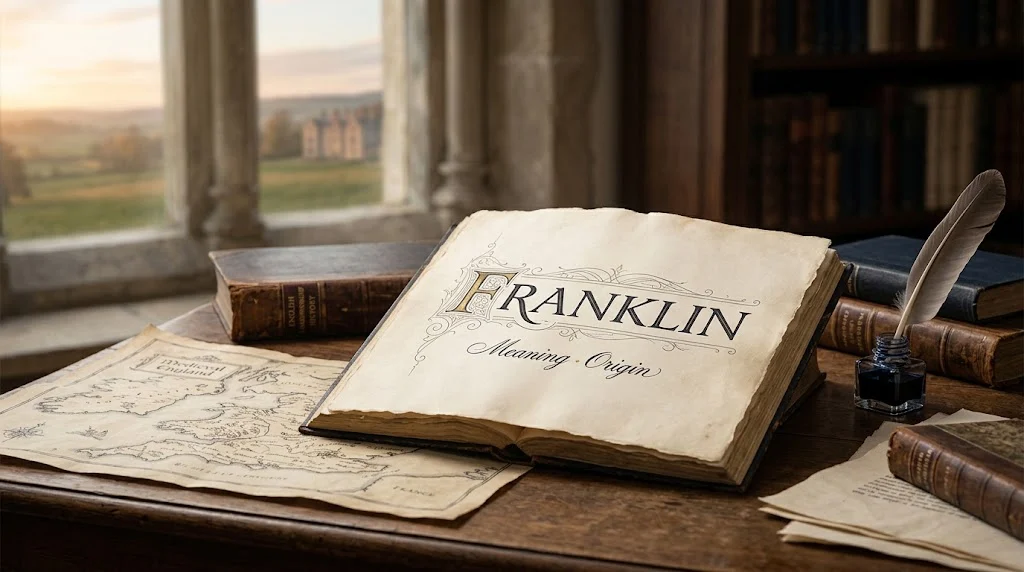
The Franklin name meaning is commonly connected with a free landowner, freeholder, or person of independent social status. The name comes from a Middle English term derived from Anglo-Norman French, and it began as a social-status term before becoming a surname and eventually a given name.
The name Franklin has a distinctive combination of historical depth and familiar modern appeal. Unlike many given names that originated directly from personal characteristics, Franklin developed from a medieval occupational or social-status term describing a particular class of free landowner. Over time, that word became a surname and later an established first name.
Today, Franklin can sound traditional, scholarly, dignified, and distinctly English. Its historical associations are also strengthened by famous bearers such as Benjamin Franklin, one of the best-known figures in American history. This article explores the Franklin name meaning, origin, etymology, history, pronunciation, variations, and modern use.
What Is the Franklin Name?
Franklin is an English personal name that developed from a medieval term referring to a free person or freeholder, particularly someone who owned land but was not part of the nobility.
The name is therefore closely connected with ideas such as:
- Freedom
- Independence
- Land ownership
- Social standing
- Self-reliance
- Respectability
Historically, franklin was not originally a personal first name. It was a descriptive term for a particular social position. Like many surnames that originated from occupations, places, or social roles, it eventually became a family name and later a given name.
This history gives Franklin a different character from names whose meanings were originally religious, mythological, or purely descriptive.
Franklin Name Meaning
The Franklin name meaning is generally understood as “freeholder,” “free landowner,” or “free person.”
The word freeholder is particularly useful for understanding the historical meaning. In medieval English society, a franklin was associated with a free man who held land independently and occupied a respectable position without belonging to the aristocratic nobility.
The name can therefore carry several related ideas:
Traditional meaning:
A freeholder or free landowner.
Broader symbolic meaning:
Freedom, independence, stability, and self-sufficiency.
Modern interpretation:
A classic name that can suggest independence, confidence, and a connection with English history.
It is important, however, to distinguish the historical meaning from modern symbolic interpretations. The original term referred to a specific social and legal position rather than simply describing someone who was “free” in an abstract sense.
Franklin Name Origin and Etymology
The origin of Franklin can be traced to medieval England, where franklin was used as a social-status term.
The word is connected to Anglo-Norman French frankelin, which is related to franc, meaning “free.” The term entered Middle English as frankelin or frankeleyn and was used for a freeholder or free man of substantial but non-noble status.
The linguistic development can be simplified as:
Old/Anglo-Norman French → Middle English → surname → given name
The element frank is important because it is associated with the idea of being free. However, the historical word franklin developed into a more specific social designation rather than simply meaning “free.”
This distinction makes the etymology especially interesting. Franklin is not merely a modern interpretation of the word “free”; it has a documented connection to medieval social organization.
Franklin Name History
The history of Franklin is closely connected with medieval English society.
In medieval England, social position was often reflected in the language people used to describe one another. A franklin was generally understood as a freeholder or free man who held land and occupied a position below the nobility but above many dependent agricultural workers.
The term appears in medieval English literature and historical records. One famous literary example is the Franklin, a character in Geoffrey Chaucer’s The Canterbury Tales. Chaucer’s Franklin is portrayed as a prosperous landowner known for hospitality and a comfortable lifestyle.
This literary association is significant because it provides a window into how the term was understood in medieval English culture.
Over subsequent centuries, Franklin became established as a hereditary surname. Like many medieval surnames, it could identify a family whose earlier ancestor was known by the social designation “franklin.”
Eventually, the surname began to be used as a first name as well.
Franklin in English Naming Traditions
Franklin belongs to a broader group of English names that developed from words describing occupations, social roles, or personal circumstances.
Examples of this naming process can be seen in surnames such as:
- Baker
- Cooper
- Fletcher
- Freeman
- Marshall
- Franklin
These names originally served practical identifying purposes. A person might be known by a word describing their occupation, status, or role in the community. As surnames became hereditary, those descriptions became family names.
Franklin is particularly interesting because its original designation described social status and landholding, rather than a specific occupation.
This gives the name a historical connection to concepts of independence and property ownership.
Franklin and Geoffrey Chaucer
One of the most recognizable historical references to the word franklin appears in Geoffrey Chaucer’s The Canterbury Tales.
The Franklin is one of the pilgrims in Chaucer’s collection of stories. He is portrayed as a prosperous landowner and a person who values hospitality and good living.
This does not mean that the personal name Franklin originated from Chaucer’s character. The word franklin was already in use before Chaucer. Instead, the literary character is valuable because he illustrates the social meaning associated with the term during the medieval period.
For people interested in name history, this provides an unusually vivid connection between the word Franklin and medieval English literature.
Franklin and Benjamin Franklin
The name Franklin also has a powerful association with Benjamin Franklin, the American statesman, inventor, writer, scientist, and diplomat.


4
Benjamin Franklin became one of the most influential figures associated with the American founding era. Because of his prominence, the name Franklin acquired an additional cultural association with intellectual curiosity, public service, writing, science, and civic life.
This association is cultural rather than part of the original etymological meaning. In other words, Benjamin Franklin did not give the name its historical meaning. Instead, his life helped make Franklin particularly recognizable as a personal name in American culture.
How Do You Pronounce Franklin?
Franklin is commonly pronounced:
FRANK-lin
Phonetically, it can be represented approximately as:
/ˈfræŋklɪn/
The name has two syllables:
Frank + lin
The pronunciation is generally straightforward for English speakers, which contributes to the name’s accessibility across English-speaking communities.
Is Franklin a Boy Name or Girl Name?
Franklin is traditionally used as a masculine given name.
It began as a surname and later developed into a male first name in English-speaking naming traditions. Today, it is most commonly recognized as a boy’s name, although naming practices can change over time and individual families may use names in different ways.
The related short form Frank can also be used independently as a given name.
Franklin as a Surname
Before becoming a familiar first name, Franklin was primarily a surname.
As a surname, Franklin belongs to the category of names derived from medieval social descriptions. An ancestor identified as a franklin could have passed the designation down to later generations as a hereditary family name.
This is an important part of understanding the name’s development:
Social title or status term → hereditary surname → personal given name
The transition is similar to the development of many other English surnames that later became first names.
Franklin vs. Frank
Franklin and Frank are closely related in everyday naming, but they are not exactly the same name.
| Name | Meaning/Origin | Overall Style |
|---|---|---|
| Franklin | Medieval English social-status term associated with a freeholder | Traditional, distinguished, formal |
| Frank | Related to the Germanic name Frank and also used as a short form of Franklin | Short, familiar, classic |
| Frankie | Diminutive form associated with Frank and Franklin | Friendly, casual, youthful |
Someone named Franklin may use Frank or Frankie as a nickname, but these forms can also function as independent names.
What Does Franklin Symbolize?
Although the historical meaning should remain the primary focus, Franklin can inspire several modern symbolic associations.
Because the original term was associated with a freeholder, the name may symbolically suggest:
- Independence — connected with the historical idea of being free.
- Stability — associated with landholding and established social position.
- Confidence — reflecting a name with a strong historical sound.
- Tradition — its roots reach back to medieval England.
- Intellectual character — strengthened by cultural associations with Benjamin Franklin.
- Respectability — connected with the social position represented by the medieval term.
These are modern interpretations rather than additional dictionary meanings of the name.
Why Parents May Choose the Name Franklin
Franklin can appeal to parents looking for a name that feels both historical and approachable.
Some of its strongest qualities are:
- It has a documented English history.
- Its meaning is connected with independence and freeholding.
- It has a recognizable pronunciation.
- It can work as both a formal first name and a surname.
- Frank provides a natural short form.
- It has strong historical associations without being exclusively tied to one tradition.
The name can therefore fit families who prefer classic names with substantial historical backgrounds.
Names Similar to Franklin
If you like Franklin, you may also appreciate names with a similarly traditional or surname-inspired style.
Winston
A traditional English name with a strong historical character.
Frederick
A classic Germanic name associated with peace and power.
Harrison
An English surname that developed into a popular given name.
Theodore
A long-established name with a formal, scholarly character.
Walter
A traditional Germanic name with a long history in English-speaking cultures.
Arthur
A historic name associated with British literary and legendary traditions.
Everett
A surname-style given name with a classic yet modern sound.
Franklin Name Examples
Here are a few natural examples showing how Franklin may be used as a first name:
- Franklin James Carter
- Franklin Thomas
- Franklin Edward
- Franklin David
- Franklin Alexander
In everyday conversation, someone named Franklin might also be called Frank or Frankie, depending on personal preference.
For example:
“Franklin has always been interested in history.”
Or:
“Frank decided to use his full name, Franklin, for professional settings.”
These examples demonstrate the difference between the formal name and its familiar short forms.
Is Franklin an Old-Fashioned Name?
Franklin has a distinctly traditional character, but calling it simply “old-fashioned” would miss some of its appeal.
It belongs to the category of names that have moved through several stages of use: medieval descriptive term, surname, and given name. That long history gives Franklin a vintage quality while its recognizable sound keeps it accessible to modern audiences.
For parents who like classic, literary, surname-style, or historical names, Franklin can offer a balance between tradition and individuality.
Franklin Name Meaning and Cultural Significance
The cultural significance of Franklin comes from several different layers rather than a single source.
First, the name preserves a connection to medieval English social terminology. Second, its appearance in The Canterbury Tales gives it a place in English literary history. Third, the surname became established within English-speaking communities. Finally, figures such as Benjamin Franklin gave the name a strong association with American intellectual and civic history.
These layers make Franklin more than a simple dictionary definition. Its identity has developed through language, social history, literature, family naming traditions, and historical personalities.
FAQs
1. What does the name Franklin mean?
Franklin traditionally means “freeholder” or “free landowner,” referring to a free man who held land independently in medieval England.
2. What is the origin of the name Franklin?
Franklin originated in medieval England from a Middle English term connected with Anglo-Norman French frankelin, related to the idea of being free.
3. Is Franklin a boy’s name?
Yes. Franklin is traditionally a masculine given name, although individual naming practices can vary.
4. Is Franklin an English name?
Yes. Franklin has strong English linguistic and historical roots, developing from a medieval English social-status term.
5. What is the nickname for Franklin?
Common informal forms include Frank and Frankie, although a person named Franklin may choose to use the full name.
6. How do you pronounce Franklin?
Franklin is commonly pronounced FRANK-lin, with two syllables.
7. Is Franklin a surname?
Yes. Franklin first became established as a surname before also developing into a given name.
8. What does Franklin symbolize?
Symbolically, Franklin can suggest freedom, independence, stability, tradition, and self-reliance, although these are interpretations rather than its literal etymology.
9. Is Franklin a biblical name?
No. Franklin is not originally a biblical name; its roots are connected with medieval English and Anglo-Norman terminology.
10. Is Franklin a good name for a baby?
Franklin can be a strong choice for parents who want a classic, historical, distinctive name with a natural nickname such as Frank.
Conclusion
The Franklin name meaning is rooted in the medieval English term for a freeholder or free landowner. Its connection to Anglo-Norman French and Middle English gives the name a well-established linguistic history, while its development from a social designation into a surname and then a given name makes its naming journey particularly interesting.
Today, Franklin combines an old-world foundation with a familiar and approachable sound. Its associations with medieval England, literature, and figures such as Benjamin Franklin add cultural depth without changing its original meaning. For anyone seeking a traditional name connected with freedom, independence, history, and dignity, Franklin remains a distinctive choice.
Discover More Related Articles:
- Karen Name Meaning | From Greek Origins to Modern Times In 2026
- Arianna Name Meaning | Discover Its Ancient Roots, Mythological Connections & Timeless Appeal In 2026
- Inez Name Meaning | The Elegant Legacy That Makes This Name So Special 2026









35 thoughts on “Franklin Name Meaning | Origin, History & History Behind the Name in 2026”