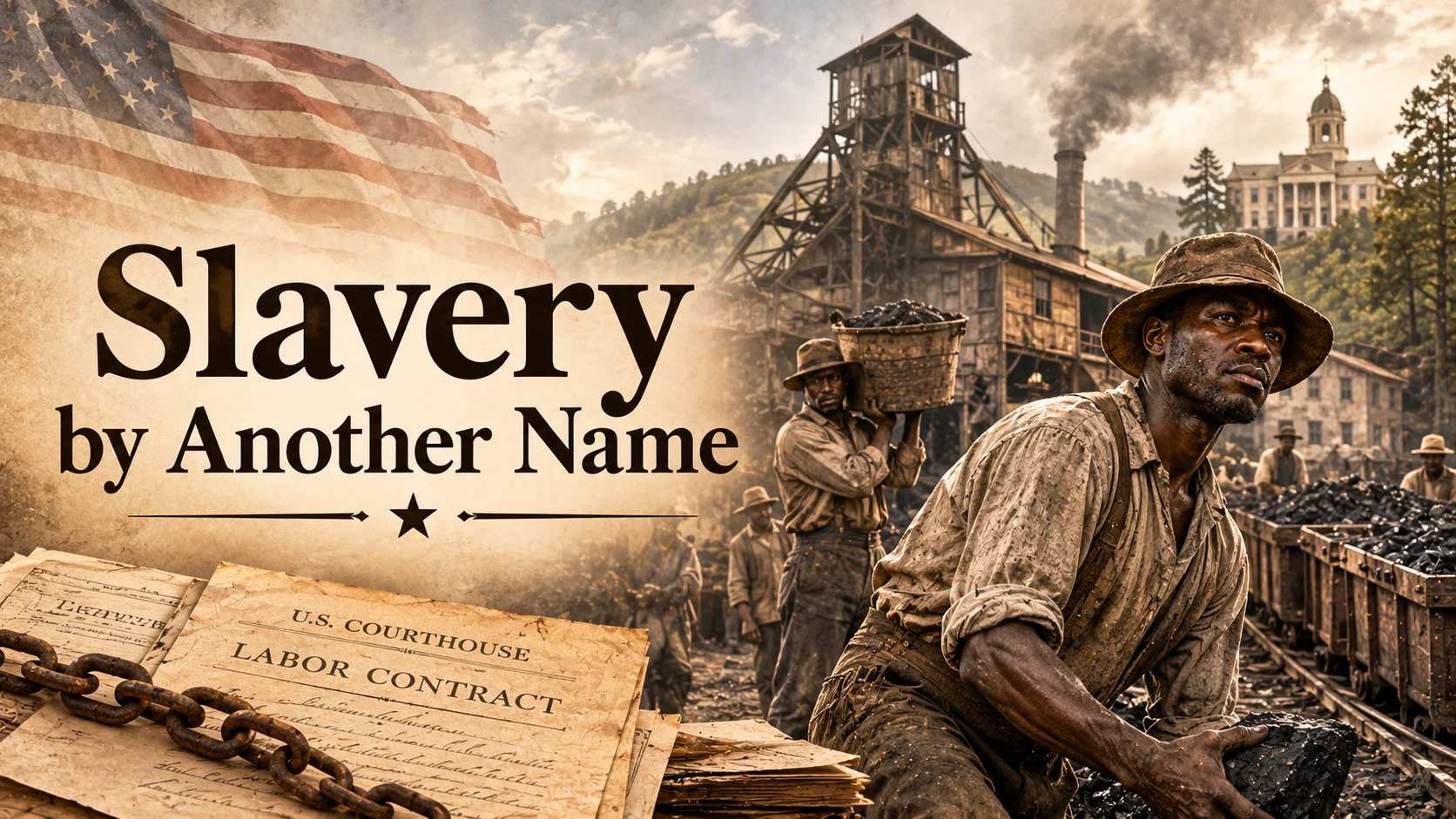
Slavery by Another Name describes the system of forced labor and racial exploitation that continued in the United States after slavery was officially abolished in 1865. The phrase is also the title of a Pulitzer Prize-winning book by Douglas A. Blackmon, which documents how African Americans were arrested, imprisoned, leased to businesses, and forced to work under brutal conditions long after the Civil War.
The history of American slavery did not end with emancipation in the way many people imagine. Although the Thirteenth Amendment legally abolished slavery and involuntary servitude, except as punishment for a crime, discriminatory laws and economic practices created new ways to exploit formerly enslaved people and their descendants.
In his book Slavery by Another Name: The Re-Enslavement of Black Americans from the Civil War to World War II, journalist and author Douglas A. Blackmon investigates this overlooked chapter of American history. His research reveals how government authorities, private businesses, and powerful landowners participated in systems that deprived African Americans of their freedom.
Understanding this history helps explain the relationship between slavery, Reconstruction, racial discrimination, forced labor, and the development of the modern American economy.
What Is Slavery by Another Name?
Slavery by Another Name refers to the continuation of slavery-like exploitation in the United States after the formal abolition of slavery. It describes practices in which African Americans were deprived of freedom through discriminatory laws, unjust arrests, forced labor, debt arrangements, and abusive prison systems.
The expression became particularly well known through Douglas A. Blackmon’s 2008 historical book, which examines how these practices continued from the aftermath of the Civil War into the twentieth century.
Traditional American slavery involved treating enslaved people as property and forcing them to work without freedom. The later system operated through different legal and economic mechanisms, but it could produce similarly coercive conditions.
For example, African American men could be arrested for minor offenses, convicted through unfair legal proceedings, and leased to private companies that needed inexpensive labor.
These workers often experienced:
- Physical punishment and intimidation.
- Dangerous working environments.
- Little or no meaningful compensation.
- Restricted freedom of movement.
- Long periods of forced employment.
- Separation from families and communities.
The term does not suggest that every post-emancipation labor arrangement was identical to plantation slavery. Instead, it highlights how systems of racial control and involuntary labor survived through new institutions.
Slavery by Another Name: Meaning and Historical Significance
The meaning of Slavery by Another Name goes beyond the simple idea of slavery continuing after 1865.
It explains how the legal end of one institution did not automatically eliminate the economic interests, racial attitudes, and political structures that had supported it.
After emancipation, millions of African Americans sought opportunities to build independent lives. They wanted to own property, earn wages, reunite families, establish businesses, obtain education, and participate in political life.
However, many Southern communities resisted these changes.
Formerly enslaved people frequently encountered discriminatory laws, economic restrictions, racial violence, and unfair criminal justice practices. These conditions made it difficult for many African Americans to exercise the freedoms promised by emancipation.
The difference between legal freedom and actual freedom
Legal freedom means that a person is recognized by law as free. Actual freedom also requires the ability to make meaningful decisions about employment, movement, personal safety, and everyday life.
After the Civil War, African Americans gained important constitutional protections, but those protections were frequently violated.
A person could technically be free while still facing circumstances that made independent living extremely difficult.
For example, an African American worker might be arrested under a discriminatory local law, charged with an offense, and required to pay a fine. If the individual could not afford the payment, authorities could arrange for the person’s labor to be transferred to a private employer.
This process transformed the criminal justice system into a source of inexpensive and sometimes violently controlled labor.
That contradiction is central to the historical argument behind the book.
Origin and Background of Slavery by Another Name
To understand the origins of this system, it is important to examine the events surrounding the American Civil War and the abolition of slavery.
The Civil War and emancipation
The American Civil War lasted from 1861 to 1865. One of its central issues was slavery, particularly the expansion and preservation of the institution in the United States.
In 1863, President Abraham Lincoln issued the Emancipation Proclamation. It declared enslaved people in designated areas still in rebellion against the United States to be free.
However, the proclamation did not immediately abolish slavery throughout the country.
The Thirteenth Amendment, ratified in December 1865, formally abolished slavery and involuntary servitude, except as punishment for a crime following due process.
This amendment represented a major constitutional transformation. Nevertheless, Southern governments and institutions developed practices that undermined the freedom of many African Americans.
Reconstruction and the struggle for freedom
The Reconstruction era followed the Civil War and involved efforts to rebuild the former Confederate states while establishing legal and political rights for formerly enslaved people.
Three constitutional amendments became particularly important:
| Amendment | Year | Main purpose |
|---|---|---|
| Thirteenth Amendment | 1865 | Abolished slavery, with a criminal-punishment exception |
| Fourteenth Amendment | 1868 | Established citizenship and equal protection under the law |
| Fifteenth Amendment | 1870 | Prohibited denying voting rights based on race, color, or previous condition of servitude |
Although these amendments created important protections, enforcement was inconsistent.
As Reconstruction weakened and federal protection declined in the South, discriminatory state and local policies became increasingly powerful.
This environment helped create the conditions in which forced labor systems could develop.
How Did Slavery Continue After Emancipation?
Several interconnected systems contributed to the continued exploitation of African Americans.
1. Black Codes
Black Codes were discriminatory laws introduced by Southern states after the Civil War.
They were designed to restrict the freedoms of formerly enslaved people and maintain racial and economic control.
Depending on the state, these laws restricted employment opportunities, movement, property rights, and other aspects of everyday life.
Some regulations targeted unemployment or behavior that authorities considered suspicious.
For example, vagrancy laws could be used against African Americans who lacked formal employment or were unable to demonstrate that they had a recognized occupation.
People arrested under these laws could face fines, imprisonment, or forced labor.
Although Black Codes varied between states, their broader effect was to undermine the freedom African Americans had recently gained.
2. Convict Leasing
Convict leasing was one of the most important systems discussed in Douglas Blackmon’s book.
Under this arrangement, state and local governments leased prisoners to private businesses and individuals.
Companies used these prisoners to perform demanding work in industries such as:
- Coal mining.
- Railroad construction.
- Brick manufacturing.
- Timber production.
- Agricultural operations.
- Industrial facilities.
The government received revenue from leasing prisoners, while businesses obtained access to inexpensive labor.
African Americans were disproportionately targeted by discriminatory arrests and convictions.
In many cases, leased prisoners faced dangerous conditions, inadequate food, physical abuse, and extreme working hours.
Because private employers could replace injured or deceased workers with additional prisoners, they often had little financial incentive to protect workers’ lives.
Convict leasing therefore became a profitable system for businesses and government institutions while imposing devastating consequences on African American communities.
3. Debt Peonage
Debt peonage was another practice that restricted personal freedom through financial obligations.
Under debt peonage, workers were forced to continue working because they supposedly owed money to an employer, landowner, or another authority.
The debts could involve:
- Housing costs.
- Food and supplies.
- Medical expenses.
- Transportation.
- Loans and advances.
- Other charges imposed by employers.
In abusive arrangements, workers could find that their debts never disappeared, even after extended periods of labor.
Some were prevented from leaving employment because their employers claimed they had not repaid their obligations.
This system turned financial dependence into a method of controlling labor.
4. Sharecropping
China responde con foto las acusaciones de “trabajo forzado” – DW – 26/03/2021
Sharecropping became widespread across the American South after the Civil War.
Under this arrangement, landowners provided land and sometimes supplies to tenant farmers. In return, farmers gave the landowner an agreed share of their crops.
Sharecropping was not automatically slavery. Some arrangements involved voluntary agreements, and experiences varied considerably.
However, discriminatory contracts, excessive debts, unfair accounting, and limited access to alternative employment often trapped African American families in poverty and dependence.
Landowners could control important economic resources, leaving tenant farmers with little bargaining power.
In some circumstances, debt and intimidation made it extremely difficult for families to leave.
5. Racial Violence and Intimidation
Racial violence also played a significant role in maintaining systems of exploitation.
African Americans who attempted to leave abusive employment, challenge unfair treatment, organize politically, or exercise their rights could face threats and physical violence.
White supremacist organizations, including the Ku Klux Klan, used terror and intimidation to undermine Black political participation and social independence.
Violence reinforced economic exploitation by making resistance dangerous.
Together, discriminatory laws, forced labor, financial dependence, and racial terror created a system that restricted the freedom of African Americans long after formal emancipation.
History of Slavery by Another Name: From the Civil War to World War II
Slavery and racism, tools of capitalist exploitation | International Communist Current
The historical period examined in Slavery by Another Name extends from the end of the Civil War into the early twentieth century, with some forms of forced labor continuing into the World War II era.
The late 1860s and 1870s
Following emancipation, formerly enslaved people attempted to establish independent households, secure employment, and participate in public life.
However, discriminatory laws and economic pressures limited these opportunities.
As Reconstruction weakened, Southern authorities increasingly relied on criminal laws and prison labor arrangements that disproportionately affected African Americans.
The 1880s and 1890s
Convict leasing expanded in several Southern states.
Governments leased prisoners to private businesses operating mines, farms, railroads, and industrial facilities.
The arrangement generated money for state and local governments while providing companies with a source of inexpensive labor.
African American prisoners often experienced particularly brutal treatment.
The early twentieth century
Forced labor remained connected to Southern agriculture and industrial development.
Investigations and legal challenges gradually exposed the abuses associated with convict leasing and peonage.
However, ending these practices proved difficult because powerful economic and political interests benefited from them.
The World War II era
By the early 1940s, the international fight against fascism and racial oppression brought renewed attention to America’s own racial inequalities.
The contradiction between American democratic ideals and domestic racial discrimination became increasingly difficult to ignore.
Some forced labor practices declined or were dismantled during this period, although racial discrimination and other forms of exploitation continued.
Blackmon’s historical account demonstrates that the consequences of slavery extended far beyond the official date of emancipation.
What Is Slavery by Another Name by Douglas Blackmon About?
Slavery by Another Name by Douglas A. Blackmon on Apple Books
Slavery by Another Name is a historical nonfiction book written by American journalist Douglas A. Blackmon and published in 2008.
Its full title is Slavery by Another Name: The Re-Enslavement of Black Americans from the Civil War to World War II.
The book investigates how forced labor continued after the abolition of slavery through convict leasing, debt peonage, discriminatory criminal laws, and other coercive practices.
Blackmon uses historical records, government documents, business records, and personal accounts to reconstruct the experiences of people who were forced into labor.
One important focus is the role of private companies and public institutions in benefiting from these arrangements.
The book also challenges the assumption that emancipation immediately brought meaningful freedom to all African Americans.
Who is Douglas A. Blackmon?
Douglas A. Blackmon is an American journalist and author known for his reporting on race, business, and American history.
His investigation into forced labor in the twentieth-century South helped inspire the research behind Slavery by Another Name.
The book received the 2009 Pulitzer Prize for General Nonfiction, bringing national attention to a largely overlooked part of American history. PenguinRandomHouse.com: Books+1
Why did Blackmon write the book?
Blackmon sought to investigate how slavery-like labor systems survived long after the Civil War.
His research explored the relationship between government authorities, private businesses, discriminatory laws, and the exploitation of African Americans.
Rather than treating convict leasing as an isolated abuse, he examined how it became connected to the wider economic and political structures of the American South.
His work encouraged readers to reconsider conventional accounts of emancipation and the development of the modern United States.
Major Themes and Lessons of Slavery by Another Name
The book explores several important themes that help readers understand the historical experience of African Americans.
Freedom versus exploitation
One of the central themes is the difference between being legally free and having the practical ability to control one’s life.
Emancipation changed the legal status of formerly enslaved people, but it did not immediately remove every institution that restricted their independence.
Economic interests and forced labor
The book demonstrates how economic incentives contributed to the continuation of forced labor.
Businesses benefited from inexpensive workers, while local governments received financial payments through convict leasing.
These arrangements show how economic development could become connected to racial exploitation.
The role of government institutions
Another important theme is government responsibility.
Sheriffs, courts, local officials, and state governments could participate in systems that transformed discriminatory criminal enforcement into forced labor.
The history illustrates how public institutions can violate the rights they are supposed to protect.
Historical memory and education
Blackmon’s work also emphasizes the importance of studying uncomfortable historical events.
Understanding post-emancipation forced labor provides a fuller picture of American history, including the relationship between slavery, industrial development, racial inequality, and civil rights.
Slavery by Another Name vs. Traditional Slavery
Although the systems shared important characteristics, traditional slavery and post-emancipation forced labor were not identical.
| Feature | Traditional slavery | Post-emancipation forced labor |
|---|---|---|
| Historical period | Primarily before 1865 in the United States | After 1865 into the twentieth century |
| Legal position | Enslaved people treated as property | Victims often classified as prisoners or debtors |
| Main mechanism | Hereditary chattel slavery | Convict leasing, peonage, coercion |
| Freedom | Denied by law | Restricted through legal and economic practices |
| Labor | Forced unpaid labor | Forced, unpaid, or severely underpaid labor |
| Racial impact | Primarily targeted Black people in the American system | Disproportionately targeted African Americans |
| Control | Enslavers and slaveholding institutions | Employers, authorities, courts, and landowners |
The important distinction is that slavery was legally abolished, but slavery-like exploitation continued through different mechanisms.
Why Is Slavery by Another Name Important Today?
The history discussed in Slavery by Another Name remains important because it provides context for understanding racial inequality and the development of American institutions.
It demonstrates that ending a discriminatory law does not automatically eliminate the structures and practices that supported discrimination.
The book also encourages readers to examine how criminal justice, labor arrangements, economic opportunities, and political power have affected different communities throughout American history.
Its lessons are relevant to discussions about:
- The history of mass incarceration.
- Racial discrimination in the justice system.
- Prison labor and workers’ rights.
- Economic inequality.
- Civil rights and constitutional protections.
- Historical responsibility and public education.
It is important not to assume that every modern prison labor arrangement is equivalent to historical convict leasing. The legal circumstances and conditions differ. Nevertheless, the historical comparison can encourage meaningful questions about consent, compensation, working conditions, and human rights.
FAQs
1. What does Slavery by Another Name mean?
It refers to forced labor and racial exploitation that continued in America after slavery was officially abolished in 1865.
2. Who wrote Slavery by Another Name?
Douglas A. Blackmon wrote the historical nonfiction book, published in 2008, which won the 2009 Pulitzer Prize for General Nonfiction.
3. What is the main message of Slavery by Another Name?
The book explains how African Americans continued to experience slavery-like conditions through convict leasing, debt peonage, and discriminatory laws.
4. What was convict leasing?
Convict leasing was a system in which governments rented prisoners to private businesses for labor, often under extremely abusive conditions.
5. Did slavery end after the Civil War?
Slavery was constitutionally abolished in 1865, but forced labor and other slavery-like practices continued in parts of America for decades.
6. How was sharecropping connected to slavery?
Sharecropping was a farming arrangement that sometimes trapped African American families in debt and economic dependence, although it was not automatically slavery.
7. Why is Slavery by Another Name important?
It reveals an overlooked part of American history and explains how racial exploitation continued after emancipation.
8. Did Slavery by Another Name win a Pulitzer Prize?
Yes. Douglas A. Blackmon’s book received the 2009 Pulitzer Prize for General Nonfiction.
Conclusion
Slavery by Another Name reveals a disturbing chapter of American history in which the abolition of slavery did not immediately bring freedom and equality to African Americans. Through convict leasing, debt peonage, discriminatory laws, and racial intimidation, forced labor continued in different forms after the Civil War. Douglas A. Blackmon’s research helps readers understand how these systems operated and how government institutions and private businesses benefited from exploitation.
The book remains an important historical resource because it challenges simplified accounts of emancipation and encourages a deeper understanding of racial injustice. Learning about this period helps preserve the experiences of those who suffered under forced labor and reminds future generations that freedom requires more than legal recognition; it also requires dignity, equal protection, and the ability to live without coercion.
Discover More Related Articles:
- Franklin Name Meaning | Origin, History & History Behind the Name in 2026
- Frank Name Meaning | Origin, History & Significance In 2026
- Archer Name Meaning| Origin, History, Symbolism & Significance in 2026