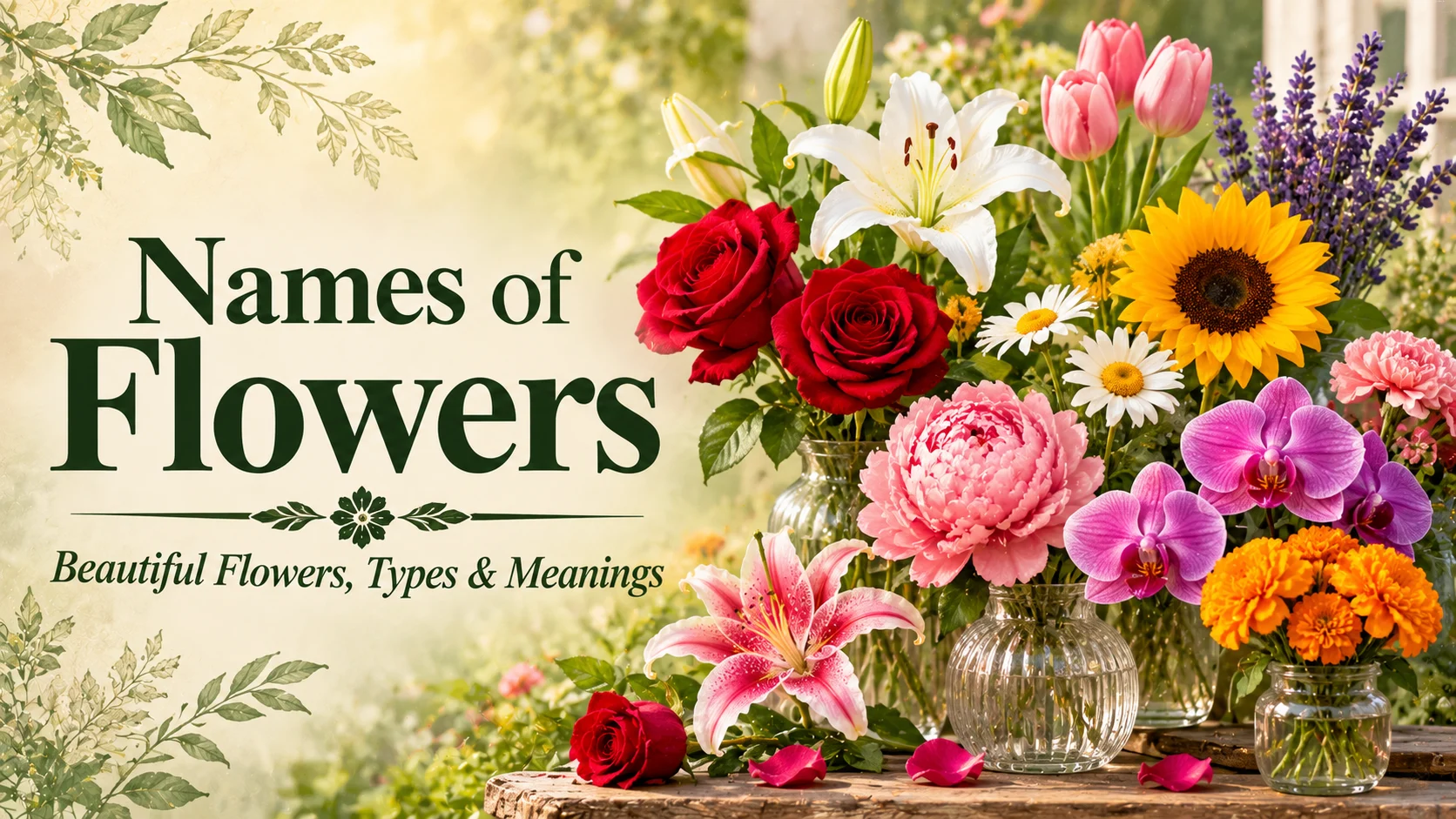
The name of flowers refers to the common or botanical names given to flowering plants, such as Rose, Lily, Tulip, Sunflower, Jasmine, Orchid, and Daisy. Each flower has unique characteristics, colors, fragrances, and symbolic meanings, making flower names useful for gardening, education, identification, gifts, and baby-name inspiration.
Flowers are among the most recognizable and beautiful parts of the natural world. They come in countless shapes, sizes, and colors, from delicate white Jasmine blossoms to bright Sunflowers and elegant Orchids. Learning the name of flowers helps people identify different plants, understand their characteristics, and appreciate their cultural and symbolic importance.
you are looking for common flower names, beautiful flowers with pictures, flowers in English, or scientific flower names, this guide introduces more than 100 varieties. It also explains their colors, meanings, growing characteristics, and popular categories.
What Are Flower Names?
Flower names are the common or scientific names used to identify different flowering plants and their blossoms. Examples include Rose, Lily, Daisy, Tulip, Jasmine, Marigold, and Sunflower. These names help people recognize plant varieties, understand their characteristics, and distinguish one flower from another.
Some flowers are named after their appearance, fragrance, historical background, or botanical classification. Others have names rooted in different languages and cultures. While common names are easy to remember, scientific names provide a more precise way to identify individual plant species.
100+ Names of Flowers in English
There are thousands of flowering plant species around the world. Some are popular garden favorites, while others grow naturally in forests, grasslands, mountains, and tropical environments.
Below is a helpful list of more than 100 flower names, organized into categories.
1. Popular and Common Flower Names
These flowers are widely recognized and commonly found in gardens, parks, bouquets, and floral decorations.
| No. | Flower Name | Main Characteristics |
|---|---|---|
| 1 | Rose | Fragrant flower with layered petals |
| 2 | Lily | Elegant flower with prominent petals |
| 3 | Tulip | Cup-shaped spring flower |
| 4 | Sunflower | Large flower with a central disk |
| 5 | Daisy | Simple flower with a central disk and surrounding petals |
| 6 | Jasmine | Small, often fragrant blossoms |
| 7 | Marigold | Bright yellow or orange flower heads |
| 8 | Orchid | Diverse flower family with distinctive shapes |
| 9 | Hibiscus | Large, colorful tropical-looking blossoms |
| 10 | Lavender | Purple flower spikes with aromatic foliage |
| 11 | Carnation | Ruffled petals and long-lasting blooms |
| 12 | Daffodil | Spring flower with a trumpet-shaped center |
| 13 | Peony | Large, full, layered blooms |
| 14 | Chrysanthemum | Many-petaled flower heads |
| 15 | Gerbera | Bright, daisy-like flower |
| 16 | Poppy | Delicate petals and distinctive seed capsules |
| 17 | Magnolia | Large, often fragrant blossoms |
| 18 | Zinnia | Colorful flowers in many shapes |
| 19 | Petunia | Trumpet-shaped flowers |
| 20 | Morning Glory | Climbing plant with funnel-shaped flowers |
2. Beautiful and Elegant Flower Names
Some flowers are especially admired for their graceful appearance, unusual shapes, delicate petals, or attractive colors.
| No. | Flower Name | Notable Feature |
|---|---|---|
| 21 | Camellia | Smooth, layered petals |
| 22 | Gardenia | Creamy white, fragrant flowers |
| 23 | Ranunculus | Many delicate, overlapping petals |
| 24 | Anemone | Open blooms with a dark central area in many varieties |
| 25 | Freesia | Fragrant, funnel-shaped blossoms |
| 26 | Delphinium | Tall spikes of blue or purple flowers |
| 27 | Hydrangea | Large clusters of small flowers |
| 28 | Sweet Pea | Fragrant flowers with delicate petals |
| 29 | Lisianthus | Rose-like blooms |
| 30 | Amaryllis | Large, trumpet-shaped flowers |
| 31 | Hellebore | Early-season blooms in several colors |
| 32 | Clematis | Climbing plant with showy flowers |
| 33 | Plumeria | Fragrant flowers associated with tropical regions |
| 34 | Wisteria | Hanging clusters of blossoms |
| 35 | Bleeding Heart | Heart-shaped flowers |
| 36 | Cosmos | Airy foliage and daisy-like flowers |
| 37 | Scabiosa | Rounded flower heads |
| 38 | Stephanotis | White, star-shaped fragrant flowers |
| 39 | Nerine | Curved, delicate petals |
| 40 | Protea | Large, distinctive flower heads |
3. Wildflower Names
Wildflowers grow naturally in different environments without necessarily being cultivated in gardens. Their appearance and growing conditions depend on the species and region.
| No. | Flower Name | Description |
|---|---|---|
| 41 | Bluebell | Bell-shaped flowers |
| 42 | Buttercup | Small, bright yellow blossoms |
| 43 | Cornflower | Usually vivid blue flowers |
| 44 | Foxglove | Tall spikes of tubular flowers |
| 45 | Forget-Me-Not | Tiny blue flowers |
| 46 | Yarrow | Flat clusters of small flowers |
| 47 | Primrose | Early-blooming garden and wildflower |
| 48 | Black-Eyed Susan | Yellow petals surrounding a dark center |
| 49 | Chicory | Blue, daisy-like flowers |
| 50 | Heather | Small flowers growing along woody stems |
| 51 | Clover | Rounded clusters of small blossoms |
| 52 | Evening Primrose | Delicate flowers that often open in the evening |
| 53 | Fireweed | Tall spikes of pink or purple flowers |
| 54 | Queen Anne’s Lace | Flat clusters of tiny white flowers |
| 55 | Indian Paintbrush | Colorful, bract-like floral displays |
4. Tropical Flower Names
Tropical flowers are associated with warm climates and include many plants with striking colors, unusual shapes, and attractive fragrances.
| No. | Flower Name | Main Feature |
|---|---|---|
| 56 | Bird of Paradise | Unusual, bird-like flower shape |
| 57 | Heliconia | Colorful, hanging or upright floral bracts |
| 58 | Anthurium | Glossy, heart-shaped spathe |
| 59 | Passion Flower | Complex and distinctive flower structure |
| 60 | Torch Ginger | Large, colorful flower heads |
| 61 | Ylang-Ylang | Strongly fragrant, narrow-petaled flowers |
| 62 | Bougainvillea | Colorful papery bracts surrounding small flowers |
| 63 | Ixora | Dense clusters of small flowers |
| 64 | Crown of Thorns | Small flowers surrounded by colorful bracts |
| 65 | Allamanda | Large, trumpet-shaped yellow flowers |
| 66 | Blue Ginger | Decorative blue-purple flower structures |
| 67 | Night-Blooming Cereus | Large flowers that bloom at night in certain species |
| 68 | Torch Lily | Upright, colorful flower spikes |
| 69 | Mandevilla | Climbing plant with trumpet-shaped flowers |
| 70 | Canna Lily | Bold flowers and broad tropical-looking leaves |
5. Rare and Unique Flower Names
Some flowers are less familiar because they grow in limited regions, have unusual appearances, or are not commonly cultivated.
| No. | Flower Name | Interesting Characteristic |
|---|---|---|
| 71 | Kadupul Flower | Night-blooming cactus flower |
| 72 | Ghost Orchid | Unusual orchid with pale flowers |
| 73 | Chocolate Cosmos | Dark flowers with a chocolate-like fragrance |
| 74 | Jade Vine | Hanging clusters of turquoise-green flowers |
| 75 | Corpse Flower | Famous for its strong odor and enormous flowering structure |
| 76 | Middlemist’s Red | Extremely rare cultivated camellia |
| 77 | Parrot’s Beak | Unusual curved flowers |
| 78 | Black Bat Flower | Dark flowers with long, whisker-like structures |
| 79 | Monkey Face Orchid | Orchid whose flowers may resemble a monkey’s face |
| 80 | Queen of the Night | Name used for several night-blooming plants |
| 81 | Blue Poppy | Striking blue flowers in suitable mountain climates |
| 82 | Ghost Pipe | Unusual white, non-green flowering plant |
| 83 | Sea Daffodil | Coastal plant with fragrant white flowers |
| 84 | Snake’s Head Fritillary | Bell-shaped flowers with a checkered pattern |
| 85 | Chocolate Lily | Dark, unusual-looking flowers |
6. More Flower Names to Expand Your Vocabulary
Here are additional flower names that are useful for students, gardeners, flower enthusiasts, and anyone building a flower-name collection.
| No. | Flower Name | Main Feature |
|---|---|---|
| 86 | Aster | Star-shaped flower heads |
| 87 | Begonia | Decorative flowers and foliage |
| 88 | Bouvardia | Clusters of star-shaped flowers |
| 89 | Calendula | Bright orange or yellow blooms |
| 90 | Coreopsis | Cheerful daisy-like flowers |
| 91 | Dahlia | Decorative flowers in many forms |
| 92 | Echinacea | Cone-shaped central disk |
| 93 | Gaillardia | Colorful, daisy-like flowers |
| 94 | Gladiolus | Tall spikes of flowers |
| 95 | Lupine | Tall clusters of pea-like flowers |
| 96 | Nigella | Delicate flowers and ornamental seed pods |
| 97 | Salvia | Spikes of small flowers |
| 98 | Snapdragon | Distinctive, mouth-shaped blossoms |
| 99 | Verbena | Clusters of small flowers |
| 100 | Wallflower | Colorful flowers with a pleasant fragrance |
| 101 | Stock | Fragrant flower spikes |
| 102 | Phlox | Clusters of colorful flowers |
| 103 | Sweet William | Clusters of small, patterned flowers |
| 104 | Tuberose | Highly fragrant white flowers |
| 105 | Hoya | Waxy, star-shaped flower clusters |
Flower Names and Their Meanings
Flowers have been used to communicate emotions, celebrate special occasions, and represent different ideas across cultures. Their symbolic meanings often depend on historical traditions, literature, and local customs.
Here are some popular flowers and their commonly associated meanings.
| Flower | Common Symbolic Meaning |
|---|---|
| Rose | Love, romance, and beauty |
| Lily | Purity and renewal |
| Sunflower | Happiness, warmth, and admiration |
| Daisy | Innocence and simplicity |
| Jasmine | Grace and beauty |
| Lavender | Calmness and tranquility |
| Tulip | Love and new beginnings |
| Orchid | Elegance and refinement |
| Marigold | Celebration and remembrance |
| Peony | Prosperity and good fortune |
| Carnation | Affection and admiration |
| Forget-Me-Not | Remembrance and lasting affection |
| Iris | Hope, wisdom, and faith |
| Poppy | Remembrance and sleep |
| Gardenia | Purity and secret admiration |
These meanings are symbolic rather than scientific definitions. For example, red roses are commonly associated with romantic love, while yellow roses can represent friendship or happiness in many modern floral traditions.
Flower Names by Color
One of the easiest ways to recognize flowers is by their colors. Different species may appear in several shades, and some varieties have multiple colors within the same bloom.
White Flowers
White flowers are often associated with simplicity, elegance, and peacefulness.
Popular white flowers include:
- White Rose
- White Lily
- Gardenia
- Jasmine
- White Tulip
- Baby’s Breath
- Moonflower
- White Orchid
- Snowdrop
- Stephanotis
Red Flowers
Red flowers are often chosen for romantic arrangements, celebrations, and decorative gardens.
Examples include:
- Red Rose
- Red Tulip
- Poppy
- Red Carnation
- Anthurium
- Amaryllis
- Hibiscus
- Red Dahlia
Yellow Flowers
Yellow blossoms are commonly connected with sunshine, friendship, and cheerful occasions.
Examples include:
- Sunflower
- Daffodil
- Buttercup
- Yellow Rose
- Marigold
- Coreopsis
- Yellow Tulip
- Allamanda
Pink Flowers
Pink flowers are popular in bouquets, weddings, and ornamental gardens.
Examples include:
- Pink Peony
- Pink Rose
- Camellia
- Cherry Blossom
- Pink Carnation
- Sweet Pea
- Pink Hydrangea
- Cosmos
Purple and Blue Flowers
Purple and blue flowers are admired for their distinctive shades and decorative appeal.
Examples include:
- Lavender
- Bluebell
- Delphinium
- Iris
- Cornflower
- Hyacinth
- Wisteria
- Salvia
- Blue Poppy
- Morning Glory
Types of Flowers Based on Their Growing Habits
Flowers can also be classified according to their life cycles and growing characteristics. Understanding these categories helps gardeners select suitable plants.
1. Annual Flowers
Annual flowers complete their life cycle within one growing season. They grow, flower, produce seeds, and die during that period.
Examples include:
- Marigold
- Zinnia
- Petunia
- Cosmos
- Calendula
- Sunflower
2. Perennial Flowers
Perennial flowers live for more than two years. Many return seasonally, although their flowering periods and growth habits vary.
Examples include:
- Peony
- Lavender
- Echinacea
- Daylily
- Iris
- Delphinium
3. Biennial Flowers
Biennial plants generally complete their life cycle over two growing seasons. They usually produce leaves during the first season and flowers and seeds during the second.
Examples include:
- Foxglove
- Sweet William
- Canterbury Bells
- Hollyhock (some varieties and growing conditions)
4. Bulb Flowers
Bulb flowers grow from underground storage structures, including true bulbs, corms, and tubers.
Examples include:
- Tulip
- Daffodil
- Hyacinth
- Crocus
- Gladiolus
- Amaryllis
Scientific Names of Popular Flowers
Common flower names can differ between countries and languages. Scientific names help identify plants more precisely because they follow an internationally recognized botanical naming system.
Here are some examples:
| Common Name | Scientific Name |
|---|---|
| Rose | Rosa |
| Sunflower | Helianthus annuus |
| Common Daisy | Bellis perennis |
| Tulip | Tulipa |
| Jasmine | Jasminum |
| Marigold (African marigold) | Tagetes erecta |
| Garden Lavender | Lavandula angustifolia |
| Hibiscus (Chinese hibiscus) | Hibiscus rosa-sinensis |
| Common Peony | Paeonia officinalis |
| Common Daffodil | Narcissus pseudonarcissus |
| Common Zinnia | Zinnia elegans |
| Common Petunia | Petunia × atkinsiana |
A scientific name usually consists of two parts: the genus name and the specific epithet. For example, Helianthus annuus identifies the common sunflower.
It is important to remember that some common names refer to multiple species, so a scientific name is often more precise than a common name alone.
Most Popular Flowers for Gardens and Bouquets
Not every flower is suitable for every purpose. Some are especially popular in gardens, while others are preferred for cut-flower arrangements.
Best Flowers for Home Gardens
- Marigolds: Often grown for their bright colors and relatively easy care.
- Petunias: Popular for containers, hanging baskets, and garden beds.
- Zinnias: Colorful flowers that attract pollinators.
- Sunflowers: Tall plants with cheerful flower heads.
- Lavender: Valued for its fragrance and attractive foliage.
- Cosmos: Lightweight, colorful flowers that suit informal gardens.
Popular Flowers for Bouquets
- Roses: A classic choice for romantic and formal arrangements.
- Lilies: Often used in elegant floral displays.
- Carnations: Long-lasting flowers available in many colors.
- Gerberas: Bright, cheerful flowers for casual bouquets.
- Tulips: Popular seasonal flowers for simple arrangements.
- Hydrangeas: Known for their large flower clusters.
- Peonies: Frequently selected for decorative and wedding bouquets.
When choosing flowers, consider their fragrance, seasonal availability, vase life, and any safety concerns for children or pets.
How to Choose the Right Flower
Choosing the right flower depends on its intended purpose, growing environment, appearance, and maintenance requirements.
Consider these factors before selecting a flower:
- Climate: Choose varieties that can tolerate the temperatures and weather conditions in your region.
- Sunlight: Some flowers need full sunlight, while others grow better in partial shade.
- Water requirements: Select flowers according to how frequently you can water them.
- Growing space: Consider the plant needs a large garden, a small pot, or a hanging basket.
- Flowering season: Some flowers bloom in spring, while others flower during summer, autumn, or different seasons in tropical climates.
- Purpose: Select flowers for decoration, fragrance, gifting, pollinator gardens, or landscaping.
- Maintenance: Some plants require regular pruning and care, while others are relatively low-maintenance.
For example, marigolds and zinnias are popular choices for sunny gardens, while certain begonias are better suited to partially shaded areas.
Why Are Flower Names Important?
Flower names are useful for more than simply identifying plants. They help people communicate about nature, learn botanical vocabulary, and understand the differences between flowering species.
Some important uses include:
- Education: Students learn flower names as part of biology and environmental studies.
- Gardening: Gardeners use plant names to research growing conditions and care requirements.
- Floral arrangements: Florists identify suitable flowers for weddings, gifts, and celebrations.
- Cultural traditions: Flowers play important roles in festivals, ceremonies, and remembrance.
- Language learning: Learning flower names expands English vocabulary.
- Plant identification: Common and scientific names help distinguish different varieties.
Flower names are also popular in creative writing, photography, art, and baby-name inspiration because many flower names have associations with beauty, nature, and personal expression.
FAQs
1. What are the 10 most popular flower names?
Rose, Lily, Tulip, Sunflower, Daisy, Jasmine, Orchid, Marigold, Hibiscus, and Lavender are among the most recognizable flower names.
2. What is the most beautiful flower in the world?
Beauty is subjective, but Roses, Orchids, Peonies, Tulips, and Cherry Blossoms are widely admired.
3. What are some rare flower names?
Kadupul Flower, Ghost Orchid, Jade Vine, Chocolate Cosmos, and Middlemist’s Red are examples of unusual or rare flowers.
4. What are the names of flowers in English?
Common English flower names include Rose, Daisy, Lily, Sunflower, Marigold, Daffodil, and Jasmine.
5. Which flowers are best for home gardens?
Marigolds, Zinnias, Petunias, Sunflowers, and Cosmos are popular garden choices, depending on climate and sunlight.
6. What are some flowers with beautiful meanings?
Roses symbolize love, Daisies represent innocence, Sunflowers suggest happiness, and Forget-Me-Nots symbolize remembrance.
7. What are the scientific names of flowers?
Examples include Rosa for roses, Tulipa for tulips, and Helianthus annuus for the common sunflower.
8. Which flowers are available in different colors?
Roses, Tulips, Dahlias, Carnations, Orchids, and Chrysanthemums come in numerous colors and varieties.
Conclusion
Learning the name of flowers opens the door to discovering the incredible diversity of the plant world. From familiar favorites like Roses, Tulips, and Sunflowers to unusual varieties like Jade Vine, Ghost Orchid, and Chocolate Cosmos, every flower has distinctive characteristics worth exploring.
You are studying plants, planning a garden, choosing a bouquet, or simply expanding your English vocabulary, this collection of flower names provides a useful starting point. Explore different varieties, discover their colors and symbolic meanings, and enjoy the beauty of flowers in everyday life.
Discover More Related Articles:
- Name Calculator | Discover Your Name Number, Meaning & Numerology in 2026
- Charlie Kirk’s Book Stop in the Name of God | Meaning, Summary & Key Lessons In 2026
- Lina Name Meaning | Origin, History, & Cultural Significance In 2026