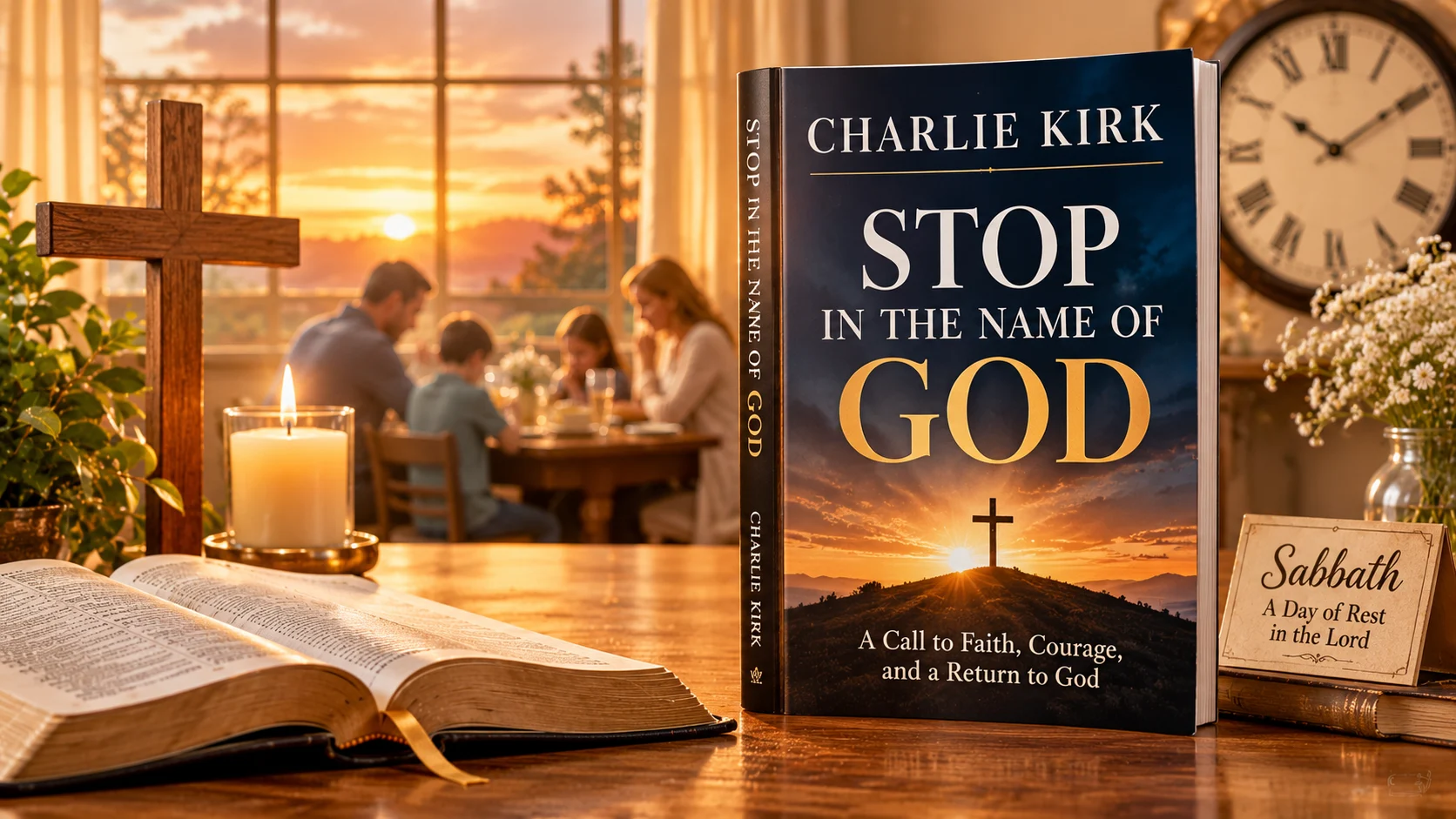
Stop, in the Name of God: Why Honoring the Sabbath Will Transform Your Life is a Christian nonfiction book by Charlie Kirk that explores the importance of observing the Sabbath, taking regular rest, strengthening relationships with family, and reconnecting with God. The book argues that setting aside one day each week for spiritual renewal can help people move away from constant busyness and rediscover a more meaningful life.
The Charlie Kirk book Stop in the Name of God explores a subject that often receives less attention in modern discussions about productivity and success: the importance of stopping, resting, and making time for spiritual life. Rather than treating rest as simply a break from work, Kirk presents the Sabbath as a meaningful religious practice rooted in biblical teachings.
The book is particularly relevant to readers interested in Christianity, biblical principles, spiritual discipline, and the relationship between faith and everyday life. It also addresses modern challenges such as digital distractions, demanding work schedules, materialism, and the pressure to remain constantly productive.
Written during the final period of Kirk’s life and published after his death, the book represents an important part of his religious writing. This article explores its background, central message, major themes, biblical connections, and the lessons readers can take from it.
What Is Charlie Kirk’s Book Stop in the Name of God?
Stop, in the Name of God: Why Honoring the Sabbath Will Transform Your Life is a religious nonfiction book written by American conservative commentator Charlie Kirk.
Published by Winning Team Publishing in December 2025, the book focuses on the biblical concept of the Sabbath and its relevance to modern living. It encourages readers to establish a regular period of rest dedicated to God, family, reflection, and personal renewal. Richland Library+1
The central argument is that human beings should not measure their lives entirely through work, productivity, financial success, or constant activity. Instead, Kirk argues that a healthy life requires a balance between meaningful work and intentional rest.
The book approaches the Sabbath as more than a religious obligation. It presents the practice as an opportunity to reconnect with spiritual values and recognize that life has purposes beyond professional responsibilities.
Kirk also discusses how modern technology and consumer culture can make it difficult for people to disconnect from their everyday responsibilities.
His message is particularly directed toward people who feel overwhelmed by work, social expectations, and the constant pressure to stay available.
What Does Stop in the Name of God Mean?
The title Stop, in the Name of God expresses the book’s central message: people should intentionally pause their regular activities and recognize the importance of spiritual rest.
The word “stop” is especially significant because modern society often celebrates being busy. People are encouraged to work longer, achieve more, respond faster, and remain connected throughout the day.
Kirk challenges this approach by presenting rest as an important part of God’s design for human life.
The phrase “in the name of God” gives the message its religious foundation. It connects the act of resting with faith, obedience, gratitude, and recognition of God’s authority.
The complete title, Why Honoring the Sabbath Will Transform Your Life, further explains the author’s purpose. He believes that observing a weekly Sabbath can influence several areas of life, including:
- Spiritual growth and religious commitment.
- Stronger family relationships.
- Greater appreciation for meaningful experiences.
- Freedom from unnecessary digital distractions.
- A healthier relationship with work.
- More time for prayer, reflection, and worship.
The title therefore communicates a religious and practical message rather than simply suggesting that people should take occasional breaks.
Who Was Charlie Kirk?
What is Charlie Kirk’s book ‘Stop in the Name of God’ about? – Deseret News
Charlie Kirk was an American conservative political commentator, author, and public speaker. He was best known for founding Turning Point USA in 2012, an organization focused on engaging young Americans in conservative political ideas.
Over the years, Kirk became a recognizable figure in American political discussions through campus appearances, public debates, radio programs, podcasts, and books.
Although much of his public reputation came from political activism, Christianity also became an increasingly important subject in his public life and writing.
He frequently discussed religious faith, biblical values, family, morality, and the role of Christianity in American society.
His book Stop, in the Name of God reflects this religious interest by focusing on the Sabbath and its importance in everyday life.
Kirk was fatally shot during a public campus event at Utah Valley University on September 10, 2025. He completed the manuscript approximately one month before his death. The book was subsequently published on December 9, 2025. Deseret News+2
Why Did Charlie Kirk Write Stop in the Name of God?
The book developed from Kirk’s personal experience with exhaustion, demanding professional responsibilities, and his growing interest in the biblical Sabbath.
According to his account in the book, he experienced increasing fatigue and spiritual confusion while managing multiple responsibilities.
In 2021, he discussed these struggles with David Engelhardt, a pastor and Turning Point USA board member. Engelhardt asked him he was observing the Sabbath.
Kirk initially believed that his responsibilities made it difficult to dedicate an entire day to rest. However, the conversation encouraged him to investigate what the Bible actually teaches about the Sabbath.
He began studying biblical passages about creation, rest, worship, and God’s commandments.
As his understanding developed, he became increasingly interested in making the Sabbath part of his weekly routine.
He eventually wanted to share this discovery with other people, especially those who believed that constant work was necessary for success.
The book grew out of this personal and spiritual journey. Deseret News+1
The Personal Experience Behind the Book
Kirk’s experience provides an important context for understanding the book.
He was involved in political organizations, public speaking, media appearances, and business responsibilities. His schedule often required extensive travel and continuous professional engagement.
He came to believe that working harder was not always the solution to exhaustion.
Instead, he began exploring the possibility that regular rest was an essential part of a meaningful life.
This experience shaped the book’s practical approach. Rather than discussing the Sabbath only as an ancient religious tradition, he connected it with the pressures people experience in contemporary society.
What Is the Main Message of the Book?
The central message of Stop, in the Name of God is that people need a regular period of intentional rest to maintain a meaningful relationship with God and avoid allowing work and material responsibilities to dominate their lives.
Kirk argues that the Sabbath should be understood as a gift rather than an inconvenience.
His discussion connects several major themes.
1. The Importance of the Sabbath
The Sabbath is the foundation of the entire book.
In biblical tradition, the Sabbath is associated with the seventh day of creation, when God rested after completing His work.
Genesis 2:2–3 describes God resting on the seventh day and blessing it.
Kirk uses this biblical account to explain that rest is not necessarily a response to physical exhaustion. It is also an opportunity to recognize the goodness of creation and appreciate life.
He encourages readers to treat the Sabbath as a meaningful weekly commitment rather than an optional activity that can always be postponed.
2. Rest Is More Than Physical Relaxation
Another important idea is the difference between ordinary relaxation and spiritual rest.
Watching television, sleeping late, or taking a vacation may provide temporary relief from daily responsibilities. However, Kirk argues that Sabbath rest involves something deeper.
It includes making time for:
- Prayer and religious reflection.
- Worship and spiritual learning.
- Family conversations.
- Personal relationships.
- Nature and quiet surroundings.
- Gratitude and appreciation.
According to this approach, rest becomes an intentional practice that gives people time to consider what matters most.
3. Work Has a Purpose, but It Should Not Control Life
Kirk does not present work as something inherently negative.
Instead, he connects meaningful work with responsibility, purpose, and human contribution.
He argues that people should work diligently during the week while also recognizing that productivity should not become the only measure of their value.
This creates an important distinction between working responsibly and becoming consumed by professional responsibilities.
The book encourages readers to establish boundaries so that employment, business, and financial ambitions do not completely replace spiritual and family life.
4. Family Relationships Need Dedicated Time
Family is another important subject throughout the book.
Modern schedules can make it difficult for families to spend meaningful time together. Even when people are physically present, phones, work messages, and other distractions can interfere with conversations.
Kirk presents the Sabbath as an opportunity to give family relationships greater attention.
A weekly period without unnecessary professional interruptions can create opportunities for shared meals, conversations, religious activities, and stronger personal connections.
5. Disconnecting From Technology
The book also examines the influence of digital technology.
Smartphones, computers, social media, and constant notifications can make people feel as though they must always be available.
Kirk argues that taking a break from these distractions can help people become more present in their surroundings.
His approach encourages readers to establish technology boundaries during their weekly rest period.
The purpose is not necessarily to reject modern technology but to prevent it from controlling every part of daily life.
The Biblical Meaning of the Sabbath in the Book
Best Bible Chapters to Read: 25 Essential Passages (2026)
To understand the book properly, it is important to understand the biblical background of the Sabbath.
The Sabbath has a significant place in both Jewish and Christian religious traditions, although the traditions differ in how they understand and observe it.
The Sabbath in the Book of Genesis
The biblical account of creation provides the foundation for the Sabbath.
According to Genesis 2:2–3, God completed His work of creation and rested on the seventh day.
This passage establishes a connection between creation, rest, and the blessing of the seventh day.
Kirk uses this account to argue that rest is part of a purposeful pattern established by God.
The Sabbath in the Ten Commandments
The Sabbath also appears in the Ten Commandments.
Exodus 20:8–11 instructs the Israelites to remember the Sabbath day and keep it holy.
The commandment emphasizes six days of labor followed by a seventh day dedicated to rest.
In this context, Sabbath observance is connected with religious commitment, worship, and recognition of God’s role as Creator.
The Sabbath in Jewish Tradition
In Judaism, the Sabbath is commonly known as Shabbat.
It begins at sunset on Friday and continues until nightfall on Saturday.
Traditional Shabbat observance includes prayers, family meals, religious services, rest, and restrictions on certain categories of work.
Kirk draws attention to this established tradition while presenting his own Christian perspective on the importance of weekly Sabbath observance.
It is important to recognize that Jewish Shabbat practices have their own religious history and meaning. They should not be treated as identical to every Christian interpretation of the Sabbath.
The Sabbath in Christian Tradition
Christian communities have different interpretations of Sabbath observance.
Some Christians emphasize Saturday as the biblical seventh-day Sabbath, while many others associate their weekly day of worship and rest with Sunday.
There are also differences concerning which activities should be avoided and how the Sabbath commandment applies to Christians.
Kirk discusses these questions while emphasizing the broader spiritual value of setting aside regular time for God.
His book is therefore best understood as his personal Christian argument for Sabbath observance, not as a universal statement of agreement among all Christian denominations. Adventist Review+2
Major Themes Explored in Stop in the Name of God
The book contains 13 chapters and explores the Sabbath through biblical, spiritual, personal, and cultural perspectives. Deseret News
Here are some of its most important themes.
| Theme | Main Idea |
|---|---|
| Sabbath observance | Set aside regular time for God and spiritual renewal. |
| Biblical creation | Rest is connected with God’s creation of the world. |
| Meaningful work | Work should contribute to life without controlling it. |
| Family | Give relationships greater attention and priority. |
| Technology | Reduce unnecessary digital distractions. |
| Materialism | Do not allow possessions and consumption to define happiness. |
| Spiritual growth | Develop a stronger relationship with God. |
| Sleep and health | Recognize the importance of physical recovery. |
| Gratitude | Appreciate life beyond professional achievements. |
Materialism and Modern Consumer Culture
Kirk also discusses how consumer culture can influence people’s priorities.
He questions the idea that greater financial success and material possessions automatically produce happiness.
His argument is that people sometimes sacrifice valuable time, relationships, and spiritual commitments to obtain things they do not genuinely need.
The Sabbath, in his interpretation, creates an opportunity to step away from this cycle.
Sleep and Physical Well-Being
Another subject addressed in the book is the importance of sleep.
Kirk connects regular rest with the broader idea that human beings need time to recover physically and mentally.
He also challenges the habit of treating sleep as an inconvenience that can be sacrificed whenever work becomes demanding.
These discussions support the book’s broader argument that rest should be an intentional part of everyday life.
However, the book’s religious arguments should be distinguished from clinical medical guidance. Its spiritual recommendations do not replace professional advice about sleep or health.
What Makes Stop in the Name of God Relevant Today?
The book addresses several challenges associated with modern lifestyles.
Many people spend their days responding to messages, completing professional tasks, following social media, and managing personal responsibilities.
Even when they finish work, they may continue thinking about unfinished tasks or checking their phones.
This creates a situation in which genuine rest becomes difficult.
Kirk’s message challenges the assumption that people must remain constantly productive.
Its relevance can be understood through several modern issues.
Work-related pressure: People may feel that taking time away from work makes them less successful or responsible.
Digital distractions: Smartphones and social media can interrupt family time and personal reflection.
Weak personal boundaries: Work responsibilities can extend into evenings, weekends, and holidays.
Material expectations: Consumer culture can encourage people to prioritize money and possessions over meaningful experiences.
Spiritual disconnection: Busy schedules can leave little time for prayer, worship, and religious learning.
The book suggests that a regular Sabbath can provide a practical way to reconsider these priorities.
Practical Lessons Readers Can Take From the Book
Although the book is based on Christian religious beliefs, its discussion of intentional rest also raises practical questions about how people organize their lives.
Readers interested in applying its ideas may consider the following practices.
- Choose a regular rest period: Establish a consistent weekly time for spiritual reflection and personal renewal.
- Reduce digital interruptions: Turn off unnecessary notifications and avoid routine work messages.
- Spend time with family: Prioritize meaningful conversations and shared activities.
- Make room for worship: Dedicate time to prayer, Scripture reading, or religious services.
- Appreciate nature: Spend time outdoors without treating every activity as another task.
- Work with purpose: Approach professional responsibilities seriously without allowing them to dominate every part of life.
- Practice gratitude: Reflect on personal blessings and relationships rather than focusing exclusively on achievements.
These practices reflect the book’s emphasis on creating a healthier relationship between work, faith, family, and rest.
They should be adapted to individual religious beliefs, family responsibilities, and circumstances.
Is Stop in the Name of God Worth Reading?
The book is worth reading depends on a reader’s interests and expectations.
It may be particularly valuable for readers who:
- Are interested in Christian books about the Sabbath.
- Want to explore biblical teachings about rest.
- Enjoy faith-based discussions about modern lifestyles.
- Are interested in Charlie Kirk’s religious views.
- Want to reflect on the relationship between work and spiritual life.
- Are looking for ideas about family time and technology boundaries.
Readers looking for a detailed academic study of Jewish Shabbat traditions or a comprehensive comparison of Christian Sabbath theology may want to consult additional religious and historical sources.
The book presents a particular Christian perspective rather than representing every religious interpretation.
Different Perspectives on the Book
Religious readers have responded to the book from different theological perspectives.
Some Christian reviewers appreciate its emphasis on the spiritual value of rest and the importance of recovering the Sabbath as a meaningful practice.
Other reviewers question aspects of Kirk’s interpretation, including his treatment of biblical Sabbath requirements and the relationship between Saturday and Sunday observance.
For example, the United Church of God review recognizes the book’s attention to Sabbath rest while criticizing certain theological interpretations. The Adventist Review also discusses its religious arguments and distinctive approach. United Church of God+1
These differing responses demonstrate why readers should approach the book as an author’s argument that can be explored, evaluated, and compared with other religious perspectives.
Book Publication Details
Here are the main bibliographic details of Charlie Kirk’s book.
CHARLIE KIRK’S STOP, IN THE NAME OF GOD — ADvindicate
Stop, in the Name of God: Why Honoring the Sabbath Will Transform Your Life
Written by Charlie Kirk
Publisher: Winning Team Publishing
Publication date: December 9, 2025
ISBN: 9798218777920
Format: Hardcover
Length: 292 pages (retailer listing)
Bibliographic information: 2ndandcharles.com+1
More information: Official book website · Google Books listing
FAQs
1. What is Charlie Kirk’s book Stop in the Name of God about?
It explores the biblical Sabbath, emphasizing weekly rest, Christian faith, family relationships, and spiritual renewal.
2. When was Stop in the Name of God published?
The book was published on December 9, 2025, by Winning Team Publishing, after Charlie Kirk’s death.
3. Who wrote Stop in the Name of God?
Charlie Kirk, the American conservative commentator and founder of Turning Point USA, wrote the book.
4. What is the main message of the book?
Its main message is that observing a weekly Sabbath can strengthen faith, restore balance, and create time for meaningful relationships.
5. Why did Charlie Kirk write this book?
He wrote it after discovering the personal and spiritual importance of Sabbath observance in his own life.
6. What does Sabbath mean in Christianity?
The Sabbath is a biblical day of rest and religious observance, although Christian denominations differ in how they observe it.
7. Does the book discuss family and technology?
Yes. It encourages readers to prioritize family connections and reduce digital distractions during their weekly rest.
8. Is Stop in the Name of God Charlie Kirk’s final book?
It is widely described as his final book project, completed shortly before his death and published posthumously.
9. How many chapters does the book contain?
The book contains 13 chapters exploring Sabbath observance, faith, work, and modern life.
10. Who should read Stop in the Name of God?
It is especially relevant to readers interested in Christianity, biblical teachings, spiritual growth, and the importance of weekly rest.
Conclusion
Stop, in the Name of God presents Charlie Kirk’s argument that the Sabbath is more than an old religious tradition. It is a meaningful opportunity to reconnect with God, appreciate family, and recognize the importance of rest. By connecting biblical teachings with modern challenges, the book encourages readers to reconsider their priorities.
Ultimately, its central message is that a meaningful life requires more than constant work and achievement. Readers agree with Kirk’s theological interpretations or approach the subject from another perspective, the book offers an opportunity to reflect on faith, spiritual renewal, relationships, and the value of making time for what truly matters.
Discover More Related Articles:
- Franklin Name Meaning | Origin, History & History Behind the Name in 2026
- Frank Name Meaning | Origin, History & Significance In 2026
- Archer Name Meaning| Origin, History, Symbolism & Significance in 2026











8 thoughts on “Charlie Kirk’s Book Stop in the Name of God | Meaning, Summary & Key Lessons In 2026”