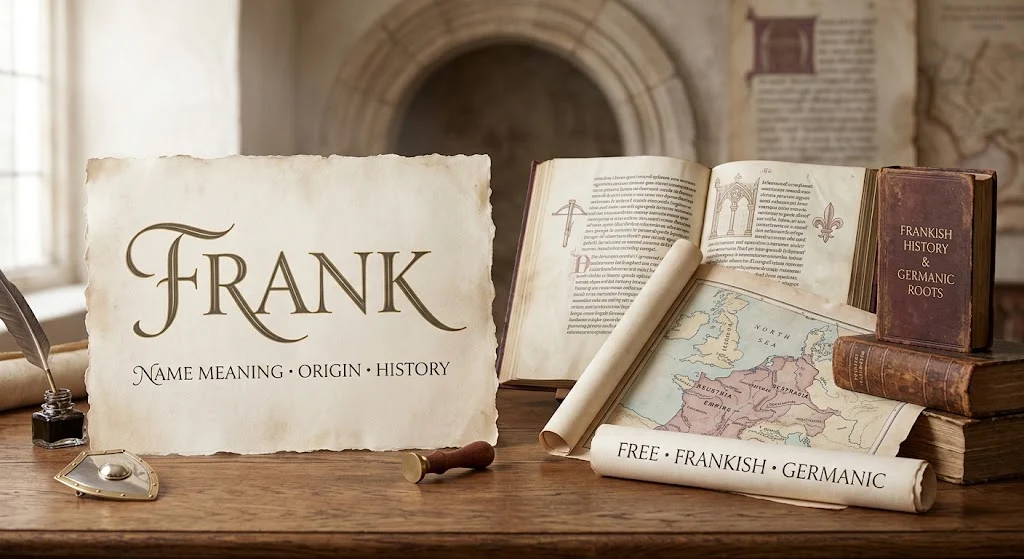
The Frank name meaning is commonly associated with the Franks, an ancient Germanic people, and is traditionally connected with the idea of being free or a freeman. The name has a long European history and is related to the development of words such as frank and Frankish.
The name Frank is a classic masculine given name with deep roots in European history. Although it is often associated with the modern English adjective frank, meaning open or candid, the personal name has a much older connection to the Franks, the Germanic people whose name became associated with the region that eventually developed into modern France.
Understanding the meaning of Frank requires looking beyond a simple dictionary definition. Its story connects Germanic naming traditions, the medieval Frankish world, Old French and Medieval Latin, and later English usage. Over time, the name became associated not only with its historical ethnic origin but also with qualities such as freedom, openness, honesty, and straightforwardness.
This guide explores the Frank name meaning, its origin and etymology, historical development, pronunciation, related names, cultural associations, and modern usage.
What Is the Name Frank?
Frank is a masculine given name used independently in several European languages, including English, German, Dutch, and Scandinavian languages. It originated as a name associated with the Franks, a Germanic people who became a major political and cultural force in Western Europe during late antiquity and the early Middle Ages.
The name should also be distinguished from Francis. Frank has its own historical existence and is not simply a shortened form of Francis. However, the two names became closely connected in some periods, and Frank has also been used as a short form of Francis in modern naming practices.
Today, Frank generally gives the impression of a traditional, concise, strong, and established name. Its one-syllable structure makes it simple to pronounce, while its historical background gives it considerably more depth than its short spelling suggests.
Frank Name Meaning
The Frank name meaning is most strongly associated with the Franks and the later sense of “free” or “freeman.”
The historical relationship between these meanings is important. Modern sources generally explain that the word meaning “free” developed in connection with the name of the Franks rather than necessarily being the original meaning of the tribal name itself. In other words, “free” is an important historical meaning associated with Frank, but the ultimate origin of the name of the Franks is not completely certain.
The name therefore carries several related associations:
- Frank — connected historically with the Franks
- Free — a later and strongly established meaning
- Freeman — connected with the historical social sense of freedom
- Open or candid — an association that developed from the adjective frank
- Straightforward — a modern character association with frankness
The word frank in English eventually developed meanings connected with being open, sincere, and outspoken. This semantic development came through Old French franc, meaning “free,” “sincere,” “genuine,” or “open,” and ultimately through Medieval Latin francus.
Does Frank Really Mean “Free”?
Yes, “free” is a well-established meaning associated with Frank, but the etymological story deserves some qualification.
The Franks were a Germanic people, and their ethnic name was recorded in Latin as Franci. Over time, francus came to have the sense of “free” or “freeman.” One explanation is that the conquering Frankish population held a privileged free status in parts of Gaul, which encouraged the semantic connection between being a Frank and being free.
The ultimate origin of the ethnic name Frank itself remains debated. A traditional theory connects it with a Germanic word for a javelin or spear, while other etymological proposals have been suggested. Therefore, it is more accurate to say that “free” is the established historical meaning associated with the name rather than claiming that “free” is unquestionably the original root meaning.
Frank Name Origin and Etymology
The origin of Frank is closely tied to the Franks, an ancient Germanic people who became prominent in Western Europe.
The personal name is connected with older Germanic forms such as Franko or Francho, while the name of the people appears in historical forms related to Franci. Behind the Name describes Frank as coming from an Old German name referring to a member of the Germanic crew known as the Franks.
The Franks established themselves in areas corresponding broadly to parts of present-day France, Belgium, the Netherlands, and western Germany. Their political influence became especially important during the early medieval period.
A Possible Connection to a Spear
One traditional etymological theory connects the name of the Franks with a type of spear or javelin. The proposed Proto-Germanic form is often reconstructed as frankô. This theory is based on related Germanic words for weapons.
However, this explanation should not be presented as certain. The ultimate origin of the tribal name is disputed, and some scholars have proposed alternative Germanic explanations. For an accurate name article, it is better to describe the weapon theory as traditional or possible, rather than as an established fact.
This uncertainty actually makes the history of Frank more interesting: the name has a well-documented historical association with the Franks, while the deeper origin of the ethnonym remains a subject of linguistic discussion.
History of the Name Frank
The history of Frank stretches back to the world of late antiquity and the early medieval period.
The Franks became increasingly important in Western Europe from approximately the third and fourth centuries onward. They eventually established a powerful kingdom under the Merovingians and later the Carolingians. Leaders such as Clovis I and Charlemagne played major roles in the political development of medieval Western Europe.
The name of the Franks became closely connected with the territory that developed into France. As the Frankish kingdoms evolved, the ethnic name also acquired broader linguistic and cultural meanings.
The personal name Frank survived as a given name in continental Europe and later spread more widely. It was brought to England by the Normans, contributing to its presence in English naming traditions.
By the modern period, Frank had become an established traditional given name in English and several other European languages.
Frank and the Meaning of “Frank”
One of the most interesting aspects of the name is its connection to the English adjective frank.
Today, if someone is described as frank, they are usually understood to be honest, direct, open, or candid. For example:
“She gave a frank answer to the question.”
This modern meaning developed from the historical sense of franc meaning “free,” “sincere,” “genuine,” or “open.” English acquired the word through Old French.
As a result, the personal name Frank can have a modern symbolic association with qualities such as:
- Honesty
- Openness
- Directness
- Sincerity
- Independence
- Freedom
These are modern associations, however, rather than a claim that every person named Frank possesses these characteristics.
Frank Pronunciation
In standard English, Frank is pronounced:
FRANK — /fræŋk/
It has one syllable and rhymes approximately with words such as bank, thank, and rank.
The pronunciation varies slightly across languages. For example, German, Dutch, and French have their own phonetic realizations of the name. Behind the Name lists distinct pronunciations for English, German, Dutch, and French usage.
Its short, uncomplicated pronunciation is one reason Frank works easily across different naming traditions.
Frank as a Traditional Baby Name
For parents considering Frank as a baby name, its main appeal comes from its combination of simplicity and history.
Frank is:
- Short and easy to spell
- Easy to pronounce in English
- Historically established
- Masculine and traditional
- Recognizable across several European cultures
- Connected to a significant period of European history
The name can feel vintage without being difficult to understand. It also has the advantage of functioning well at different ages: Frank can suit a child, a teenager, and an adult without requiring a nickname.
Its traditional character may particularly appeal to parents who prefer classic names over highly modern or invented choices.
Frank vs. Francis
Frank and Francis are closely associated in naming history, but they are not identical names.
| Name | Historical association | Common impression |
|---|---|---|
| Frank | Connected to the Franks; also used independently | Short, classic, direct |
| Francis | From Latin Franciscus and strongly associated with Saint Francis | Traditional, formal, religious/historical |
| Frankie | Diminutive or nickname form of Frank and sometimes Francis | Friendly, informal |
| Franklin | Separate established name, sometimes shortened to Frank | Formal, surname-style |
It has its own Germanic/Frankish history, although it became intertwined with Francis in some naming traditions. Modern sources also recognize Frank as a possible short form of Francis.
Frank vs. Franklin
They may sound related because Frank is a common nickname for Franklin, but they are separate names.
Frank is the shorter traditional given name associated with the Franks.
Franklin is a longer English name that developed from a surname and historically referred to a landholder or free person. Frank can be used as a nickname for Franklin, but the two names should not be treated as etymologically identical.
This distinction is useful for parents who like the sound of Frank but are deciding they prefer a short standalone name or a longer formal name.
Variations and Related Forms of Frank
Frank appears in several linguistic and cultural forms.
Commonly associated forms include:
- Franck — French form
- Franco — Italian and Spanish form
- Franko — found in several European naming traditions
- Franka — feminine form used in some languages
- Frankie — familiar diminutive
- Fran — shortened form
- Francis — historically associated but not etymologically identical
- Franklin — a separate related-looking name that can use Frank as a nickname
Behind the Name lists Frank as a name used in English, German, Dutch, Danish, Swedish, Norwegian, and French, with different related forms across European languages.
Cultural Significance of the Name Frank
The cultural significance of Frank comes largely from its connection with Frankish Europe.
The Franks were central to the formation of medieval political structures in Western Europe. Their name became associated with territories and languages that eventually contributed to the development of modern France and surrounding regions.
The name also has a second layer of cultural meaning because the word frank came to mean open, sincere, and candid. This gives the name a particularly interesting combination of historical and linguistic associations.
It can therefore be understood through two connected ideas:
Historical Frank:
A name connected with the Frankish people and medieval Europe.
Modern Frank:
A name that can symbolically suggest honesty, openness, and straightforwardness through the English word frank.
Famous People Named Frank
Frank has been used by many notable people in modern history.
Examples include:
- Frank Sinatra, American singer and actor
- Frank Lloyd Wright, influential American architect
- L. Frank Baum, American author best known for The Wonderful Wizard of Oz
These figures demonstrate the name’s wide cultural reach across music, architecture, and literature.
The popularity of the name among notable figures also contributes to its strong association with the classic American and European naming traditions.
Is Frank a German Name?
Frank has Germanic roots and is strongly connected with the Franks, but it should not be described as exclusively German.
The Franks were a Germanic people whose historical territories extended across parts of modern France, Belgium, the Netherlands, and Germany. The personal name subsequently developed and spread across multiple European languages.
So, if someone asks Frank is German, the most accurate answer is that it has Germanic historical roots and is used in German, but it is also an established name in English and several other European languages.
What Does Frank Symbolize?
Although a name’s historical meaning does not determine a person’s personality, Frank can carry several positive symbolic associations.
Freedom
The strongest traditional symbolic association is freedom, reflecting the historical development of francus and related words meaning free or freeman.
Honesty
Because English frank means open and candid, the name can symbolically suggest honesty and direct communication.
Strength
Its association with the Franks gives the name a historical and warrior-era character, although this should be understood as cultural symbolism rather than a literal personality trait.
Simplicity
Frank’s short spelling and one-syllable pronunciation give it a clean, uncomplicated quality that has helped it remain recognizable across generations.
Example Sentences Using Frank
Here are a few natural examples showing how the name is used:
- Frank is a classic masculine name with Germanic historical roots.
- The name Frank is associated with the ancient Franks.
- Many people connect the meaning of Frank with freedom and openness.
- Frankie can be used as a friendly nickname for Frank.
- Frank remains recognizable across several European naming traditions.
FAQs
What does the name Frank mean?
Frank is historically associated with the Franks and is commonly connected with the meaning “free” or “freeman.”
What is the origin of the name Frank?
Frank has Germanic and Frankish roots and developed from names associated with the ancient Frankish people.
Is Frank a German name?
Frank has Germanic roots and is used in German, but it is also common as a traditional name in several other European languages.
Does Frank mean free?
Yes, “free” is a well-established historical meaning associated with Frank, although the ultimate origin of the Frankish tribal name is uncertain.
Is Frank short for Francis?
Frank can be used as a short form of Francis, but Frank also exists as an independent name with its own older history.
What is the feminine form of Frank?
Franka is a feminine form found in some European naming traditions.
How do you pronounce Frank?
In English, Frank is pronounced “FRANK” and has one syllable.
Is Frank a biblical name?
No, Frank is not a biblical name; its historical roots are connected to Germanic and Frankish naming traditions.
What are nicknames for Frank?
Common informal forms include Frankie, Franky, and Fran, depending on language and naming tradition.
Is Frank a good name for a baby?
Frank can be a good choice for parents looking for a short, classic, historically established masculine name with strong European roots.
Conclusion
The Frank name meaning combines ancient history with a familiar modern quality. Historically connected with the Franks, the name became associated with ideas of freedom and the status of a freeman, while the English word frank later developed meanings connected with openness, sincerity, and directness.
With its short pronunciation, established European history, and range of related forms, Frank remains a strong choice for parents who appreciate traditional names with genuine historical depth. Its connection to Frankish Europe gives it an identity that reaches far beyond its simple one-syllable form.
Discover More Related Articles:
- Karen Name Meaning | From Greek Origins to Modern Times In 2026
- Arianna Name Meaning | Discover Its Ancient Roots, Mythological Connections & Timeless Appeal In 2026
- Inez Name Meaning | The Elegant Legacy That Makes This Name So Special 2026






14 thoughts on “Frank Name Meaning | Origin, History & Significance In 2026”