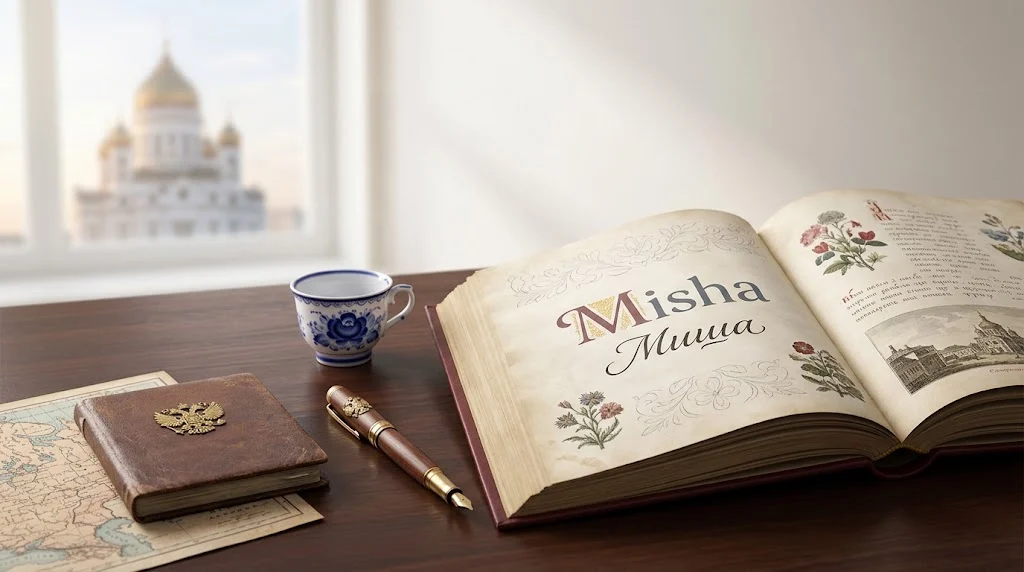
Misha is most commonly a Russian diminutive of Mikhail, the Russian form of Michael. Because Michael ultimately comes from the Hebrew name Mikha’el, the name is traditionally understood through the meaning “Who is like God?” Misha is generally used as a familiar or affectionate form of Mikhail in Russian.
The name also appears in other cultures and languages with different independent uses. Therefore, the Misha name meaning should not automatically be reduced to a single universal definition.
Its meaning and gender association can vary according to the naming tradition in which it is used.
What Is the Name Misha?
Misha is a short and familiar form of a longer personal name. In Russian, Миша (Misha) is traditionally a diminutive of Михаил (Mikhail). Mikhail is the Russian form of Michael, a name with ancient Hebrew roots.
A diminutive is a shortened or altered form of a personal name that can communicate familiarity, affection, or informality. Russian naming traditions make extensive use of such forms, and Misha belongs to this broader pattern.
For example:
Mikhail → Misha
This does not mean that Misha is simply a random shortened spelling of Mikhail. It is an established Russian name form with its own place in Russian usage. Sources documenting Russian names specifically identify Misha as a Russian diminutive of Mikhail.
In English-speaking countries, however, Misha may be encountered as a standalone given name rather than only as a nickname. Its use outside the Russian naming system can therefore be somewhat different.
Misha Name Meaning
The most established interpretation of Misha comes from its relationship with Mikhail, and ultimately Michael.
Michael derives from the Hebrew name Mikha’el, traditionally interpreted as a rhetorical question meaning:
“Who is like God?”
This is not intended as a literal question expecting an answer. In religious naming traditions, it expresses the idea that no one is comparable to God.
Because Misha is a diminutive of Mikhail, the deeper traditional meaning is inherited from this name family rather than from a separate Russian word meaning “who is like God.”
This distinction is important when researching names. A nickname or diminutive does not necessarily have an independent dictionary meaning. Sometimes its meaning is best understood by tracing the longer name from which it developed.
Misha at a glance
| Attribute | Details |
|---|---|
| Name | Misha |
| Russian form | Миша |
| Traditional Russian use | Diminutive of Mikhail |
| Related name | Michael |
| Traditional meaning of Michael | “Who is like God?” |
| Language association | Russian |
| Traditional gender in Russian | Masculine |
| Possible modern usage | Can be used independently in other cultures |
| Style | Short, friendly, familiar, international |
Misha Name Origin and Etymology
The clearest etymological path for the traditional Russian Misha is:
Hebrew Mikha’el → Michael → Mikhail → Misha
The original Hebrew name is generally represented as Mikha’el. It combines elements understood as referring to “who,” “like,” and “God,” producing the familiar interpretation “Who is like God?”
Michael became an important name in Jewish and Christian traditions and subsequently developed into different forms in many languages.
In Russian, Michael is represented as Mikhail (Михаил). Misha (Миша) developed as a familiar diminutive of Mikhail.
This linguistic history explains why Misha can sound quite different from Michael while still belonging to the same name family.
The relationship is comparable to other Russian naming patterns in which a formal given name has a familiar form used in everyday conversation. Misha therefore carries both a linguistic connection to the ancient name Michael and a specifically Russian cultural identity as a diminutive.
The Russian Connection of Misha
The Russian connection is one of the most important aspects of the name.
Russian naming traditions distinguish between formal names and familiar forms used by family, friends, and close acquaintances. Misha is one such familiar form for Mikhail. Reference works on Russian names consistently identify Миша as a Russian diminutive of Михаил.
This gives Misha a warm and approachable character in its traditional context.
The distinction can be illustrated simply:
- Mikhail — formal Russian given name
- Misha — familiar or diminutive form
- Michael — English and other-language form of the same broader name family
Another Russian form is Mishka (Мишка), which is also documented as a diminutive of Mikhail.
Therefore, Misha should not be treated as an unrelated Russian name simply because it looks different from Mikhail.
Is Misha a Boy or Girl Name?
In its traditional Russian usage, Misha is masculine because it is a diminutive of the masculine name Mikhail.
However, naming practices can change when names move between languages and cultures.
Outside Russia and Russian-speaking communities, Misha can sometimes be used as a standalone name for girls or as a gender-neutral name. There are also separate uses of the spelling Misha in other linguistic and cultural contexts.
For example, some name databases record Misha as a feminine name in particular Indian, English, Persian, Arabic, Pashto, and Urdu contexts, but these should not be confused with the traditional Russian etymology.
So the most accurate answer is:
Traditionally, Misha is a masculine Russian diminutive of Mikhail, but modern international usage can make Misha a unisex or feminine given name in some cultures.
Is Misha a Biblical Name?
Misha itself is not the primary biblical form of the name.
Its traditional Russian connection is through Mikhail, which is the Russian form of Michael. Michael is a biblical name associated with the archangel Michael in Jewish and Christian traditions.
Therefore, it is more accurate to describe Misha as a Russian diminutive of a biblical name rather than calling Misha itself a direct biblical name.
The distinction matters because many modern names are familiar forms, nicknames, or regional variants of names that have much older religious or historical roots.
The name family can be represented as:
Mikha’el → Michael → Mikhail → Misha
This gives Misha a meaningful connection to biblical naming traditions without claiming that “Misha” is itself the original biblical form.
Misha Pronunciation
The Russian name Миша is commonly transliterated into English as Misha.
For English speakers, it is often approximated as:
MEE-sha
The first syllable sounds like “me,” followed by “sha.”
However, pronunciation can vary slightly depending on the speaker’s language and accent. In Russian, the pronunciation reflects the sounds of the original Cyrillic form Миша, rather than an English spelling being pronounced according to English spelling rules.
For families choosing the name internationally, “MEE-sha” is generally an easy pronunciation for English speakers to recognize.
Misha in Different Cultural Contexts
One reason the name can be confusing online is that Misha does not have only one usage worldwide.
In Russian naming tradition, its established meaning and identity come from Mikhail. But other languages may use the same spelling independently.
For example, some user-submitted name records identify Misha with separate feminine uses and meanings in South Asian, Persian, Arabic, Pashto, and Urdu contexts. These entries should be treated separately from the Russian diminutive because they represent different naming traditions.
This is an important point for anyone researching baby names: the same spelling does not necessarily mean the same etymology.
Two names can look identical in Latin letters while having completely different origins.
For that reason, if a family is considering Misha because of a particular cultural or linguistic meaning, it is useful to establish which tradition they are referring to.
Misha vs. Mikhail vs. Michael
Misha, Mikhail, and Michael are closely related, but they serve different naming functions.
| Name | Main association | Role |
|---|---|---|
| Misha | Russian | Diminutive/familiar form |
| Mikhail | Russian | Formal given name |
| Michael | Hebrew/Christian naming tradition; widely used internationally | Major international form |
| Mishka | Russian | Another diminutive of Mikhail |
Mikhail is the Russian form of Michael, while Misha is a familiar Russian form of Mikhail. Behind the Name
This makes Misha particularly interesting for parents who like the historical depth of Michael but prefer a shorter and softer-sounding name.
Misha vs. Michael
The difference between Misha and Michael is mainly one of linguistic form and naming tradition.
Michael has a more formal and internationally recognizable character. It is widely established across many languages and cultures.
Misha, by contrast, has a shorter, more intimate sound and a strong association with Russian usage.
| Feature | Misha | Michael |
|---|---|---|
| Length | Short | Longer |
| Russian connection | Strong | Indirect through Mikhail |
| Traditional role | Diminutive | Full given name |
| Style | Friendly, familiar | Classic, formal |
| Biblical connection | Through Michael | Direct |
| International recognition | Moderate | Very high |
Neither name is inherently “better.” The choice depends on a family prefers the formal international form or the distinctive Russian diminutive.
What Does the Name Misha Symbolize?
A name’s historical meaning and its modern symbolic associations are not always the same thing.
Because Misha is connected to Mikhail and Michael, it can be associated with ideas such as:
- Faith
- Spiritual devotion
- Humility before God
- Strength of belief
- Russian cultural heritage
- Warmth and familiarity
- Family closeness
These are symbolic associations, not additional literal translations of the name.
The literal traditional meaning belongs to the Michael name family: “Who is like God?” Misha inherits that association through Mikhail rather than having a separate Russian definition with the same wording.
Is Misha a Good Name?
Misha can be an appealing choice for parents who want a name that is short, distinctive, easy to pronounce, and connected to a longer historical name.
It has several qualities that make it versatile:
- Short and memorable: Misha is only two syllables.
- International sound: The pronunciation is relatively accessible in many languages.
- Historical depth: It belongs to the ancient Michael/Mikha’el name family.
- Russian heritage: Its traditional use connects it specifically with Russian naming culture.
- Friendly style: As a diminutive, it has an affectionate and approachable quality.
- Flexible modern usage: Outside Russian contexts, it may function as a standalone name.
Parents should simply be aware that the name’s gender perception can vary. In traditional Russian usage it is masculine, while in some other countries Misha is also used for girls or as a gender-neutral name.
Names Related to Misha
If you like Misha, several related names may also be worth considering.
Mikhail
Mikhail is the formal Russian name from which Misha traditionally derives. It has a distinctly Russian character while retaining the broader international connection to Michael.
Michael
Michael is the internationally familiar form of the name family. Its traditional Hebrew interpretation is “Who is like God?”
Mishka
Mishka is another Russian diminutive of Mikhail. It is closely related to Misha and has a similarly affectionate character.
Mika
Mika is a separate name form with multiple linguistic histories. Although it may sound similar to Misha, it should not automatically be treated as another form of Misha.
Michail
Michail is another transcription/form connected with Michael and is used in several European and Greek contexts. It should be distinguished from the specifically Russian diminutive Misha.
Examples of Using the Name Misha
Misha can work differently depending on it is being used traditionally as a familiar Russian form or independently as a given name.
1Example — Russian naming context:
“Mikhail is his formal name, but his family calls him Misha.”
2 Example — Standalone modern usage:
“Misha was chosen because the parents wanted a short name with Russian roots.”
3 Example — Name-family context:
“Misha is related to Mikhail, just as other diminutives can develop from formal given names.”
These examples show why context matters. Calling every Misha a nickname would be inaccurate because the name is also used independently in some modern naming environments.
The Personality of the Name Misha
Name personality descriptions are subjective rather than scientifically established facts. Still, names develop cultural impressions based on their sound, history, and associations.
Misha is often perceived as:
Warm: Its diminutive history gives it an affectionate quality.
Friendly: The short, two-syllable structure feels approachable.
Gentle: The sound is softer than many longer masculine names.
International: Misha is relatively easy to recognize and pronounce across different languages.
Distinctive: It is less common in many English-speaking naming environments than Michael.
These are style impressions rather than proven characteristics of people who bear the name.
FAQs
What does the name Misha mean?
Misha is traditionally a Russian diminutive of Mikhail, which is the Russian form of Michael, meaning “Who is like God?”
Is Misha a Russian name?
Yes. In traditional Russian usage, Миша (Misha) is a diminutive of Mikhail.
Is Misha a boy or girl name?
Traditionally, Misha is masculine in Russian because it comes from Mikhail, but it can be used as a feminine or gender-neutral name in some other cultures.
Is Misha a nickname for Michael?
Misha is more precisely a Russian diminutive of Mikhail, and Mikhail is the Russian form of Michael. Behind the Name
What is the biblical meaning of Misha?
Misha is not the original biblical form, but its traditional name family connects it to Michael, whose Hebrew meaning is “Who is like God?”
How do you pronounce Misha?
Misha is commonly pronounced approximately MEE-sha, although pronunciation can vary according to language and accent.
Is Misha a unisex name?
Misha is traditionally masculine in Russian, but modern usage in other countries can make it unisex or feminine.
What names are related to Misha?
The closest traditional forms include Mikhail, Michael, and Mishka, with Misha being a Russian diminutive of Mikhail.
Conclusion
Misha has a rich name history because it connects a familiar Russian form with the much older name Michael. In its traditional Russian usage, Misha is a diminutive of Mikhail, and Mikhail is the Russian form of Michael. The deeper meaning of the name family is the Hebrew expression “Who is like God?”
What makes Misha especially appealing is the combination of historical depth and modern simplicity. It can carry Russian cultural associations while remaining short, friendly, and easy to use internationally. Because the name also has independent uses in other cultures, its exact interpretation should always be considered in context.
Discover More Related Articles:
- Franklin Name Meaning | Origin, History & History Behind the Name in 2026
- Frank Name Meaning | Origin, History & Significance In 2026
- Archer Name Meaning| Origin, History, Symbolism & Significance in 2026