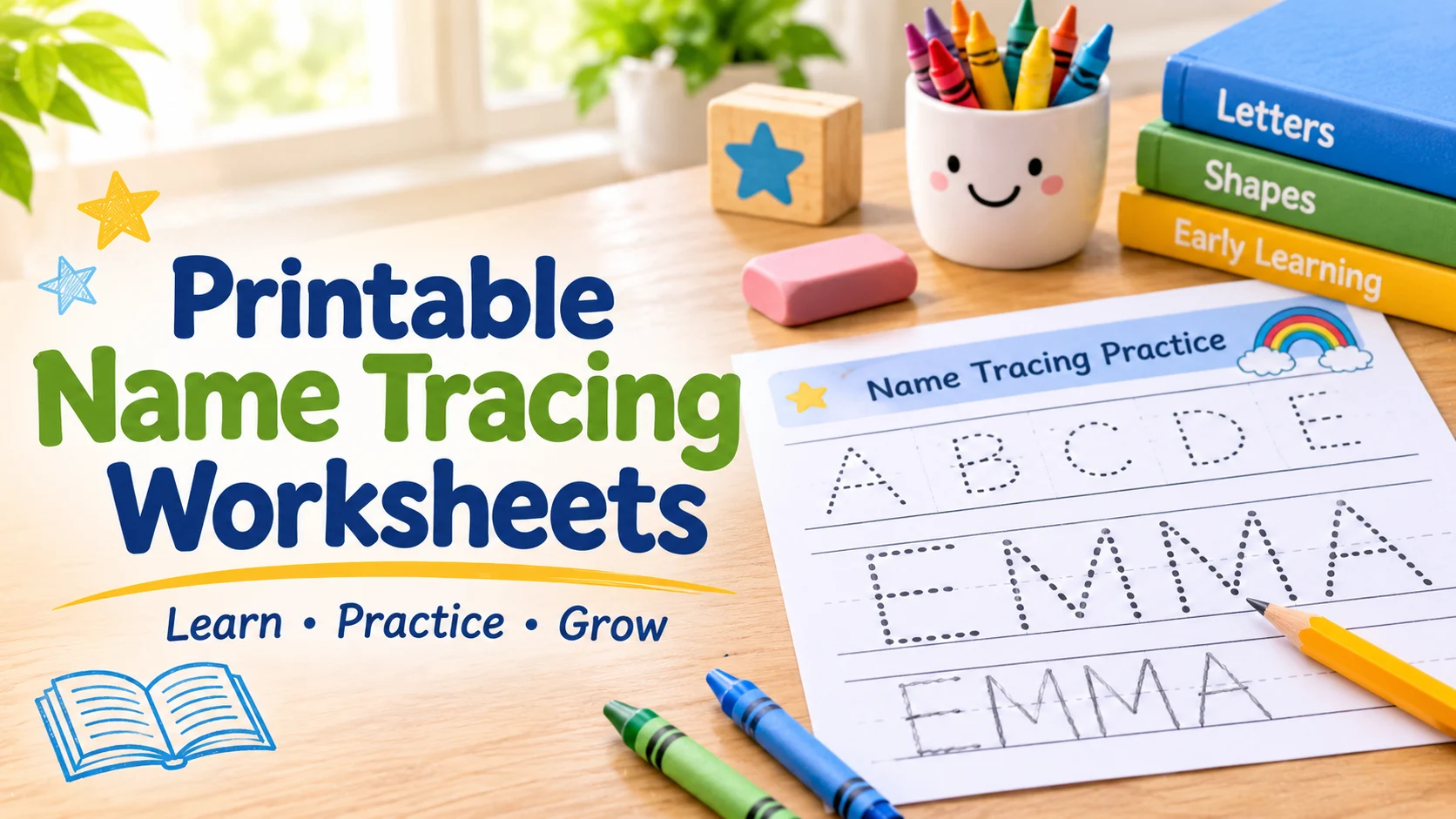
Printable name tracing worksheets are educational practice sheets that help children learn to recognize, trace, and write their own names. They usually feature dotted letters, handwriting guides, and blank spaces where children can practice independently. These worksheets are especially useful for preschoolers, toddlers, and kindergarten students developing early handwriting skills.
Learning to write their own name is an exciting milestone for young children. It helps them recognize an important word, understand letter shapes, and begin developing the handwriting skills they will use throughout school. Printable name tracing worksheets make this learning process easier by providing simple, guided activities that children can practice at home or in the classroom.
Parents, preschool teachers, and kindergarten educators can use these worksheets to introduce letter formation in a fun and structured way. Children can follow dotted letters, practice holding a pencil, recognize uppercase and lowercase letters, and gradually learn to write their names without assistance.
The best part is that printable name tracing activities can be personalized. Instead of practicing random letters, children can work with their actual names, making handwriting practice more meaningful and engaging.
In this guide, you will discover what name tracing worksheets are, how they support early learning, which types are available, how to use them, and how to create personalized name tracing printables for children.
What Are Printable Name Tracing Worksheets?
Printable name tracing worksheets are downloadable or printable educational resources designed to help children practice writing their names. They typically display a child’s name using dotted, dashed, or lightly printed letters that children can trace with a pencil, crayon, or marker.
These worksheets are commonly used in preschool, pre-kindergarten, daycare, and kindergarten classrooms.
A typical worksheet may include:
- A child’s name written in large dotted letters.
- Uppercase and lowercase letter practice.
- Blank handwriting lines for independent writing.
- Space for repeated tracing exercises.
- Simple pictures or illustrations for decoration.
- Letter formation guides.
For example, a child named Emma might receive a worksheet displaying:
E m m a
The name may appear several times, allowing the child to trace each letter before attempting to write it independently.
Unlike general alphabet worksheets, personalized name tracing pages focus on a word that children encounter regularly in their everyday lives.
Benefits of Name Tracing Printables for Children
Name tracing activities provide more than handwriting practice. They introduce several foundational skills that support early childhood learning.
1. Develops Early Handwriting Skills
Tracing dotted letters helps children become familiar with the shapes and movements involved in writing. They learn how letters are formed and how to move a pencil across the page.
With regular practice, children can gradually transition from tracing letters to writing them independently.
2. Improves Letter Recognition
Children repeatedly see the letters that make up their names. This exposure helps them become familiar with individual letter shapes and recognize their names in different settings.
For example, a child named Noah may begin identifying the letters N, O, A, and H in books, classroom displays, and other printed materials.
3. Strengthens Fine Motor Skills
Holding a pencil and following dotted lines requires small, controlled movements of the fingers and hands.
These activities provide opportunities to practice fine motor coordination, which is also useful for drawing, coloring, cutting, and other everyday tasks.
4. Builds Confidence and Independence
Writing a familiar name can feel more achievable than copying unfamiliar words.
When children successfully trace their names, they can feel proud of their progress. As their skills develop, they may become more confident about attempting handwriting tasks independently.
5. Encourages Name Recognition
Recognizing their own names is an important early literacy activity.
Children often see their names on classroom labels, artwork, personal belongings, and school materials. Name tracing worksheets reinforce this familiarity by connecting written letters with something meaningful to them.
Different Types of Printable Name Tracing Worksheets
Not every child needs the same type of handwriting activity. Some are just beginning to recognize letters, while others are ready to practice writing without dotted guides.
Here are several popular types of name tracing printables.
1. Dotted Name Tracing Worksheets
<PRIVATE_PERSON> Dotted worksheets display names using small dots or dashed lines that children follow with a pencil.
These are particularly useful for beginners who need visual guidance when forming letters.
Best for: Preschoolers and children starting handwriting practice.
2. Personalized Name Tracing Worksheets
Personalized worksheets feature a specific child’s name rather than a generic word.
Parents or teachers can enter names such as Olivia, Liam, Sophia, or Ethan to create individual handwriting practice sheets.
Best for: Children learning to recognize and write their own names.
3. Uppercase and Lowercase Name Worksheets
These worksheets introduce children to capital and small letters.
For example, a child might practice:
- JAMES
- James
- james
The goal is to help children recognize different letter forms and understand how uppercase and lowercase letters appear in writing.
Best for: Preschool and kindergarten students learning letter recognition.
4. Blank Name Writing Worksheets
Blank handwriting worksheets provide empty writing lines instead of dotted letters.
Children can use these pages to practice writing their names from memory or by looking at a reference example.
Best for: Children who are ready to move beyond tracing.
5. Rainbow Name Tracing Worksheets
Rainbow tracing activities allow children to trace their names multiple times using different colors.
For example, they might trace the same name with a red crayon, blue marker, green pencil, and yellow crayon.
This adds a creative element to handwriting practice.
Best for: Children who enjoy colorful and playful learning activities.
6. Preschool Name Tracing Worksheets
Preschool worksheets generally feature large letters, simple layouts, and plenty of space for tracing.
They may also include pictures, basic shapes, and other beginner-friendly elements.
Best for: Children who are developing their first handwriting skills.
How to Use Printable Name Tracing Worksheets
Using printable name tracing sheets is simple. Parents and teachers can follow a few basic steps to make practice sessions productive.
Step 1: Choose a Personalized Worksheet
Start by selecting a worksheet that includes the child’s actual name.
Make sure the letters are large enough to see clearly and that the tracing lines are easy to follow.
Step 2: Print the Worksheet
Download the worksheet and print it on standard paper. Regular printer paper works well for most handwriting activities.
If children will use markers or crayons, slightly thicker paper may be helpful.
Step 3: Demonstrate Letter Formation
Before asking children to begin, show them how to follow the dotted lines.
Demonstrate the starting point and direction of each letter where possible. Encourage children to work slowly instead of rushing through the activity.
Step 4: Let Children Trace Independently
Allow children to follow the letters at their own pace.
Avoid correcting every small mistake. Gentle encouragement and repeated practice are generally more helpful than expecting perfect handwriting immediately.
Step 5: Practice Writing Without Dots
Once children become comfortable tracing their names, introduce blank writing lines.
They can use a printed example as a reference and gradually try writing their names without looking.
Step 6: Celebrate Their Progress
Display completed worksheets on a refrigerator, classroom board, or learning folder.
Recognizing their efforts can make children more interested in continuing handwriting practice.
Printable Name Tracing for Different Age Groups
Children develop handwriting abilities at different rates. Choosing suitable worksheets can make learning more comfortable and enjoyable.
| Age or Stage | Recommended Activity | Learning Focus |
|---|---|---|
| Toddlers | Name recognition and large-letter activities | Familiarity with written names |
| Preschool | Large dotted name tracing | Letter shapes and pencil control |
| Pre-K | Repeated tracing and uppercase letters | Letter formation |
| Kindergarten | Tracing and independent writing | Handwriting confidence |
| Early elementary | Blank name-writing practice | Independent handwriting |
These are general suggestions rather than strict age requirements. A child’s readiness and individual development should guide worksheet selection.
What Makes a Good Name Tracing Worksheet?
A useful worksheet should be simple, readable, and appropriate for the child’s current abilities.
Consider the following features when choosing printable name tracing pages:
Clear dotted letters: Dots or dashed lines should be visible enough for children to follow.
Large handwriting space: Beginners benefit from larger letters and generous spacing.
Simple design: Too many decorative elements can distract children from the main activity.
Correct spelling: Always check the child’s name before printing a personalized worksheet.
Uppercase and lowercase options: Different letter styles provide additional handwriting practice.
Independent writing space: Blank lines give children an opportunity to apply what they have learned.
A worksheet does not need complicated graphics to be effective. A clean design with clear letters is often the most practical choice.
How to Create Personalized Name Tracing Worksheets
Creating a personalized name tracing worksheet is an easy way to give children handwriting activities that match their needs.
Follow these steps:
- Choose a name tracing worksheet template or handwriting worksheet generator.
- Enter the child’s name with the correct spelling.
- Select a suitable font, preferably a clear dotted or tracing font.
- Choose uppercase, lowercase, or mixed-case formatting.
- Adjust the letter size and spacing.
- Add blank writing lines if the child needs independent practice.
- Preview the worksheet to check the spelling and layout.
- Download the finished design as a printable PDF or image.
- Print the worksheet and begin practicing.
Some online tools offer customization options such as different handwriting styles, background designs, and multiple tracing rows.
Always check a website requires registration or payment before downloading worksheets.
Creative Ways to Make Name Tracing More Fun
Handwriting practice does not have to feel like a formal school assignment. Small creative changes can make the activity more enjoyable.
Here are some simple ideas:
Use Different Writing Tools
Instead of always using a pencil, let children experiment with crayons, colored pencils, or washable markers when appropriate.
Different tools can make repeated practice feel more interesting.
Create a Name Art Project
After tracing their names, children can decorate the letters with stickers, drawings, or colorful patterns.
This combines letter recognition with creative expression.
Practice With Sensory Materials
Children can form the letters of their names using playdough, finger paint, or a tray of sand under adult supervision.
These activities offer additional ways to explore letter shapes beyond paper worksheets.
Make a Weekly Name Practice Chart
Create a simple chart with different activities for each day:
- Monday: Trace the name.
- Tuesday: Color the letters.
- Wednesday: Practice uppercase letters.
- Thursday: Write the name on blank lines.
- Friday: Try writing the name independently.
Keep activities short and enjoyable. Children do not need lengthy sessions to become familiar with their names.
Printable Name Tracing Worksheets for Teachers and Parents
Name tracing printables are useful in both home and classroom learning environments.
For Parents
Parents can use personalized worksheets to introduce handwriting practice at home. A few minutes of relaxed practice can help children become familiar with their names.
These activities can also be included in home learning routines alongside reading, drawing, and alphabet games.
For Preschool Teachers
Teachers can prepare individual worksheets for students and use them during handwriting centers or independent learning activities.
Personalized pages can also help children recognize their belongings and classroom labels.
For Kindergarten Classrooms
Kindergarten educators can use name tracing worksheets as part of early writing instruction.
Children can begin with dotted letters and progress toward writing their names independently.
Teachers can also use these worksheets to observe which letters children recognize and which letter formations may require additional guidance.
Common Mistakes to Avoid During Name Tracing Practice
Although name tracing is a simple activity, a few mistakes can make the learning experience less comfortable.
- Expecting perfect handwriting: Beginners need time to develop coordination and control.
- Using letters that are too small: Small tracing letters can be difficult for young children to follow.
- Forcing long practice sessions: Short, positive activities are often more manageable.
- Ignoring correct letter formation: Demonstrate how letters are formed rather than focusing only on completing the page.
- Using overly complicated worksheets: Decorative elements should not interfere with tracing.
- Comparing children: Every child develops handwriting skills at an individual pace.
The main purpose is to build familiarity, confidence, and basic writing skills rather than produce perfect handwriting immediately.
FAQs
1. What are printable name tracing worksheets?
They are printable practice sheets that help children trace and learn to write their names using dotted or guided letters.
2. What age is suitable for name tracing?
Many children begin exploring name recognition and tracing during the preschool years, depending on their individual development.
3. Can I create personalized name tracing worksheets?
Yes, many worksheet generators allow you to enter a child’s name and customize the tracing format.
4. Are name tracing worksheets free?
Many websites offer free printable name tracing worksheets, although some customization tools may require payment.
5. What should children use for name tracing?
Children can practice with pencils, crayons, colored pencils, or washable markers.
6. How often should children practice name tracing?
Short, regular practice sessions are a useful starting point, adjusted to each child’s interest and ability.
7. Do name tracing worksheets improve handwriting?
They provide opportunities to practice letter formation, pencil control, and recognition of written letters.
8. Can teachers use name tracing worksheets in kindergarten?
Yes, teachers can use personalized worksheets for handwriting centers, independent practice, and early literacy activities.
Conclusion
Printable name tracing worksheets are practical learning resources that help children become familiar with their names while developing early handwriting skills. With dotted letters, personalized activities, and blank writing spaces, these printables provide an accessible way to introduce letter formation and name recognition at home or in the classroom.
You are a parent supporting your preschooler’s learning or a teacher preparing kindergarten activities, choosing simple and age-appropriate worksheets can make handwriting practice more enjoyable. Start with easy tracing exercises, encourage regular practice, and gradually introduce independent writing as children become more confident.
Discover More Related Articles:
- Name Calculator | Discover Your Name Number, Meaning & Numerology in 2026
- Charlie Kirk’s Book Stop in the Name of God | Meaning, Summary & Key Lessons In 2026
- Lina Name Meaning | Origin, History, & Cultural Significance In 2026