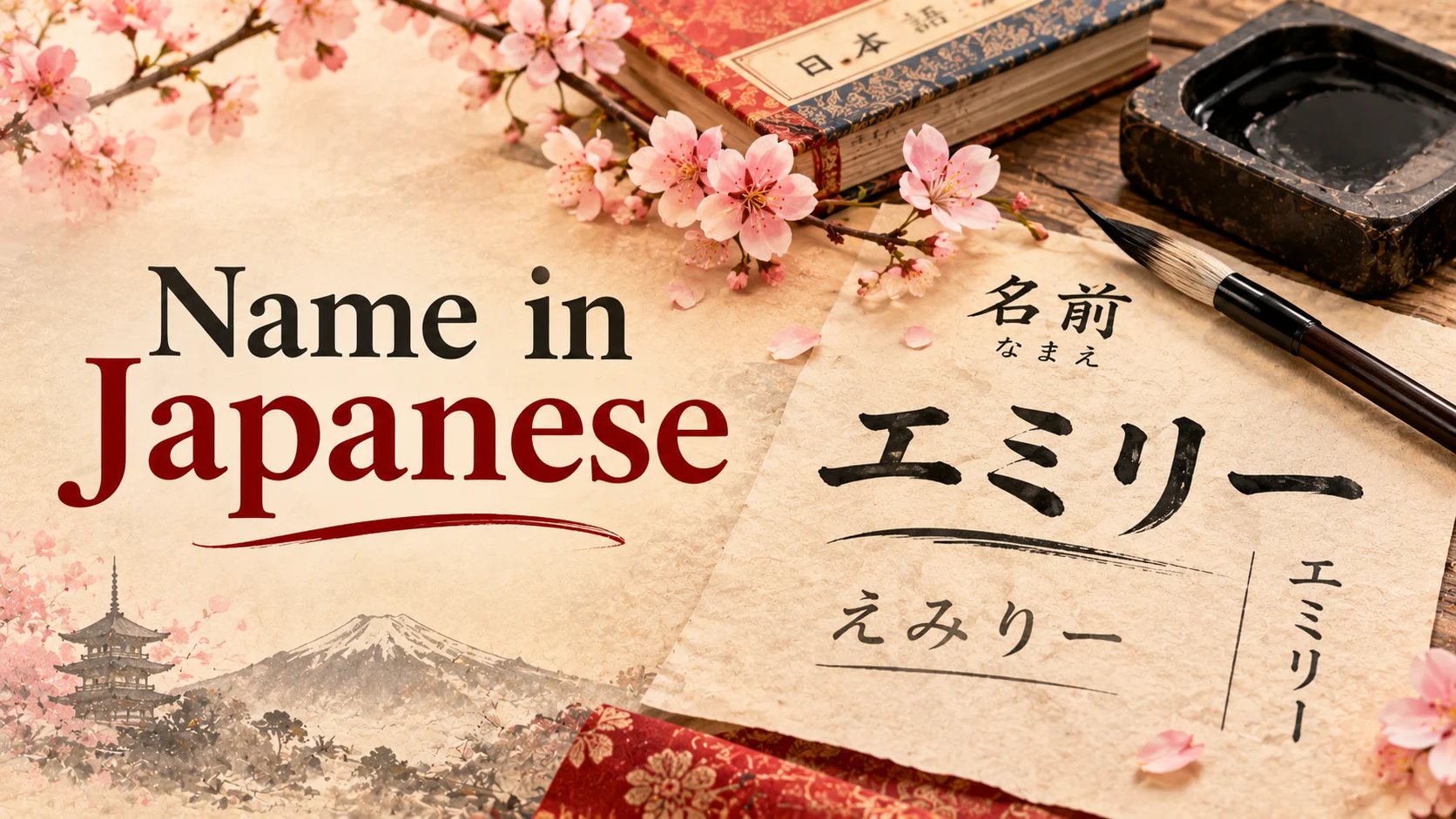
A name in Japanese is usually written using Japanese writing systems called Kanji, Hiragana, and Katakana. Japanese names traditionally use kanji, which can carry meanings such as beauty, strength, nature, wisdom, and happiness. Foreign names are generally written in katakana according to their pronunciation rather than translated word for word.
Japanese names have a fascinating connection to language, culture, identity, and symbolism. you want to write your own name in Japanese, understand Japanese naming traditions, or discover how Japanese characters represent different meanings, learning about Japanese names can help you appreciate this unique writing system.
This guide explains how names work in Japanese, how to write foreign names, the meanings of Japanese characters, traditional naming customs, and examples of popular Japanese names.
What Does Name in Japanese Mean?
The phrase name in Japanese refers to the way a person’s name is written, pronounced, or represented using the Japanese language and writing system. Foreign names are usually converted into katakana based on their pronunciation, while traditional Japanese names are commonly written using kanji characters.
For example:
- John → ジョン (Jon)
- Emma → エマ (Ema)
- Michael → マイケル (Maikeru)
- Sarah → サラ (Sara)
- David → デイビッド (Deibiddo)
Japanese names can also contain meaningful characters representing nature, beauty, kindness, strength, and other qualities. Understanding the difference between foreign-name transliteration and traditional Japanese naming makes it easier to write and interpret names correctly.
How Does the Japanese Writing System Work?
Japanese uses three primary writing systems: Kanji, Hiragana, and Katakana. Each has a different purpose, and all three play an important role in writing personal names.
El arte de memorizar mil kanji – Principia
【楽天市場】漢字用半紙「弥生」100枚パック入 書道用紙 機械漉半紙 因州和紙 書道 習字 書道半紙:パピルスボックス
7
1. Kanji (漢字)
Kanji are characters originally adapted from Chinese writing. Unlike the other two main Japanese scripts, kanji generally represent meanings as well as sounds.
Japanese parents often choose kanji for their children’s names because individual characters can express particular ideas or wishes.
Examples include:
| Kanji | Common meaning |
|---|---|
| 美 | Beauty |
| 愛 | Love |
| 花 | Flower |
| 桜 | Cherry blossom |
| 空 | Sky |
| 海 | Sea |
| 光 | Light |
| 優 | Kindness or gentleness |
| 勇 | Courage |
| 幸 | Happiness or good fortune |
A name may contain one or several kanji characters. However, the meaning of a complete name depends on the specific characters and how they are combined.
2. Hiragana (ひらがな)
Hiragana is a phonetic Japanese writing system. Its characters represent sounds rather than having individual dictionary meanings.
It is commonly used for grammatical elements, native Japanese words, and some personal names.
Examples:
- あ (a)
- い (i)
- う (u)
- え (e)
- お (o)
A name such as Sakura can be written as さくら in hiragana.
Hiragana gives names a soft, simple visual appearance and is sometimes selected when parents prefer a name without kanji.
3. Katakana (カタカナ)
Katakana is another phonetic Japanese writing system. It is commonly used for foreign words, loanwords, and personal names originating outside Japan.
If you want to write your English name in Japanese, katakana is generally the most appropriate choice.
Examples:
| English name | Japanese katakana |
|---|---|
| John | ジョン |
| Emily | エミリー |
| Daniel | ダニエル |
| Jessica | ジェシカ |
| Robert | ロバート |
| William | ウィリアム |
| Sophia | ソフィア |
| Alexander | アレクサンダー |
Katakana represents an approximation of the original pronunciation using Japanese sounds. It does not automatically translate the original name’s meaning.
How to Write Your Name in Japanese
Writing your name in Japanese is easier when you understand how Japanese sounds work. You do not need to learn thousands of kanji characters to write a foreign name.
Follow these simple steps.
Mastering Katakana: The Complete Guide for Japanese Language Learners – Japambience
Step 1: Identify Your Name’s Pronunciation
Start by identifying how your name is actually pronounced rather than relying only on its English spelling.
For example, the name Michael is commonly pronounced approximately as MY-kəl in English. Its Japanese katakana form is マイケル (Maikeru).
Different accents or pronunciations can sometimes produce different Japanese spellings.
Step 2: Break the Name Into Sounds
Japanese pronunciation generally uses combinations of vowels and consonant-vowel sounds.
The five basic Japanese vowels are:
| Japanese | Pronunciation |
|---|---|
| ア | A |
| イ | I |
| ウ | U |
| エ | E |
| オ | O |
For example, the English name Emma becomes E-ma in Japanese pronunciation:
Emma → エマ
Similarly:
Daniel → ダニエル
Step 3: Convert the Sounds Into Katakana
Once you identify the pronunciation, choose the katakana characters that most closely represent it.
Some English sounds do not have exact Japanese equivalents. Japanese spelling therefore uses the closest available sound combinations.
For instance:
- Chris → クリス
- Kevin → ケビン
- Lisa → リサ
- Peter → ピーター
- Olivia → オリビア
Step 4: Check the Final Pronunciation
Read the Japanese version aloud and compare it with your original name.
The result should sound reasonably close to your preferred pronunciation, although some differences are unavoidable.
Important: If you need a Japanese spelling for official paperwork, identification, or another formal purpose, check the required spelling with the relevant institution rather than relying on an informal online translation.
Japanese Name Meaning and Symbolism
Traditional Japanese names often have meanings connected to nature, positive qualities, seasons, and personal hopes.
The use of kanji makes Japanese naming particularly interesting because two people can have names with identical pronunciations but different written characters and meanings.
For example, a name can communicate a wish for happiness, beauty, wisdom, or strength through its selected kanji.
Here are some commonly encountered meaningful characters.
Cherry tree pink flowers background
上野の穴場スポット17選!地元民が教えるおすすめ観光名所も紹介 | NEWT(ニュート)
Summer in Japan: Your Seasonal Guide – Japan Travel
8
| Japanese character | Meaning | Symbolic association |
|---|---|---|
| 花 (Hana) | Flower | Beauty and growth |
| 桜 (Sakura) | Cherry blossom | Spring and renewal |
| 愛 (Ai) | Love | Affection |
| 美 (Mi) | Beauty | Elegance |
| 光 (Hikari) | Light | Hope and brightness |
| 海 (Umi) | Sea | Nature and openness |
| 雪 (Yuki) | Snow | Winter and purity |
| 空 (Sora) | Sky | Freedom and possibility |
| 幸 (Kō/Sachi, among other readings) | Happiness | Good fortune |
| 夢 (Yume) | Dream | Hope and ambition |
These are character meanings, not universal definitions of every personal name containing them. The reading and interpretation of a name depend on its complete written form.
Popular Japanese Names and Their Meanings
Japanese names come in many styles. Some are inspired by natural beauty, while others express personality traits, family hopes, or traditional values.
Below are examples of Japanese given names and common written forms.
Japanese Girl Names
Royalty-Free photo: Closeup photo of pink cherry blossoms | PickPik
1. Sakura (さくら / 桜)
Meaning: Cherry blossom. It is associated with spring, beauty, and renewal.
White cherry blossom in close up photography photo – Free Flower Image on Unsplash
2. Hana (はな / 花)
Meaning: Flower. It suggests natural beauty and growth.
3. Aoi (あおい)
Meaning: Depends on the kanji. Common associations include blue, hollyhock, and greenery.
福井の定番・有名・穴場・おすすめスポット33選【2026年度】|特集|福いろ|福井市公式観光サイト 名所/グルメ/お土産/イベント
4. Yui (ゆい)
Meaning: Depends on the chosen kanji; possible associations include connection and binding.
5. Akari (あかり)
Meaning: Light or brightness, depending on the written form.
Japanese Boy Names
Radiant Pink Lotus Flower Surrounded by Dense Green Leaves
1. Ren (れん / 蓮)
Meaning: Lotus when written as 蓮. It is also associated with the lotus flower’s beauty.
世界遺産・富士山の登山ルート解説と、おすすめ絶景スポット8選! | TABI CHANNEL
2. Haruto (はると)
Meaning: Depends on the kanji selected; different spellings can suggest sunlight, spring, or flight.
3. Sora (そら / 空)
Meaning: Sky. It can symbolize openness and freedom.
4. Itsuki (いつき)
Meaning: Depends on the kanji; some forms are associated with trees and nature.
15 Asian Garden Ideas to Create a Peaceful Outdoor Retreat
5. Daiki (だいき)
Meaning: Depends on the characters used; possible associations include greatness and brightness.
These examples demonstrate why Japanese names should not be interpreted from pronunciation alone. The same spoken name can have multiple kanji spellings.
Japanese Names for Foreign People
Foreign people living in Japan or interacting with Japanese speakers generally use their original names written in katakana.
For example, someone named Emma does not normally need to choose a Japanese name. They can simply use エマ when writing their name in Japanese.
Here are additional examples from different naming backgrounds.
| Original name | Japanese spelling | Romanized reading |
|---|---|---|
| Muhammad | ムハンマド | Muhannmado |
| Ahmed | アハメド | Ahemedo |
| Ali | アリ | Ari |
| Fatima | ファティマ | Fatima |
| Maria | マリア | Maria |
| James | ジェームズ | Jēmuzu |
| Noah | ノア | Noa |
| Isabella | イザベラ | Izabera |
| Daniel | ダニエル | Danieru |
| Ryan | ライアン | Raian |
Note: These are illustrative katakana approximations. The preferred spelling can vary according to the person’s actual pronunciation and established Japanese usage.
A foreign name does not have to be replaced with a traditional Japanese name. Keeping the original name in katakana is a normal and practical approach.
Japanese Name Order: First Name and Last Name
Japanese naming conventions traditionally place the family name before the given name.
This is different from the common Western convention, where the given name usually comes first.
For example:
- Western order: Ichiro Suzuki
- Traditional Japanese order: Suzuki Ichiro
Here, Suzuki is the family name, while Ichiro is the given name.
Some commonly encountered Japanese family names include:
- Sato (佐藤)
- Suzuki (鈴木)
- Takahashi (高橋)
- Tanaka (田中)
- Watanabe (渡辺)
- Ito (伊藤)
- Yamamoto (山本)
Many Japanese surnames contain kanji connected with geographical features, natural elements, or historical place descriptions.
In international communication, Japanese people may also present their names in Western order, depending on the context and personal preference. Japan Guide+1
Japanese Name Pronunciation: Understanding the Sounds
Pronunciation is an important part of converting names into Japanese. Japanese has a different sound structure from English, so certain consonants and consonant combinations are adapted.
For example, English has consonant combinations that Japanese does not commonly use as independent syllables.
Consider these examples:
| English sound/name | Japanese form |
|---|---|
| Tom | トム |
| Mark | マーク |
| Jack | ジャック |
| Steve | スティーブ |
| George | ジョージ |
| Kate | ケイト |
| Anna | アンナ |
| Lucy | ルーシー |
Why Does Japanese Pronunciation Sound Different?
There are several reasons:
- Vowel combinations: Japanese generally uses a more limited set of vowel sounds.
- Consonant endings: Many English consonant endings require an extra vowel when represented in Japanese.
- Long vowels: Some Japanese spellings use a long-vowel mark (ー) to represent extended vowel sounds.
- Sound differences: Certain English consonants have no exact Japanese equivalent.
For example, the name Mark becomes マーク (Māku), while Jack becomes ジャック (Jakku).
This is why translating a name into Japanese is more accurately described as phonetic transliteration rather than literal translation.
Kanji vs. Hiragana vs. Katakana: What Is the Difference?
Although all three writing systems are used in Japanese, they serve different purposes.
| Feature | Kanji | Hiragana | Katakana |
|---|---|---|---|
| Main function | Meaning and sound | Phonetic writing | Phonetic writing |
| Appearance | Complex characters | Rounded characters | Angular characters |
| Foreign names | Not the usual choice | Sometimes used | Standard choice |
| Japanese names | Very common | Also used | Also possible |
| Example | 桜 | さくら | サクラ |
The most important distinction is that kanji can communicate meaning, while hiragana and katakana primarily represent pronunciation.
The Japanese government also publishes guidance on the use of these writing systems, including the representation of foreign personal names. 文化庁+1
Japanese Naming Traditions and Cultural History
Japanese naming traditions have developed over many centuries. They reflect changes in language, family structures, cultural values, and social preferences.
The Historical Influence of Kanji
Kanji entered Japanese writing through historical contact with Chinese culture. Japanese speakers adapted these characters to represent their own language.
Over time, kanji became an important part of Japanese personal naming. Parents could select characters based on their meanings, sounds, and visual appearance.
The Importance of Meaning
Many Japanese parents consider the meanings of the characters when choosing a child’s name.
For example:
- 愛 represents love.
- 美 represents beauty.
- 勇 represents courage.
- 光 represents light.
- 幸 represents happiness.
These characters can express positive wishes for a child’s future.
Modern Japanese Naming Practices
Modern Japanese naming practices include both traditional and creative approaches.
Some parents begin by choosing the sound of a name and then select kanji that fit the desired pronunciation and meaning. Others prefer familiar kanji combinations or names written in hiragana.
The pronunciation and appearance of a name are both important considerations. MDPI+2
Can You Translate Your Name Into Japanese Kanji?
Yes, it is possible to create a kanji-based representation of a foreign name in some contexts, but it requires care.
Kanji characters have particular meanings and multiple possible readings. Simply choosing characters that resemble the sounds of an English name does not guarantee that Japanese readers will understand or pronounce the result as intended.
For example, a person named Lily might want a Japanese-style representation using characters associated with flowers. However, selecting a character associated with a flower does not automatically make it a standard Japanese spelling of Lily.
There are two different approaches:
1. Phonetic representation: Write the original name in katakana, preserving its approximate pronunciation.
2. Creative kanji representation: Select characters for their meanings or sounds to create an artistic interpretation.
The first approach is suitable for ordinary communication. The second is a creative naming exercise and should not be mistaken for an established Japanese translation.
For official or legal naming purposes, follow the applicable rules rather than inventing a kanji spelling.
Examples of Names Written in Japanese Sentences
Understanding how names appear in everyday Japanese can help you use them naturally.
Here are some simple examples:
1. My name is Emma.
私の名前はエマです。
Watashi no namae wa Ema desu.
2. My name is John.
私の名前はジョンです。
Watashi no namae wa Jon desu.
3. What is your name?
お名前は何ですか?
Onamae wa nan desu ka?
4. Nice to meet you.
はじめまして。
Hajimemashite.
5. I am Sarah.
私はサラです。
Watashi wa Sara desu.
These examples show how katakana names can be included in ordinary Japanese sentences.
Why Do Japanese Names Have Different Kanji Spellings?
Japanese has many characters with similar or identical pronunciations. Consequently, a spoken name does not always reveal how it is written.
For example, two people named Yuki may have different kanji spellings. One might use 雪, meaning snow, while another might use 幸, associated with happiness.
Similarly, a name can have multiple possible readings depending on the characters chosen.
This is why asking someone how their name is written is often more reliable than guessing its kanji from pronunciation.
Some Japanese names also use special name readings known as nanori. These are readings associated particularly with personal names and may not be obvious from ordinary dictionary pronunciations. Behind the Name+1
Important Things to Know Before Using a Japanese Name
If you want to use your name in Japanese for personal, educational, or creative purposes, remember these points:
- Use katakana for the usual representation of foreign names.
- Check pronunciation before converting an English name.
- Do not assume that every Japanese character has a matching English name meaning.
- Remember that kanji combinations can have different readings.
- Ask a Japanese speaker to verify an unfamiliar spelling.
- Use your established official spelling when completing formal documents.
- Treat decorative kanji translations as creative interpretations rather than standard translations.
Japanese names are not simply English names written with different letters. Their spelling and pronunciation follow a distinct linguistic and cultural system.
FAQs
1. How do I write my name in Japanese?
Write your name in katakana based on its pronunciation. For example, Emma becomes エマ.
2. What Japanese alphabet is used for foreign names?
Katakana is the standard writing system for most foreign personal names in Japanese.
3. Can I write my name in Japanese kanji?
You can create a creative kanji representation, but it may not be a standard or natural Japanese spelling.
4. What is the difference between kanji and hiragana?
Kanji characters generally express meaning and sound, while hiragana represents pronunciation.
5. How do I find my Japanese name?
Identify your name’s pronunciation and convert it into suitable katakana characters.
6. Do Japanese names have meanings?
Yes. Many Japanese names use kanji characters with meanings connected to nature, beauty, happiness, and other positive qualities.
7. Is Japanese written from left to right?
Japanese can be written horizontally from left to right or vertically from top to bottom, with vertical text traditionally progressing from right to left.
8. Can two people have the same Japanese name?
Yes. Different people can share the same pronunciation or kanji spelling, while some people with identical pronunciations have different kanji.
Conclusion
Writing your name in Japanese is a simple way to explore the Japanese language and its beautiful writing systems. Foreign names are generally written in katakana, while traditional Japanese names often use kanji to express meanings connected to beauty, nature, happiness, love, and strength. Hiragana is another option for representing names phonetically.
you want to write your name in Japanese letters, understand Japanese name meanings, or explore traditional naming customs, learning the differences between kanji, hiragana, and katakana will help you get started. Remember that pronunciation matters, and a Japanese spelling should represent the way you actually say your name.
Discover More Related Articles:
- Name Calculator | Discover Your Name Number, Meaning & Numerology in 2026
- Charlie Kirk’s Book Stop in the Name of God | Meaning, Summary & Key Lessons In 2026
- Lina Name Meaning | Origin, History, & Cultural Significance In 2026