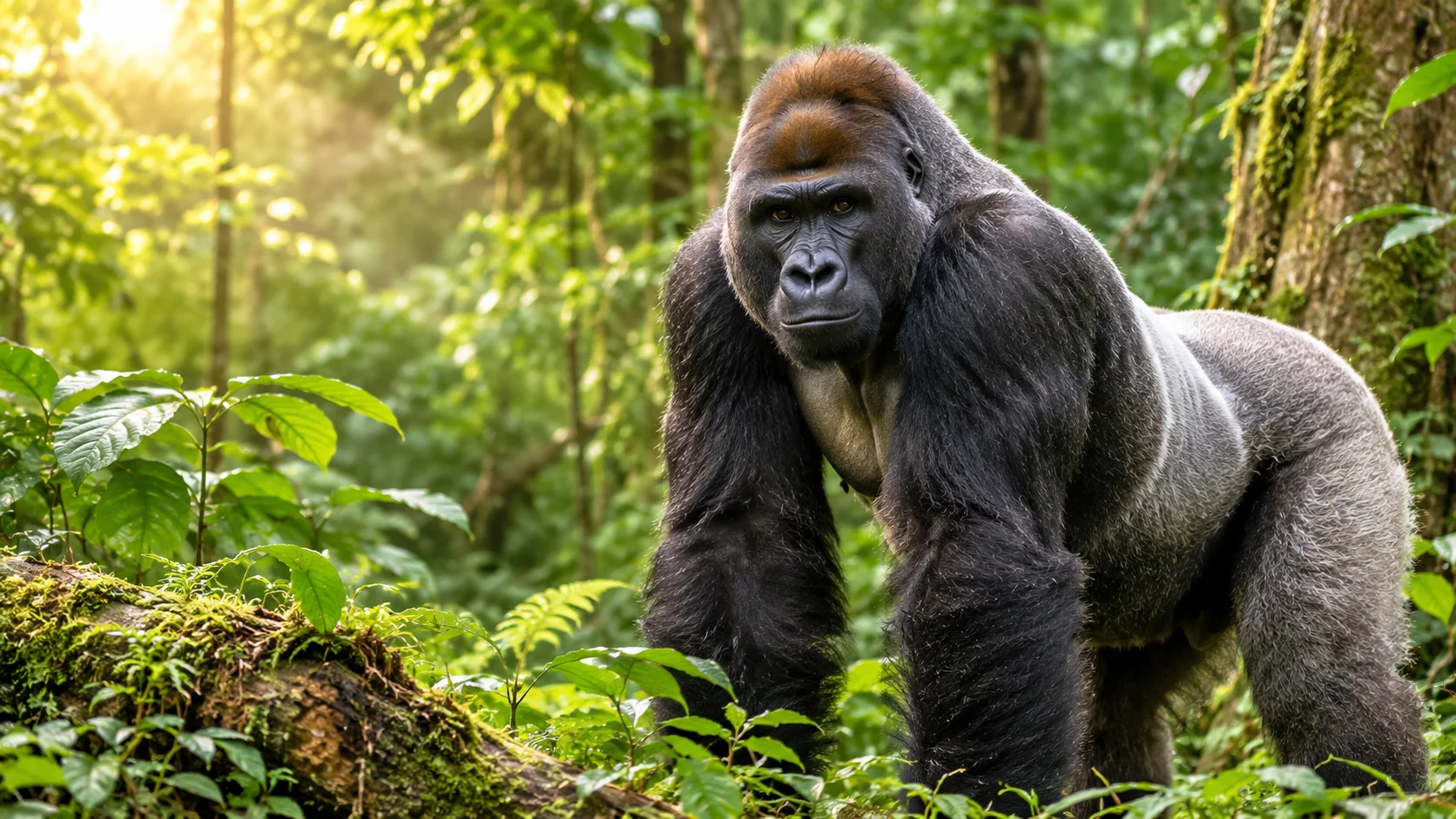
The scientific name of the gorilla genus is Gorilla. The two living gorilla species are the western gorilla (Gorilla gorilla) and the eastern gorilla (Gorilla beringei). Both belong to the great ape family Hominidae and are native to equatorial Africa.
Gorillas are among the largest living primates and are closely related to humans, chimpanzees, and bonobos. Their scientific classification helps researchers distinguish between different gorilla species, understand their evolutionary relationships, and study their behavior, anatomy, and natural habitats.
Although people often use the expression “gorilla scientific name” to ask for one biological name, there are actually two recognized living species. Each species also contains two generally recognized subspecies.
In this article, we explore the scientific name of gorillas, their taxonomy, different species, physical characteristics, habitats, and conservation importance.
What Is the Scientific Name of a Gorilla?
The scientific name of the gorilla genus is Gorilla. However, the scientific name depends on which species is being discussed.
The two living species are:
- Western gorilla (Gorilla gorilla): Found primarily in the forests of western and central equatorial Africa.
- Eastern gorilla (Gorilla beringei): Found in parts of central and eastern Africa, including mountainous and lowland forest habitats.
The word Gorilla identifies the genus, while the second word identifies the species in the scientific binomial name.
For example, Gorilla gorilla refers to the western gorilla, whereas Gorilla beringei refers to the eastern gorilla.
This distinction is important because the general word “gorilla” describes members of the genus, not just one particular species.
Gorilla Scientific Name and Biological Classification
Biological classification organizes living organisms into groups according to shared characteristics and evolutionary relationships.
Gorillas belong to the order Primates, which includes monkeys, lemurs, and apes. They are members of the family Hominidae, commonly known as the great ape family.
Here is the scientific classification of gorillas:
| Taxonomic Rank | Classification |
|---|---|
| Kingdom | Animalia |
| Phylum | Chordata |
| Class | Mammalia |
| Order | Primates |
| Suborder | Haplorhini |
| Infraorder | Simiiformes |
| Family | Hominidae |
| Subfamily | Homininae |
| Crew | Gorillini |
| Genus | Gorilla |
| Species | Gorilla gorilla / Gorilla beringei |
The classification shows that gorillas are mammals, primates, and great apes.
Their closest living relatives are chimpanzees and humans, although gorillas belong to a separate evolutionary lineage.
10. The Two Main Species of Gorillas
Scientists generally recognize two living gorilla species: western gorillas and eastern gorillas. Each species has two recognized subspecies, making four commonly recognized gorilla subspecies in total. Gorilla Agreement+2
1. Western Gorilla (Gorilla gorilla)
Western lowland gorilla male silverback walking
Creating a New Sanctuary for the Cross River Gorilla – Rainforest Trust
Western lowland gorilla dominant male silverback ‘Makumba’ aged 32 years head and shoulders portrait
8
The western gorilla lives mainly in the tropical forests of western and central equatorial Africa. It is generally divided into two subspecies:
- Western lowland gorilla (Gorilla gorilla gorilla): The more widespread and numerous western subspecies, found in countries including Gabon, Cameroon, and the Republic of the Congo.
- Cross River gorilla (Gorilla gorilla diehli): A rare subspecies living in a restricted forest region along the Nigeria–Cameroon border.
Western gorillas are known for their broad chests, strong arms, dark fur, and complex social behavior. They spend much of their time feeding on vegetation, fruit, and other available plant foods. UN-GRASP+2
2. Eastern Gorilla (Gorilla beringei)
Mountain gorilla male Silverback sitting portrait
Virunga, DRC – Conservation under fire — Brent Stirton
10
The eastern gorilla is the second recognized gorilla species. It inhabits parts of eastern Central Africa, particularly the Democratic Republic of the Congo, Uganda, and Rwanda.
It also has two recognized subspecies:
- Mountain gorilla (Gorilla beringei beringei): Lives in high-altitude forests in the Virunga Mountains and the Bwindi region of Uganda.
- Grauer’s gorilla (Gorilla beringei graueri): Also called the eastern lowland gorilla, it lives in forested areas of the eastern Democratic Republic of the Congo.
Eastern gorillas are generally larger and have darker coats than western gorillas, although appearance varies among individuals and populations. Mountain gorillas are particularly associated with cool, mountainous forest environments. The APES Atlas+2
Difference Between the Four Gorilla Subspecies
The four gorilla subspecies have distinct scientific names, geographical ranges, and environmental adaptations.
| Gorilla Subspecies | Scientific Name | Main Habitat |
|---|---|---|
| Western lowland gorilla | Gorilla gorilla gorilla | Western and central African forests |
| Cross River gorilla | Gorilla gorilla diehli | Nigeria–Cameroon border forests |
| Mountain gorilla | Gorilla beringei beringei | Mountain forests of Uganda, Rwanda, and DR Congo |
| Grauer’s gorilla | Gorilla beringei graueri | Eastern DR Congo forests |
These names are useful in zoology, wildlife research, conservation programs, and scientific publications because they identify gorilla populations more precisely than the general term “gorilla.”
Origin and Meaning of the Scientific Name Gorilla
The word Gorilla has an interesting historical background.
The name was recorded in 1847 by American physician and missionary Thomas Staughton Brutal , who described the western gorilla using the scientific name Troglodytes gorilla. The animal was later placed in the separate genus Gorilla, established by French zoologist Isidore Geoffroy Saint-Hilaire in 1852. Report: Gorilla+1
The name is traditionally connected with the Greek word Gorillai. In an ancient account by Carthaginian explorer Hanno, this term was used for hairy, wild people encountered during an expedition along the African coast.
However, the historical account does not establish that the creatures described were definitely modern gorillas. The connection explains the history of the word rather than providing a literal biological meaning.
What Does Gorilla gorilla Mean?
The scientific name Gorilla gorilla follows the binomial naming system.
- Gorilla: The genus name.
- gorilla: The species name or specific epithet.
Together, these two words identify the western gorilla as a distinct species.
The eastern gorilla has a different scientific name: Gorilla beringei. The name beringei honors German explorer Friedrich Robert von Beringe, who collected specimens associated with the eastern gorilla’s scientific description.
History of Gorilla Classification
Gorilla classification has developed as scientists have gained more knowledge about their anatomy, geographical distribution, and genetics.
Early Scientific Descriptions
In 1847, Thomas Staughton Brutal and naturalist Jeffries Wyman published an early scientific description of the western gorilla. At the time, it was called Troglodytes gorilla.
Later, the gorilla was assigned to its own genus, Gorilla, separating it from other great apes in scientific classification.
Recognition of Eastern Gorillas
In 1903, German zoologist Paul Matschie described the eastern gorilla and gave it the scientific name Gorilla beringei.
For many years, eastern and western gorillas were sometimes classified differently. However, anatomical and genetic research supported recognizing them as separate species.
Modern Gorilla Taxonomy
Modern classification generally recognizes two living gorilla species and four subspecies.
Genetic research has helped scientists understand how western and eastern gorilla populations differ and how their evolutionary histories developed. This classification is important for studying biodiversity and protecting genetically distinct populations. ielc.libguides.com+2
Physical Characteristics of Gorillas
Virunga, DRC – Conservation under fire — Brent Stirton
Gorillas are the largest living primates. They have powerful bodies, long muscular arms, broad shoulders, and relatively small ears.
Some of their most recognizable physical characteristics include:
- Strong bodies: Gorillas have muscular shoulders, chests, and arms.
- Dark fur: Most gorillas have dark brown or blackish fur.
- Large hands: Their hands are adapted for grasping objects, climbing, and moving through forest environments.
- Distinctive faces: Gorillas have expressive faces with prominent brow ridges and broad nostrils.
- Silverback hair: Mature males often develop silver-gray hair across their backs, which gives them the familiar name silverback.
Adult males are generally considerably larger than females. Their size and physical strength help them perform important roles within their social groups.
Habitat and Geographical Distribution
Gorillas are native to equatorial Africa. Their natural environments include tropical rainforests, mountain forests, swamp forests, and other forest habitats.
The two species occupy different geographical regions.
Western gorilla habitat:
- Cameroon
- Gabon
- Republic of the Congo
- Equatorial Guinea
- Central African Republic
- Nigeria, in the Cross River region
Eastern gorilla habitat:
- Democratic Republic of the Congo
- Uganda
- Rwanda
Mountain gorillas live in high-altitude forest environments, while western lowland gorillas generally inhabit tropical lowland forests.
Gorilla habitats provide food, shelter, nesting materials, and protection. However, habitat destruction and human activities continue to threaten several populations. UN-GRASP+2
Diet and Feeding Habits
Gorillas are primarily herbivorous animals. Their diets consist mainly of plant materials, although the exact foods they consume depend on their species, habitat, and seasonal availability.
Common foods include:
- Leaves
- Stems
- Shoots
- Fruits
- Bamboo
- Roots
- Bark
- Flowers
Some gorillas also consume small invertebrates occasionally.
Western lowland gorillas generally eat more fruit when it is available, while mountain gorillas consume substantial amounts of leaves, stems, and other vegetation.
Their feeding habits play an important role in forest ecosystems. By consuming fruits and dispersing seeds, gorillas can contribute to the natural regeneration of forests. UN-GRASP+1
Gorilla Behavior and Social Structure
Gorillas are social animals that usually live in family groups called troops.
A typical group may include:
- One dominant adult male, known as a silverback.
- Several adult females.
- Young gorillas and infants.
The silverback generally provides leadership and protection for the group. He helps coordinate movement, responds to potential threats, and plays an important role in maintaining group relationships.
Gorillas communicate through vocalizations, facial expressions, body movements, and physical interactions.
Although their large size can make them appear intimidating, gorillas are generally peaceful animals when undisturbed. They usually prefer avoiding conflict rather than fighting.
Gorilla vs. Chimpanzee: What Is the Difference?
Gorillas and chimpanzees are both great apes, but they belong to different genera and have different physical and behavioral characteristics.
| Feature | Gorilla | Chimpanzee |
|---|---|---|
| Scientific genus | Gorilla | Pan |
| Species | G. gorilla, G. beringei | P. troglodytes, P. paniscus |
| Family | Hominidae | Hominidae |
| Body size | Generally larger | Generally smaller |
| Social structure | Groups often led by a silverback | Communities with complex social relationships |
| Diet | Primarily plant-based | Omnivorous |
| Native region | Equatorial Africa | Tropical Africa |
Both animals are intelligent great apes and share a common evolutionary ancestor with humans. However, gorillas and chimpanzees developed along separate evolutionary branches.
Why Is the Scientific Name of a Gorilla Important?
Scientific names are important because common animal names can vary between languages and geographical regions.
The scientific name provides a standardized way to identify a species internationally.
For example, someone studying gorillas in Uganda and another researcher studying them in the Democratic Republic of the Congo can use scientific names to identify the same species or distinguish different subspecies.
Scientific classification is especially important for:
- Wildlife research: Helps scientists study gorilla anatomy, genetics, behavior, and evolution.
- Conservation: Allows conservationists to identify threatened species and subspecies.
- Education: Provides accurate biological information for students and researchers.
- Biodiversity: Helps document differences between animal populations.
- International communication: Makes animal identification more consistent across countries and languages.
The scientific name Gorilla therefore represents more than a biological label. It connects gorillas to their evolutionary history and their place in the animal kingdom.
Conservation Status of Gorillas
Gorillas face several threats in their natural environments. Habitat loss, illegal hunting, disease, and human conflict can negatively affect their populations.
According to the conservation assessments commonly referenced by wildlife organizations, the two gorilla species face serious extinction risks.
- Western gorillas are classified as Critically Endangered.
- Eastern gorillas are classified as Critically Endangered.
- Mountain gorillas, a subspecies of eastern gorilla, are classified as Endangered.
These distinctions matter because conservation status can differ between a species and its individual subspecies. WWF+2
Conservation organizations work to protect gorillas through habitat preservation, anti-poaching programs, scientific monitoring, veterinary care, and community education.
Protecting gorillas also helps preserve the wider forest ecosystems in which they live.
Interesting Facts About Gorillas
Here are some interesting facts about gorillas and their scientific classification:
- Gorillas are the largest living primates.
- Their scientific genus name is Gorilla.
- There are two recognized living gorilla species.
- The western gorilla is scientifically named Gorilla gorilla.
- The eastern gorilla is scientifically named Gorilla beringei.
- Scientists generally recognize four gorilla subspecies.
- Mature male gorillas often develop silver-colored hair on their backs.
- Gorillas are native to equatorial Africa.
- They are members of the great ape family Hominidae.
- Gorillas use vocalizations, facial expressions, and body language to communicate.
These facts demonstrate why gorillas are important subjects in zoology, evolutionary biology, and wildlife conservation.
FAQs
1. What is the scientific name of a gorilla?
The gorilla genus is called Gorilla. Its two living species are Gorilla gorilla (western gorilla) and Gorilla beringei (eastern gorilla).
2. What is the scientific name of a western gorilla?
The scientific name of the western gorilla is Gorilla gorilla, and its two subspecies are the western lowland and Cross River gorillas.
3. What is the scientific name of an eastern gorilla?
The eastern gorilla is scientifically known as Gorilla beringei, which includes mountain and Grauer’s gorillas.
4. What is the scientific name of a mountain gorilla?
The mountain gorilla’s scientific name is Gorilla beringei beringei, a subspecies of the eastern gorilla.
5. How many species of gorillas exist?
Scientists generally recognize two living species: western gorillas and eastern gorillas, with four recognized subspecies.
6. What family do gorillas belong to?
Gorillas belong to the family Hominidae, which also includes humans, chimpanzees, and orangutans.
7. Where do gorillas live naturally?
Gorillas live in equatorial Africa, inhabiting tropical rainforests, lowland forests, and mountainous forest regions.
8. Are gorillas monkeys or apes?
Gorillas are great apes, not monkeys, and they belong to the primate order.
Conclusion
The scientific name of the gorilla genus is Gorilla, which includes two living species: the western gorilla (Gorilla gorilla) and the eastern gorilla (Gorilla beringei). Each species has two recognized subspecies, including the western lowland, Cross River, mountain, and Grauer’s gorillas. These classifications help scientists understand their biological differences, evolutionary relationships, and geographical distribution.
Gorillas are remarkable great apes that play an important role in African forest ecosystems. Learning their scientific names and classifications helps us appreciate their biodiversity and the importance of protecting their natural habitats. Conservation efforts are essential to ensure that these magnificent animals survive for future generations.
Discover More Related Articles:
- Franklin Name Meaning | Origin, History & History Behind the Name in 2026
- Frank Name Meaning | Origin, History & Significance In 2026
- Archer Name Meaning| Origin, History, Symbolism & Significance in 2026