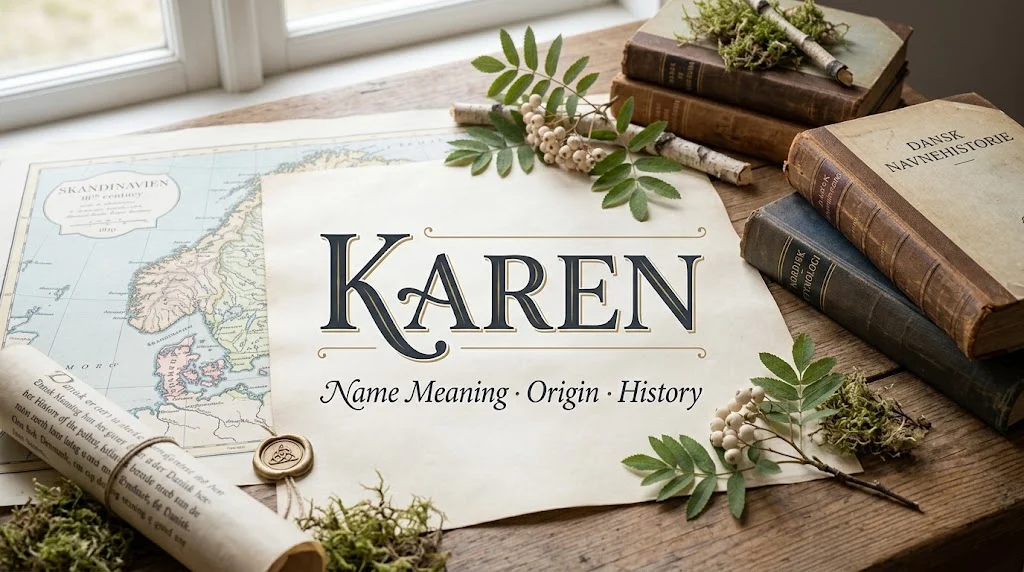
The Karen name meaning is commonly given as “pure” or “clear,” because Karen is traditionally understood as a Scandinavian form of Katherine/Catherine. The deeper etymology of Katherine is uncertain, although the association with “pure” became firmly established through Christian naming traditions.
The name Karen has a long history across Scandinavian and English-speaking cultures. It is especially associated with Danish and Norwegian naming traditions, where it developed as a form of Katherine. Over time, Karen became an established given name in its own right and spread well beyond Scandinavia.
This guide explores the Karen name meaning, its etymology, history, pronunciation, cultural associations, variants, and modern usage.
What Is the Name Karen?
Karen is traditionally a feminine given name and a Scandinavian form of Katherine or Catherine. It is particularly associated with Danish and Norwegian usage, although the name has also been widely used in English-speaking countries.
The name is often connected with the traditional meaning “pure.” This meaning comes through the long-standing interpretation of Katherine, rather than from a completely certain literal translation of an undisputed ancient root.
Karen therefore belongs to a large family of related names that includes:
- Katherine
- Catherine
- Katharine
- Karin
- Katerina
- Katarina
- Katrine
- Kathrine
- Karenina, in some naming traditions
Although these names share historical connections, their exact forms and usage differ according to language and culture.
Karen Name Meaning
The most commonly reported Karen name meaning is “pure.”
This interpretation is traditionally associated with Katherine and its related forms. The name has therefore acquired positive symbolic associations such as:
- Purity
- Innocence
- Clarity
- Grace
- Simplicity
- Moral character
It is important, however, to distinguish between a traditional name meaning and a completely certain linguistic etymology.
The ancient origin of the name Katherine is debated. One traditional explanation connects it with the Greek word katharos, meaning “pure,” but historical linguists have not established this as an unquestionably proven etymology. Even so, the “pure” interpretation became extremely influential and is the meaning most commonly associated with Katherine and its many forms, including Karen.
What Does Karen Mean?
In everyday name references, Karen is generally understood to mean “pure.”
The name’s connection with Katherine gives it a traditional rather than purely modern meaning. Its long history also means that its cultural associations can differ depending on the country and period in which it is used.
Karen Name Origin and Etymology
The Karen name origin is generally traced through Scandinavian forms of Katherine.
Karen is particularly associated with Danish and Norwegian naming traditions. It developed as a regional form related to Katherine, a name that has a much older history and numerous forms across Europe.
The broader name family includes Greek, Latin, and European linguistic stages, although the exact earliest etymology of Katherine remains uncertain.
A simplified development can be represented as:
Katherine/Catherine → Scandinavian forms → Karen
This should not be understood as a single perfectly documented linguistic chain in every historical period. Names changed in different ways across regions, and medieval naming traditions often produced several parallel forms.
Is Karen a Scandinavian Name?
Yes. Karen is strongly associated with Scandinavian naming traditions, particularly Danish and Norwegian usage.
It is also used outside Scandinavia, especially in English-speaking countries. Because of this, Karen can be described as both a Scandinavian name and an internationally recognized given name.
History of the Name Karen
Karen’s history is closely connected with the wider European history of Katherine and Catherine.
Katherine became an important Christian name through the influence of Saint Catherine of Alexandria, a figure who became widely venerated in medieval Christianity. As Christian naming traditions spread across Europe, different languages developed their own forms of the name.
In Scandinavia, forms such as Karen and Karin became established.
This pattern was common in European naming history. A name could travel from one language community to another while changing its spelling and pronunciation. The resulting forms could eventually become independent traditional names within particular cultures.
Karen therefore represents more than a simple modern spelling. It reflects the way European names evolved through:
- Language change
- Christian traditions
- Regional pronunciation
- Medieval naming practices
- Scandinavian cultural usage
Karen in Scandinavian Culture
The name Karen has a particularly strong historical presence in Scandinavian countries.
In Denmark and Norway, Karen developed as a familiar feminine form associated with Katherine. Related forms such as Karin became especially recognizable in Swedish contexts.
These regional differences show how the same underlying name family can take distinct forms across closely related languages.
For example:
| Name | Common association |
|---|---|
| Karen | Danish/Norwegian and broader international usage |
| Karin | Swedish and other Scandinavian usage |
| Katrine | Danish/Norwegian form |
| Kathrine | Scandinavian form |
| Katherine | English and broader international usage |
| Catherine | English/French and international usage |
| Katarina | Several European and Slavic-language traditions |
The names are related, but they should not be treated as completely interchangeable in every cultural context.
Karen Pronunciation
In English, Karen is commonly pronounced:
KAIR-en
The first syllable sounds similar to “care,” followed by a short unstressed “en.”
Pronunciation can vary slightly according to accent and language. In Scandinavian languages, the pronunciation may differ from the common English pronunciation.
For parents choosing the name, its relatively simple spelling and pronunciation are among its practical advantages.
Is Karen a Biblical Name?
Karen is not a biblical name in its own original form.
It is a Scandinavian form related to Katherine/Catherine, and Katherine itself is not generally considered a biblical personal name.
However, the Katherine name family became deeply connected with Christian history, particularly through saints and European Christian traditions.
This distinction is useful:
- Biblical name: A personal name appearing in the Bible.
- Christian traditional name: A name that became established through Christian history, saints, or religious traditions.
- Karen: A Scandinavian form associated with the Christian European Katherine tradition.
So Karen has a strong historical Christian-cultural connection without being a biblical name itself.
Karen and the Meaning of Purity
The association between Karen and purity is one of the most recognizable aspects of the name.
Purity can be interpreted in several ways when discussing name symbolism. It does not necessarily refer only to innocence. In naming traditions, symbolic purity can suggest:
- A clear heart
- Sincerity
- Integrity
- Cleanliness
- Simplicity
- Good intentions
These are symbolic associations, not personality predictions. A name does not scientifically determine someone’s character.
For parents interested in name symbolism, however, “pure” gives Karen a gentle and traditional quality.
Karen Name Variants
Because Karen belongs to the Katherine/Catherine family, it has many related forms.
Some of the most recognizable include:
Katherine — A traditional English form.
Catherine — A widely used English and French-associated form.
Katharine — A historical spelling variant of Katherine.
Karin — A Scandinavian form closely related to Karen.
Katrine — A Scandinavian form related to Katherine.
Kathrine — Another Scandinavian spelling.
Katarina — A form found in several European naming traditions.
Katerina — A form used in various languages and cultures.
These forms demonstrate how names adapt as they move between languages.
Karen Nicknames and Short Forms
Karen is already relatively short, so it does not require a nickname.
Possible informal forms may include:
- Kari
- Kare
- Kary
- Ren
However, nickname preferences are personal and vary greatly between families and cultures. Some people named Karen may use the full name throughout their lives.
Because Karen has only five letters and two syllables, it also works naturally as a complete name without needing a shortened form.
Karen as a Baby Name
Parents considering Karen may be attracted to its:
- Classic European background
- Scandinavian connection
- Simple spelling
- Easy pronunciation
- Traditional feminine character
- Association with purity
- Long history
Karen also has an interesting generational quality. It has been particularly prominent in certain periods and regions, so its perceived style can vary depending on where and when it is encountered.
A name can move in and out of fashion without losing its historical significance. Karen’s long-established presence gives it a recognizable identity independent of current naming trends.
Is Karen an Old-Fashioned Name?
Karen can sometimes sound traditional or vintage, especially in places where it was particularly popular among earlier generations.
That does not make it historically outdated. Many established names experience periods of greater and lesser popularity.
Karen has several qualities that can appeal to parents looking for a classic name:
- It is short.
- It has a clear pronunciation.
- It has European roots.
- It belongs to a historically established name family.
- It has a straightforward spelling.
It sounds old-fashioned depends heavily on the country, generation, and cultural context.
Karen in Modern Culture
The name Karen has acquired an additional cultural association in contemporary English-language internet culture.
In particular, **“Karen” has sometimes been used as a slang stereotype for a person—usually a woman—portrayed as demanding, entitled, or excessively confrontational, especially toward service workers or other people in public situations.
This modern slang meaning is separate from the historical meaning and etymology of the personal name.
It is important not to confuse the two. The traditional name Karen developed through Scandinavian naming history and its connection with Katherine. The modern slang usage is a much more recent cultural development.
Because of this contemporary association, the social perception of the name can vary considerably by country and generation.
Karen vs. Katherine vs. Karin
Karen, Katherine, and Karin are closely related names, but they have different linguistic and cultural identities.
| Name | Main association | Relationship |
|---|---|---|
| Karen | Danish, Norwegian, international | Scandinavian form related to Katherine |
| Karin | Swedish and Scandinavian | Related Scandinavian form |
| Katherine | English and international | Major traditional form |
| Catherine | English/French and international | Related form of Katherine |
The important distinction is that these names belong to the same broader historical family while developing their own regional identities.
What Does the Name Karen Symbolize?
Based on its traditional association with “pure,” Karen can symbolically represent:
Purity: The most established traditional interpretation.
Clarity: A modern symbolic extension of purity and clearness.
Grace: Its connection with a long-established European Christian name family can give it a graceful, traditional character.
Simplicity: The short spelling and uncomplicated pronunciation make Karen feel straightforward and accessible.
Tradition: Its Scandinavian history and connection with Katherine give it a strong historical foundation.
These are cultural and symbolic interpretations rather than claims about the personality of every person named Karen.
Examples of Karen in Use
Karen works naturally as a first name in different naming styles.
For example:
- Karen Elizabeth — a traditional combination.
- Karen Louise — a classic European-style pairing.
- Karen Marie — a simple, established combination.
- Karen Sophia — a more contemporary combination.
- Karen Elise — a name pairing with a Scandinavian feel.
The name can also appear in historical, literary, professional, and everyday contexts.
Example sentence:
Karen chose the traditional name because of its Scandinavian background and association with purity.
Another example:
The family selected Karen to honor a Scandinavian grandmother.
Is Karen a Good Name?
Karen is a good name is ultimately a personal choice, but it has several objective qualities that may appeal to different families.
It has a well-established European history, a recognizable pronunciation, and a connection with the extensive Katherine/Catherine name family.
Parents who value historical names may appreciate its Scandinavian roots, while those looking for a short name may like its simple structure.
One factor modern parents may want to consider is the contemporary slang association attached to Karen in some English-speaking communities. This association is unrelated to the name’s traditional etymology but may influence how the name is perceived today.
The Meaning of Karen at a Glance
| Attribute | Detail |
|---|---|
| Name | Karen |
| Gender association | Traditionally feminine |
| Primary origin | Scandinavian |
| Strong regional associations | Danish and Norwegian |
| Related name | Katherine/Catherine |
| Traditional meaning | “Pure” |
| Pronunciation | Common English: KAIR-en |
| Name type | Feminine given name |
| Related forms | Karin, Katrine, Kathrine, Katherine, Catherine, Katarina |
| Biblical name? | No, not in its original form |
| Traditional cultural connection | European Christian naming tradition |
FAQs
What does the name Karen mean?
Karen is traditionally associated with the meaning “pure,” through its connection with Katherine and Catherine.
Where does the name Karen come from?
Karen is primarily associated with Scandinavian naming traditions, especially Danish and Norwegian usage.
Is Karen a Scandinavian name?
Yes. Karen is strongly associated with Scandinavian languages and is traditionally regarded as a Scandinavian form related to Katherine.
Is Karen a biblical name?
No. Karen is not a biblical name itself, although its related Katherine/Catherine tradition has a long history in Christian Europe.
How do you pronounce Karen?
In common English pronunciation, Karen is usually pronounced KAIR-en, with slight variations depending on accent.
What names are related to Karen?
Related forms include Karin, Katrine, Kathrine, Katherine, Catherine, Katarina, and Katerina.
Does Karen mean pure?
Yes, “pure” is the traditional meaning commonly associated with Karen, although the deeper etymology of Katherine is historically debated.
Is Karen an old-fashioned name?
Karen can sound traditional or vintage in some cultures because of its popularity in earlier generations, but it remains a historically established name.
What is the origin of Karen?
Karen developed as a Scandinavian form associated with Katherine, particularly within Danish and Norwegian naming traditions.
Conclusion
Karen is a classic Scandinavian name with a rich European background and a traditional association with purity. Its connection to Katherine and Catherine places it within a broad family of names that have developed across languages and cultures over centuries.
While the name has gained a separate modern slang association in some English-speaking communities, its original identity remains rooted in Scandinavian naming history and the long-standing Katherine name tradition. For those interested in names with a simple form and deep historical connections, Karen remains a distinctive choice.
Discover More Related Articles:
- Lewis Name Meaning | From Germanic Origins to Modern Appeal In 2026
- Brody Name Meaning | Origin, History & Significance In 2026
- Castiel Name Meaning | Origin, History & Angelic Symbolism In 2026









10 thoughts on “Karen Name Meaning | From Greek Origins to Modern Times In 2026”