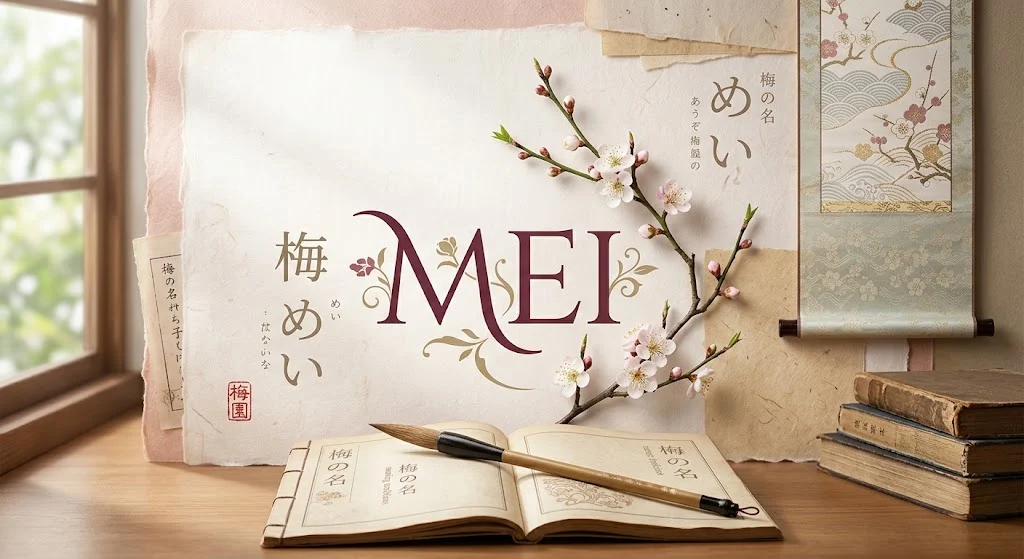
Mei is a beautiful feminine name with Chinese and Japanese associations. In Chinese, Mei can be written as 美, meaning “beautiful,” or 梅, referring to the Chinese plum (Prunus mume). In Japanese, the meaning can change according to the kanji used.
The mei name meaning is therefore not limited to one definition. Depending on its written form and cultural context, Mei can suggest beauty, elegance, nature, delicacy, or the enduring qualities associated with the plum blossom.
This flexibility is one reason the name has a particularly graceful and memorable character.
What Is the Name Mei?
Mei is a short feminine given name associated most notably with Chinese and Japanese naming traditions. Although the spelling is the same in Roman letters, its meaning cannot always be determined simply from the pronunciation.
Chinese names are generally written with Chinese characters, and different characters can have different meanings even when they share the same pronunciation. For Mei, commonly documented Chinese forms include 美 (měi) and 梅 (méi). The first means “beautiful,” while the second refers to the Chinese plum. Other Chinese characters with the same or similar pronunciation can also be used.
Japanese Mei is a separate naming possibility. Japanese names can also have multiple kanji combinations with the same reading, so the precise meaning depends on how the name is written. One documented Japanese form uses 芽, meaning “bud” or “sprout,” together with characters that can contribute meanings such as reliance, life, or clothing.
This makes Mei an excellent example of why name meaning and name spelling should be considered together, particularly for Chinese and Japanese names.
Mei Name Meaning
The most commonly cited meanings associated with the Chinese name Mei are “beautiful” and “Chinese plum.” These meanings come from different Chinese characters rather than representing two definitions of one character.
Mei as “Beautiful”
When written as 美, Mei comes from the Mandarin pronunciation měi and carries the meaning “beautiful.” The character is associated with beauty and is also found in many Chinese given names.
As a name, this meaning can create an appealing association with:
- Beauty
- Grace
- Elegance
- Refinement
- Pleasant appearance
It is important, however, not to treat these qualities as personality predictions. A name meaning describes the linguistic or cultural meaning of its characters; it does not determine someone’s character.
Mei as “Chinese Plum”
When written as 梅, Mei refers to the Chinese plum, commonly identified botanically as Prunus mume.
This gives the name a strong connection with the natural world. Rather than describing a personal characteristic directly, the name can evoke a flowering tree and the qualities culturally associated with it.
For parents who prefer names inspired by nature, this interpretation gives Mei a particularly distinctive dimension.
Mei Name Origin and Etymology
The origin of Mei depends on which naming tradition and written form are being discussed.
Chinese Origin
The Chinese name Mei is associated with characters including 美 and 梅. 美 (měi) means “beautiful,” while 梅 (méi) means Chinese plum. Both are established Chinese characters, but they have different meanings and should not be treated as interchangeable translations.
This distinction is especially important when researching the Mei name origin. Romanization gives us the spelling “Mei,” but the original Chinese character provides the semantic information.
Japanese Origin
Mei is also documented as a Japanese feminine name. In Japanese, the meaning depends on the kanji selected. For example, one documented construction begins with 芽 (me), meaning “bud” or “sprout,” combined with another character. Other kanji combinations are possible.
Therefore, saying that Mei has one universal Japanese meaning would be misleading. The written form matters.
How Do You Pronounce Mei?
For the Chinese name, Mei is commonly represented in English-language sources with a pronunciation close to “may.” Behind the Name gives the Chinese form as approximately /meɪ̯/.
However, Chinese is a tonal language, so simply reproducing the English “may” does not communicate every feature of the Mandarin pronunciation.
For English speakers, Mei is generally easy to pronounce and visually straightforward, which contributes to its international appeal.
History and Cultural Context of Mei
Mei’s cultural significance becomes especially interesting when the name is connected with 梅, the Chinese plum.
The Chinese plum is not merely an ordinary botanical reference. The character 梅 has a long history of use in Chinese language and naming. Nature-based characters are common components of East Asian naming traditions because plants, flowers, seasons, virtues, and other concepts can carry positive symbolic associations.
The beauty interpretation, represented by 美, takes a different route. Rather than referring to a plant, it directly expresses the concept of beauty.
This means two people named Mei could have names with different literal meanings even though their names look identical when written in the Latin alphabet.
Mei in Chinese Naming
Chinese names often depend heavily on the characters selected by a family. A Romanized name alone may therefore leave out an important part of the name’s meaning.
For example:
- 美 → “beautiful”
- 梅 → “Chinese plum”
Both can be represented as Mei in Romanization.
Other characters can also produce the same or similar pronunciation, which means the exact written name should be checked before assigning a single meaning.
Symbolism Associated With the Name Mei
Because Mei can represent both beauty and the Chinese plum, it has two especially clear symbolic directions.
Beauty and Elegance
The character 美 gives Mei a direct association with beauty. This can make the name attractive to parents looking for a short name with an elegant positive meaning.
Nature and the Plum
The character 梅 connects Mei with the Chinese plum. This creates a nature-inspired interpretation involving flowers, trees, and seasonal beauty.
The combination of a short sound and meaningful characters gives Mei a refined quality without making the name complicated.
Is Mei a Chinese or Japanese Name?
It can be either, depending on the specific name and writing system.
Mei is documented as a Chinese feminine name and also as a Japanese feminine name. However, the origins should not be blended together as though they represent one single etymology. Chinese Mei and Japanese Mei can have different character choices and therefore different meanings.
This is an important distinction for anyone researching the Mei name meaning in Chinese versus the Mei name meaning in Japanese.
| Context | Possible Writing | Meaning/Association |
|---|---|---|
| Chinese | 美 | Beautiful |
| Chinese | 梅 | Chinese plum |
| Japanese | 芽 + another kanji | Can relate to a bud/sprout and the meaning of the second character |
| Japanese | Other kanji combinations | Meaning varies by characters |
The table illustrates why the written characters are essential when determining the exact meaning.
Mei vs. Mai
Mei and Mai look and sound somewhat similar in English, but they should not automatically be treated as variants of the same name.
Mai has its own naming traditions. For example, documented Japanese Mai can come from 舞, meaning “dance,” or from combinations such as 麻衣; Vietnamese Mai can be connected with the Sino-Vietnamese form of 梅.
| Name | Common Context | Example Meaning |
|---|---|---|
| Mei | Chinese | Beautiful; Chinese plum |
| Mei | Japanese | Meaning varies by kanji |
| Mai | Japanese | Dance; other meanings depending on kanji |
| Mai | Vietnamese | Plum/apricot in a Sino-Vietnamese context |
So while Mei and Mai may sound related in some contexts, their linguistic histories are not automatically identical.
Mei as a Baby Name
Mei can appeal to parents looking for a name that is:
- Short and easy to remember
- Feminine
- Internationally recognizable
- Connected with Chinese or Japanese culture
- Associated with beauty or nature
- Simple to spell in English
Its short structure also makes it easy to pair with longer middle or family names.
For parents choosing Mei because of its Chinese meaning, the most important step is deciding which Chinese character is intended. Choosing 美 and choosing 梅 creates different literal meanings.
Similarly, parents choosing a Japanese Mei should identify the intended kanji spelling before describing the name’s meaning.
What Does Mei Symbolize?
The symbolism depends on the character, but two major themes stand out.
Mei as 美 symbolizes beauty and aesthetic appeal because the character literally means “beautiful.”
Mei as 梅 symbolizes the Chinese plum and therefore gives the name a strong botanical and nature-oriented association.
Together, these interpretations make Mei a name that can evoke beauty, nature, delicacy, and elegance without requiring a long or elaborate form.
Names Similar to Mei
If you like Mei, several names may also appeal to you because of their short structure, East Asian associations, or meanings connected with beauty and nature.
Meilin
Meilin is a Chinese name that can combine Mei with 林 (“forest”) or 琳 (“fine jade, gem”), depending on the characters used.
Mai
Mai is used in several naming traditions, including Japanese and Vietnamese contexts, but its meaning varies according to language and characters.
Emi
Japanese Emi can be formed from characters including 美, meaning “beautiful,” combined with different characters such as those meaning fragrance or increase.
Miku
Japanese Miku can include 美, giving it a possible connection to beauty, although its complete meaning depends on the remaining character combination.
Why the Written Character Matters
One of the most important lessons from researching Mei is that Romanized spelling does not always preserve the complete meaning of a name.
Consider the following:
Mei → 美 → beautiful
versus
Mei → 梅 → Chinese plum
The English spelling remains exactly the same, but the Chinese characters—and therefore the literal meanings—are different.
This principle applies broadly to Chinese and Japanese names. When a name is transliterated into English, several distinct characters can sometimes become the same Romanized spelling.
For that reason, a reliable name explanation should identify the original character, not simply assign one meaning to every person with the same English spelling.
Is Mei a Good Name?
Mei can be an appealing choice for parents who value simplicity, cultural depth, and positive symbolism.
Its greatest strength is perhaps its versatility: depending on the intended character, Mei can express beauty or connect directly with the Chinese plum. Its short form also makes it easy to pronounce and remember in many English-speaking settings.
For a culturally specific name, however, meaning should always be considered alongside the correct writing system. If the name is intended to be Chinese or Japanese, using the appropriate characters helps preserve the meaning and cultural context behind it.
FAQs
What does the name Mei mean?
Mei can mean “beautiful” when written as 美 in Chinese, or “Chinese plum” when written as 梅.
Is Mei a Chinese name?
Yes, Mei is documented as a Chinese feminine given name, including forms written with 美 and 梅.
Is Mei a Japanese name?
Yes, Mei is also used as a Japanese feminine name, with its meaning depending on the kanji chosen.
How do you pronounce Mei?
The Chinese name Mei is commonly represented approximately as “may” in English pronunciation guides.
What does Mei mean in Chinese?
In Chinese, Mei can mean “beautiful” through 美 or refer to the Chinese plum through 梅.
Is Mei a feminine name?
Mei is documented primarily as a feminine Chinese and Japanese given name.
What is the Chinese character for Mei?
Common Chinese forms include 美 and 梅, but other characters with similar pronunciation can also be used.
Is Mei related to Mai?
Not necessarily; Mei and Mai have different linguistic and cultural uses, although some forms may share historical characters or related pronunciations.
Conclusion
Mei is a short and elegant name with meaningful roots in Chinese and Japanese naming traditions. In Chinese, 美 gives the name the meaning “beautiful,” while 梅 connects it with the Chinese plum, creating a nature-inspired interpretation. Japanese Mei can have different meanings depending on the kanji used.
Ultimately, the Mei name meaning is best understood through its original written form rather than its Romanized spelling alone. Associated with beauty, nature, or another kanji-based meaning, Mei offers a simple name with considerable cultural and linguistic depth.
Discover More Related Articles:
- Karen Name Meaning | From Greek Origins to Modern Times In 2026
- Arianna Name Meaning | Discover Its Ancient Roots, Mythological Connections & Timeless Appeal In 2026
- Inez Name Meaning | The Elegant Legacy That Makes This Name So Special 2026