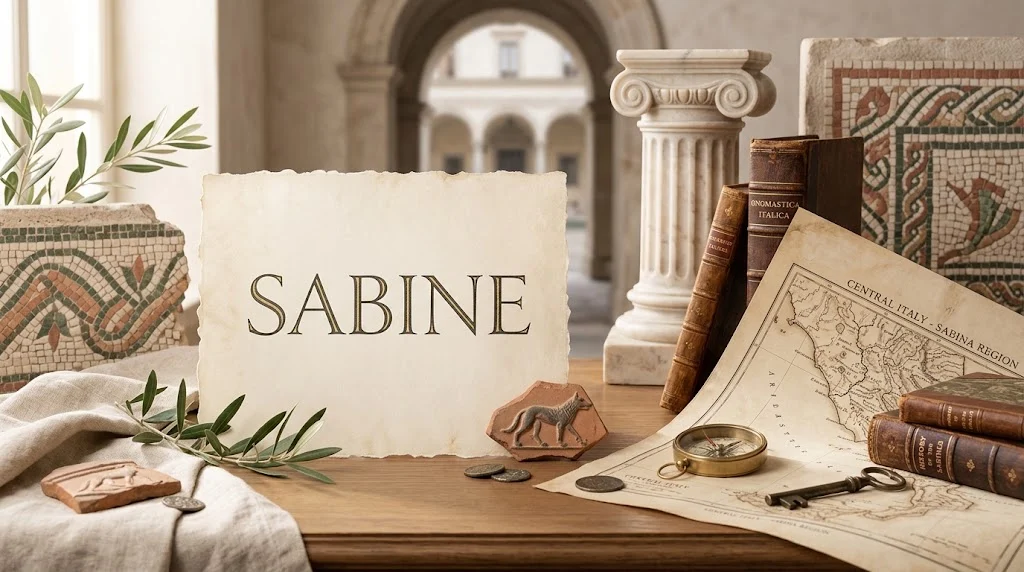
Sabine is a feminine given name of Latin origin associated with the ancient Sabine people of central Italy. It comes from the Latin name Sabina, the feminine form of Sabinus, and is commonly understood as “Sabine woman” or “woman of the Sabine people.”
The name carries an ancient historical connection to the Sabines, an Italic people who lived in central Italy before and during the early development of Rome. Because of this background, Sabine has a distinctive blend of classical, European, and historical character.
In this guide, we will explore the Sabine name meaning, its etymology, ancient history, pronunciation, cultural associations, variations, and how the name is used today.
What Is the Name Sabine?
Sabine is a feminine personal name with roots in the Latin form Sabina. The name is connected to Sabinus, a Latin term referring to the Sabine people, an ancient Italic population associated with central Italy.
Unlike names whose meanings describe a physical quality or abstract virtue, Sabine has an ethnic and geographic origin. Its original sense is tied to membership in, or association with, the Sabine people.
In simple terms:
- Name: Sabine
- Gender: Traditionally feminine
- Origin: Latin
- Root: Sabinus / Sabina
- Historical association: The Sabines of ancient Italy
- Traditional sense: “Sabine woman” or “woman of the Sabine people”
- Pronunciation: Commonly suh-BEEN or sa-BEEN, depending on language
The exact pronunciation can vary between English, French, German, and other European languages.
Sabine Name Meaning
The Sabine name meaning is traditionally connected with the identity of the ancient Sabine people.
The Latin masculine form Sabinus referred to a Sabine man or someone associated with the Sabines, while Sabina was its feminine counterpart. Sabine developed as a related European form of this ancient name.
Therefore, the name can be understood as:
“Sabine woman,” “woman of the Sabine people,” or “one belonging to the Sabines.”
This is important because Sabine’s meaning is primarily historical and ethnonymic, rather than a word such as “beautiful,” “strong,” or “graceful.”
Over time, however, names often acquire cultural associations beyond their original literal meanings. Sabine can therefore evoke ideas of heritage, antiquity, European history, classical culture, and enduring tradition, even though these are modern associations rather than the name’s literal etymological definition.
Sabine Name Origin and Etymology
The origin of Sabine reaches back to the Latin language and the ancient Sabine people of Italy.
The Latin form Sabinus was associated with the Sabines. Its feminine counterpart was Sabina. The modern name Sabine is connected to this Latin naming tradition and became established in several European languages.
The basic development can be represented as:
Sabine → Sabina → Sabinus → Sabine people
This should not be interpreted as a perfectly linear modern spelling evolution in every language. Rather, it shows the relationship between the modern feminine name, its Latin form, and the ancient ethnonym.
The ultimate origin of the word Sabinus itself is less certain. Historical linguists have proposed different explanations for the deeper origin of the name of the Sabines, so it is more accurate to say that the Latin connection is well established while the deeper etymology is less certain.
This distinction matters when discussing name meanings. The safest interpretation is therefore based on the established relationship between Sabina/Sabine and the ancient Sabine people rather than assigning the name an unsupported symbolic meaning.
Who Were the Ancient Sabines?
To understand the name Sabine, it helps to understand the people from whom it originated.
The Sabines were an ancient Italic people associated primarily with the mountainous region of central Italy, north and northeast of Rome. They lived in the Italian peninsula during the period when Rome was developing from an early settlement into a major regional power.
The Sabines appear frequently in early Roman traditions and historical accounts. Their relationship with Rome was complex and included periods of conflict, interaction, migration, and cultural integration.
One of the best-known stories connecting the Sabines with Rome is the traditional story commonly called the Rape of the Sabine Women. According to Roman tradition, early Romans abducted women from neighboring communities, including the Sabines, and this eventually led to conflict between the Romans and Sabines.
In the traditional story, the Sabine women later intervened between the fighting Romans and Sabines, helping bring the conflict to an end.
Modern historians generally treat such early Roman stories carefully because they combine historical traditions, legend, and later Roman storytelling. They remain important, however, because they demonstrate how deeply the Sabines became connected with Rome’s traditional foundation narratives.
Sabine in Roman History
The Sabines occupy an interesting position in the traditional history of Rome.
Ancient Roman writers described close relationships between early Romans and Sabines. One famous tradition even associates several early Roman kings with Sabine ancestry or connections.
The historical picture is more complicated than the legends suggest. Rome developed through interaction among multiple communities in central Italy, and the Sabines were one of several peoples involved in this wider cultural landscape.
Over time, Sabine communities became increasingly integrated into Roman society. Their identity remained historically significant even as the distinction between separate Italic communities and Roman citizens changed.
This historical background gives the name Sabine an unusually strong connection to the ancient Mediterranean world.
Someone choosing the name today may appreciate it because it sounds elegant and modern while carrying a connection to ancient Italy and Roman-era history.
Sabine as a Feminine Name
Sabine is traditionally used as a feminine given name, particularly in European naming traditions.
The form Sabina is also historically important and remains a recognizable feminine name in several languages. Sabine became particularly familiar in French- and German-speaking contexts, although its use is not restricted to those cultures.
The feminine form reflects the Latin naming pattern in which masculine and feminine forms could be distinguished grammatically.
For example:
| Form | General association |
|---|---|
| Sabinus | Latin masculine form associated with the Sabines |
| Sabina | Latin feminine form |
| Sabine | European feminine form |
| Sabina | Variant used in several European languages |
These forms are related, but their pronunciation, spelling, and popularity can differ by country.
How Do You Pronounce Sabine?
The pronunciation of Sabine depends on the language and region.
In English, it is commonly pronounced approximately:
suh-BEEN
In French, the pronunciation is closer to:
sa-BEEN
The final sound and stress can therefore vary depending on the name is being pronounced according to English, French, German, or another linguistic tradition.
When choosing the name for a child, parents may want to decide which pronunciation they prefer, particularly if they live in a multilingual environment.
Sabine Name Meaning in Different Cultural Contexts
Sabine has a particularly interesting cultural identity because it appears in multiple European naming traditions.
French Context
In French, Sabine is a traditional feminine given name with a connection to the Latin Sabina. Its sound and spelling give it a distinctly French character to many modern speakers.
German Context
Sabine has also been used extensively as a feminine given name in German-speaking regions. In this context, it is recognized as a traditional European name rather than simply an ancient historical term.
Latin and Roman Context
The deepest historical association of Sabine comes from the Latin Sabina and the ancient Sabines. Here, the name points toward a specific ancient people of central Italy.
Modern International Context
Today, Sabine can be recognized internationally because of European migration, literature, media, and cross-cultural naming. Its historical roots make it appealing to people looking for a name that feels established without being overly common in every English-speaking setting.
Sabine Name Symbolism
The literal meaning of Sabine is historical rather than symbolic, but names often develop associations through their cultural background.
Sabine may symbolically suggest:
- Ancient heritage
- European history
- Classical culture
- Strength of tradition
- Cultural identity
- Connection to Italy
- Elegance and refinement
- Historical continuity
These should be understood as modern interpretations, not dictionary meanings of the name.
The name’s strongest distinctive quality is its connection to an identifiable ancient population. That gives Sabine a sense of historical depth that many modern names do not have.
Sabine Name Variations and Related Forms
Sabine belongs to a wider family of names connected with the Latin Sabinus and Sabina.
Some related forms include:
| Name | Relationship |
|---|---|
| Sabine | European feminine form |
| Sabina | Latin feminine form and international variant |
| Sabinus | Latin masculine form |
| Sabin | Related masculine form used in some European naming traditions |
| Sabino | Romance-language masculine form |
The exact usage of these forms depends on the language and country.
Although the spellings are similar, they should not automatically be treated as identical names in every cultural context.
Sabine vs. Sabina
Sabine and Sabina are closely related names, but they have different linguistic forms and regional associations.
| Feature | Sabine | Sabina |
|---|---|---|
| Gender | Traditionally feminine | Traditionally feminine |
| Root | Latin Sabina/Sabinus | Latin Sabina |
| Historical association | Sabine people | Sabine people |
| Style | European, refined, distinctive | Classical, traditional |
| Pronunciation | Varies by language | Varies by language |
Both names ultimately connect to the ancient Sabines, but Sabine has its own established usage and pronunciation traditions.
Why Choose the Name Sabine?
Parents may choose Sabine for several different reasons.
1. It Has Ancient Roots
Sabine reaches back to the ancient history of Italy, giving it a long historical background.
2. It Is Distinctive
Sabine is recognizable without sounding like a highly modern invented name. It can therefore appeal to parents looking for something uncommon but historically established.
3. It Has European Connections
The name has been used across European linguistic traditions, especially in French- and German-speaking contexts.
4. It Has a Strong Historical Identity
Unlike names based primarily on abstract virtues, Sabine points to a specific historical people and cultural tradition.
5. It Works Across Languages
Although pronunciation differs, the spelling Sabine is relatively recognizable internationally.
Examples of Sabine in Naming Contexts
Here are a few natural examples showing how the name can be discussed:
- Sabine is a feminine name with Latin roots.
- The name Sabine is connected with the ancient Sabine people of Italy.
- Sabine and Sabina are related feminine forms.
- She chose Sabine because she wanted a name with an ancient European history.
- Sabine has a different pronunciation depending on the language being spoken.
These examples demonstrate that Sabine functions as a personal name while retaining its historical connection to the ancient Sabines.
Is Sabine an Old-Fashioned Name?
Sabine has an old historical origin, but that does not necessarily make it old-fashioned.
The name has continued to be used in modern European societies, although its level of popularity varies considerably by country and generation.
Its appeal today often comes from the combination of an ancient root and an elegant modern sound. For parents interested in traditional names that are less immediately common in English-speaking countries, Sabine can feel both established and distinctive.
Is Sabine a Good Name?
Sabine is a good name is ultimately a matter of personal preference, but it has several characteristics that make it appealing.
It is:
- Historically established
- Feminine
- Connected to Latin
- Associated with ancient Italy
- Relatively distinctive
- Recognizable across several European languages
- Easy to connect with related forms such as Sabina
Its main consideration is pronunciation. People in different countries may pronounce the name differently, so parents may want to decide they prefer an English, French, German, or another pronunciation.
Sabine Name Meaning and Modern Appeal
The modern appeal of Sabine comes from the way it combines history with simplicity.
It does not require a complicated explanation to function as a given name, yet its background leads to an ancient cultural tradition. The name can therefore appeal to people interested in classical history, European heritage, traditional naming, or distinctive feminine names.
The original association with the Sabines also gives Sabine a stronger historical identity than many names whose modern meanings are based primarily on later interpretations.
FAQs
What does Sabine mean?
Sabine is traditionally understood as “Sabine woman” or “woman of the Sabine people,” referring to an ancient Italic population of central Italy.
What is the origin of the name Sabine?
Sabine has Latin roots and is connected with Sabina, the feminine form of Sabinus, a term associated with the ancient Sabines.
Is Sabine a girl’s name?
Yes, Sabine is traditionally a feminine given name, although related forms such as Sabinus and Sabino are masculine.
How do you pronounce Sabine?
In English, Sabine is commonly pronounced approximately “suh-BEEN,” while French pronunciation is closer to “sa-BEEN.”
Is Sabine a French name?
Sabine is widely recognized as a French feminine name, but its deeper historical roots are Latin and connected with the ancient Sabines.
What is the meaning of Sabina?
Sabina is the Latin feminine form related to Sabinus and carries the same historical association with the Sabine people.
Is Sabine a biblical name?
Sabine is not generally classified as a biblical name; its documented background is connected to Latin and ancient Italic history.
Is Sabine an Italian name?
Sabine has a strong historical connection to Italy because the ancient Sabines lived in central Italy, although the modern form is used across several European languages.
Is Sabine a rare name?
Its popularity varies by country and period, but Sabine is generally less common in contemporary English-speaking naming than many mainstream feminine names.
What names are similar to Sabine?
Related or stylistically similar choices include Sabina, Sabine, Sabin, and Sabino, depending on the language and gender desired.
Conclusion
The Sabine name meaning is rooted in the ancient Sabine people of central Italy. Derived through the Latin Sabina and related to Sabinus, the name is traditionally understood as “Sabine woman” or “woman of the Sabine people.” Its history connects a graceful feminine name with the ancient cultural landscape of Italy and early Rome.
Today, Sabine remains an elegant and distinctive choice with strong European character. Its Latin roots, historical depth, international variants, and connection to ancient Italy make it especially appealing to anyone looking for a feminine name that feels traditional, meaningful, and culturally rich.
Discover More Related Articles:
- Karen Name Meaning | From Greek Origins to Modern Times In 2026
- Arianna Name Meaning | Discover Its Ancient Roots, Mythological Connections & Timeless Appeal In 2026
- Inez Name Meaning | The Elegant Legacy That Makes This Name So Special 2026