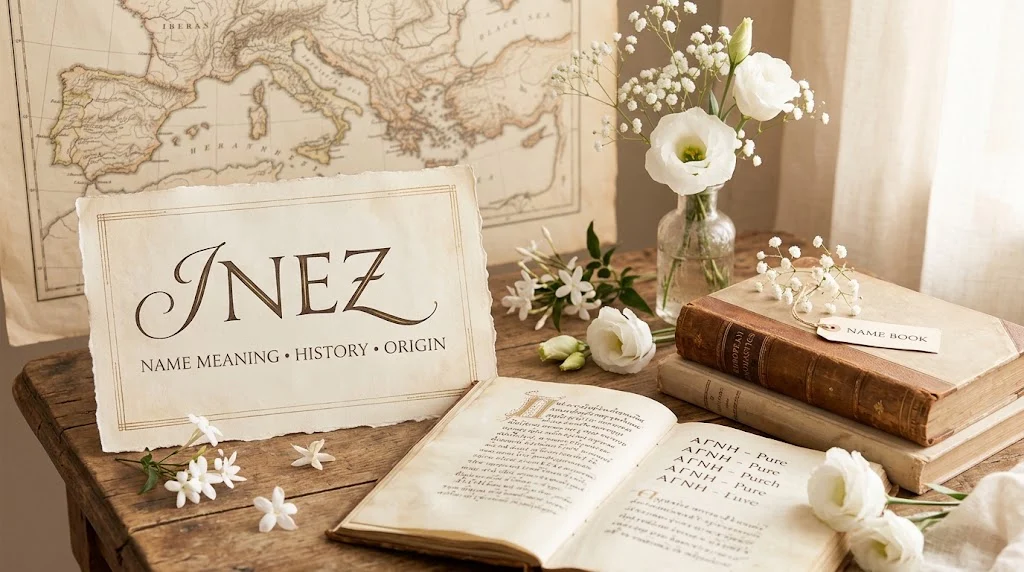
The Inez name meaning is commonly connected with “pure,” “chaste,” or “holy.” Inez is a feminine name related to Inés, the Spanish form of Agnes, and ultimately traces to the Greek name Hagnē, from hagnos, a word associated with purity and holiness.
The name Inez has a distinctive international character. Although its modern spelling may look simple and independent, it belongs to a much older family of names that includes Agnes, Inés, and Inês. Its history connects Greek linguistic roots with Christian naming traditions and later Spanish, Portuguese, English, Dutch, and Swedish usage.
For parents researching the Inez name meaning, the appeal is often its combination of historical depth and contemporary simplicity. It is short, recognizable, elegant, and associated with a traditional meaning of purity.
This guide explores the Inez name meaning, pronunciation, origin, etymology, history, cultural associations, variants, and related names.
What Is the Name Inez?
Inez is a feminine given name and a variant of Inés. Inés is the Spanish form of Agnes, while Inez is used as a variant of Inés in several naming traditions. Behind the Name lists Inez as a feminine name used in English, Swedish, and Dutch, with Inés as its immediate related form.
The name therefore has a longer linguistic history than its four letters might suggest.
A simplified name family looks like this:
Greek Hagnē → Latin/European Agnes → Spanish Inés → Inez
This does not mean that every modern bearer of Inez is directly using a Spanish name. Rather, Inez belongs to an international network of related forms that developed as the name moved between languages and cultures.
That distinction is useful because Inez can have different cultural associations depending on where it is used.
Inez Name Meaning
The Inez name meaning is generally given as “pure,” “chaste,” or “holy.” These meanings ultimately come from the Greek linguistic root associated with hagnos and the Greek feminine name Hagnē.
The traditional meanings can be understood in several closely related ways:
- Pure
- Chaste
- Holy
- Innocent
- Morally upright
The central idea is purity, rather than a literal modern description of someone’s personality.
This is important when interpreting traditional name meanings. A name meaning such as “pure” represents the historical or linguistic sense associated with the name; it does not predict a person’s character.
What Does Inez Mean?
In its traditional etymological sense, Inez means “pure” or “chaste,” with a broader association with holiness. The name belongs to the Agnes family and ultimately derives from the Greek Hagnē.
For modern naming purposes, Inez can therefore carry an attractive symbolic association with purity, innocence, grace, and integrity.
Inez Name Origin and Etymology
The history of Inez begins with Agnes, whose roots go back to Ancient Greek.
Behind the Name identifies Agnes as a Latinized form of the Greek name Ἅγνη (Hagnē), derived from Greek ἁγνός (hagnos), meaning “chaste.”
Etymology Online likewise traces Agnes through Old French to Greek Hagnē, explaining its associations with “pure” and “chaste.”
The development can be represented broadly as:
Hagnē → Agnes → Inés → Inez
The exact history of individual spellings is more complicated than a single straight-line transformation, because names change as they move between languages. Nevertheless, Inez is clearly connected to this wider family.
The Greek Root
The Greek element behind Agnes is significant because hagnos had a semantic range involving holiness, sacredness, purity, and chastity. When applied to people, the word could convey the idea of being pure or morally upright.
Over centuries, this linguistic idea became embedded in the name Agnes and its numerous European forms.
Is Inez a Spanish Name?
Inez is strongly associated with the Spanish name Inés, but it is not accurate to say that every use of Inez is simply Spanish.
The Spanish form is Inés, which Behind the Name identifies specifically as the Spanish form of Agnes.
The spelling Inez is itself listed as a variant of Inés and has usage in English, Swedish, and Dutch.
This makes Inez an interesting example of how a traditional name can cross linguistic boundaries. A family may choose Inez because of Spanish heritage, because they prefer its spelling, or simply because they like its sound and historical associations.
Inez and the Name Agnes
Inez and Agnes are related names, not completely unrelated names that happen to have similar meanings.
Agnes represents the older European form that ultimately traces back to Greek Hagnē. Inez developed through the Iberian forms of the name, especially Inés.
| Name | Language/Usage | Relationship |
|---|---|---|
| Agnes | English and several European languages | Traditional form |
| Inés | Spanish | Spanish form of Agnes |
| Inês | Portuguese | Portuguese form of Agnes |
| Inez | English, Swedish, Dutch | Variant of Inés |
| Ines | Several European languages | Related variant |
Behind the Name lists Inês as the Portuguese form of Agnes and Inez as a variant of Inés.
Inez Name History
The history of Inez is best understood through the history of Agnes and its European variants.
Agnes became an important Christian name because of Saint Agnes, an early Christian martyr. According to traditional Christian history, Saint Agnes was martyred during the persecutions associated with the Roman emperor Diocletian. Her reputation helped the name spread throughout Christian Europe.
As Christianity and European languages developed, the name appeared in different linguistic forms. Spanish produced Inés, Portuguese produced Inês, and other languages developed their own related spellings and pronunciations.
Inez belongs to this larger history of linguistic adaptation.
Saint Agnes and the Christian Tradition
Saint Agnes is particularly important to the historical development of the name family.
Her name became associated with Christian ideas of purity and chastity, which reinforced the existing meaning of the Greek root. She is traditionally regarded as a patron saint of young girls.
This religious history helps explain why names derived from Agnes can carry associations beyond their basic etymological meaning.
For someone choosing Inez today, however, the name does not have to be used in a religious sense. Its historical background can be appreciated alongside its modern sound and style.
Inez Pronunciation
The pronunciation of Inez can vary according to language and personal preference.
In English, pronunciation sources list more than one possibility, including forms represented approximately as “ih-NEZ” and “eye-NEZ.”
The related Spanish name Inés is pronounced approximately “ee-NESS,” with the stress on the second syllable.
The Portuguese Inês has another pronunciation pattern; European Portuguese is approximately “ee-NESH,” while Brazilian Portuguese commonly uses a pronunciation closer to “ee-NESS.”
Therefore, pronunciation may depend on a person is using the English spelling Inez or a Spanish or Portuguese form.
Cultural Meaning and Symbolism of Inez
Because Inez belongs to the Agnes name family, its strongest traditional symbolism comes from purity and holiness.
Modern parents may interpret these qualities more broadly as:
- Purity of character
- Grace
- Innocence
- Integrity
- Gentleness
- Inner strength
These are symbolic interpretations rather than additional dictionary meanings of the name.
The short form of Inez also gives it a modern visual quality. Four-letter names are often appreciated for being easy to spell and visually distinctive, although preferences naturally vary from family to family.
Inez in Different Languages
One of the most interesting aspects of the name is its international family of forms.
Spanish: Inés
Inés is the Spanish form of Agnes. It retains the historical connection to the same Greek root.
Portuguese: Inês
Inês is the Portuguese form of Agnes. It is particularly recognizable because of the Portuguese accent mark and its distinctive pronunciation.
French: Inès
Inès is a French form related to Inés and Agnes.
English, Swedish, and Dutch: Inez
The spelling Inez is listed with English, Swedish, and Dutch usage and is identified as a variant of Inés.
These forms demonstrate how names can preserve an underlying historical identity while adapting their spelling and pronunciation to different languages.
Is Inez a Classic Name?
Yes. Inez can reasonably be described as a classic name, particularly because it belongs to a name family with centuries of documented European history.
However, classic does not mean that the spelling Inez has been equally common in every country or every historical period.
The name family has appeared in many forms, including Agnes, Inés, Inês, Inès, and Inez. This gives Inez historical depth without requiring it to sound identical to the oldest form.
For parents seeking a name that feels short, refined, international, and historically established, Inez can be an appealing choice.
Is Inez a Girl’s Name?
Yes. Inez is traditionally a feminine given name. Behind the Name classifies it as feminine and lists usage in English, Swedish, and Dutch.
Its related forms, including Inés and Inês, are also traditionally feminine names.
What Makes Inez a Distinctive Name?
Several characteristics give Inez its identity:
1. Short spelling:
Inez has only four letters, making it concise and visually memorable.
2. Historical depth:
Its history reaches back through Inés and Agnes to the Greek Hagnē.
3. International connections:
The name is related to forms used across Spanish, Portuguese, French, English, Swedish, Dutch, and other European naming traditions.
4. Traditional symbolism:
Its core meaning is associated with purity and chastity.
5. Flexible style:
Inez can feel vintage and traditional while still having a clean, contemporary appearance.
Names Related to Inez
If you like Inez, you may also be interested in names from the same linguistic family:
- Agnes — the traditional form behind the family
- Inés — Spanish form
- Inês — Portuguese form
- Inès — French form
- Ines — variant spelling used in several European languages
- Agni — a related Greek form in the wider Agnes family
- Agnese — Italian form
- Agnès — French/Catalan form
The relationship between these names varies by language, but they belong to the broader family associated with Agnes.
Inez as a Baby Name
For parents considering Inez as a baby name, its main strengths are its brevity, history, and international character.
The name works particularly well for families who want something that feels established without being overly long or complicated.
It can also pair well with longer middle names because its short structure creates a natural contrast. For example:
- Inez Alexandra
- Inez Catherine
- Inez Victoria
- Inez Gabrielle
- Inez Juliette
These are naming examples rather than claims about traditional combinations.
The most important consideration is personal preference: pronunciation, spelling, cultural connection, and how the name sounds with the family’s surname.
Inez vs. Inés vs. Inês
Although these names are closely related, the spelling can signal different linguistic traditions.
| Name | Main association | Key distinction |
|---|---|---|
| Inez | English, Swedish, Dutch | Variant spelling of Inés |
| Inés | Spanish | Spanish form of Agnes |
| Inês | Portuguese | Portuguese form of Agnes |
| Inès | French | French form related to Inés |
| Agnes | English and European languages | Older traditional form |
The choice between them may therefore depend less on meaning and more on language, pronunciation, family heritage, and preferred spelling.
What Does Inez Symbolize?
Traditionally, Inez symbolizes purity, chastity, and holiness because of its connection to the Greek root behind Agnes.
In a modern symbolic interpretation, parents might associate the name with:
- purity of heart
- innocence
- grace
- integrity
- quiet strength
- timeless elegance
These modern associations should be understood as interpretations rather than additional historical definitions.
FAQs
What does the name Inez mean?
Inez traditionally means “pure,” “chaste,” or “holy,” through its connection to Inés and ultimately the Greek name Hagnē.
Is Inez a Spanish name?
Inez is closely associated with Spanish Inés, but Inez itself is also used as a variant in English, Swedish, and Dutch.
What is the origin of the name Inez?
Inez is a variant of Inés, the Spanish form of Agnes, whose ultimate linguistic origin is the Greek Hagnē.
Is Inez a girl name?
Yes, Inez is traditionally a feminine given name and is classified as feminine in major name references.
How do you pronounce Inez?
Inez has more than one English pronunciation, while Spanish Inés is approximately pronounced “ee-NESS.”
Is Inez related to Agnes?
Yes. Inez belongs to the same broader name family as Agnes and developed through the Spanish form Inés.
What is the Portuguese version of Inez?
The Portuguese equivalent is Inês, which is the Portuguese form of Agnes.
Is Inez a biblical name?
Inez is not a biblical name in the sense of appearing as a biblical personal name; its historical background is connected instead with Agnes and Christian tradition.
Is Inez a classic name?
Yes. Inez has historical depth through its connection with Agnes and related European forms, while its short spelling gives it a modern feel.
What names are similar to Inez?
Agnes, Inés, Inês, Inès, Ines, and Agnese are closely related or linguistically connected forms in the wider Agnes name family.
Conclusion
The Inez name meaning has deep linguistic roots and a long European history. As a variant of Inés and part of the broader Agnes family, Inez ultimately connects to the Greek Hagnē and the traditional ideas of purity, chastity, and holiness.
What makes Inez especially appealing is the balance between its historical background and simple modern form. Its connections with Spanish Inés, Portuguese Inês, French Inès, and English Agnes give it an international identity while allowing the four-letter spelling to stand on its own.
Discover More Related Articles:
- Lewis Name Meaning | From Germanic Origins to Modern Appeal In 2026
- Brody Name Meaning | Origin, History & Significance In 2026
- Castiel Name Meaning | Origin, History & Angelic Symbolism In 2026











2 thoughts on “Inez Name Meaning | The Elegant Legacy That Makes This Name So Special 2026”