
The Lewis name meaning is commonly connected with ideas such as “famous warrior,” “renowned in battle,” or “famous in war.” Lewis is an English and Welsh-used form of Louis, ultimately derived from the Germanic name Hludwig, combining elements associated with fame and battle.
The name Lewis has a long history across England, Wales, Scotland, France, and other parts of Europe. It has been used as both a given name and a surname, giving it a distinctive blend of traditional heritage and familiar modern appeal.
This guide explores the Lewis name meaning, origin, etymology, history, pronunciation, variations, symbolism, and common questions about the name.
What Is the Lewis Name?

Lewis is traditionally a masculine given name and is also a well-established surname. As a first name, it is especially associated with English and Welsh naming traditions, while its broader linguistic history connects it to the European name Louis.
The name ultimately traces back to an old Germanic name usually reconstructed as Hludwig or represented in related historical forms. The first element is associated with fame or renown, while the second is connected with battle or warfare.
Because names change as they move between languages, Lewis does not have just one isolated historical form. It belongs to a wider family of related names that includes Louis, Ludwig, Ludovic, Luigi, and Luis.
At a glance
| Attribute | Lewis |
|---|---|
| Name type | Given name and surname |
| Common usage | Primarily masculine |
| Associated forms | Louis, Ludwig, Luis, Luigi, Ludovic |
| Language traditions | English, Welsh, Scottish and wider European usage |
| Traditional meaning | “Famous warrior” / “renowned in battle” |
| Pronunciation | LOO-is |
| Name style | Classic, traditional, strong |
Lewis Name Meaning
The most widely cited interpretation of the Lewis name meaning is “famous warrior” or “renowned in battle.” This meaning comes from the Germanic elements behind the name.
The first element, commonly represented as hlud, carries the sense of something being famous, loud, or renowned. The second element, wig, refers to battle or warfare. Together, the elements form the idea of a person who is famous or renowned in battle.
It is important to understand that this is an etymological meaning, rather than a statement about the personality of everyone named Lewis. Modern parents may choose Lewis because they like its sound, history, family connection, or traditional character without attaching any literal warrior symbolism to the child.
What does Lewis mean spiritually or symbolically?
Although Lewis is not inherently a religious name, its traditional meaning can inspire symbolic associations with:
- Courage
- Strength
- Reputation
- Leadership
- Determination
- Bravery
- Resilience
- Achievement
These are modern symbolic interpretations rather than literal translations of the original name.
Lewis Name Origin and Etymology
The history of Lewis begins with an old Germanic naming tradition. Lewis is connected to Louis, which developed from Germanic forms related to Hludwig.
The name can be understood through two principal elements:
- hlud — associated with fame, renown, or being renowned
- wig — associated with battle or warfare
The resulting name is therefore traditionally interpreted along the lines of “famous in battle” or “renowned warrior.”
Over centuries, the name passed through different languages and naming traditions. Germanic forms influenced names such as Ludwig, while the name developed into Louis in French and related forms in other European languages. Lewis became an established English form.
This linguistic development explains why Lewis, Louis, Luis, Luigi, and Ludwig can look and sound quite different while ultimately belonging to the same broad historical name family.
History of the Name Lewis
Lewis has a particularly interesting history because it has existed as both a first name and a family name.
The related name Louis became especially prominent in France, where it was borne by numerous members of French royalty. The popularity and prestige of Louis helped related forms spread throughout Europe.
In English-speaking contexts, Lewis became a familiar form of the name. It developed a strong presence in England, Wales, Scotland, and later in other English-speaking countries.
The name also became particularly recognizable through literature, academia, exploration, and public life. One of the best-known literary examples is C. S. Lewis, the British writer and scholar famous for The Chronicles of Narnia. Another famous bearer is Lewis Carroll, the pen name of English author Charles Lutwidge Dodgson, best known for Alice’s Adventures in Wonderland.
These associations have helped Lewis maintain a strong connection with literature and intellectual culture.
Lewis in Welsh and British Naming Traditions
Lewis has a particularly strong association with Wales, where it has long been used as both a first name and surname.
As a surname, Lewis became established in Wales through patronymic naming practices and the historical use of personal names as family names. The surname can therefore have different ancestral histories depending on the individual family.
It is also important not to assume that every person with the surname Lewis has the same ethnic or geographic ancestry. Surnames can spread between regions through migration, marriage, language change, and other historical processes.
As a given name, Lewis remains recognizable as a traditional British name with a straightforward pronunciation and long historical background.
Lewis Pronunciation
Lewis is commonly pronounced:
LOO-is
It has two syllables:
Lew-is
The pronunciation is generally straightforward in English, although names can sometimes be pronounced differently depending on family, regional, or linguistic tradition.
Is Lewis pronounced like Louis?
In many English-speaking contexts, Lewis and Louis can have the same or very similar pronunciation: LOO-is.
However, pronunciation of Louis can vary depending on the language and region. The spelling Lewis generally gives English speakers a clearer indication of the traditional English pronunciation.
Lewis as a First Name
Lewis has the qualities of a classic name: it has considerable historical depth without sounding excessively formal.
Parents may choose Lewis because it offers:
- A traditional British feel
- A connection to European history
- A strong etymological meaning
- Easy pronunciation
- Familiar spelling
- Literary associations
- A classic rather than highly fashionable style
Unlike some names that are strongly tied to one particular era, Lewis can work across generations. It can sound equally appropriate for a child, teenager, or adult.
Lewis as a Surname
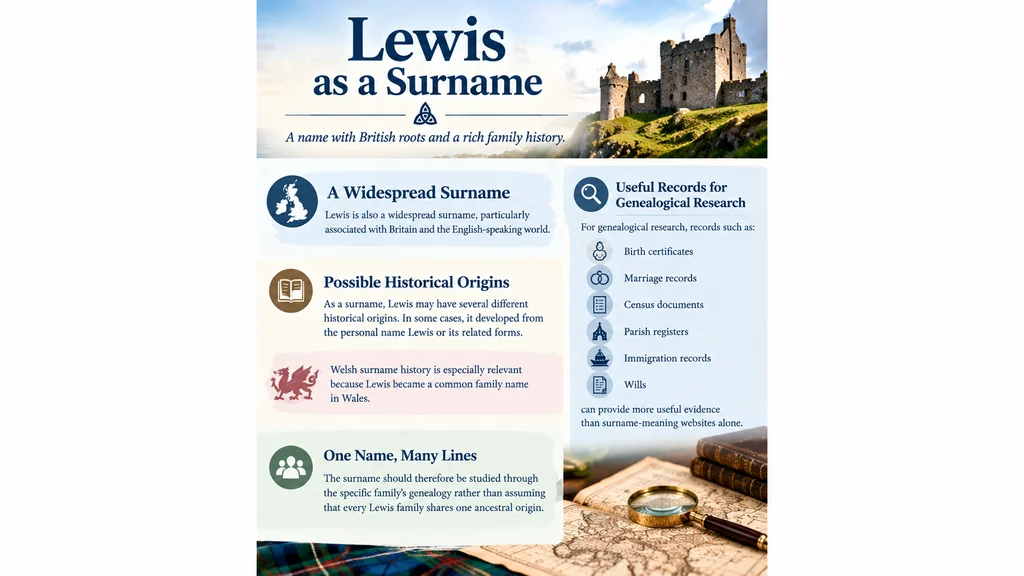
Lewis is also a widespread surname, particularly associated with Britain and the English-speaking world.
As a surname, Lewis may have several different historical origins. In some cases, it developed from the personal name Lewis or its related forms. Welsh surname history is especially relevant because Lewis became a common family name in Wales.
The surname should therefore be studied through the specific family’s genealogy rather than assuming that every Lewis family shares one ancestral origin.
For genealogical research, records such as birth certificates, marriage records, census documents, parish registers, immigration records, and wills can provide more useful evidence than surname-meaning websites alone.
Variations of Lewis
Lewis belongs to a large international family of related names.
| Name | Common linguistic association |
|---|---|
| Lewis | English form |
| Louis | French and English usage |
| Ludwig | German form |
| Luis | Spanish form |
| Luís | Portuguese form |
| Luigi | Italian form |
| Ludovic | French and related European forms |
| Lodewijk | Dutch form |
Although these names are historically related, their exact development differs by language and period. They should not always be treated as interchangeable names.
Lewis vs. Louis
Lewis and Louis are closely related, but their spellings reflect different linguistic traditions.
| Feature | Lewis | Louis |
|---|---|---|
| Common pronunciation in English | LOO-is | LOO-is |
| Traditional association | English/Welsh usage | French and broader European usage |
| Historical relationship | Related to Louis | Related to Lewis |
| Traditional meaning | Famous in battle | Famous in battle |
| Style | British, classic, familiar | French, royal, classic |
The two names share a historical family but have developed their own cultural identities.
Famous People Named Lewis
Several well-known figures have helped give the name Lewis strong cultural associations.
C. S. Lewis
C. S. Lewis was a British writer, literary scholar, and Christian thinker best known for The Chronicles of Narnia. His works have made the name Lewis particularly recognizable in literature.
Lewis Carroll
He was the pen name of Charles Lutwidge Dodgson, the English author and mathematician who wrote Alice’s Adventures in Wonderland and Through the Looking-Glass.
Lewis Hamilton
Lewis Hamilton is a British racing driver and one of the most recognizable modern public figures with the first name Lewis. His international career has brought additional visibility to the name.
These individuals represent very different fields, showing how the name Lewis has appeared across literature, scholarship, and modern sports.
Personality Traits Associated With the Name Lewis
Name meanings do not scientifically determine personality. However, traditional name symbolism can inspire certain qualities.
Because Lewis is historically associated with renown and battle, people sometimes connect the name with characteristics such as:
- Courage
- Confidence
- Strength
- Leadership
- Determination
- Ambition
- Resilience
These are symbolic associations rather than predictions about someone who bears the name. A person’s character is shaped by many factors beyond their name.
Is Lewis a Good Name?
Lewis can be an excellent choice for parents looking for a classic name with substantial historical depth.
Its advantages include:
- Strong meaning: Its Germanic roots connect it with fame and battle.
- Historical depth: The name has centuries of documented linguistic and cultural development.
- Simple pronunciation: Lewis is generally easy to say in English.
- Classic style: It avoids feeling overly tied to one short-lived naming trend.
- International connections: Lewis belongs to a broad European family of related names.
- Literary associations: Figures such as C. S. Lewis and Lewis Carroll give it strong cultural recognition.
Its greatest appeal may be the balance between familiarity and heritage: Lewis feels traditional without being excessively formal.
Lewis Name Meaning in Modern Use

Today, the name Lewis is generally understood as a traditional personal name rather than as a literal reference to warfare.
For a modern child, the historical meaning can be appreciated as a symbolic connection to strength, courage, and distinction. At the same time, its established use in Britain and other English-speaking communities gives it a familiar, approachable quality.
The name also works well with many surname styles because of its short, clear structure. Its two-syllable pronunciation makes it easy to use in everyday conversation.
FAQs
What does the name Lewis mean?
Lewis traditionally means “famous warrior” or “renowned in battle,” from ancient Germanic name elements associated with fame and warfare.
What is the origin of Lewis?
Lewis is an English form related to Louis and ultimately traces back to the Germanic name Hludwig.
How do you pronounce Lewis?
Lewis is commonly pronounced LOO-is, with two syllables: “Lew-is.”
Is Lewis a Welsh name?
Lewis has strong historical associations with Wales and is widely established as a Welsh surname, although its deeper linguistic roots are Germanic.
Is Lewis a biblical name?
Lewis is not originally a biblical name; its etymology comes from an ancient Germanic naming tradition.
What names are similar to Lewis?
Louis, Luis, Ludwig, Luigi, and Ludovic are historically related forms or names within the same broader name family.
Is Lewis a good baby name?
Lewis is a strong classic choice for parents seeking a traditional name with historical depth, simple pronunciation, and a distinguished meaning.
Is Lewis a boy’s name?
Lewis is traditionally used as a masculine given name, particularly in English-speaking naming traditions.
Conclusion
The Lewis name meaning is traditionally associated with “famous warrior” or “renowned in battle,” reflecting the Germanic elements behind the name. Its history connects it to the broader European family of names that includes Louis and Ludwig, while Lewis itself developed as an established English form.
With its long British history, Welsh associations, literary connections, and simple pronunciation, Lewis remains a classic choice with a strong heritage. Its traditional symbolism of fame and battle can also be interpreted more broadly today as a name representing courage, strength, and distinction.
Discover More Related Articles:
- Callahan Name Meaning | Irish Origin, History & Symbolism In 2026
- Cillian Name Meaning | Irish Origin, History, Pronunciation & Significance In 2026
- Milan Name Meaning | Origin, History & Significance in 2026











5 thoughts on “Lewis Name Meaning | From Germanic Origins to Modern Appeal In 2026”