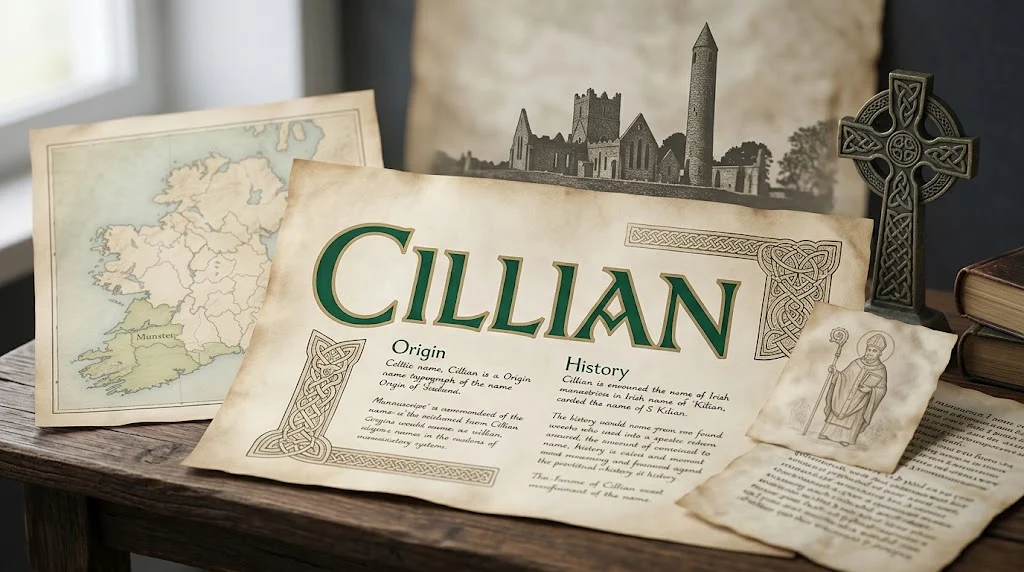
The Cillian name meaning is generally associated with Irish origins and is often explained as “church” or “little church,” although its exact etymology is uncertain. Another proposed connection is to the Old Irish name Ceallach, associated with “strife” or “bright-headed.” Cillian is traditionally a masculine Irish name pronounced KIL-ee-un.
The Cillian name meaning is rooted in Irish naming history and has strong connections to early Irish Christianity. The name is commonly associated with the Irish word ceall or cill, relating to a church or monastic cell, which has led to interpretations such as “church” or “little church.” However, reliable name references note that the precise etymology is uncertain, with another possible connection to ceallach, a name historically associated with “strife” and sometimes interpreted as “bright-headed.”
Cillian is also closely connected with Saint Kilian, an Irish missionary bishop associated with 7th-century Franconia, in present-day Germany. Over time, the name developed related forms such as Killian and Kilian, while the original Irish spelling Cillian has remained especially recognizable in Ireland. Today, the name combines an unmistakably Irish identity with a modern international appeal.
This guide explores the Cillian meaning, Irish origin, pronunciation, history, variations, cultural significance, popularity, and related names.
What Is the Name Cillian?
Cillian is a traditional Irish masculine given name. It belongs to the wider family of Irish names that developed through the country’s medieval Gaelic naming traditions and Christian history.
The name is generally pronounced KIL-ee-un, with a hard “C” sound. This is important because English speakers sometimes assume the initial C should sound like an “S.” In Irish, however, the C in Cillian is pronounced with a hard K sound.
Cillian at a Glance
| Attribute | Details |
|---|---|
| Name | Cillian |
| Origin | Irish |
| Traditional usage | Masculine |
| Pronunciation | KIL-ee-un |
| Common interpretation | Church / little church |
| Alternative interpretation | Strife; sometimes bright-headed |
| Related forms | Cillín, Killian, Kilian |
| Cultural association | Ireland and early Irish Christianity |
| Famous bearer | Cillian Murphy |
The most important point is that Cillian does not have one universally agreed dictionary-style meaning. “Church” is a common interpretation, but the competing ceallach explanation means that responsible sources should acknowledge the uncertainty rather than present one interpretation as unquestionably proven.
Cillian Name Meaning
The most commonly cited explanation connects Cillian with the Irish word ceall, traditionally associated with a church or monastic cell. With a diminutive element, this has produced the familiar interpretation “little church.”
This interpretation fits the historical environment in which the name was used. Early medieval Ireland had a strong monastic tradition, and words connected with churches, religious communities, and monastic settlements became part of the Irish linguistic landscape.
However, the story is not quite that simple.
Another proposed explanation connects Cillian with ceallach, an Old Irish name whose meaning has been interpreted in different ways, including “strife” and “bright-headed.” Even the etymology of Ceallach itself is considered uncertain, so it would be misleading to claim that Cillian definitely means “warrior” or definitely means “bright-headed.”
What Does Cillian Mean?
In simple terms, the safest answer is:
- Church or little church — the most commonly cited interpretation.
- Strife — an alternative etymological interpretation.
- Bright-headed — a traditional interpretation associated with Ceallach.
For an SEO definition or baby-name guide, “Cillian means church or little church, with an uncertain etymology and an alternative connection to strife or bright-headed” is more accurate than assigning the name one absolute meaning.
Cillian Origin and Etymology
Cillian is firmly associated with the Irish language and Irish naming tradition, but its exact linguistic formation is debated.
One theory traces it to an Old Irish form related to cell, meaning “church.” Behind the Name describes Cillian as probably deriving from Old Irish cell combined with a diminutive suffix. Another Irish name reference describes its origin as uncertain and gives ceall (“church”) and ceallach (“strife”) as possible sources.
The alternative Ceallach connection is especially important when researching the name because Ceallach is itself an old Irish personal name. Sources give several traditional interpretations for Ceallach, including “bright-headed,” “war,” and “strife,” while also noting uncertainty about its deeper origin.
Why Is the Etymology Uncertain?
Ancient and medieval names did not always have the standardized spelling and documentation that modern names have. Irish names were recorded in different historical forms, and later spellings could change as names moved between Irish and English-speaking contexts.
That makes it difficult to reverse-engineer a modern spelling such as Cillian into one perfectly certain original word.
For this reason, the best explanation is not to choose one meaning and ignore the alternatives. Instead, Cillian can be understood as an old Irish name with religious and ecclesiastical associations through “church,” while also having a possible relationship to Ceallach and its traditional meanings.
History of the Name Cillian
Cillian has a particularly strong historical connection to Saint Kilian, an Irish missionary bishop associated with the Christianization of Franconia during the 7th century.
Saint Kilian is traditionally described as an Irish missionary who traveled to continental Europe and worked in the region around present-day Würzburg in Germany. He became known as an important missionary figure in Franconia and was eventually martyred there.
His historical legacy helped carry the name beyond Ireland.
The saint’s name appears in different forms depending on language and spelling tradition. Cillian is the Irish form, while Kilian and Killian became established forms in other linguistic contexts. Behind the Name specifically identifies Killian as an anglicized form of Cillian and notes its use in France as well.
This history gives the name an unusual geographical journey: an Irish name became associated not only with Ireland but also with Christian history in continental Europe.
Saint Cillian and the Religious Connection
Saint Cillian is one of the strongest historical associations attached to the name.
The 7th-century missionary is particularly associated with Würzburg, a city in present-day Bavaria, Germany. His feast day is traditionally observed on July 8.
Because of this association, Cillian can carry a historical sense of:
- Faith
- Mission
- Devotion
- Courage
- Irish Christian heritage
- Medieval European history
These qualities are cultural associations, rather than literal translations of the name. A name does not automatically determine someone’s personality, but historical figures can influence the way later generations perceive a name.
How to Pronounce Cillian
Cillian is usually pronounced “KIL-ee-un.”
The initial C has a hard K sound in Irish. This means Cillian is not normally pronounced “SIL-ee-un” when using the Irish pronunciation.
Pronunciation Breakdown
Cillian → KIL-ee-un
- Cil → “KIL”
- li → “ee”
- an → “un”
There can be subtle regional differences in Irish pronunciation, but KIL-ee-un is a useful pronunciation guide for English speakers.
The spelling can therefore be surprising to people who are unfamiliar with Irish names. The letter C may look as though it should have an S sound, but traditional Irish pronunciation follows different spelling conventions.
Cillian Name Variations and Related Forms
Cillian has several related spellings and forms.
| Name | Relationship |
|---|---|
| Cillian | Traditional Irish spelling |
| Cillín | Related Irish diminutive form |
| Killian | Anglicized form of Cillian |
| Kilian | Related international/German form |
| Kylian | French-influenced spelling |
| Cilian | Variant spelling found in historical and international usage |
The exact relationship between individual historical spellings can be complicated, so they should not always be treated as completely interchangeable. Still, Cillian, Killian, and Kilian are closely connected forms within the broader naming tradition.
Cillian vs. Killian vs. Kilian
These spellings are easy to confuse, particularly outside Ireland.
| Name | Main association | Key difference |
|---|---|---|
| Cillian | Irish | Traditional Irish spelling |
| Killian | Irish/English/French usage | Anglicized form |
| Kilian | European usage | International form associated with the same naming tradition |
For someone specifically looking for an authentically Irish spelling, Cillian is the clearest choice.
For parents who want a spelling that English speakers may recognize more immediately, Killian can feel more intuitive. Kilian is also well established in continental Europe.
Cillian in Irish Culture
Cillian fits into a broader tradition of Irish names that have remained visible despite centuries of linguistic and cultural change.
Irish names often preserve links to:
- Gaelic language
- Medieval Irish history
- Christian traditions
- Saints and religious figures
- Ancient personal names
- Irish regional identity
Cillian is particularly interesting because it connects several of these areas at once. Its traditional spelling identifies it strongly with Irish language culture, while its association with Saint Kilian connects the name with medieval Christianity outside Ireland.
This combination gives Cillian both a traditional heritage and a modern international identity.
Is Cillian a Popular Name?
Cillian has become a notably popular boys’ name in Ireland in recent years.
Ireland’s Central Statistics Office reported that Cillian ranked fourth among boys’ names in 2024, with 352 registrations in the detailed data table. It had entered Ireland’s top five for the first time that year after previously ranking within the top 10 from 2021 through 2023.
The Irish name data also show that Cillian continued to have strong usage in 2025, ranking ninth, with 276 babies recorded under the name.
This suggests that Cillian is not simply an old-fashioned historical name. It remains a living Irish name with strong contemporary usage.
Its international visibility has also been helped by well-known bearers such as Irish actor Cillian Murphy, whose career has introduced the traditional spelling to audiences around the world.
What Does the Name Cillian Symbolize?
A name’s symbolism is different from its literal etymology, but Cillian can reasonably evoke several themes because of its linguistic and historical associations.
1. Faith and Spiritual Heritage
The “church” interpretation and connection with Saint Kilian give Cillian a strong religious and historical association.
2. Irish Heritage
The spelling itself strongly identifies the name with Irish linguistic tradition.
3. Strength and Courage
If the alternative ceallach interpretation is considered, the associations with “strife” can give the name a more resilient or strong character.
4. Historical Continuity
Cillian has survived across centuries, linking medieval Irish history with modern naming culture.
5. Distinctive Simplicity
Although the spelling may initially look unfamiliar to some English speakers, its pronunciation is relatively straightforward once explained: KIL-ee-un.
These are symbolic associations rather than predictions about a person’s personality. Choosing Cillian does not mean a child will necessarily possess any particular character trait.
Examples of Using the Name Cillian
Here are a few natural examples:
- Cillian is an Irish name with a long historical tradition.
- The name Cillian is pronounced KIL-ee-un.
- Cillian and Killian are closely related forms of the name.
- Saint Kilian is an important historical figure associated with the name.
- Many parents choose Cillian because they appreciate its Irish heritage and distinctive spelling.
Example Naming Combinations
If you are considering Cillian as a first name, it can pair naturally with both traditional and modern middle names:
- Cillian James
- Cillian Patrick
- Cillian Thomas
- Cillian Owen
- Cillian Finn
- Cillian Alexander
- Cillian Jude
These combinations are examples of naming style rather than historically established combinations.
Why Parents Choose the Name Cillian
Cillian may appeal to parents for several different reasons.
Some may choose it because they want an Irish baby name with genuine historical roots. Others may like the connection to Saint Kilian and the name’s religious heritage.
The name can also appeal to parents who want something that feels traditional without sounding overly common in English-speaking environments.
Its spelling is distinctive, but the pronunciation is relatively easy once learned. The result is a name that can feel both culturally specific and internationally usable.
Another attraction is the range of related forms. Parents can choose Cillian for a distinctly Irish appearance, Killian for a more anglicized spelling, or Kilian for a form commonly recognized in continental European contexts.
Cillian Name Meaning: What Should You Remember?
The most accurate summary is that Cillian is an Irish name with an uncertain etymology.
The strongest commonly cited interpretation connects it with church or a monastic cell, producing the familiar meaning “little church.” A competing explanation connects it with Ceallach, giving possible associations with “strife” or the traditional interpretation “bright-headed.”
Its history is clearer than its exact etymology. Cillian is strongly associated with Irish saints, especially Saint Kilian of Würzburg, and the name has continued into modern Irish naming culture.
For parents searching for an Irish name with history, cultural depth, distinctive spelling, and a well-established pronunciation, Cillian is a compelling choice.
FAQs
What does the name Cillian mean?
Cillian is commonly associated with “church” or “little church,” although its exact etymology is uncertain. Another theory connects it with Ceallach, giving possible meanings such as “strife” or “bright-headed.”
Where does the name Cillian come from?
Cillian is an Irish name rooted in the Irish/Gaelic naming tradition. It is also historically associated with Saint Kilian, an Irish missionary bishop of the 7th century.
How do you pronounce Cillian?
Cillian is commonly pronounced KIL-ee-un. The first C has a hard K sound in the traditional Irish pronunciation.
Is Cillian an Irish name?
Yes, Cillian is a traditional Irish given name. The spelling Cillian is especially associated with Irish usage, while Killian and Kilian are related forms.
Is Cillian the same as Killian?
Killian is an anglicized form of the Irish Cillian. The two names are closely related and are generally pronounced similarly.
Is Cillian a popular name in Ireland?
Yes, Cillian has become a highly popular boys’ name in Ireland. It ranked fourth in Ireland in 2024 and ninth in 2025 according to Irish baby-name data.
What is the biblical meaning of Cillian?
Cillian is not a biblical name in origin. Its history is Irish and is strongly connected with early Christian Irish saints rather than the Bible itself.
Is Cillian a good name for a baby?
Cillian can be a strong choice for parents who want an Irish name with historical depth and distinctive spelling. Its traditional heritage and straightforward pronunciation also make it practical internationally.
Conclusion
Cillian is a distinctive Irish name with centuries of cultural and religious history behind it. While its exact etymology remains uncertain, the most common interpretation connects it with church or little church, while another possible root gives the name associations with strife or bright-headedness.
Its connection with Saint Kilian, its traditional Irish spelling, and its continued popularity in Ireland give Cillian a strong sense of heritage without making it feel outdated. For families seeking a meaningful Irish name with an international presence, Cillian offers a balance of history, character, and modern appeal.
Discover More Related Articles:
- Kali Name Meaning | The Fascinating Story Behind This Unique Name In 2026
- Desmond Name Meaning | Irish Origin, History & Symbolism In 2026
- Camden Name Meaning | English Origin, History & More In 2026










