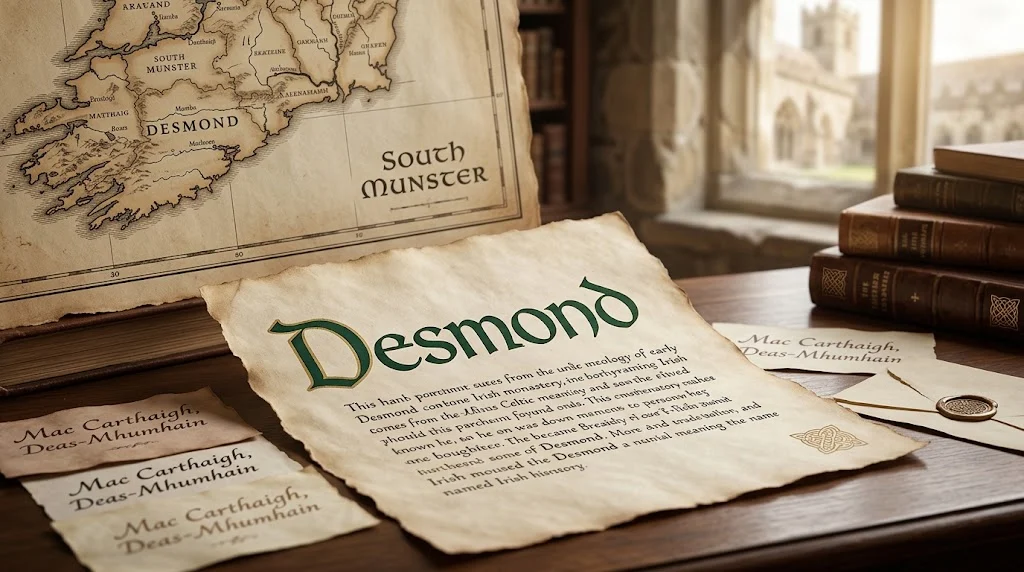
The Desmond name meaning is closely connected to the Irish place-name Deasmhumhain, meaning “South Munster.” Desmond originally referred to a historic region and kingdom in southern Ireland and later developed into a surname and masculine given name.
The name carries strong associations with Irish heritage, regional identity, history, and tradition. In this guide, we explore the Desmond name meaning, Irish origin, pronunciation, history, cultural background, variants, symbolism, and modern usage.
What Is the Desmond Name?
Desmond is a masculine given name of Irish and English usage. It is an anglicized form of the Irish Deasmhumhain, the name of a historic region in southern Ireland. The same place-name is generally translated as “South Munster.” Desmond also developed as a surname for people associated with that region.
Unlike names whose meanings describe a personal quality such as “strong,” “wise,” or “brave,” Desmond has a geographical origin. Its original significance identifies a place and, by extension, someone connected with that place.
This makes Desmond part of an important naming tradition in which surnames and given names developed from locations, regions, occupations, ancestry, or geographical identity.
Desmond at a glance
- Name: Desmond
- Gender: Traditionally masculine
- Usage: English and Irish
- Origin: Irish
- Irish form: Deasmhumhain
- Primary meaning: “South Munster”
- Type of meaning: Geographical/place-name
- Related surname: Desmond
- Irish shortened form: Deasún
- Common pronunciation: DEZ-mənd /ˈdɛz.mənd/
Desmond Name Meaning
The Desmond name meaning is “South Munster.” The meaning comes from the Irish place-name Deasmhumhain, which referred to a region in southern Ireland and historically to the kingdom of Desmond.
The meaning is therefore best understood as a regional or geographical reference, rather than a description of personality.
In older Irish naming traditions, a geographical designation could identify where a person came from or where a family was associated. This explains how a place-name could eventually become a surname and later be adopted as a given name.
What does “South Munster” mean?
Munster is one of Ireland’s historic provinces. Desmond was associated with the southern part of Munster, particularly areas corresponding broadly to parts of modern southwestern Ireland.
The Irish place-name Deasmhumhain is explained as being formed from Irish deas, meaning “south,” and Mumhain, the Irish name associated with Munster. The place-name was later anglicized as Desmond.
So the semantic development can be represented simply as:
Deasmhumhain → Desmond → “South Munster” → regional surname → given name
This geographical connection gives Desmond a distinctive meaning rooted in Irish history.
Desmond Name Origin and Etymology
The origin of Desmond is Irish, specifically connected to the historical place-name Deasmhumhain. Behind the Name identifies Desmond as an anglicized form of Deasmhumhain, meaning “south Munster.”
The name’s development is important because Desmond is not simply an old personal name whose original meaning has been forgotten. Its history is tied to a real geographic region in Ireland.
The related Irish surname Ó Deasmhumhnaigh also played a role in the development of Desmond as a family name. Patrick Woulfe’s Irish Names and Surnames describes Deasmhumhnach as an old Irish designation for a native of, or someone belonging to, Desmond or South Munster.
The surname form Ó Deasmhumhnaigh is likewise described as referring to a descendant of someone from Desmond or South Munster.
This gives the name two closely connected pathways:
- Place-name: Deasmhumhain → Desmond
- Surname: Ó Deasmhumhnaigh → Desmond
Over time, Desmond became established as a masculine given name in English and Irish usage.
History and Cultural Background of Desmond
The history behind Desmond goes much deeper than its use as a modern first name. Desmond was the name of a historic region and kingdom in southern Ireland. According to Behind the Name, the kingdom of Desmond emerged in connection with the partition of the larger kingdom of Munster.
Because of this historical background, the word Desmond originally carried a strong geographical identity. It referred to a particular part of Ireland rather than to an abstract quality.
Desmond as a historic region
The region of Desmond was associated particularly with southwestern Ireland. Historical sources describe Desmond or South Munster as covering substantial areas of what are now parts of counties such as Cork and Kerry, with its historical boundaries changing over time.
The region also became important in medieval and early modern Irish political history. The FitzGerald family became closely associated with Desmond and held the title Earl of Desmond.
The earldom became particularly significant during the political conflicts of the sixteenth century. The Desmond Rebellions of 1569–1573 and 1579–1583 were major conflicts involving the FitzGeralds of Desmond and the expanding authority of the English Crown in Munster.
These events helped make the word Desmond historically prominent beyond its original geographical meaning.
The Desmond identity
Because of its association with South Munster, the name can evoke several layers of Irish heritage:
- Southwestern Ireland
- Munster
- Medieval Irish history
- Regional identity
- Irish surnames
- The FitzGeralds of Desmond
- Gaelic and Anglo-Irish history
It is important, however, to distinguish historical associations from the literal etymological meaning. Desmond literally refers to South Munster; ideas such as strength, nobility, resilience, or tradition are later cultural associations rather than dictionary meanings of the name.
Desmond as a Surname
Before becoming familiar as a first name, Desmond had an important connection with Irish surname tradition.
The surname Desmond can be an anglicized form of Ó Deasmhumhnaigh, associated with a person descended from or connected to someone from Desmond or South Munster.
This is a common pattern in Irish naming history. A geographical identity can become a hereditary family designation, and a surname can eventually be adopted as a personal name.
Other English-language given names have followed similar surname-to-first-name paths. In Desmond’s case, however, the original place-name remains especially important because it explains the name’s underlying meaning.
Desmond Pronunciation
Desmond is commonly pronounced DEZ-mənd, with the stress on the first syllable.
The standard English pronunciation is represented as /ˈdɛz.mənd/.
For a simple pronunciation guide, you can say:
Desmond = DEZ-mund
The Irish-related form Deasún is also associated with Desmond and is described as an Irish shortened form of Deasmhumhain.
Desmond Name Variations and Related Forms
Desmond has several historically or linguistically related forms.
| Name | Relationship | Notes |
|---|---|---|
| Desmond | English/Irish form | Anglicized form associated with Deasmhumhain |
| Deasmhumhain | Irish place-name | Means “South Munster” |
| Deasún | Irish form | Shortened form of Deasmhumhain |
| Ó Deasmhumhnaigh | Irish surname | Surname associated with someone from Desmond |
| Des | Short form | Common informal shortening of Desmond |
The spelling Desmond is the form most familiar to English speakers today. The Irish forms help reveal the name’s linguistic and historical roots rather than functioning simply as alternative spellings.
What Does Desmond Symbolize?
The literal meaning of Desmond is geographical, but names can acquire broader symbolic associations through their history and cultural use.
Desmond can symbolically suggest:
- Irish heritage because of its direct Irish origin
- Regional identity because it originally referred to South Munster
- Historical depth because Desmond was a historic region and kingdom
- Tradition because the name has a long surname and place-name history
- Connection to ancestry because the surname identified people associated with a particular region
These are best understood as modern interpretations or cultural associations, not as additional literal translations.
For parents choosing the name, Desmond can therefore offer something different from a name whose meaning is simply “strong” or “beautiful.” It carries a sense of place and heritage.
Famous People Named Desmond
One of the best-known people with the given name Desmond was Desmond Tutu, the South African Anglican archbishop and human-rights activist. Behind the Name lists him as a notable bearer of the name.
His international prominence helped make Desmond recognizable well beyond Ireland and the United Kingdom.
The name has also appeared across literature, entertainment, music, sports, and popular culture. Because it has a traditional yet recognizable sound, Desmond can work in both historical and contemporary settings.
Examples of Using the Name Desmond
Here are a few natural examples of how Desmond can appear in real naming contexts:
Baby-name example:
“Desmond is a strong choice for parents looking for a traditional name with Irish historical roots.”
Full-name example:
“Desmond James Murphy combines the classic first name with a distinctly Irish family surname.”
Historical context:
“The name Desmond has a direct connection to the historic region of South Munster.”
Personal introduction:
“My name is Desmond, and my parents chose it because they liked its Irish heritage.”
These examples show that Desmond functions naturally as a first name, while its historical background also makes it meaningful as a surname and regional identifier.
Desmond vs. Deasmhumhain vs. Ó Deasmhumhnaigh
These forms are related, but they should not be treated as interchangeable.
| Term | Meaning/Role | How It Differs |
|---|---|---|
| Desmond | Anglicized name/place-name | Modern English form and masculine given name |
| Deasmhumhain | “South Munster” | Irish historical place-name |
| Deasún | Irish shortened form | Shortened Irish form connected with Deasmhumhain |
| Ó Deasmhumhnaigh | Irish surname | Family name associated with a person from Desmond |
The distinction matters because Desmond is simultaneously connected to a place, a surname, and a given name. Its meaning is easiest to understand when these layers are kept separate.
Is Desmond a Good Name?
Desmond can be a strong choice for parents who want a name with historical depth, Irish roots, and a traditional masculine character.
Its biggest appeal is that the meaning has a genuine geographical and historical foundation. Rather than relying on a modern symbolic interpretation, the name connects directly to Deasmhumhain, the historic name associated with South Munster.
It also has a familiar English pronunciation, making it relatively accessible internationally while retaining a clear connection to Irish history.
Is Desmond an Irish Name?
Yes. Desmond is commonly classified as an Irish and English name, with its origin connected to the Irish Deasmhumhain.
It is an anglicized form rather than a simple modern English invention. Its roots go back to the historical geography of southern Ireland.
Modern Appeal of the Name Desmond
Today, Desmond has a classic quality without sounding identical to the most common traditional names.
Its appeal comes from several characteristics:
- It has a recognizable pronunciation.
- It has a documented Irish origin.
- It has geographical and historical depth.
- It works naturally as both a first name and surname.
- It offers the nickname Des.
- It has connections to notable historical and cultural figures.
For parents interested in heritage names, Desmond can therefore provide a balance between traditional roots and modern usability.
FAQs
What does the name Desmond mean?
Desmond means “South Munster,” referring to a historic region of southern Ireland.
Is Desmond an Irish name?
Yes, Desmond is an Irish and English name derived from the Irish Deasmhumhain.
What is the origin of Desmond?
Desmond originates from the Irish place-name Deasmhumhain, associated with South Munster.
How do you pronounce Desmond?
Desmond is commonly pronounced DEZ-mund, represented as /ˈdɛz.mənd/.
Is Desmond a surname?
Yes, Desmond is also an Irish surname connected with people from the historic region of Desmond.
What is the Irish form of Desmond?
Deasún is an Irish shortened form related to Deasmhumhain.
Is Desmond a good baby name?
Desmond can be a strong choice for parents seeking a traditional masculine name with Irish historical roots.
What does Desmond symbolize?
Beyond its literal meaning, Desmond can symbolize Irish heritage, regional identity, tradition, and historical connection.
Conclusion
The Desmond name meaning comes from the Irish Deasmhumhain, meaning “South Munster.” Its roots are geographical rather than descriptive, connecting the name to a historic region and kingdom in southern Ireland. The name later became associated with Irish surname traditions before developing as a masculine given name in English and Irish usage.
With its links to South Munster, Irish history, and generations of surname usage, Desmond carries a strong sense of heritage and place. For anyone researching an Irish baby name, family name, or the history behind the name, Desmond offers a distinctive combination of geography, culture, and historical identity.
Discover More Related Articles:
- Sylvie Name Meaning | Origin, History, Pronunciation & Symbolism In 2026
- Juan Name Meaning | Origin, History, & Cultural Significance In 2026
- Xander Name Meaning | Origin, History, Pronunciation & History In 2026











1 thought on “Desmond Name Meaning | Irish Origin, History & Symbolism In 2026”