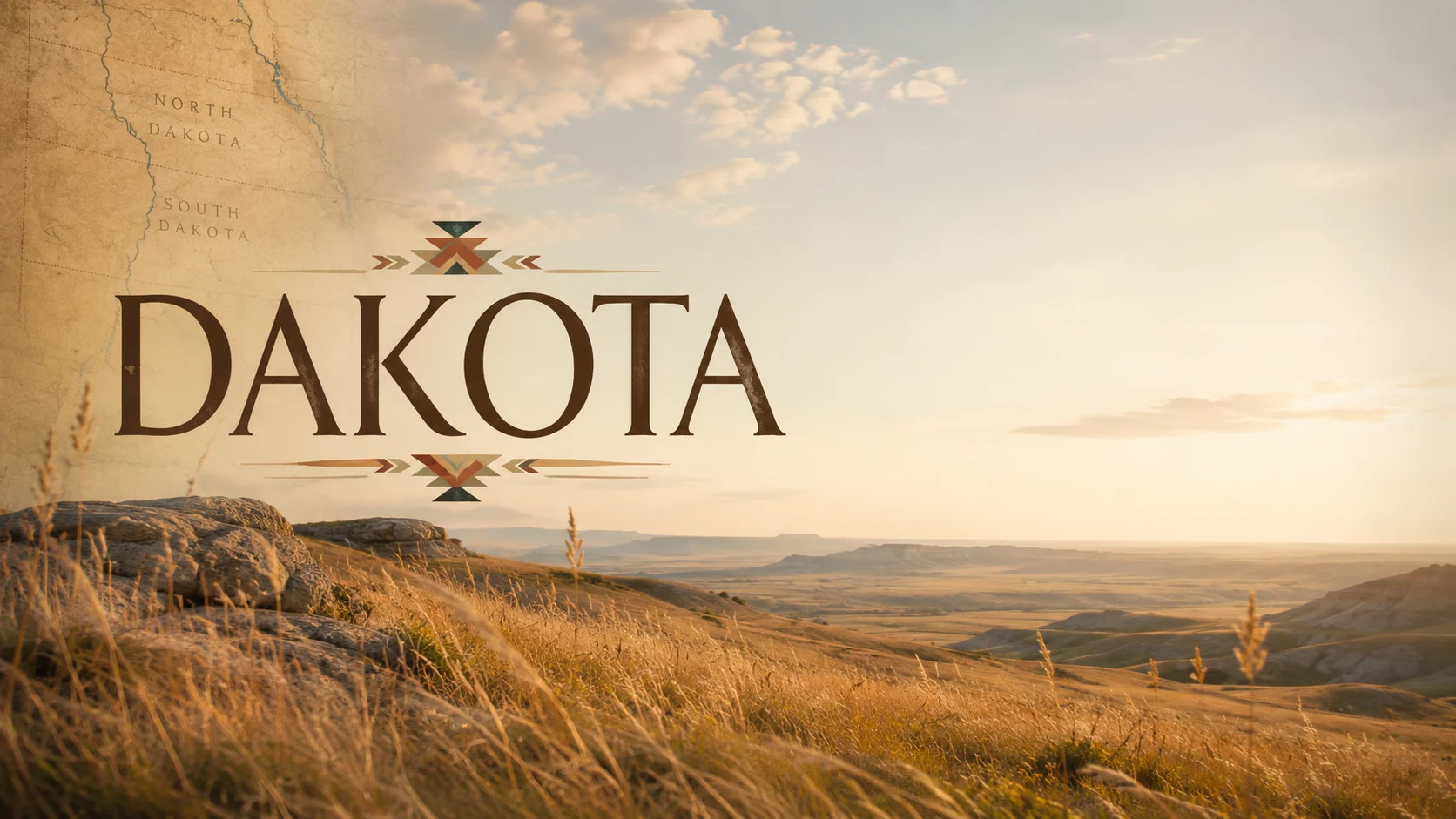
The Dakota name meaning is commonly connected with the Dakota people and is generally understood as “friend” or “ally.” Dakota is a name with strong connections to Indigenous history, the Great Plains, and the Dakota people of North America. Today, it is widely recognized as a gender-neutral given name and is also familiar through the U.S. states of North Dakota and South Dakota.
The name has an interesting journey from an Indigenous ethnonym and geographic designation to a modern first name. Understanding Dakota requires looking beyond a simple baby-name definition because its history is closely tied to language, culture, geography, and the identity of the Dakota people.
What Is the Dakota Name?
Dakota is a given name, surname, and geographic name with Indigenous North American roots. As a personal name, it is generally used for both kids, making it a popular unisex or gender-neutral choice.
The word is particularly associated with the Dakota people, one of the groups historically included within the broader Sioux peoples. The term is also closely related to the linguistic and cultural groupings often described as Dakota, Lakota, and Nakota.
In modern naming, Dakota can therefore carry several associations:
- Friendship and alliance
- Indigenous North American heritage
- The Great Plains
- Strength and independence
- Nature and open landscapes
- American geographic history
- A modern gender-neutral identity
It is important, however, not to treat the name as merely a generic “Native American” word. Dakota has a specific cultural and linguistic connection to the Dakota people, and its history deserves to be represented accurately and respectfully.
Dakota Name Meaning
The most commonly given Dakota name meaning is “friend” or “ally.”
This interpretation comes from the traditional association of the word with a person who is friendly, allied, or connected to a group. Because names can develop through different languages and historical contexts, simplified baby-name definitions should not be treated as a complete explanation of the word’s cultural significance.
As a modern first name, Dakota is often chosen because of the positive qualities associated with the traditional interpretation.
What Does Dakota Mean?
Dakota generally means “friend” or “ally,” and the name is closely connected to the Dakota people of the Great Plains.
The idea of friendship makes Dakota particularly appealing to parents looking for a name with a warm and positive meaning. At the same time, its historical connection gives it a deeper identity than a name selected solely for its pleasant sound.
Symbolic Meaning of Dakota
Beyond the literal interpretation, parents may associate Dakota with qualities such as:
- Friendship
- Loyalty
- Connection
- Cooperation
- Strength
- Independence
- Community
- Resilience
- Natural beauty
- Cultural heritage
These symbolic associations are modern interpretations rather than additional literal translations of the name.
Dakota Name Origin and Etymology
The origin of Dakota is connected to the Dakota language and the Dakota people, who have longstanding cultural and historical ties to the Great Plains of North America.
The term Dakota is part of a larger linguistic and cultural relationship involving Dakota, Lakota, and Nakota. These names are associated with related varieties of the Siouan language family and with peoples whose histories are intertwined across the northern Great Plains.
The word’s commonly cited sense of “friend” or “ally” helps explain why the name has such a positive modern interpretation.
However, etymology can be more complicated than the short definitions found on baby-name websites. The Dakota people are not simply a historical source for a modern name. Dakota is also a living cultural identity, and the language continues to be important to Dakota communities.
Is Dakota a Native American Name?
Yes. Dakota is directly associated with the Dakota people, an Indigenous people of North America.
That makes Dakota different from names that are merely described as having a vague “Native American” origin. Its cultural background can be traced to a particular Indigenous people and their language and history.
When choosing Dakota as a baby name, it is useful to understand this background rather than relying only on the simplified definition “friend.”
History and Cultural Context of Dakota
The Dakota people have deep historical connections to the Great Plains and surrounding regions of North America. Their history predates the creation of the modern United States and the eventual naming of U.S. states after the Dakota people.
Dakota communities have historically lived across areas that now include parts of the Upper Midwest and Great Plains. Their experiences include complex relationships with neighboring Indigenous nations, European settlers, and the expanding United States.
The word Dakota consequently became significant not only as an ethnic and linguistic designation but also as a geographic name.
Dakota and the Great Plains
The Great Plains are central to understanding the cultural context of the name.
The region is characterized by expansive grasslands and has been home to numerous Indigenous nations for centuries. The Dakota people developed social, political, economic, and cultural traditions within this broader environment.
Because of this history, the name Dakota may evoke modern associations with:
- Wide-open plains
- Prairie landscapes
- Indigenous heritage
- Community
- Traditional culture
- American frontier history
These associations are connected to the name’s historical context, although they should not be confused with its literal meaning.
Dakota, Lakota, and Nakota
One important distinction is the relationship among Dakota, Lakota, and Nakota.
These terms refer to related peoples and linguistic varieties within the broader Sioux cultural and linguistic world. Historical classification can be complicated, and different sources may use the terms somewhat differently.
A simplified way to understand the relationship is:
| Term | General association |
|---|---|
| Dakota | Dakota peoples and their language varieties |
| Lakota | Lakota peoples and their language |
| Nakota | Related peoples and linguistic varieties |
| Sioux | A broader historical term used for several related groups |
These identities should not be treated as interchangeable in every context. Each community has its own history and identity.
Why Is Dakota Used as a Baby Name?
Dakota became increasingly recognizable as a personal name in modern English-speaking societies partly because of its geographic associations and distinctive sound.
Unlike many traditional first names, Dakota can function comfortably for both males and females. Its two-syllable pronunciation also makes it easy to say and remember.
Parents may choose Dakota because they like:
- Its gender-neutral quality
- Its connection to the American landscape
- Its positive meaning
- Its distinctive sound
- Its short spelling
- Its strong cultural associations
- Its modern feel
- Its connection to place names
The name can feel both contemporary and traditional, depending on how it is perceived.
Is Dakota a Boy or Girl Name?
Dakota is generally considered a unisex or gender-neutral name.
It has been used for both kids, although its popularity can vary by country, generation, and gender.
This flexibility is one reason Dakota remains appealing to parents who want a name without a strongly gendered ending or traditional male/female classification.
Dakota as a Girl Name
For girls, Dakota often has a modern, energetic quality. It can fit alongside other contemporary names inspired by places, nature, or distinctive geographic terms.
Dakota as a Boy Name
For boys, Dakota has a strong and outdoors-oriented character. Its association with the Great Plains can also give it a rugged American feel.
There is no requirement that Dakota be restricted to one gender. Its established use as a given name for both sexes supports its classification as unisex.
Dakota Name Pronunciation
The most common English pronunciation of Dakota is:
duh-KOH-tuh
It has three syllables:
Da-Ko-Ta
The middle syllable usually receives the strongest emphasis.
For English speakers, the pronunciation is generally straightforward, which contributes to the name’s accessibility as a modern first name.
However, pronunciation and usage can vary depending on the language and community in which the word is being spoken. A modern English pronunciation should not automatically be assumed to represent the pronunciation used in every Dakota-language context.
Dakota as a Place Name
Dakota is perhaps most widely recognized geographically through North Dakota and South Dakota.
The two U.S. states were admitted to the Union in 1889 and retained the Dakota name, reflecting the region’s historical Indigenous associations.
This geographic use has had a major influence on how English speakers perceive Dakota today.
For many people, hearing “Dakota” immediately brings to mind:
- The Great Plains
- Prairie landscapes
- North Dakota
- South Dakota
- American geography
- Western and Midwestern culture
The place-name connection is one reason Dakota can feel simultaneously like a personal name and a geographic name.
Dakota as a Surname
Dakota can also appear as a surname, although it is much more recognizable to many people as a given name or geographic term.
Like many place-associated surnames, its use as a family name can reflect historical connections to a location, community, or ancestral identity. The exact origin of a particular person’s surname should be established through genealogical records rather than assumed from the meaning of the word alone.
Cultural Significance of the Dakota Name
The cultural significance of Dakota deserves particular attention because it is connected to a living Indigenous people.
Using Dakota solely as a fashionable label can overlook the history behind the word. The name has cultural, linguistic, and historical significance that extends beyond its use in contemporary baby naming.
A respectful understanding recognizes that:
Dakota is not simply a word meaning “friend.” It is also a name associated with a people, languages, communities, and a long history in North America.
This distinction is especially important when discussing Indigenous names. Short baby-name definitions can provide a starting point, but they cannot capture the complete cultural context.
Famous People Named Dakota
Dakota is now familiar internationally as a personal name, partly because of well-known people who have it.
One prominent example is Dakota Fanning, the American actress known for films and television work beginning from a young age. Another is Dakota Johnson, an American actress known for her work in film and television.
Their visibility has helped make Dakota familiar to audiences who may not otherwise encounter it as a first name.
It is worth noting that the popularity of a name should not be attributed to a single celebrity without reliable evidence. Famous bearers can increase recognition, but naming trends usually develop through multiple cultural influences.
Names Similar to Dakota
If you like Dakota because of its sound, meaning, or modern style, several other names may appeal to you.
Similar in Sound
- Daley
- Dallas
- Dakota
- Delaney
- Koda
- Kody
- Koda
Similar in Style
- Aspen
- Phoenix
- Denver
- Savannah
- Sierra
- River
- Montana
- Jordan
Many of these names share Dakota’s modern, geographic, or nature-inspired quality, although they do not necessarily share the same linguistic origin or meaning.
Dakota vs. Lakota
Dakota and Lakota are related but should not simply be treated as two spellings of the same name.
| Name | General meaning or association | Main distinction |
|---|---|---|
| Dakota | Commonly associated with “friend” or “ally” | Connected specifically with Dakota peoples and language |
| Lakota | Associated with Lakota people and language | Refers to a distinct but closely related cultural and linguistic identity |
| Nakota | Associated with related Indigenous communities | Another related identity and linguistic designation |
The three terms belong to a closely connected historical and linguistic context, but each has its own significance.
Is Dakota a Good Baby Name?
Dakota is a good baby name depends on your personal preferences, but it has several qualities that make it appealing.
Advantages include:
- Easy to pronounce in English
- Works for kids
- Has a positive traditional interpretation
- Strong geographic associations
- Distinctive without being extremely complicated
- Connected to significant North American history
The main consideration is cultural awareness. Because Dakota has a direct connection to an Indigenous people, parents should understand and respect that background rather than treating the name as an invented modern nature name.
What Personality Is Associated With the Name Dakota?
Name personality descriptions are not scientific predictions. A person’s name does not determine their character.
Still, popular naming culture often associates Dakota with qualities such as:
- Friendly
- Independent
- Confident
- Adventurous
- Loyal
- Strong-minded
- Sociable
- Open-hearted
- Creative
- Resilient
These are symbolic associations rather than established personality traits.
Common Questions About the Dakota Name
What does Dakota mean?
Dakota is commonly interpreted as “friend” or “ally.” The name is closely associated with the Dakota people of North America and has a deeper cultural and linguistic history beyond its simplified baby-name meaning.
Is Dakota a Native American name?
Yes. Dakota is directly connected with the Dakota people, an Indigenous people of North America. The term is also associated with Dakota languages and the broader historical and cultural world of the Great Plains.
Is Dakota a unisex name?
Yes. Dakota is widely used as a gender-neutral or unisex given name. It has been given to both kids, making it a flexible choice for modern parents.
How do you pronounce Dakota?
In common English usage, Dakota is pronounced duh-KOH-tuh, with three syllables. Pronunciation may differ in Indigenous-language contexts, so the English pronunciation should not be assumed to represent every Dakota-language pronunciation.
What is the origin of the name Dakota?
Dakota has Indigenous North American roots and is associated specifically with the Dakota people and Dakota languages. The name later became familiar as a geographic term through North Dakota and South Dakota.
Is Dakota related to Lakota?
Yes. Dakota and Lakota belong to a closely related linguistic and cultural context. However, they identify different communities and should not automatically be treated as interchangeable names.
Is Dakota a good name for a girl?
Yes. Dakota has long been used as a girl’s name and is commonly recognized as gender-neutral. Its modern sound and geographic associations make it an appealing choice for many parents.
Is Dakota a good name for a boy?
Yes. Dakota is also established as a boy’s name. Its association with the Great Plains can give it an outdoorsy or strong modern character.
What names are similar to Dakota?
Names such as Aspen, Dallas, Montana, Phoenix, River, Sierra, Jordan, and Denver can have a similar modern, geographic, or gender-neutral feel. Their origins and meanings, however, are different from Dakota.
FAQs
What does Dakota mean in a name?
Dakota is commonly said to mean “friend” or “ally.” It is also directly associated with the Dakota people and their linguistic and cultural heritage.
Is Dakota a boy or girl name?
Dakota is a unisex name used for both kids. Its gender-neutral character is one of its most recognizable modern naming features.
What is the origin of Dakota?
Dakota has Indigenous North American origins and is specifically connected with the Dakota people and Dakota languages of the Great Plains.
Does Dakota mean friend?
Yes. “Friend” or “ally” is the common English-language interpretation associated with the name Dakota.
Is Dakota a rare name?
Dakota is not generally considered an obscure name in the United States. Its recognition comes from both personal-name usage and the geographic names North Dakota and South Dakota.
Conclusion
The Dakota name meaning is most commonly given as “friend” or “ally,” but the name carries much more history than that short definition suggests. Dakota is closely connected to the Dakota people, their languages, the Great Plains, and the geographic history of North Dakota and South Dakota.
As a modern first name, Dakota stands out because it is distinctive, easy to recognize, and comfortably gender-neutral. Its Indigenous cultural background also makes it a name worth understanding respectfully rather than viewing only as a fashionable baby-name choice.