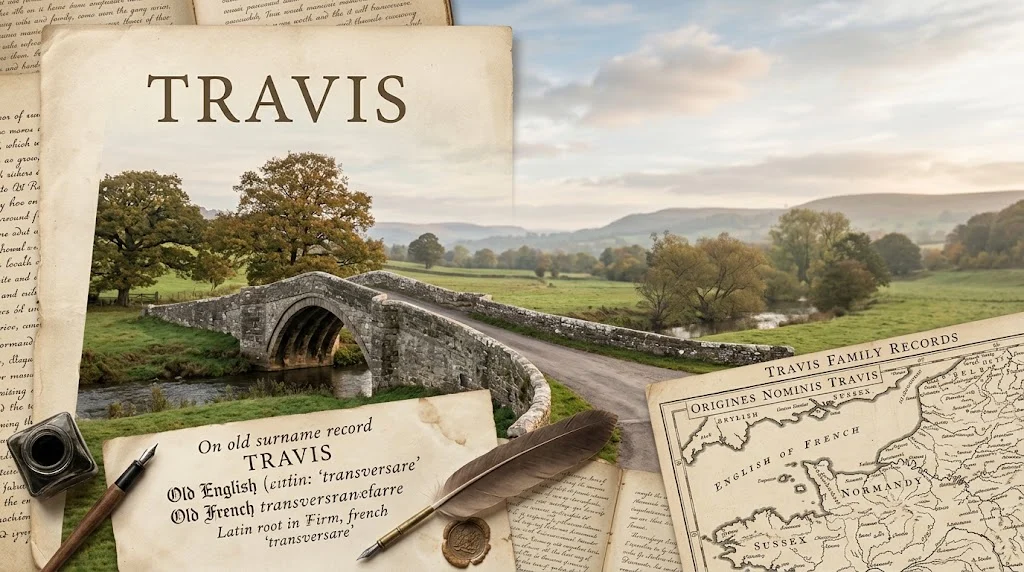
Travis is an English masculine given name derived from the English surname Travis, which has roots in Old French and Middle English. It is generally connected with the idea of “to cross,” “crossing,” or “passage,” and historically may have referred to someone who lived near a crossing place or was associated with a toll for crossing a bridge or boundary.
The name has a distinctly English-language history but ultimately reflects Norman French linguistic influence. Over time, Travis developed from a surname into an established first name, particularly in English-speaking communities.
Its history also became associated in the United States with William B. Travis, a commander at the Battle of the Alamo.
What Is the Travis Name?
Travis is traditionally a masculine English given name that originated from a surname. Unlike names that began as personal names in ancient religious or mythological traditions, Travis belongs to the large group of English first names that developed from family names.
The surname has a complicated etymological history. Family-history sources connect it with Old French and Middle English forms such as travers, travas, and travis. These words could be associated with crossing, passage, movement across a boundary, or a toll connected with crossing.
As a first name, Travis is now understood primarily as a personal name rather than as a literal description of a person’s occupation or location.
Basic Travis Name Profile
| Attribute | Details |
|---|---|
| Name | Travis |
| Gender | Traditionally masculine |
| Usage | English |
| Name type | Surname-derived given name |
| Primary linguistic connection | Old French and Middle English |
| Commonly cited meaning | “To cross” / “crossing” |
| Pronunciation | TRAV-is |
| Historical surname connection | Travis |
| Related form | Travers |
The exact historical meaning should be treated with some care because surname etymologies can have more than one possible explanation. The available evidence supports a connection with crossing or passage, while some sources also identify meanings associated with a toll or with a person living near a crossing place.
Travis Name Meaning
The most commonly cited interpretation of the Travis name meaning is “to cross.” This explanation comes from the connection between the English surname Travis and the Old French verb traverser, meaning “to cross.”
The broader surname history gives the meaning additional context. Old French and Middle English words related to travers and travis could refer to a crossing or passage. They could also describe movement across something, such as a boundary or bridge. In some interpretations, the surname could have identified a person who lived near such a crossing or someone connected with a toll charged for crossing it.
This makes crossing, passage, and movement the most useful concepts for understanding the name historically.
It is important, however, not to turn these historical associations into a modern personality definition. A name’s etymological meaning does not scientifically determine a person’s character. For someone choosing Travis for a baby, its historical association with crossing can be appreciated as a linguistic or symbolic idea rather than as a prediction about personality.
What Does Travis Mean?
In its simplest form, Travis means “to cross” and is associated with the ideas of crossing, passage, or a place of crossing. The name developed from a surname with Old French and Middle English connections.
Travis Name Origin and Etymology
The origin of Travis is particularly interesting because the name represents the movement of words between languages and naming traditions.
The surname Travis is associated with English usage, especially historically in parts of England such as Lancashire and Yorkshire. Family-history sources trace it to Old French and Middle English vocabulary.
Old French Influence
One commonly cited source for the name is the Old French word traverser, meaning “to cross.” The English given name Travis is described as coming from the English surname Travis, which itself developed from this linguistic source.
This is consistent with the historical influence of Norman French on English vocabulary and surnames. After the Norman Conquest, French-language influences became deeply embedded in English society, including personal and family naming traditions.
Middle English Forms
The surname’s history also includes Middle English forms such as travas and travis. These forms were associated with words that could have several meanings, including ideas related to crossing, sideways movement, disagreement, or tolls associated with crossing a boundary or bridge.
Because medieval surnames were often formed from occupations, locations, physical features, or activities, there may not be a single explanation that applies to every historical Travis family.
Why the Etymology Has Several Interpretations
The history of Travis illustrates why surname etymology should not always be reduced to one dictionary definition.
Historical sources identify several possibilities:
- A person associated with a crossing or passage
- Someone who lived near a crossing place
- Someone who paid or collected a toll for crossing
- A word associated with crosswise or sideways movement
- A surname connected with a Norman French or English place-name tradition
For modern name research, “to cross” or “crossing” is the clearest short explanation, while the broader possibilities provide useful historical context.
History of the Name Travis
Travis first has to be understood as a surname before it became a common given name. This surname-to-first-name transition is a familiar pattern in English naming history.
Names such as Carter, Parker, Cooper, Taylor, Hunter, and Travis demonstrate how English family names can eventually become personal names. The process often involves a surname becoming familiar enough within a culture that parents begin selecting it independently as a first name.
Travis follows this pattern.
The surname was historically connected with English regions and Norman French linguistic influence. Later, the name gained a recognizable place in American naming culture as a masculine first name.
Travis in American History
One notable historical association is William B. Travis, who was born in 1809 and became a commander of the Texan forces at the Battle of the Alamo in 1836. According to Behind the Name, the use of Travis as an American given name was influenced by this historical figure.
This association is useful when discussing the development of Travis as a first name in the United States, although it should not be interpreted as the sole reason for the name’s use.
Travis as a Modern Given Name
By the 20th century, Travis was firmly established as a masculine given name in the United States. U.S. Social Security Administration historical data show Travis among the more frequently given boys’ names in several decades, including the 1980s, 1990s, and 2000s. For example, the SSA lists Travis at number 42 among male names for the 1980s, number 53 for the 1990s, and number 163 for the 2000s.
These decade rankings describe U.S. birth-name data for those specific periods; they should not be treated as a statement about the name’s popularity in every country or in the present day.
Cultural Meaning and Associations of Travis
The historical meaning of Travis centers on crossing and passage. As a modern personal name, however, its cultural associations come from its use over time rather than from the literal etymology alone.
Because Travis became established as an English-language masculine name, it can carry a familiar, straightforward quality in English-speaking contexts.
Its surname origin also places it within a broader tradition of surname-derived first names. This gives Travis a different historical character from names that originated directly as biblical, Greek, Latin, or mythological personal names.
The name can therefore be understood through three connected layers:
- Linguistic layer: Old French and Middle English roots associated with crossing.
- Surname layer: A historical English family name connected with a crossing, passage, or related activity.
- Given-name layer: A masculine first name adopted from the surname tradition.
These layers help explain why a short modern name can have a relatively complex history.
Travis Pronunciation
Travis is commonly pronounced:
TRAV-is
It has two syllables, with the emphasis on the first syllable.
A simple pronunciation guide is:
TRAV-iss
The pronunciation is relatively consistent in contemporary English, although accents may produce small differences in vowel sounds.
Travis Name Variations and Related Names
Because Travis originated as a surname, its closest historical relationships are found among surname and linguistic forms rather than among traditional nickname families.
Travers
Travers is a related English surname and name form. It shares the broader historical connection with Old French vocabulary concerning crossing or passage.
Travis vs. Trevor
Travis and Trevor sound somewhat similar, but they do not have the same origin.
Trevor comes from a Welsh surname and is associated with Welsh place-name elements, while Travis developed from the English surname Travis with Old French linguistic connections.
Therefore, Travis should not be treated simply as a variant of Trevor.
Travis vs. Similar Names
| Name | General Origin | Main Distinction |
|---|---|---|
| Travis | English surname; Old French/Middle English influence | Associated with crossing or passage |
| Travers | English surname | Closely related historically to crossing terminology |
| Trevor | Welsh/English | Comes from Welsh place-name tradition |
| Trent | English surname | Originally connected with the River Trent |
| Trevor | Welsh surname | Historically associated with Welsh place-name elements |
The important distinction is that similar-looking names do not necessarily share an etymology. Travis has its own surname history and should be researched separately.
Examples of Using the Name Travis
The name can appear in several naming contexts:
- Travis is a traditional masculine English given name.
- Travis was originally connected with an English surname.
- The Travis name meaning is commonly associated with “to cross.”
- The historical surname may have referred to a crossing place or a person connected with crossing.
- Travis and Trevor may sound similar, but their origins are different.
For parents considering the name, a simple naming description could be:
Travis — an English name associated with crossing, passage, and movement, with roots in an English surname influenced by Old French.
Is Travis a Good Name for a Baby?
Travis is suitable for a baby is ultimately a personal decision, but its history gives parents several concrete characteristics to consider.
It is a relatively straightforward name to spell and pronounce in English, has a clear masculine naming tradition, and has the advantage of being both a first name and a surname.
Its historical meaning also provides an interesting concept: crossing from one place to another. Some parents may appreciate this as a symbolic association with journeys, transitions, or movement through life.
At the same time, the literal etymology should remain separate from personality claims. Choosing Travis does not imply that a child will necessarily be adventurous, strong, independent, or any other particular type of person.
Famous Historical Association: William B. Travis
One of the most significant historical figures associated with the name is William B. Travis (1809–1836).
Travis served as a commander of the Texan forces at the Battle of the Alamo. His historical association is specifically relevant to the development of Travis as an American given name.
This provides an important example of how historical people can influence the cultural recognition of a personal name. However, the name itself predates William Travis because Travis already existed as an English surname.
In other words, William B. Travis did not create the name. Rather, his historical prominence helped connect the name with American naming culture.
The Symbolism of Crossing in the Name Travis
Although symbolism is subjective, the historical concept behind Travis offers a natural metaphor: crossing from one side to another.
In a naming context, this can be interpreted in several ways:
- Moving from one stage of life to another
- Passing through a significant transition
- Connecting two places or communities
- Completing a journey
- Crossing a physical or metaphorical boundary
These are modern interpretations rather than dictionary definitions of the name. The documented linguistic history supports the concept of crossing or passage, while the symbolic meanings are personal interpretations.
Travis Name Meaning in Different Contexts
The meaning of Travis can be presented differently depending on the context.
As a Given Name
As a first name, Travis is generally described as a masculine English name derived from the surname Travis.
As a Surname
As a surname, Travis has a more complex history involving Old French and Middle English vocabulary and possible associations with crossings, tolls, or places of passage.
And as a Modern Name
Today, most people encountering Travis as a first name are unlikely to interpret it literally as “one who crosses.” It functions primarily as a personal name with a historical etymology.
This distinction between etymological meaning and modern usage is important when researching any name.
FAQs
What does Travis mean?
Travis is commonly associated with “to cross,” “crossing,” or “passage,” based on its Old French and Middle English surname roots.
What is the origin of the name Travis?
Travis is an English given name derived from the English surname Travis, which has Old French and Middle English linguistic connections.
Is Travis a boy’s name?
Yes. Travis is traditionally used as a masculine given name in English.
How do you pronounce Travis?
Travis is generally pronounced TRAV-is, with two syllables and emphasis on the first syllable.
Is Travis a surname?
Yes. Travis originally existed as an English surname before becoming established as a given name.
Is Travis related to Trevor?
No. Although Travis and Trevor sound similar, Travis has Old French and Middle English connections, while Trevor comes from a Welsh surname tradition.
What is the biblical meaning of Travis?
Travis does not have a biblical origin; its documented history comes from an English surname with Old French and Middle English connections.
What is the symbolism of Travis?
Its historical association with crossing or passage can be interpreted symbolically as movement, transition, connection, or completing a journey.
Conclusion
The Travis name meaning is commonly connected with “to cross,” “crossing,” or “passage.” The name developed from an English surname with Old French and Middle English roots, giving it a distinctive connection to the linguistic and naming history of medieval England.
Today, Travis stands as an established masculine English given name with a long surname tradition behind it. Its history combines language, place, movement, and American cultural associations, making it more than a simple modern first name.
Discover More Related Articles:
- Angelina Name Meaning | The Timeless Grace Behind a Name Made for Elegance In 2026
- Simone Name Meaning | The Beautiful Story Behind This Classic Name In 2026
- Zariah Name Meaning | The Enduring Charm of This Unique Name In 2026