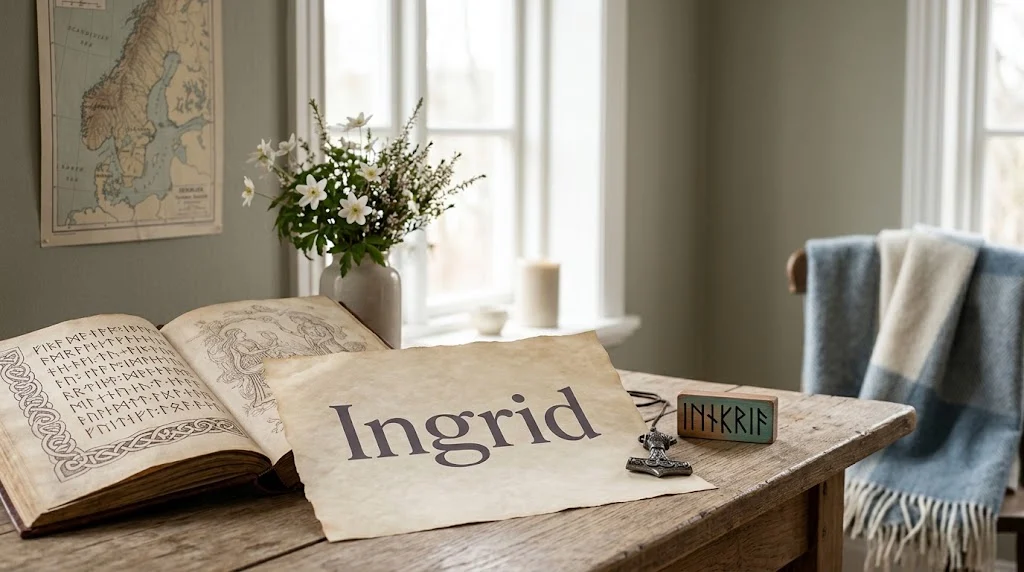
Ingrid name meaning is commonly explained as “Ing is beautiful” or “beautiful/beloved of Ing.” Ingrid comes from the Old Norse name Ingríðr, formed from Ing, a Germanic divine name, and fríðr, an Old Norse element meaning “beautiful” or “beloved.” It is a classic Scandinavian feminine name with deep Nordic linguistic and historical roots.
The name Ingrid combines an ancient Scandinavian heritage with a simple, elegant sound. It has been used particularly in Sweden, Norway, and Denmark and is also established in several other European languages.
Today, Ingrid is often associated with Scandinavian culture, classic style, strength, refinement, and timeless beauty.
What Is the Ingrid Name?
Ingrid is a feminine given name of Old Norse origin. Its historical form is Ingríðr, while Ingrid is the modern form used in several languages and naming traditions.
The name belongs to a broader family of Germanic and Scandinavian names containing the element Ing. This element refers to Ing, a Germanic divine figure whose name is also connected with the Old Norse name Yngvi. The second element, fríðr, contributes the sense of beauty or belovedness.
Unlike a modern invented name whose meaning may depend mainly on contemporary interpretation, Ingrid has a documented historical linguistic background. Its meaning is therefore best understood through its Old Norse components rather than through modern symbolic interpretations.
In simple terms:
- Name: Ingrid
- Gender: Traditionally feminine
- Origin: Old Norse
- Scandinavian connection: Strong
- Historical form: Ingríðr
- Main meaning: “Ing is beautiful”
- Meaning of fríðr: “beautiful” or “beloved”
- Related forms: Ingrida, Ingrīda, Íngrid, Inkeri, Inga
Ingrid Name Meaning in Detail
The Ingrid name meaning comes from the combination of two important linguistic elements.
Ing
The first element is Ing, a name associated with an ancient Germanic divine figure. The element appears in several Germanic and Scandinavian personal names, including names such as Ingeborg, Ingegerd, Ingvar, and Ingemar.
Because Ing is connected with Germanic religious tradition, the first part of Ingrid gives the name a distinctly ancient and Scandinavian character.
Fríðr
The second element is the Old Norse fríðr, which carries meanings such as “beautiful” and “beloved.”
When these elements are brought together in the Old Norse name Ingríðr, the result is generally interpreted as “Ing is beautiful.” It can also be understood more loosely as a name expressing beauty or belovedness in association with Ing.
This is why modern explanations of Ingrid sometimes shorten the meaning to “beautiful” or “beloved.” Those shorter descriptions capture part of the name’s sense, but the fuller historical explanation is more specific.
Ingrid Origin and Etymology
The Ingrid origin can be traced to Old Norse, the North Germanic language historically spoken across Scandinavia and surrounding areas.
The older form Ingríðr is the linguistic ancestor of modern Ingrid. Name references identify it as an Old Norse name constructed from Ing + fríðr. The form Ingrid developed as the name continued to be used in Scandinavian languages.
Understanding the etymology is important because several simplified explanations of Ingrid appear online. Some sources describe it merely as “beautiful,” while others call it “goddess of beauty.” The latter wording should be treated cautiously. The documented etymology supports the combination of Ing and fríðr, rather than a literal translation of Ingrid as “goddess of beauty.”
Therefore, the most precise short explanation is:
Ingrid means “Ing is beautiful,” from Old Norse Ingríðr.
The interpretation “beautiful” or “beloved” reflects the meaning of the fríðr element, while “Ing” refers to the Germanic divine name incorporated into the compound.
The History of the Name Ingrid
Ingrid has a long history within Scandinavian naming traditions. Its roots belong to the Old Norse naming system, in which personal names were frequently constructed by combining meaningful elements.
Names containing Ing were part of this wider Germanic tradition. The element appears in multiple historical names, demonstrating that it was not unique to Ingrid.
Over time, the Old Norse form Ingríðr developed into forms used across different Scandinavian languages. The modern form Ingrid became particularly associated with Sweden, Norway, and Denmark.
The name also spread beyond Scandinavia. Modern name references record Ingrid in Estonian, German, and Dutch usage, alongside its Scandinavian use.
This geographical spread helps explain why Ingrid can feel both distinctly Nordic and broadly European. Its linguistic roots are Scandinavian, but the name has become recognizable in several different European naming cultures.
Ingrid in Scandinavian Culture
Ingrid is strongly connected with Scandinavian naming culture. Sweden, Norway, and Denmark are especially important to the name’s history and continued use.
Scandinavian names often preserve elements from older Germanic and Old Norse languages. Ingrid is a good example of this continuity: its modern spelling is relatively simple, while its historical form connects it to a much older linguistic tradition.
The name’s cultural associations should not be confused with its literal etymology. For example, people may associate Ingrid with qualities such as elegance, independence, natural beauty, or Nordic heritage, but these are modern cultural impressions, not direct translations of the name.
The historically supported meaning comes from its linguistic components.
Ingrid Pronunciation
The pronunciation of Ingrid varies somewhat between languages.
In English, Ingrid is commonly pronounced approximately:
ING-grid
The first syllable receives the strongest emphasis, making the name easy to recognize and pronounce for many English speakers.
In Scandinavian languages, pronunciation can differ from English. Swedish and Norwegian pronunciations, for example, have their own regional phonetic characteristics.
This variation is normal for a name with a long international history. The spelling remains recognizable even when pronunciation changes according to the language being spoken.
Variations and Related Names
Because Ingrid has traveled across languages and regions, it has several related forms.
| Name | Language or tradition | Relationship |
|---|---|---|
| Ingrid | Swedish, Norwegian, Danish, Estonian, German, Dutch | Modern established form |
| Ingríðr | Old Norse | Historical form |
| Íngrid | Spanish, Catalan | Language-specific form |
| Ingrīda | Latvian | Latvian form |
| Ingrida | Lithuanian | Lithuanian form |
| Inkeri | Finnish | Related Finnish form |
| Inga | Several European languages | Related name associated with Ing |
| Inger | Swedish, Norwegian, Danish | Historically related form |
These names are related through linguistic history, but they are not necessarily interchangeable in every culture.
For example, Inga can function as its own established name, while Ingrid remains a distinct name with its own history.
Ingrid and the Name Element Ing
One of the most interesting aspects of Ingrid is the presence of Ing.
Ing appears in a range of Germanic names. This makes Ingrid part of a larger naming family rather than an isolated word.
Examples include:
- Ingeborg — combining Ing with an element associated with protection or help.
- Ingegerd — another Scandinavian name beginning with Ing.
- Ingvar — a masculine Scandinavian name containing Ing.
- Ingemar — another Germanic/Scandinavian name built around Ing.
- Inga — a related feminine name associated with the Ing element.
The recurring element demonstrates how historical naming systems often worked: parents could combine established name elements to create names with recognizable linguistic and cultural associations.
Ingrid Name Meaning and Symbolism
Beyond its literal etymology, Ingrid can carry several symbolic associations in modern naming discussions.
Beauty
The strongest symbolic connection comes from fríðr, the Old Norse element associated with beauty and belovedness. This makes beauty the most direct symbolic theme associated with Ingrid.
Nordic Heritage
Because Ingrid developed from Old Norse and became established in Scandinavian countries, the name naturally evokes Nordic heritage.
Tradition
Ingrid has survived across many generations and languages. This gives it a traditional quality without requiring the name to be interpreted as old-fashioned.
Strength and Elegance
These are common modern impressions of Ingrid, particularly because of its concise pronunciation and Scandinavian cultural associations. They are better understood as contemporary name impressions rather than literal translations.
Famous Bearers of the Name Ingrid
One of the best-known people named Ingrid was Ingrid Bergman, the Swedish actress who became an internationally recognized film star during the 20th century.
Her career helped make Ingrid familiar to audiences far beyond Scandinavia. She is particularly associated with classic cinema and remains one of the most recognizable historical bearers of the name.
It is important, however, to distinguish a famous bearer’s influence from the actual etymology of the name. Ingrid did not originate because of Ingrid Bergman; the name has much older Old Norse roots.
Why Ingrid Feels Both Traditional and Modern
Ingrid has a useful balance between historical depth and contemporary simplicity.
Its ancient origin gives it a strong connection to Scandinavian history, while its short spelling makes it easy to use internationally. Unlike some highly elaborate historical names, Ingrid does not require extensive modification to fit modern naming conventions.
Several qualities contribute to this impression:
- It has a short, recognizable spelling.
- Its pronunciation is relatively straightforward.
- It has documented Scandinavian roots.
- It has established forms in multiple languages.
- Its meaning includes the positive concept of beauty or belovedness.
- It has a long history rather than being a recently created name.
For parents researching traditional baby names, these characteristics can make Ingrid particularly interesting.
Ingrid vs. Similar Scandinavian Names
Ingrid is sometimes grouped with other Scandinavian names simply because they share a Nordic setting. However, their etymologies can be quite different.
| Name | Origin | Main Meaning or Element |
|---|---|---|
| Ingrid | Old Norse | Ing + “beautiful/beloved” |
| Inga | Germanic/Scandinavian | Feminine name associated with Ing |
| Ingeborg | Old Norse | Ing + element associated with help/protection |
| Ingegerd | Old Norse | Ing + element associated with an enclosure/protection |
| Inger | Scandinavian | Historically related to Ingrid or Ingegerd |
The shared Ing element explains why these names can look similar, but their second elements give them different historical meanings.
Is Ingrid a Good Name for a Baby?
Ingrid is the right choice for a child is ultimately a personal decision. From a linguistic and historical perspective, it offers several clearly documented characteristics.
Ingrid is:
- An established feminine given name.
- Rooted in Old Norse.
- Strongly connected with Scandinavian naming traditions.
- Associated etymologically with beauty and belovedness.
- Recognizable across several European languages.
- Supported by a long historical record.
- Simple enough to work well in modern contexts.
Families interested in Scandinavian, Nordic, European, or historically rooted names may find the name especially relevant.
How the Meaning of Ingrid Can Be Understood Today
Modern parents do not necessarily choose names according to their original literal meanings. A name can carry historical, family, cultural, aesthetic, and personal significance at the same time.
For Ingrid, the original linguistic meaning provides a foundation, while modern associations may add ideas such as elegance, strength, heritage, simplicity, and beauty.
The important distinction is between etymological meaning and personal symbolism.
The etymological meaning is connected to Ing and fríðr. Personal symbolism, such as associating Ingrid with grace or independence, depends on the individual or family choosing the name.
This distinction makes the name easier to understand accurately without turning modern interpretations into historical facts.
Examples of Using the Name Ingrid
Here are a few natural examples showing how Ingrid may appear in everyday contexts:
- Ingrid was chosen because her parents wanted a name with Scandinavian roots.
- The name Ingrid has an elegant sound and a long European history.
- Ingrid is related to the Old Norse name Ingríðr.
- The meaning of Ingrid is connected with beauty and belovedness through the Old Norse element fríðr.
- Ingrid Bergman is one of the most famous historical bearers of the name.
These examples demonstrate the difference between using Ingrid as a personal name and discussing its linguistic meaning.
Common Misconceptions About Ingrid
“Ingrid simply means goddess of beauty.”
This is a popular simplified interpretation, but it is not the most precise etymological explanation. The documented Old Norse construction is Ing + fríðr, with fríðr meaning “beautiful” or “beloved.”
“Ingrid is exclusively Swedish.”
Ingrid is strongly associated with Sweden, but it is not exclusively Swedish. It is also established in Norwegian and Danish usage and appears in several other European languages.
“Ingrid is a modern Scandinavian invention.”
The opposite is closer to the historical evidence. Ingrid descends from the Old Norse Ingríðr, giving it roots in an older Scandinavian naming tradition.
Why the Ingrid Name Meaning Remains Interesting
The appeal of Ingrid comes partly from the connection between a concise modern name and an ancient linguistic history.
Its meaning does not depend on a vague modern interpretation. The name can be traced to an identifiable Old Norse form, and its components provide a clear explanation of its historical meaning.
At the same time, Ingrid has developed beyond its original linguistic environment. It can now be encountered in multiple European cultures, where pronunciation, spelling, and cultural associations may vary.
That combination of historical depth, linguistic clarity, and international familiarity gives Ingrid a distinctive place among traditional names.
FAQs
What does Ingrid mean?
Ingrid comes from Old Norse Ingríðr and is generally interpreted as “Ing is beautiful,” with fríðr meaning “beautiful” or “beloved.”
Is Ingrid a Scandinavian name?
Yes, Ingrid has Old Norse roots and is particularly associated with Swedish, Norwegian, and Danish naming traditions.
What is the origin of Ingrid?
Ingrid originates from the Old Norse name Ingríðr, formed from Ing and the element fríðr.
Is Ingrid a biblical name?
No, Ingrid is not a biblical name; its documented roots are Old Norse and Germanic rather than Hebrew or biblical.
What does the name Ingrid symbolize?
Its historical meaning connects it with beauty and belovedness, while modern associations may include Nordic heritage and elegance.
What are nicknames for Ingrid?
Possible shortened or related forms include Inga and Inge, although their use depends on the language and family tradition.
Is Ingrid an old name?
Yes, Ingrid has ancient Scandinavian roots and developed from the Old Norse form Ingríðr.
Who is a famous person named Ingrid?
Swedish actress Ingrid Bergman is one of the best-known historical bearers of the name.
Conclusion
The Ingrid name meaning is rooted in the Old Norse Ingríðr, generally interpreted as “Ing is beautiful,” with the element fríðr carrying the meanings “beautiful” or “beloved.” Its history connects the name with Scandinavian and wider Germanic naming traditions.
Today, Ingrid remains a recognizable name with Nordic heritage, classic character, and a meaning connected to beauty and belovedness. Its long history and international forms make it a name that bridges ancient Scandinavian language with modern European usage.
Discover More Related Articles:
- Angelina Name Meaning | The Timeless Grace Behind a Name Made for Elegance In 2026
- Simone Name Meaning | The Beautiful Story Behind This Classic Name In 2026
- Zariah Name Meaning | The Enduring Charm of This Unique Name In 2026