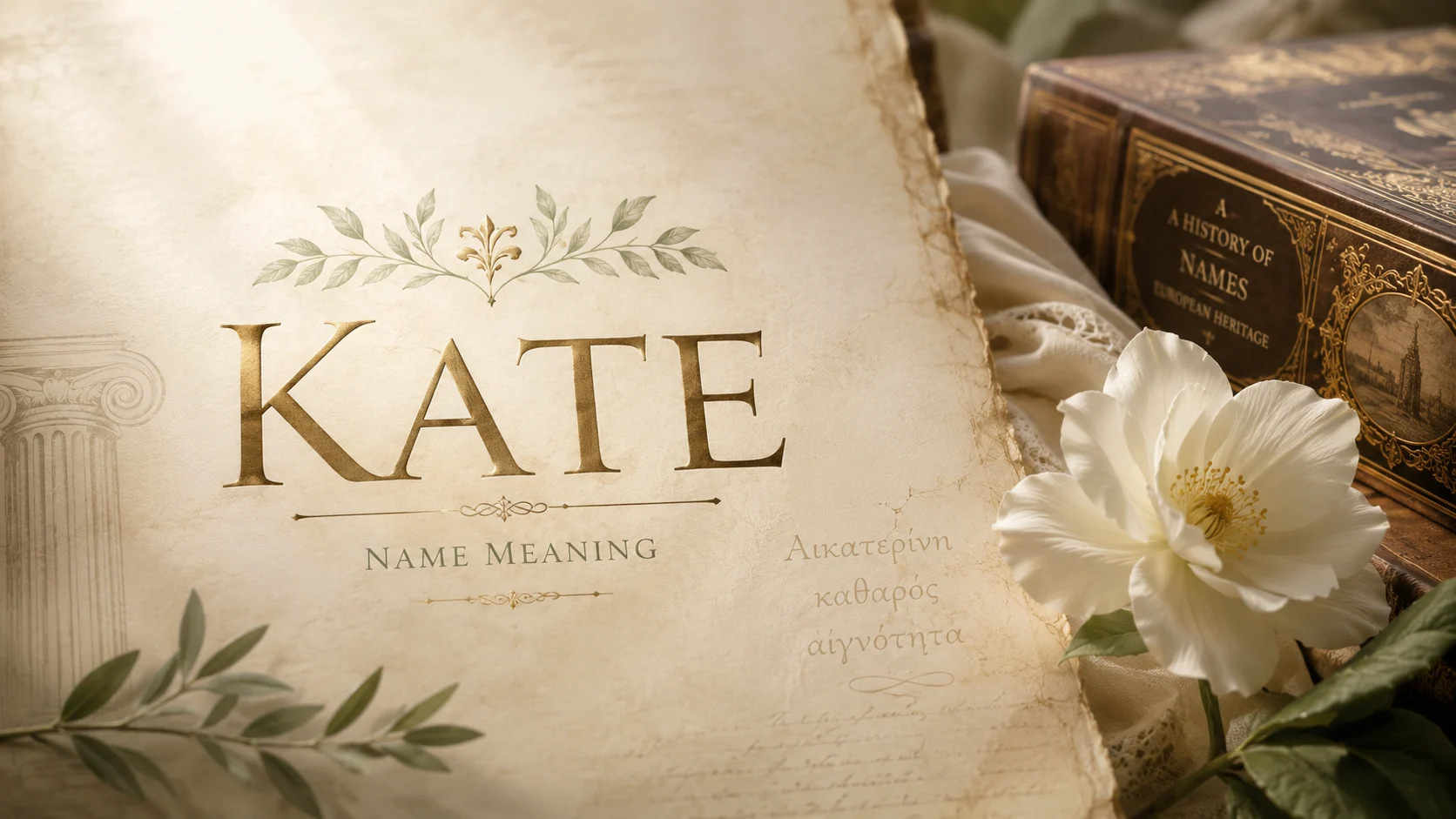
The Kate name meaning is traditionally associated with “pure”, largely because Kate is a familiar short form of Katherine or Catherine, names that have long been connected with the Greek word katharos, meaning “pure.” However, the deeper etymology of Katherine is uncertain, so “pure” is best understood as the traditional interpretation rather than a completely settled linguistic origin.
Kate has been used for centuries across English-speaking cultures and is now recognized as a graceful, simple, and internationally familiar feminine name. It can function as a nickname for Katherine, Catherine, or related forms, but Kate is also commonly given as a standalone first name.
This guide explores the Kate meaning, origin, history, pronunciation, variations, cultural associations, and common questions surrounding the name.
What Is the Name Kate?
Kate is a feminine given name that traditionally developed as a shortened form of Katherine or Catherine. It is commonly associated with the meaning “pure,” although the ultimate etymology of Katherine is uncertain. Today, Kate can be used either as a nickname or as a complete first name.
The name is especially recognizable in English-speaking countries. Its short spelling and straightforward pronunciation make it easy to use across many different settings.
Kate has several characteristics that contribute to its enduring appeal:
- It is short and easy to pronounce.
- It has a long history of use.
- It can be an independent first name.
- It is traditionally connected with Katherine and Catherine.
- It has a classic rather than highly modern sound.
- It works well across different generations.
- It has numerous related spelling forms.
Although people often describe Kate simply as a nickname, that description is incomplete today. A child can officially be named Kate without Katherine or Catherine appearing anywhere on the birth certificate.
Kate Name Meaning
The traditional Kate name meaning is “pure.”
This interpretation comes through the long-standing association between Katherine and the Greek word katharos, meaning “pure” or “clean.” Over time, Christian tradition helped strengthen the association between Katherine and purity.
However, there is an important distinction between a traditional name meaning and a completely certain etymological explanation.
The origin of the ancient name Katherine, from which Kate developed, is debated. Several theories have been proposed over the centuries, and the connection with katharos may have influenced the way the name was understood rather than representing its original linguistic source.
For modern naming purposes, however, purity remains the most widely recognized traditional meaning associated with Kate.
What Does Kate Symbolize?
Because names often acquire cultural associations beyond their literal etymology, Kate can suggest qualities such as:
- Purity
- Grace
- Simplicity
- Strength
- Elegance
- Classic style
- Confidence
- Warmth
- Independence
- Timelessness
These qualities are symbolic associations, not personality predictions. A person’s character cannot be determined from a first name.
Kate Name Origin and Etymology
Kate’s immediate linguistic history is connected to Katherine and Catherine.
The broader history leads back to the ancient Greek name commonly represented as Aikaterine or Aikaterinē. The precise origin of that ancient name is uncertain.
One of the best-known explanations connects Katherine with the Greek adjective katharos, meaning “pure.” This interpretation became particularly influential through later Christian usage and traditions surrounding Saint Catherine.
Other etymological theories have also been proposed. Because the original source of Aikaterine is not definitively established, it would be misleading to claim that every part of Katherine’s history is certain.
Kate developed much later as a shortened English form. Similar shortening patterns are common in naming traditions, where longer formal names gradually produce familiar everyday forms.
From Katherine to Kate
The development can be understood broadly as:
Aikaterine → Katherine/Catherine → Kate
This is not meant to represent a single uninterrupted linguistic transformation. Different languages, historical periods, and spelling traditions contributed to the development of the related forms.
Kate eventually became established enough to stand independently rather than functioning only as a shortened version.
History of the Name Kate
The history of Kate is closely tied to the long history of Katherine and Catherine in Europe.
The popularity and cultural influence of these names were strongly shaped by Christian traditions, particularly the veneration of Saint Catherine of Alexandria. Her story became influential in medieval Europe, and Catherine became an important Christian name in various regions.
As longer forms such as Katherine and Catherine were used, shorter everyday forms naturally emerged.
In English, Kate became one of the familiar forms associated with Katherine and Catherine.
Over time, short forms became increasingly acceptable as official given names. What may once have been primarily an informal nickname could eventually appear independently in families and official naming records.
This reflects a broader pattern in English naming. Many names that began as shortened forms have become established first names in their own right.
Examples include:
- Kate from Katherine or Catherine
- Liz from Elizabeth
- Beth from Elizabeth
- Will from William
- Jack from John or related historical forms
- Maggie from Margaret
The exact historical development differs from name to name, but the general pattern demonstrates how nicknames can eventually become independent names.
Kate and Christian Tradition
Kate’s connection to Christian history comes primarily through Katherine and Catherine, especially Saint Catherine of Alexandria.
Saint Catherine has traditionally been remembered as an early Christian martyr. Her story became prominent in medieval Christian culture, and devotion to her contributed to the spread of Catherine-related names.
Because of this history, Kate can carry a cultural connection to:
- Christian naming traditions
- Saint Catherine
- Medieval European history
- Religious art
- Traditional European names
However, Kate itself is not a separate biblical name in the Bible.
This distinction is important. Some websites describe Kate as having a “biblical meaning,” but Kate does not appear as a biblical given name in the way names such as Mary, Sarah, or Elizabeth do.
Its religious association comes largely through Katherine and Catherine and their later Christian history.
How Do You Pronounce Kate?
Kate is pronounced: KAYT.
In the International Phonetic Alphabet, it is commonly represented as:
/keɪt/
The pronunciation is straightforward for English speakers.
It consists of one syllable:
Kate → KAYT
The vowel sound is the same as the vowel sound in words such as:
- Day
- Say
- Late
- Name
- Great
The final t is pronounced clearly, giving the name its crisp ending.
Because the spelling is short and familiar, Kate generally does not create significant pronunciation difficulties in English.
Is Kate a Full Name?
Yes. Kate can be a full, standalone first name.
Historically and traditionally, Kate has often been used as a short form of Katherine or Catherine. However, modern naming practices do not require Kate to be a nickname.
Parents may choose Kate directly because they prefer its shorter sound and uncomplicated spelling.
There are therefore two common possibilities:
| Usage | Explanation |
|---|---|
| Kate as a nickname | Short form of Katherine or Catherine |
| Kate as a given name | Official first name by itself |
| Katherine | Traditional longer form |
| Catherine | Traditional related form |
| Katharine | Alternative spelling |
| Katie | Familiar diminutive related to Kate |
If someone is legally named Kate, there is no requirement that their full name be Katherine or Catherine.
Kate Name Variations
Kate is connected to several names and spelling forms across different languages and naming traditions.
Katherine
Katherine is one of the most familiar longer forms associated with Kate. It has a traditional, formal character while still allowing Kate as an everyday nickname.
Catherine
Catherine is another major related form. It has a long history in European and Christian naming traditions.
Katharine
Katharine is a recognized spelling variant of Katherine. The form is especially familiar through historical and literary usage.
Kathryn
Kathryn is another English spelling variant related to Katherine.
Katie
Katie is a more affectionate or diminutive form associated with Kate, Katherine, and related names.
Katy
Katy is another spelling variant of the familiar nickname form.
These names are related, but they are not necessarily interchangeable. Individual families may use them differently depending on personal preference, cultural tradition, or official spelling.
Kate vs. Katherine vs. Catherine
Kate is often confused with Katherine and Catherine because of their close naming relationship.
| Name | Traditional Association | Common Use |
|---|---|---|
| Kate | Pure | Standalone name or short form |
| Katherine | Pure | Formal given name |
| Catherine | Pure | Formal given name |
| Katharine | Pure | Spelling variant |
| Kathryn | Pure | Spelling variant |
| Katie | Diminutive form | Familiar nickname |
| Katy | Diminutive form | Familiar nickname |
The most important difference is that Kate is shorter and often more informal in historical usage, while Katherine and Catherine generally have a more formal appearance.
Today, however, Kate itself can be completely formal and independent.
Kate Name Meaning in Different Contexts
The meaning associated with a name can change depending on you are discussing etymology, culture, or personal symbolism.
Traditional Meaning
The traditional meaning associated with Kate is:
“Pure.”
Linguistic Meaning
From an etymological perspective, the connection between Katherine and katharos is well known, but the ultimate origin of the ancient name Aikaterine remains uncertain.
Cultural Meaning
In European and Christian history, the name is connected with Katherine and Catherine traditions, including Saint Catherine of Alexandria.
Modern Meaning
Today, many people choose Kate because it sounds:
- Elegant
- Friendly
- Classic
- Simple
- Confident
- Contemporary
These are impressions associated with the name rather than literal dictionary meanings.
Is Kate an Old-Fashioned Name?
Kate has a classic quality, but calling it simply old-fashioned would be misleading.
The name has existed in related forms for centuries, yet its short structure gives it a modern practicality.
One reason classic names remain useful is their ability to move between generations. Kate can suit a child, teenager, professional adult, or older person without sounding strongly tied to one particular age group.
Its simplicity also makes it adaptable to different naming styles.
For example:
- Kate Elizabeth sounds traditional.
- Kate Olivia has a modern feel.
- Kate Rose is short and elegant.
- Kate Victoria feels formal.
- Kate Morgan has a contemporary sound.
The overall impression depends not only on Kate itself but also on the middle and family names used with it.
Personality and Symbolism of Kate
Name meanings are sometimes connected with personality descriptions online. These descriptions should be treated as symbolic interpretations rather than scientific facts.
Because Kate is traditionally associated with purity and has a long history of use, people may symbolically connect the name with qualities such as:
Grace
Kate has a refined, uncomplicated sound that many people associate with elegance.
Confidence
Its short pronunciation gives the name a direct and energetic quality.
Simplicity
Kate contains only four letters, making it visually and phonetically simple.
Strength
The clear final “t” gives the name a firm ending, which can contribute to an impression of confidence.
Warmth
As a familiar everyday name, Kate can also sound approachable and friendly.
These interpretations are subjective. A name can inspire certain impressions, but it does not determine a person’s behavior or personality.
Famous People Named Kate
Kate has been used by many notable people in entertainment, literature, sports, public life, and other fields.
One internationally recognized example is Kate Winslet, the English actress known for films including Titanic, Eternal Sunshine of the Spotless Mind, and The Reader.
Another well-known figure is Kate Middleton, widely known as Catherine, Princess of Wales. Her public use of the name Kate has contributed to the name’s strong contemporary cultural recognition.
The name is also familiar through writers, musicians, performers, athletes, and fictional characters.
Importantly, famous people do not establish the etymological meaning of a name. They simply demonstrate how the name is used in modern culture.
Names That Sound Similar to Kate
If you like Kate because of its short and classic sound, several other names may appeal to you.
Some options include:
- Jane
- Claire
- Grace
- Rose
- Anne
- Kate
- Beth
- Emma
- Jane
- Eve
- Mae
- Leah
For parents looking for a similarly concise feminine name, Kate fits particularly well with traditional one-syllable names.
Names Related to Kate
If you want a longer name that can naturally lead to Kate as a nickname, consider:
- Katherine
- Catherine
- Katharine
- Kathryn
- Kathleen
- Katarina
- Katarine
- Katrina
- Catalina
Not every family treats all of these names as direct equivalents of Kate. Nickname traditions vary between languages, families, and regions.
For example, a family might choose Katherine formally and Kate informally, while another family may use Kate as the official name from birth.
Kate as a Baby Name
Kate can be an attractive choice for parents who want a name that is short without sounding overly trendy.
Some qualities parents may appreciate include:
- Four-letter spelling
- One-syllable pronunciation
- Familiar English usage
- Strong historical connections
- Traditional meaning
- Easy pronunciation
- Multiple longer forms
- Simple spelling
- Professional sound
- International familiarity
Another advantage is flexibility. Kate can work as either the complete name or as the everyday form of a longer traditional name.
Parents who prefer formal names may choose Katherine or Catherine and use Kate as a nickname. Those who prefer simplicity can choose Kate directly.
What Does Kate Mean Spiritually?
There is no single universally accepted spiritual meaning for Kate.
The traditional association with purity can give the name spiritual symbolism related to:
- Innocence
- Inner cleanliness
- Grace
- Moral character
- Renewal
- Goodness
These interpretations are especially influenced by the Christian history surrounding Katherine and Catherine.
However, spiritual interpretations are different from linguistic etymology. A person may personally associate Kate with love, strength, family, faith, or another quality regardless of its historical meaning.
Is Kate a Biblical Name?
Kate is not a biblical name in the strict sense.
It is primarily a shortened form of Katherine or Catherine, and those names are also not generally considered names originating directly from the Bible.
The connection with Christianity comes from later Christian history, especially the traditions surrounding Saint Catherine of Alexandria.
Therefore, it is more accurate to describe Kate as a Christian-associated traditional name rather than a biblical name.
If someone asks for the “biblical meaning of Kate,” the safest explanation is that the name has a traditional association with purity, while its Christian connection comes from later religious tradition rather than direct biblical usage.
Why Does the Name Kate Remain Appealing?
Kate combines several qualities that tend to make a first name practical and memorable.
First, it is extremely easy to spell. A person rarely needs to explain how to write it.
Second, its pronunciation is straightforward in English.
Third, it has a connection to much longer traditional names. This gives families the option of choosing between a short everyday identity and a more formal legal name.
Fourth, Kate has a long cultural history without sounding excessively elaborate.
The result is a name that can feel both classic and current.
Kate Name Meaning at a Glance
| Attribute | Details |
|---|---|
| Name | Kate |
| Gender association | Traditionally feminine |
| Primary meaning | Traditionally “pure” |
| Related names | Katherine, Catherine |
| Origin of related name | Ancient Greek tradition |
| Language history | Greek, Latin, European, English forms |
| Pronunciation | KAYT |
| Syllables | One |
| Letters | Four |
| Common use | Standalone first name or nickname |
| Christian association | Connected with Catherine traditions |
| Famous association | Kate Winslet and other notable Kates |
The most important qualification is that the ancient etymology behind Katherine and Catherine is not completely certain. “Pure” is the established traditional interpretation, but it should not be presented as an undisputed explanation of the name’s earliest origin.
FAQs
What does the name Kate mean?
The traditional Kate name meaning is “pure.” Kate is historically connected with Katherine and Catherine, whose traditional interpretation is associated with the Greek word katharos, meaning “pure.” The deeper origin of the ancient name is uncertain.
Is Kate short for Katherine or Catherine?
Yes. Kate has traditionally been used as a short form of both Katherine and Catherine. However, Kate can also be used as an independent legal first name and does not have to be short for another name.
What is the origin of the name Kate?
Kate developed as a shortened English form associated with Katherine and Catherine. Those names ultimately have a long linguistic history connected with the ancient Greek form Aikaterine, although the precise original etymology remains debated.
Is Kate a biblical name?
No, Kate is not a biblical name in the strict sense. Its Christian association comes from the later history of Katherine and Catherine, particularly traditions surrounding Saint Catherine of Alexandria.
How do you pronounce Kate?
Kate is pronounced “KAYT” and is normally written phonetically as /keɪt/ in English. It has one syllable and rhymes with words such as “late” and “date.”
Is Kate a full name?
Yes. Although Kate has traditionally been a nickname for Katherine or Catherine, it is also widely usable as a standalone given name. Someone named Kate does not necessarily have Katherine or Catherine as a legal name.
What names are similar to Kate?
Names with a similarly short and classic style include Jane, Claire, Grace, Rose, Anne, Beth, Mae, Eve, and Leah. Katherine and Catherine are the closest longer names historically related to Kate.
What does Kate symbolize?
Kate is traditionally associated with purity. In modern symbolic interpretations, it may also suggest simplicity, elegance, confidence, grace, and warmth. These qualities are cultural associations rather than scientifically established personality traits.
Is Kate an old-fashioned name?
Kate has a long history, but it is better described as classic rather than simply old-fashioned. Its short spelling and straightforward pronunciation allow it to work comfortably across different generations and naming styles.
What is the difference between Kate and Katie?
Kate is generally the shorter, more direct form, while Katie is often used as a more affectionate diminutive of Katherine, Catherine, or Kate. Naming practices vary, so families may use the forms differently.
Conclusion
The Kate name meaning is traditionally understood as “pure,” with Kate historically connected to the longer names Katherine and Catherine. Although the earliest etymology of Katherine is not completely certain, its association with purity has remained influential for centuries.
Kate has developed from a familiar nickname into a well-established standalone first name, appreciated for its simplicity, elegance, and timeless character. Its connections to European history and Christian tradition add cultural depth, while its short spelling and easy pronunciation make it practical in modern use. Chosen independently or as a nickname for Katherine or Catherine, Kate remains a classic name with a graceful and enduring appeal.











2 thoughts on “Kate Name Meaning | Elegant Roots & Modern Magic In 2026”