Maximilian is a masculine name of Latin origin associated with the meaning “greatest” or “of the greatest.” It is connected with the Latin name Maximilianus and the root maximus, meaning “greatest.” The name has a long European history and is especially associated with German-speaking and Central European naming traditions.
The Maximilian name meaning is generally connected with the Latin idea of being “greatest” or “most excellent.” The name has a distinguished historical background, particularly in Central Europe, where it became strongly associated with European royalty and the Habsburg dynasty.
Maximilian is a traditional masculine given name with several related forms, including Maximilianus, Maximilian, Maximiliano, and Maximillian. Its combination of an ancient Latin root, aristocratic historical associations, and the familiar nickname Max gives the name both a classical and modern appeal.
This guide explores the Maximilian meaning, origin, etymology, pronunciation, history, cultural associations, variations, and common questions surrounding the name.
What Is the Name Maximilian?
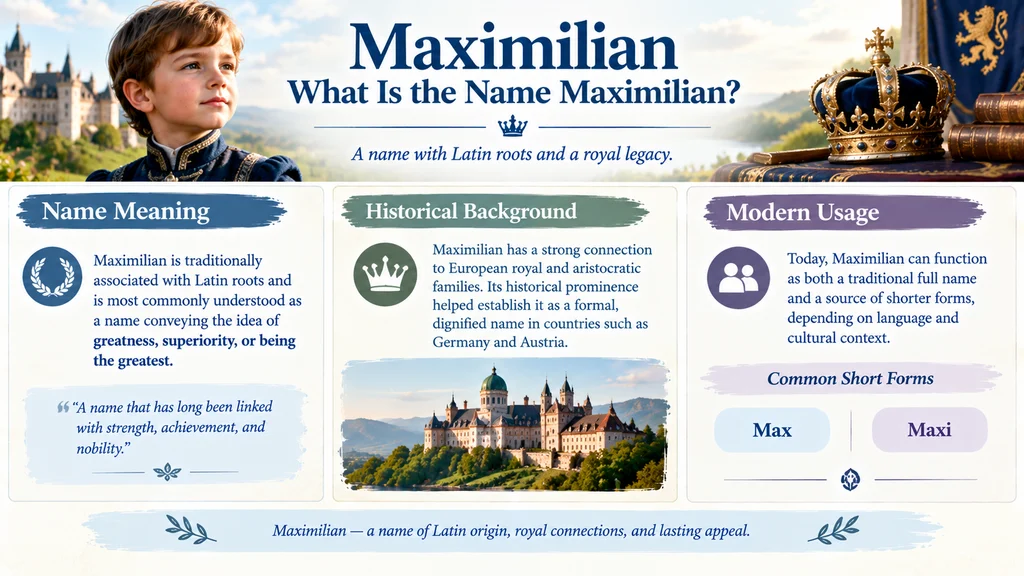
Maximilian is a masculine given name traditionally associated with Latin and Central European naming traditions. It is most commonly understood as a name conveying the idea of greatness, superiority, or being the greatest.
The name is particularly notable because it has been used by members of European royal and aristocratic families. Its historical prominence helped establish Maximilian as a formal, dignified name in countries such as Germany and Austria.
Today, Maximilian can function as both a traditional full name and a source of shorter forms such as Max and Maxi, depending on language and cultural context.
Basic Name Profile
| Attribute | Detail |
|---|---|
| Name | Maximilian |
| Gender | Traditionally masculine |
| Primary linguistic association | Latin |
| Common meaning | “Greatest” / “of the greatest” |
| Latin form | Maximilianus |
| Related root | maximus |
| Common short form | Max |
| Related forms | Maximilianus, Maximiliano, Maximillian |
| Pronunciation | Usually roughly “mak-sih-MIL-ee-an” in English |
Maximilian Name Meaning
The Maximilian name meaning is most commonly explained through the Latin root maximus, meaning “greatest,” “largest,” or “very great.”
This root is closely related to the Roman name Maximus, which comes from the Latin superlative adjective maximus, the superlative form of magnus, meaning “great.”
Because Maximilian developed through a longer Latin naming form, its traditional interpretation is often connected with ideas such as:
- Greatness
- Excellence
- Importance
- High status
- Strength
- Distinction
- Achievement
It is important to distinguish the historical etymology from modern symbolic interpretations. When baby-name sources describe Maximilian as representing qualities such as leadership or ambition, these are symbolic associations, not literal translations of the original Latin name.
In other words, the historical meaning is rooted in “greatest”, while qualities such as confidence, leadership, and strength are modern interpretations inspired by that meaning.
Maximilian Origin and Etymology
The origin of Maximilian is associated with the Latin form Maximilianus. Its development is somewhat more complicated than simply translating Maximilian as a direct Latin word.
The name is connected to Maximus, derived from Latin maximus, meaning “greatest.” Maximilianus became an established personal-name form, and the modern Maximilian developed from this Latin tradition.
There is also a historical connection between Maximilianus and the Roman family name Aemilianus, associated with Aemilius. Because of this history, some etymological discussions describe Maximilian as a blended or elaborated form influenced by both Maximus and Aemilianus.
For a simple explanation, however, the most important meaning for modern name research is its strong association with the Latin concept of greatness.
The Linguistic Connection
A simplified relationship can be represented as:
Latin magnus → maximus → Maximus → Maximilianus → Maximilian
The exact historical development of personal names can involve multiple naming traditions and adaptations, so this sequence should be understood as a helpful overview rather than a claim that every stage represents a direct one-to-one transformation.
History of the Name Maximilian
Maximilian has a particularly strong place in European history.
One of the most important reasons for its prominence was its association with the Habsburg dynasty. Several powerful European rulers and members of the Habsburg family were named Maximilian.
A particularly significant historical figure was Maximilian I, Holy Roman Emperor, who ruled as Holy Roman Emperor from 1508 until his death in 1519. His political influence and dynastic connections helped give the name a strong royal and imperial association.
The name continued to appear among later members of European royal families. Maximilian II, Holy Roman Emperor, ruled from 1564 to 1576 and further strengthened the historical association between the name and Central European monarchy.
This royal history does not mean that Maximilian was exclusively a royal name. Rather, its use by rulers helped contribute to its reputation as a formal, prestigious, and historically significant given name.
Maximilian in German and Central European Culture
Maximilian is especially familiar in German-speaking Central Europe.
The name has long been used in Germany and Austria and has also appeared in other European countries through royal, aristocratic, religious, and cultural connections.
Its formal structure gives it a distinctly traditional character. At the same time, the short form Max has become widely recognizable and much more casual.
This creates an interesting contrast:
- Maximilian sounds formal, traditional, and distinguished.
- Max sounds short, modern, friendly, and approachable.
Parents may therefore choose Maximilian because they like having both a substantial formal name and a simple everyday nickname.
Maximilian Pronunciation
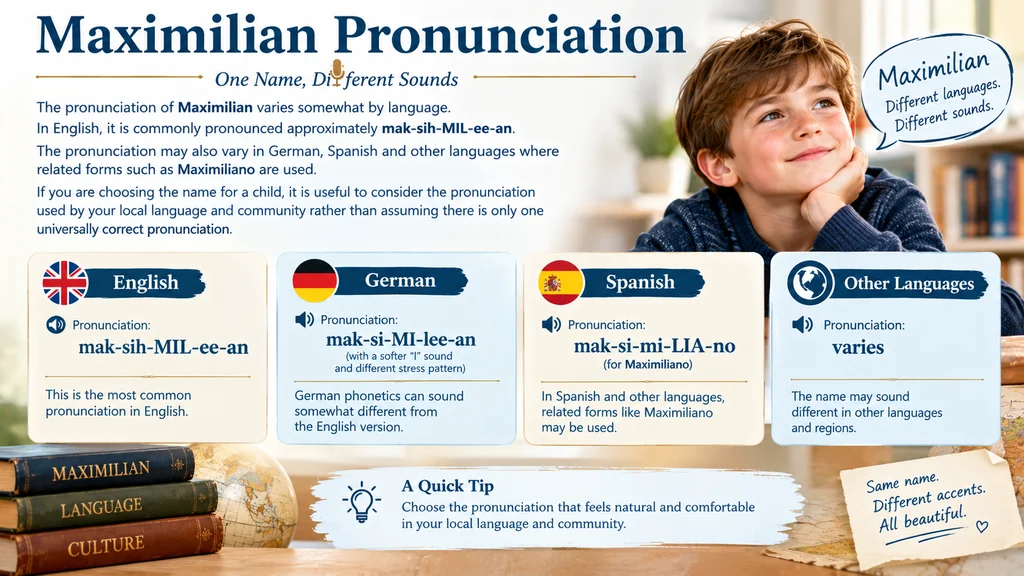
The pronunciation of Maximilian varies somewhat by language.
In English, it is commonly pronounced approximately:
mak-sih-MIL-ee-an
In German, the pronunciation follows German phonetic patterns and can sound somewhat different from the English version.
The pronunciation may also vary in Spanish and other languages where related forms such as Maximiliano are used.
If you are choosing the name for a child, it is useful to consider the pronunciation used by your local language and community rather than assuming there is only one universally correct pronunciation.
Popular Nicknames for Maximilian
One of the biggest advantages of Maximilian is the number of possible short forms.
Common nicknames and shortened forms include:
- Max
- Maxi
- Maxie
- Maxim
- Mili
- Milo in some informal naming contexts
Among these, Max is by far the most recognizable internationally.
The nickname Max also has an independent history as a short form of several names beginning with Max-, which makes it particularly flexible in modern use.
Maximilian Name Variations
Different languages and naming traditions have produced related forms of Maximilian.
| Form | Language/Cultural Association | Notes |
|---|---|---|
| Maximilian | German, English and other European usage | Traditional full form |
| Maximilianus | Latin | Historical Latin form |
| Maximiliano | Spanish | Romance-language form |
| Maximillian | English usage | Variant spelling |
| Maxim | Several European and Slavic contexts | Related form, though not identical |
| Max | International | Common short form |
These forms should not always be treated as exact linguistic equivalents. Some developed independently or have their own naming histories.
Maximilian vs. Max
Although Max is commonly used as a nickname for Maximilian, the two names are not identical in every naming context.
| Name | Meaning/Association | Main Difference |
|---|---|---|
| Maximilian | Associated with “greatest” | Long, formal traditional name |
| Max | Often associated with Maximilian, Maximus, or Maxim | Short, informal form |
| Maximus | “Greatest” | Separate Latin name with a direct superlative meaning |
| Maximilianus | Latin historical form | Earlier/formal Latin form related to Maximilian |
If someone wants a name with a strong classical and historical presence, Maximilian offers more formal character. If they prefer simplicity, Max provides a shorter alternative.
Cultural and Symbolic Meaning of Maximilian
Beyond its linguistic meaning, Maximilian can carry several symbolic associations because of its history.
The name’s connection with the idea of “greatest” can inspire symbolic qualities such as:
- Ambition
- Excellence
- Confidence
- Strength
- Leadership
- Achievement
- Distinction
Its association with European rulers also gives it a traditional image of authority and prestige.
However, these qualities should be viewed as cultural or symbolic interpretations, not personality predictions. A person’s character cannot be determined by their given name.
Famous Historical Figures Named Maximilian
The name has been borne by several historically important figures.
Maximilian I, Holy Roman Emperor
Maximilian I was one of the most influential rulers associated with the name. His reign helped expand Habsburg influence in Europe, and his dynastic policies had long-lasting consequences for European politics.
Maximilian II, Holy Roman Emperor
Maximilian II succeeded Ferdinand I and ruled as Holy Roman Emperor from 1564 to 1576. His reign continued the prominent use of Maximilian within the Habsburg imperial tradition.
Maximilian of Mexico
Maximilian I of Mexico was a Habsburg archduke who became Emperor of Mexico in the 19th century. His short reign made the name part of another important chapter in European and Mexican history.
These examples demonstrate how strongly the name has appeared in historical and political contexts, particularly among European ruling families.
Is Maximilian a Strong Name for a Baby?
For parents considering Maximilian, the name offers a combination of historical depth and modern flexibility.
Its major strengths include:
- A long European history
- A recognizable classical origin
- A positive association with greatness
- Multiple nickname possibilities
- International familiarity
- A formal and distinguished sound
- A simple nickname in Max
The main consideration is length. Maximilian is considerably longer than short names such as Max, Leo, or Liam. However, parents can use Maximilian formally while using Max in everyday life.
What Does Maximilian Mean in Different Contexts?
The name’s central meaning remains connected to greatness, but its cultural associations can differ.
In a historical context, Maximilian may evoke European monarchy, the Habsburg dynasty, and Central European history.
In a linguistic context, the name points back to Latin and the root maximus.
And in a modern baby-name context, parents may associate Maximilian with qualities such as confidence, ambition, strength, and distinction.
These different interpretations complement one another but should not be confused. The etymological meaning is different from the symbolic personality traits sometimes attached to a name.
How to Use Maximilian in a Name
Maximilian works naturally as a first name and can be paired with both traditional and modern middle names.
For example:
- Maximilian James
- Maximilian Alexander
- Maximilian Thomas
- Maximilian Henry
- Maximilian Joseph
- Maximilian Daniel
These are simply naming examples rather than historically established combinations.
The name also works particularly well when parents want a formal birth name with an easy nickname. A child could use Maximilian in formal settings while using Max with family and friends.
Why Is Maximilian Still Appealing?

Maximilian combines several qualities that continue to make traditional names attractive.
First, it has historical depth. The name can be traced through Latin naming traditions and centuries of European history.
Second, it has nickname flexibility. Max gives the name a short and contemporary everyday option.
Third, it has a positive traditional meaning. The association with “greatest” provides an inherently strong semantic foundation.
Finally, Maximilian has a recognizable European identity without being restricted to a single modern country or language.
FAQs
1. What does Maximilian mean?
Maximilian is generally associated with the Latin meaning “greatest” or “of the greatest,” through the root maximus.
2. What is the origin of Maximilian?
Maximilian has a Latin linguistic background and developed from the historical form Maximilianus, with connections to Maximus.
3. Is Maximilian a German name?
Maximilian is strongly associated with German-speaking and Central European naming traditions, although its deeper linguistic roots are Latin.
4. What is the nickname for Maximilian?
The most common nickname is Max, while forms such as Maxi may also be used in some cultures.
5. Is Maximilian a biblical name?
Maximilian is not a biblical name. It comes from Latin naming traditions rather than directly from the Bible.
6. Is Maximilian a royal name?
Maximilian has strong royal and imperial associations because several European rulers, especially Habsburg rulers, bore the name.
7. How do you pronounce Maximilian?
In English, Maximilian is commonly pronounced approximately mak-sih-MIL-ee-an, although pronunciation varies by language.
8. What does the name Max have to do with Maximilian?
Max is a widely used short form of Maximilian, although Max can also represent other names such as Maximus and Maxim.
9. Is Maximilian a popular name?
Its popularity varies significantly by country and period. It remains an established traditional name in several European naming cultures.
10. What names are similar to Maximilian?
Names with a related classical or European character include Maximus, Maxim, Alexander, Sebastian, Constantine, and Augustine.
Conclusion
The Maximilian name meaning is rooted in the Latin concept of “greatest,” through the Latin maximus and the historical form Maximilianus. Over centuries, the name developed a strong presence in Central European naming traditions and became particularly associated with the Habsburg dynasty and European rulers.
Today, Maximilian combines classical history with modern versatility. Its formal sound, prestigious historical associations, and familiar nickname Max make it a name that can feel both traditional and contemporary. For families looking for a name connected with greatness, history, and European heritage, Maximilian offers a substantial and meaningful choice.
Discover More Related Articles:
- Callahan Name Meaning | Irish Origin, History & Symbolism In 2026
- Cillian Name Meaning | Irish Origin, History, Pronunciation & Significance In 2026
- Milan Name Meaning | Origin, History & Significance in 2026