The Holly name meaning is closely connected to the holly plant, an evergreen shrub or tree known for its glossy green leaves and bright red berries. As a given name, Holly is an English nature name that evokes evergreen beauty, winter, vitality, and seasonal traditions.
The name Holly has a simple botanical origin but carries rich cultural associations. It became especially recognizable as a personal name in English-speaking countries because of the holly plant’s distinctive appearance and its strong connection with winter and Christmas.
This article explores the Holly name meaning, origin, etymology, history, symbolism, pronunciation, variations, and common questions about the name.
What Is the Holly Name?
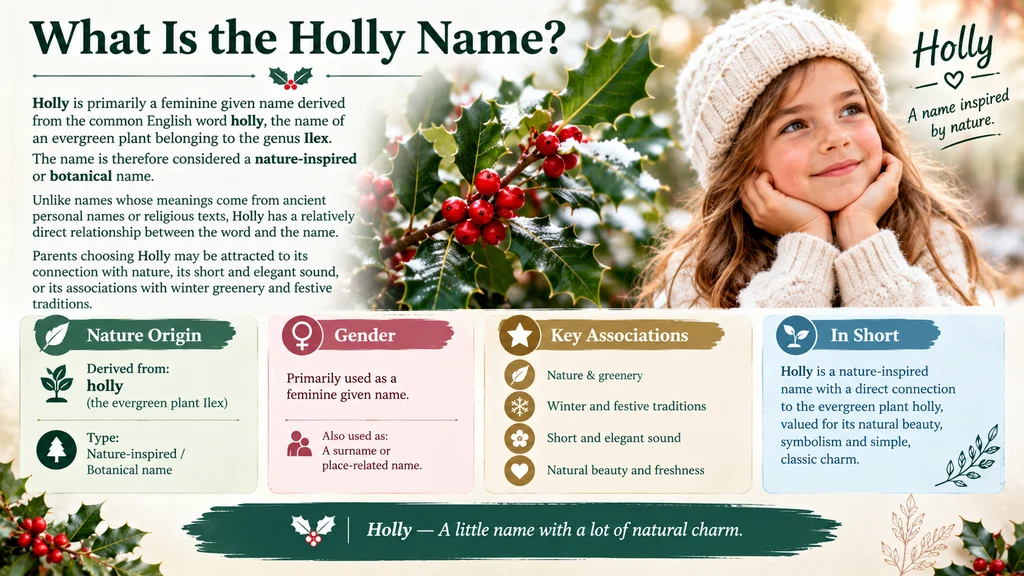
Holly is primarily a feminine given name derived from the common English word holly, the name of an evergreen plant belonging to the genus Ilex. The name is therefore considered a nature-inspired or botanical name.
Unlike names whose meanings come from ancient personal names or religious texts, Holly has a relatively direct relationship between the word and the name. Parents choosing Holly may be attracted to its connection with nature, its short and elegant sound, or its associations with winter greenery and festive traditions.
The name can also appear as a surname or place-related name, although its use as a first name is particularly familiar in modern English-speaking cultures.
What does Holly mean as a name?
As a given name, Holly essentially means “holly tree” or “holly plant.” Symbolically, however, the name can suggest qualities associated with the plant, including evergreen vitality, endurance, beauty, protection, and renewal.
These symbolic associations are cultural interpretations rather than a literal dictionary definition of the personal name.
Holly Name Meaning
The Holly name meaning comes directly from the English plant name. Holly refers to a group of evergreen plants recognized for their distinctive leaves and, on many species, bright red berries.
As a personal name, Holly therefore belongs to the broad category of nature names. Other examples include names such as Rose, Lily, Ivy, Hazel, Willow, and Heather.
The botanical connection gives Holly a particularly seasonal character. Because holly remains green during winter, it is often associated with persistence and life during a season when many other plants lose their leaves.
This makes Holly more than simply a plant-based name. In popular naming symbolism, it can represent:
- Evergreen life
- Strength and endurance
- Natural beauty
- Winter
- Renewal
- Festive tradition
- Resilience
These symbolic meanings should be understood as associations rather than strict etymological meanings.
Holly Name Origin and Etymology
The origin of Holly is relatively straightforward compared with many ancient personal names. It comes from the English word for the holly plant.
The plant word has a long history in the English language. The modern form is related to earlier English terms referring to the holly plant, including Old English holen. Over time, the word developed into forms that eventually gave English its familiar holly.
The botanical classification of holly is Ilex, a genus containing many species of evergreen trees and shrubs. However, Ilex is the scientific botanical classification, not the linguistic origin of the personal name Holly.
This distinction is useful because name etymology and botanical classification describe two different things:
| Aspect | Holly |
|---|---|
| Name type | Nature/botanical given name |
| Linguistic source | English plant word |
| Plant | Holly |
| Scientific genus | Ilex |
| Traditional association | Evergreen foliage and berries |
| Modern associations | Nature, winter, Christmas, resilience |
The name’s direct connection to an everyday English plant word also explains why Holly feels familiar and easy to understand even without extensive knowledge of historical languages.
Holly Name History
Holly’s history as a word is much older than its widespread use as a modern personal name. The plant itself was familiar to people in Britain and other parts of Europe for centuries, and its evergreen appearance made it especially noticeable during winter.
Over time, words associated with plants, flowers, and natural landscapes increasingly became personal names. Holly fits into this broader development of English nature-inspired naming.
The name became particularly recognizable as a feminine given name in the modern era. Its popularity was helped by the broader appeal of short, accessible botanical names.
Holly also gained strong cultural visibility through literature, entertainment, and public figures. One particularly famous fictional example is Holly Golightly, the central character in Truman Capote’s Breakfast at Tiffany’s, later portrayed by Audrey Hepburn in the 1961 film adaptation.
That association helped make Holly an instantly recognizable personal name, although the name itself existed independently of the character.
Holly and the Meaning of the Holly Plant
Understanding the plant helps explain why the name has such distinctive symbolism.
Holly plants are evergreen, meaning many species retain their foliage throughout the year. Their glossy leaves and, in some species, colorful berries make them especially noticeable during colder months.
In Britain and parts of Europe, holly has a long history of cultural and seasonal use. Its evergreen nature contributed to associations with life, continuity, and protection during winter.
The plant later became strongly connected with Christmas traditions in many Christian cultures. Holly branches and leaves are frequently used in seasonal decorations, and its red berries and green foliage have become recognizable elements of Christmas imagery.
As a result, the name Holly can carry two overlapping layers of association:
- Nature symbolism — evergreen life, beauty, and endurance.
- Seasonal symbolism — winter, Christmas, celebration, and tradition.
Not every person named Holly necessarily identifies with these associations, but they are important parts of the cultural background surrounding the name.
Is Holly a Nature Name?
Yes. Holly is a classic nature-inspired or botanical name because it comes directly from the name of a plant.
It belongs to the same broad naming category as:
- Rose
- Lily
- Ivy
- Hazel
- Violet
- Willow
- Fern
- Heather
- Daisy
What makes Holly distinctive is its strong evergreen and winter connection. While names such as Rose and Lily are commonly associated with flowers, Holly is associated with an evergreen plant and its seasonal imagery.
For parents interested in nature names that are familiar without being overly elaborate, Holly offers a simple option with a clear botanical connection.
Holly Name Symbolism
The symbolism of Holly comes primarily from the characteristics and cultural history of the plant.
Evergreen Life
Because holly can retain its green foliage through winter, it is naturally associated with continuity and endurance.
Resilience
The plant’s ability to remain vibrant during colder months has made it a useful symbol of strength and persistence.
Winter
Holly is one of the plants strongly associated with winter landscapes and seasonal decoration, giving the name a distinctly wintery character.
Celebration
Its connection with Christmas decorations gives Holly associations with celebration, family gatherings, warmth, and tradition.
Natural Beauty
Glossy green leaves and colorful berries give the plant an attractive appearance, contributing to the name’s broader association with natural beauty.
These symbolic interpretations are not additional literal translations of the name. They are meanings that developed through the cultural perception of the plant.
Holly Pronunciation
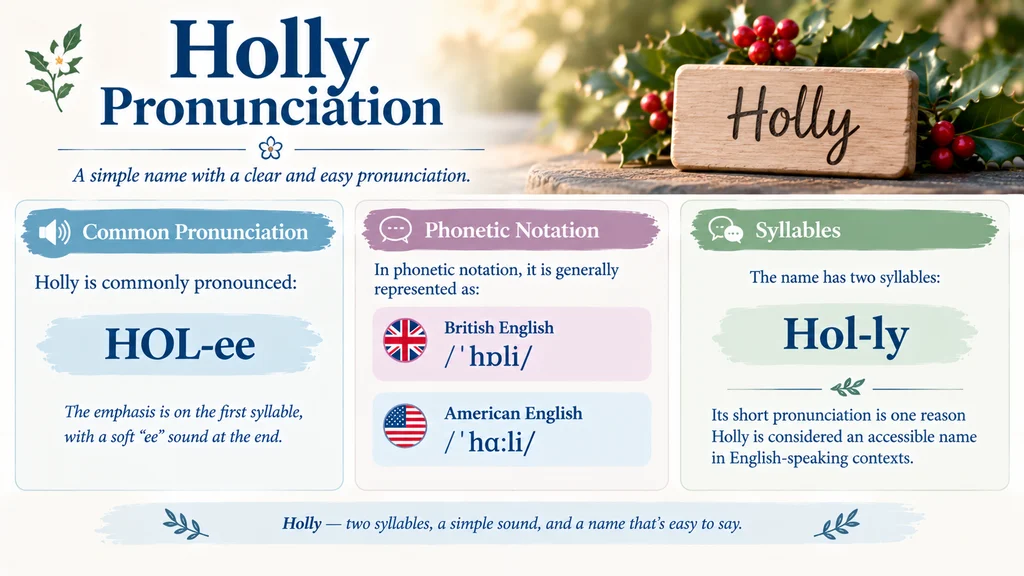
Holly is commonly pronounced:
HOL-ee
In phonetic notation, it is generally represented as /ˈhɒli/ in British English and /ˈhɑːli/ in many American English pronunciations.
The name has two syllables:
Hol-ly
Its short pronunciation is one reason Holly is considered an accessible name in English-speaking contexts.
Is Holly a Biblical Name?
Holly is not generally considered a biblical personal name in the same way as names such as Mary, Sarah, Ruth, or John.
Its origin is connected to the English plant word rather than a biblical personal name.
However, holly has acquired Christian cultural associations because of its historical use in Christmas traditions. Some later traditions have attached religious symbolism to different features of the plant, but these associations should not be confused with the name’s original linguistic etymology.
So, if someone asks for the biblical meaning of Holly, the most accurate response is that Holly is primarily an English botanical name rather than a name originating in the Bible.
Holly Name Personality and Symbolism
Baby-name websites sometimes assign personality traits to names, but these descriptions are generally symbolic or cultural rather than scientifically established characteristics.
Because Holly is associated with an evergreen plant, winter, and natural beauty, popular interpretations may connect the name with qualities such as:
- Resilience
- Warmth
- Independence
- Natural elegance
- Strength
- Cheerfulness
- Simplicity
These traits should be viewed as creative interpretations of the name rather than predictions about someone’s personality.
A person’s character is shaped by many factors, including upbringing, experiences, relationships, and individual choices not by their first name alone.
Famous Uses of the Name Holly
Holly has appeared frequently in literature, film, television, and popular culture.
One of the best-known fictional examples is Holly Golightly, the protagonist of Truman Capote’s Breakfast at Tiffany’s. The character became particularly famous through the 1961 film adaptation starring Audrey Hepburn.
The name has also been used by numerous real people in entertainment, sports, literature, and other public fields. These appearances have helped keep Holly familiar across generations.
The important point is that the name’s cultural recognition comes from many sources rather than one single historical figure.
Holly vs. Similar Nature Names
Holly is sometimes compared with other botanical names. Although they share a nature-based naming style, their meanings and associations differ.
| Name | Meaning/Source | Main Association |
|---|---|---|
| Holly | Holly plant | Evergreen, winter, Christmas |
| Ivy | Ivy plant | Climbing greenery, nature |
| Hazel | Hazel tree | Tree, nature, earthy imagery |
| Rose | Rose flower | Flower, beauty |
| Willow | Willow tree | Tree, flexibility, nature |
| Heather | Heather plant | Wildflowers, landscape |
Holly stands out because its symbolism combines botanical imagery with strong winter and festive associations.
Examples of Using Holly as a Name
Holly is generally used as a feminine first name in contemporary English-speaking naming traditions.
For example:
- Holly Grace — combines the botanical first name with a traditional middle name.
- Holly Elizabeth — gives the short first name a more formal classic pairing.
- Holly Rose — creates a combination using two nature-associated names.
- Holly James — demonstrates how Holly can be paired with a more traditional middle name.
These are naming examples rather than claims about established naming conventions.
Is Holly a Good Name?

Holly is a good name is ultimately a matter of personal preference, but it has several characteristics that make it appealing:
- It has a clear and recognizable meaning.
- It comes from nature.
- It is short and easy to pronounce.
- It has established use as a personal name.
- It carries positive associations with evergreen plants and winter traditions.
- It works well with many middle and family names.
- Its spelling is relatively straightforward in English.
For parents who prefer simple botanical names with traditional cultural associations, Holly can be a strong choice.
FAQs
What does the name Holly mean?
Holly means “holly plant” or “holly tree,” referring to the evergreen plant known for its glossy leaves and berries.
What is the origin of the name Holly?
Holly comes from the English word for the holly plant and is therefore an English botanical or nature-inspired name.
Is Holly a biblical name?
Holly is not generally a biblical name; its linguistic origin comes from the English plant word rather than the Bible.
What does Holly symbolize?
Holly can symbolize evergreen life, resilience, natural beauty, winter, celebration, and renewal through its cultural associations.
Is Holly a girl’s name?
Yes, Holly is traditionally used as a feminine given name, particularly in English-speaking countries.
How do you pronounce Holly?
Holly is commonly pronounced HOL-ee, with two syllables.
Is Holly a nature name?
Yes. Holly is a botanical name because it comes directly from the name of an evergreen plant.
Is Holly a Christmas name?
Holly is strongly associated with Christmas because holly foliage and berries have long been used in Christmas decorations and seasonal imagery.
What names are similar to Holly?
Nature-inspired names such as Ivy, Hazel, Rose, Willow, Heather, Lily, and Violet have a similar botanical naming style.
Is Holly an old name?
The word for the holly plant has an old history in English, while its use as a modern given name developed later as botanical and nature names became popular.
Conclusion
The Holly name meaning is rooted in the holly plant, making it a straightforward English nature name with a long linguistic and cultural background. Its evergreen leaves, winter presence, and seasonal traditions have given Holly symbolic associations with endurance, natural beauty, renewal, and celebration.
As a personal name, Holly combines simplicity with distinctive imagery. It is easy to pronounce, familiar across English-speaking cultures, and connected to a plant that has remained culturally recognizable for centuries. For anyone searching for a nature-inspired name with a warm winter character, Holly offers a timeless and meaningful option.
Discover More Related Articles:
- Callahan Name Meaning | Irish Origin, History & Symbolism In 2026
- Cillian Name Meaning | Irish Origin, History, Pronunciation & Significance In 2026
- Milan Name Meaning | Origin, History & Significance in 2026