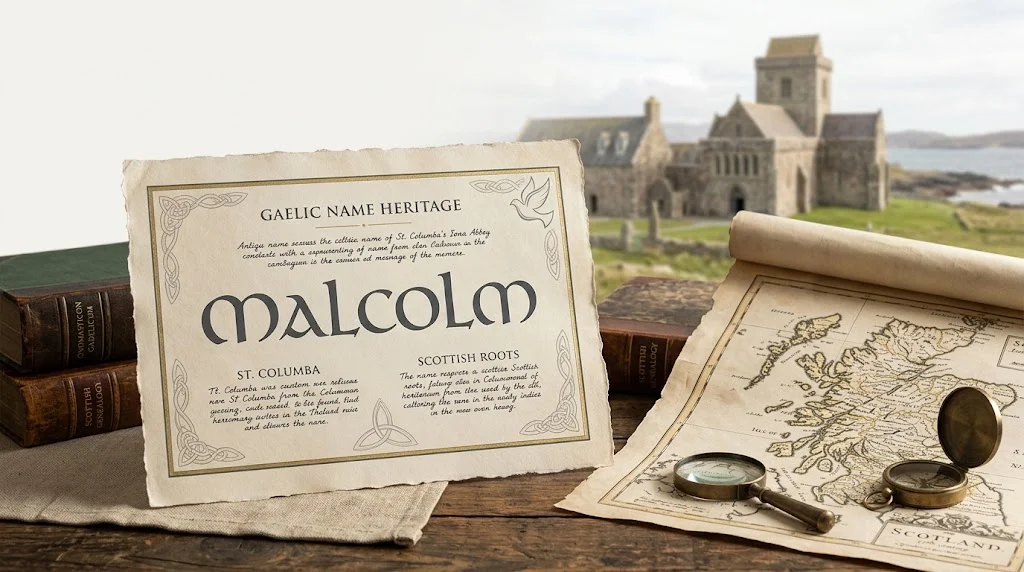
Malcolm is a masculine name of Scottish Gaelic origin meaning “disciple of Columba” or “devotee of Columba.” It comes from the Gaelic Máel Coluim, a historical name connected with St. Columba, the influential sixth-century Irish monk associated with Christianity in Scotland.
The Malcolm name meaning is traditionally understood as “disciple of Columba” or “devotee of Columba.” The name has deep Scottish Gaelic roots and a long connection with Scottish history, particularly through several medieval kings of Scotland named Malcolm.
Malcolm is more than an old-fashioned Scottish name. Its history connects Gaelic language, Christian tradition, medieval Scotland, royal naming practices, and the enduring legacy of St. Columba. Over time, Malcolm developed from a Gaelic personal name into a familiar English-language given name while retaining its strong Scottish identity.
In this guide, we will explore the meaning, origin, etymology, pronunciation, history, cultural significance, variations, symbolism, and modern usage of Malcolm.
What Is the Meaning of Malcolm?
Malcolm is a traditional masculine given name derived from the Scottish Gaelic Máel Coluim. It is generally interpreted as “disciple of Columba,” “follower of Columba,” or “devotee of Columba.”
The name is associated with Columba, better known as St. Columba, a sixth-century Christian missionary and monastic figure whose name became especially important in medieval Scotland.
The meaning can be understood through its two historical elements:
- Máel — an element used in early Gaelic personal names with associations such as devotee, follower, or disciple.
- Coluim — the Gaelic form associated with Columba.
Therefore, Malcolm is traditionally connected with the idea of someone devoted to or following Columba.
This religious association is important because Malcolm’s meaning is not simply a descriptive word such as “strong” or “brave.” Instead, it reflects an older Gaelic naming tradition in which personal names could express religious devotion or association with a revered saint.
Malcolm Name Meaning and Symbolism
The traditional Malcolm name meaning gives the name a strong sense of faith, devotion, loyalty, and heritage.
Because the name is associated with St. Columba and the early Christian tradition of Scotland, it can symbolically represent:
- Devotion
- Faith
- Loyalty
- Spiritual dedication
- Scottish heritage
- Historical strength
- Tradition
- Leadership
These symbolic qualities should be distinguished from the literal etymological meaning. A name’s symbolism can develop through its history and cultural associations, while its original linguistic meaning remains more specific.
For example, Malcolm’s association with Scottish kings has contributed to its image of authority and leadership, even though “leader” is not its literal etymological definition.
Origin and Etymology of Malcolm
Malcolm comes from the Scottish Gaelic name Máel Coluim, an early Gaelic personal name connected with Columba.
The first element, Máel, appears in a number of early Gaelic names. In this naming tradition, it could indicate a person devoted to a particular saint or religious figure. The second element, Coluim, is related to the name of Columba.
The historical form therefore carries the sense of a devotee or follower of Columba.
Who Was Columba?
St. Columba, also known as Colum Cille, was an Irish monk and missionary who lived in the sixth century. He is strongly associated with the island of Iona, where he established an important monastic community.
Iona became a significant center of Christianity and learning in the medieval Gaelic world. Because of Columba’s importance in the religious history of Scotland and Ireland, his name became incorporated into Gaelic personal naming traditions.
The name Máel Coluim consequently reflects the cultural environment in which personal names could express an individual’s relationship with a saint.
From Máel Coluim to Malcolm
As Gaelic names moved between languages and spelling traditions, Máel Coluim developed into forms such as Malcolm in English.
The modern spelling does not look identical to its Gaelic ancestor, but the connection remains clear through the historical development of the name.
This is common with older names. As names move from one language into another, their spelling and pronunciation may change while their historical identity remains recognizable.
History of the Name Malcolm
He has an especially strong place in Scottish history because several Scottish kings bore the name.
Malcolm I
Malcolm I was King of Scots during the tenth century. His reign places the name within the early history of the Scottish monarchy.
The use of a Gaelic-derived name by a Scottish king demonstrates how deeply Gaelic naming traditions were embedded in the kingdom’s historical identity.
Malcolm II
Malcolm II ruled Scotland from the early eleventh century until 1034. He was the last Scottish king from the House of Alpin.
His reign further strengthened Malcolm’s association with Scotland’s medieval royal tradition.
Malcolm III
One of the most historically famous bearers was Malcolm III of Scotland, who ruled from 1058 to 1093.
He is often known by the nickname Canmore, generally associated with the Gaelic Ceann Mór. Malcolm III is particularly well known because of his marriage to Margaret of Wessex, who later became known as Saint Margaret of Scotland.
His reign places the name Malcolm at an important point in the development of medieval Scottish monarchy.
Malcolm IV
Malcolm IV became king in the twelfth century and ruled from 1153 to 1165. He is traditionally known by the nickname “the Maiden.”
Together, these historical kings gave Malcolm a strong association with Scottish royalty and medieval history.
Malcolm and Scottish Culture
Although Malcolm is now used internationally, its strongest historical identity is Scottish.
The name developed within the Gaelic-speaking culture of Scotland, and its connection with Columba links it to the early Christian traditions of the Gaelic world.
Its Scottish identity is also reinforced by its appearance in the names of Scottish monarchs. As a result, Malcolm can evoke several layers of cultural meaning:
Gaelic language → Scottish Christianity → St. Columba → Medieval Scotland → Scottish monarchy
This chain helps explain why Malcolm remains recognizable as a traditionally Scottish name even when used outside Scotland.
Malcolm Pronunciation
In modern English, Malcolm is commonly pronounced:
MAL-kəm
The first syllable is stressed, while the second syllable is usually pronounced with a relaxed “uh” sound.
Simple pronunciation guide
Malcolm = MAL-kum
The exact pronunciation can vary slightly according to accent, but the two-syllable English pronunciation is widely familiar.
The historical Gaelic form Máel Coluim has a different pronunciation and should not be assumed to sound exactly like modern English “Malcolm.”
Is Malcolm a Biblical Name?
Malcolm is not a biblical name in the same direct sense as names such as Daniel, David, or Matthew.
Its roots are Scottish Gaelic, and its traditional meaning is connected with Columba, a Christian saint and historical religious figure.
However, Malcolm has a strong Christian historical association because of its connection with St. Columba and the Christian traditions of medieval Scotland.
Therefore, it is more accurate to describe Malcolm as a Scottish Gaelic Christian-associated name rather than a biblical name.
Is Malcolm a Scottish Name?
Yes. Malcolm is strongly associated with Scottish Gaelic heritage.
Its historical form, Máel Coluim, is Gaelic, and the name was used by multiple Scottish kings. Its association with St. Columba and medieval Scotland further strengthens its Scottish identity.
Although Malcolm is now used in many English-speaking countries, Scotland remains central to its historical background.
Malcolm Name Variations and Related Forms
Names can change considerably when they move between languages and historical periods. Malcolm itself is connected to the Gaelic form Máel Coluim.
Some related forms and spellings encountered in historical or linguistic contexts include:
| Name/Form | Connection |
|---|---|
| Malcolm | Modern English form |
| Máel Coluim | Historical Gaelic form |
| Mael Coluim | Anglicized rendering without diacritics |
| Columba | Latin form associated with the saint |
| Colum | Gaelic name associated with Columba |
These should not all be treated as exact interchangeable versions. Some are historical forms, while others are related names or linguistic forms associated with the same naming tradition.
Malcolm vs. Columba
Malcolm and Columba are closely connected historically, but they are not the same name.
| Name | Meaning/Connection | Main Association |
|---|---|---|
| Malcolm | “Disciple/devotee of Columba” | Scottish Gaelic tradition |
| Columba | Latin name associated with St. Columba | Early Christian history |
| Colum | Gaelic form related to Columba | Irish and Gaelic tradition |
The relationship is important because Columba is the figure to whom the traditional meaning of Malcolm refers.
Famous People Named Malcolm
The name Malcolm has been carried by numerous notable people in different fields.
Malcolm X
Malcolm X was an influential American Muslim minister, activist, and prominent figure in the civil rights era. His public life gave the name Malcolm a particularly recognizable association in modern American history.
Malcolm Gladwell
Malcolm Gladwell is a Canadian-English author and journalist known for books and writing on psychology, sociology, human behavior, and social trends.
These modern examples show that Malcolm is not limited to historical or royal contexts. The name continues to be used by people in contemporary public life.
What Does Malcolm Symbolize?
While the literal meaning of Malcolm centers on devotion to Columba, its broader historical associations give the name additional symbolic qualities.
Faith and Devotion
The strongest symbolic connection comes from the name’s traditional reference to a follower or devotee of Columba.
Scottish Heritage
Centuries of use in Scotland make Malcolm a natural symbol of Scottish and Gaelic heritage.
Leadership
The use of Malcolm by several Scottish kings has contributed to associations with authority, responsibility, and leadership.
Tradition
Malcolm is an old name with a documented historical presence, giving it a traditional and established character.
Strength
The name does not literally mean “strong,” but its association with kings, historical figures, and long-standing cultural traditions can give it a strong and dignified impression.
Is Malcolm a Good Name?
Malcolm can be a strong choice for parents who want a name with historical depth, Scottish heritage, and a traditional sound.
Its advantages include:
- Strong Scottish identity
- Deep historical roots
- A meaningful connection to St. Columba
- Long-standing use
- Traditional but recognizable sound
- Associations with Scottish royalty
- Several well-known modern bearers
The name also has the advantage of being familiar without sounding as commonplace as some traditional English names.
Malcolm as a Baby Name
For parents considering Malcolm as a baby name, its appeal often comes from its combination of heritage and substance.
It works particularly well for families interested in Scottish or Gaelic history, Christian heritage, traditional names, or names with documented historical roots.
The nickname Mal is also possible in informal contexts, although many people may simply use the full name Malcolm.
Because names are personal choices, the historical meaning should be viewed as cultural background rather than a prediction of a child’s personality.
Examples of Malcolm in Use
Here are a few natural examples showing how the name can appear in different contexts:
- Malcolm is a classic Scottish name with Gaelic roots.
- The name Malcolm is traditionally connected with St. Columba.
- Malcolm has been used by several Scottish kings.
- The family chose Malcolm to honor their Scottish heritage.
- Malcolm has a traditional meaning associated with devotion and religious loyalty.
These examples demonstrate how the name can be discussed in historical, cultural, and personal naming contexts.
What Makes the Name Malcolm Special?
Malcolm combines several qualities that make it distinctive.
First, it has a clear linguistic history in Scottish Gaelic. Second, its meaning is connected to one of the most important early Christian figures associated with Scotland. Third, the name has a significant royal history, having been used by several Scottish kings.
That combination gives Malcolm a layered identity:
Gaelic roots + Christian heritage + Scottish history + royal associations + modern recognition
Few names can connect all of these elements while remaining familiar and easy to use in modern English.
FAQs
What does the name Malcolm mean?
Malcolm traditionally means “disciple of Columba” or “devotee of Columba,” referring to St. Columba.
What is the origin of Malcolm?
Malcolm comes from the Scottish Gaelic Máel Coluim, a historical Gaelic personal name.
Is Malcolm a Scottish name?
Yes, Malcolm is strongly associated with Scottish Gaelic culture and history, including several Scottish kings.
Is Malcolm a biblical name?
No, Malcolm is not directly biblical; it is a Scottish Gaelic name with a strong Christian historical association.
How do you pronounce Malcolm?
Malcolm is commonly pronounced MAL-kum, with the stress on the first syllable.
What does Malcolm symbolize?
Malcolm can symbolize devotion, Scottish heritage, tradition, faith, and historical leadership.
Is Malcolm a rare name?
Malcolm is a recognizable traditional name, though its popularity varies by country and generation.
What is the Gaelic form of Malcolm?
The historical Gaelic form is Máel Coluim, which is the source of the modern English Malcolm.
Is Malcolm a good baby name?
Malcolm is a good choice for families seeking a classic, historically rich, Scottish-associated name with a distinctive meaning.
What is a nickname for Malcolm?
Common informal forms can include Mal, although many people use Malcolm in its full form.
Conclusion
The Malcolm name meaning is traditionally understood as “disciple of Columba” or “devotee of Columba,” reflecting the name’s Scottish Gaelic roots and connection with St. Columba. Its history reaches back to medieval Scotland, where the name was used by several kings and became firmly associated with Scottish heritage and leadership.
Today, Malcolm remains a distinguished traditional name with a meaningful combination of faith, history, Gaelic culture, and royal heritage. For parents seeking a name that feels classic without being overly common, Malcolm offers a well-documented historical identity and a strong cultural connection.
Discover More Related Articles:
- Karen Name Meaning | From Greek Origins to Modern Times In 2026
- Arianna Name Meaning | Discover Its Ancient Roots, Mythological Connections & Timeless Appeal In 2026
- Inez Name Meaning | The Elegant Legacy That Makes This Name So Special 2026