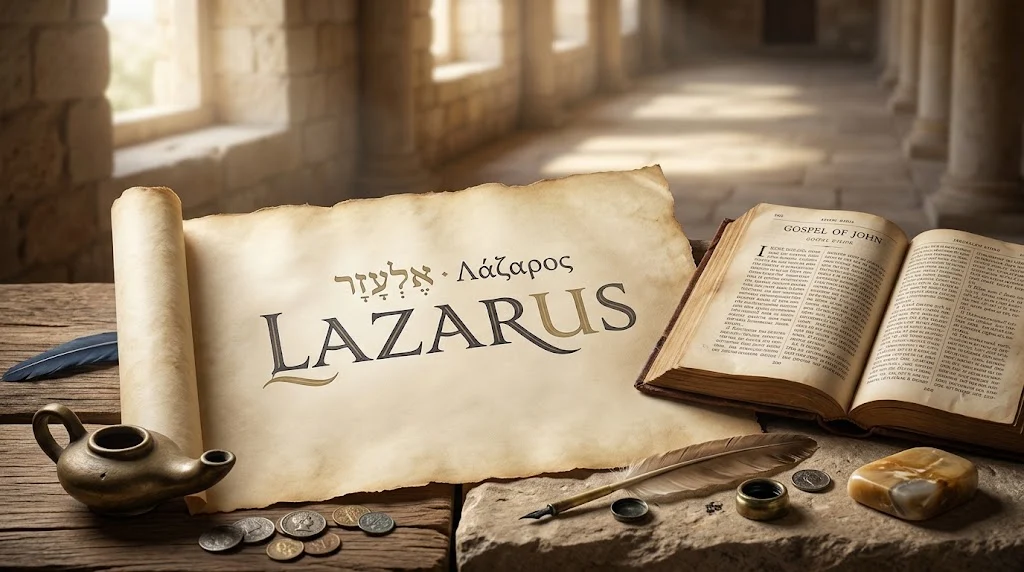
Lazarus is a masculine given name of Hebrew origin, derived from Eleazar, meaning “God has helped” or “God has helped me.” The name became especially well known through the New Testament figure Lazarus of Bethany, whose story gives the name strong associations with faith, restoration, and life renewed.
The Lazarus name meaning is commonly understood as “God has helped” or “God has helped me.” Lazarus is the Greek and Latin form connected with the Hebrew name Eleazar, a name formed from elements meaning “God” and “help.” The name is particularly familiar from the New Testament story of Lazarus of Bethany.
Beyond its literal meaning, Lazarus carries a powerful biblical history. Its association with the story of a man restored to life gives the name additional symbolic connections with faith, hope, restoration, divine intervention, and renewal. This article explores Lazarus’s etymology, biblical background, pronunciation, variants, symbolism, and use as a personal name.
What Does Lazarus Mean?
The Lazarus name meaning is “God has helped” or “God has helped me.”
Lazarus is traditionally regarded as the Greek form of the Hebrew name Eleazar (Hebrew: אֶלְעָזָר, Elʿazar). The first element, El, refers to God, while azar is associated with helping or assisting.
In a naming context, this gives Lazarus a distinctly religious meaning:
- God has helped
- God is my help
- God has assisted
- Divine help
The exact English wording can vary among name references because ancient names do not always map neatly into one modern English phrase. The central idea, however, is help from God.
Lazarus Name Origin and Etymology
Lazarus ultimately traces its linguistic history to the Hebrew name Eleazar.
The development can be represented broadly as:
Hebrew Eleazar → Greek Lazaros → Latin Lazarus → Lazarus
The Hebrew Eleazar is composed of elements associated with God and help. When the name was transmitted into Greek, it appeared as Lazaros (Lazaros), which later gave rise to the Latin form Lazarus.
This linguistic history is important because Lazarus is not simply an isolated biblical name. It belongs to a wider family of names that developed as Hebrew names were transmitted through Greek and Latin into later European languages.
The Connection With Eleazar
Eleazar and Lazarus are closely related historically, although they look quite different in English.
Eleazar preserves more of the original Hebrew form, while Lazarus represents the form that became familiar through Greek and Latin biblical tradition.
This is a useful example of how names can change when they move between languages. Pronunciation, spelling, and grammatical endings can change while the underlying name remains historically connected.
Lazarus Name Meaning in the Bible
The biblical history of Lazarus is one of the main reasons the name remains recognizable.
The most famous Lazarus is Lazarus of Bethany, a man described in the Gospel of John. He was the brother of Mary and Martha and lived in Bethany, a village near Jerusalem.
According to the Gospel account, Lazarus became seriously ill and died. Jesus later came to Bethany and called Lazarus out of the tomb.
This story gives Lazarus an unusually powerful place among biblical names.
The name’s literal meaning emphasizes God’s help, while its most famous biblical association emphasizes restoration and life after death. These ideas have influenced the symbolic interpretation of the name throughout Christian history.
It is important to distinguish the literal etymological meaning from later symbolism. “God has helped” is the name’s traditional linguistic meaning; ideas such as resurrection and renewal come primarily from the biblical story associated with Lazarus.
Lazarus and Bethany
Lazarus is closely connected with Bethany, the biblical location associated with his family.
Bethany appears in the New Testament as the home of Lazarus, Mary, and Martha. Its proximity to Jerusalem places the Lazarus narrative within the geographical setting of Jesus’s ministry in Judea.
This connection also helped make Lazarus more than simply a personal name. Over centuries, the story became part of Christian art, preaching, literature, and religious tradition.
The name therefore carries several layers of association:
Lazarus → Bethany → New Testament → Jesus → restoration → faith and hope
These associations are cultural and religious rather than additional dictionary meanings of the name.
Symbolism of the Name Lazarus
Because of its biblical history, Lazarus has acquired strong symbolic associations.
Divine Help
The most direct symbolism comes from its etymology. A person named Lazarus may be associated symbolically with the idea that God provides help.
Hope
The Lazarus narrative has traditionally been read as a story involving hope in the face of death and despair.
Restoration
The story of Lazarus being brought out of the tomb makes restoration one of the strongest symbolic associations connected with the name.
Faith
The biblical account is closely connected with questions of belief and faith, giving Lazarus a strong spiritual dimension.
Renewal
In modern naming discussions, Lazarus can evoke ideas of starting again, overcoming hardship, and experiencing renewal. These are symbolic interpretations rather than literal translations of the name.
Lazarus Pronunciation
In modern English, Lazarus is commonly pronounced approximately:
LAZ-uh-rus
The first syllable receives the primary stress.
The pronunciation can vary somewhat across languages and accents, particularly because the name has passed through Hebrew, Greek, Latin, and later European languages.
For English speakers, LAZ-uh-rus is the most familiar pronunciation.
Lazarus Name History and Cultural Context
Lazarus has a long history because its biblical associations allowed it to survive across different periods and Christian cultures.
The name entered Western naming traditions largely through the biblical and ecclesiastical use of the Latin Lazarus. As Christianity spread across Europe, biblical names became an important part of personal naming practices.
Lazarus, however, has generally had a more distinctive and less everyday character than names such as John, Peter, or Mary.
Its strong connection with the New Testament gives it a recognizable religious identity, while its relatively uncommon modern usage can make it feel unusual and memorable.
The name has also appeared in literature, religious art, historical records, and various European naming traditions.
Lazarus in Christian Tradition
The biblical Lazarus has had an especially significant influence on Christian culture.
The raising of Lazarus has been represented in religious paintings and other forms of Christian art for centuries. Artists have often depicted the moment when Lazarus emerges from the tomb, making the story visually associated with death, life, faith, and divine power.
The Lazarus narrative also contributed to the name’s wider symbolic significance.
As a result, someone choosing Lazarus today may be drawn to the name because of:
- Its biblical roots
- Its meaning connected with divine help
- Its association with faith
- Its connection with restoration
- Its historical depth
- Its distinctive sound
Lazarus vs. Eleazar
Lazarus and Eleazar are historically connected, but they are not simply interchangeable modern spellings.
| Name | Historical connection | Main association |
|---|---|---|
| Lazarus | Greek/Latin form related to Eleazar | New Testament and Christian tradition |
| Eleazar | Hebrew name | Hebrew biblical tradition |
| Lazaros | Greek form | Greek biblical tradition |
The biggest distinction is cultural and linguistic. Eleazar retains the Hebrew form, while Lazarus represents the form transmitted through Greek and Latin Christian tradition.
Lazarus vs. Other Biblical Names
Lazarus belongs to the broad category of biblical names, but it has a particularly distinctive history.
| Name | Meaning/association | Style |
|---|---|---|
| Lazarus | God has helped | Biblical, distinctive |
| Eleazar | God has helped | Hebrew, traditional |
| Isaiah | Associated with God and salvation | Hebrew, prophetic |
| Samuel | Traditionally associated with God/hearing | Hebrew, biblical |
| Gabriel | God is my strength | Biblical, angelic |
| Daniel | God is my judge | Hebrew, biblical |
The comparison shows why Lazarus can appeal to parents looking for a biblical name that is less commonly heard in everyday conversation.
Is Lazarus a Good Name?
Lazarus is a good name depends on personal taste, cultural background, and the qualities a family wants a name to convey.
It may appeal to parents who want a name that is:
- Strongly biblical
- Historically established
- Distinctive without being invented
- Rich in religious symbolism
- Connected with hope and restoration
- Recognizable but relatively uncommon
Its main consideration is that the name has a very strong biblical identity. Families who prefer names with subtle or less explicitly religious associations may prefer another option.
For families comfortable with biblical names, however, Lazarus offers a combination of ancient history, recognizable biblical identity, and an unusually powerful symbolic story.
Famous Biblical Lazarus
The most important historical figure associated with the name is Lazarus of Bethany, the man featured in the Gospel of John.
There are also other uses of Lazarus in Christian tradition and later history, but they should not automatically be treated as references to the same biblical individual.
This distinction matters because the biblical name became influential enough to be reused across many later periods and communities.
Lazarus as a Modern Baby Name
Lazarus has a distinctive sound that can feel both ancient and dramatic.
Unlike many extremely common biblical names, it tends to stand out. Its recognizable spelling makes its origin relatively easy to identify, while its ancient structure gives it a historical character.
Parents considering Lazarus may especially appreciate the combination of:
Ancient origin + biblical heritage + meaningful etymology + distinctive sound
The name can also work well for families interested in names that have survived through multiple languages and historical periods.
Names Related to Lazarus
The closest important related name is Eleazar, the Hebrew form from which Lazarus developed through Greek.
Other related or culturally connected forms may appear in different languages and naming traditions, but spelling and pronunciation can vary considerably.
When researching a specific variant, it is useful to distinguish between:
- Direct linguistic forms of the name.
- Traditional translations used in different languages.
- Names that merely sound similar but have a different origin.
This prevents unrelated names from being incorrectly presented as variants of Lazarus.
What Makes the Name Lazarus Unique?
Several features distinguish Lazarus from many other biblical names.
First, its etymology expresses divine help, giving it a clear positive religious meaning. Second, its New Testament association provides an unusually memorable historical narrative. Third, its development from Hebrew through Greek and Latin demonstrates how names can change as they move between languages.
Most importantly, the name combines a straightforward meaning with a much deeper cultural story.
Lazarus means “God has helped,” but its cultural associations extend into faith, restoration, hope, and renewal.
That combination gives the name considerable symbolic depth.
FAQs
What does the name Lazarus mean?
Lazarus traditionally means “God has helped” or “God has helped me,” and is connected with the Hebrew name Eleazar.
Is Lazarus a Hebrew name?
Lazarus is the Greek/Latin form associated with the Hebrew name Eleazar, so its ultimate origin is Hebrew.
What is the biblical meaning of Lazarus?
Its literal meaning relates to God’s help, while its biblical story gives it associations with faith, restoration, and renewed life.
Is Lazarus a biblical name?
Yes. Lazarus is the name of the man from Bethany whose story is told in the New Testament Gospel of John.
How do you pronounce Lazarus?
In English, Lazarus is commonly pronounced LAZ-uh-rus, with the emphasis on the first syllable.
Is Lazarus the same as Eleazar?
They are historically related names, with Lazarus developing from the Hebrew Eleazar through its Greek form.
What does Lazarus symbolize?
Because of its biblical history, Lazarus is often associated symbolically with divine help, hope, restoration, faith, and renewal.
Is Lazarus a good baby name?
Lazarus can be a strong choice for families seeking a distinctive biblical name with ancient history and meaningful religious associations.
Conclusion
The lazarus name meaning is traditionally understood as “God has helped” or “God has helped me.” Its history can be traced through the Hebrew name Eleazar and the Greek form Lazaros before reaching the Latin Lazarus that became familiar in Christian tradition.
Its association with Lazarus of Bethany adds another important layer to the name. Because of that biblical story, Lazarus can symbolize faith, hope, restoration, divine help, and renewal while retaining a strong connection to ancient Hebrew and Christian history.
Discover More Related Articles:
- Franklin Name Meaning | Origin, History & History Behind the Name in 2026
- Frank Name Meaning | Origin, History & Significance In 2026
- Archer Name Meaning| Origin, History, Symbolism & Significance in 2026