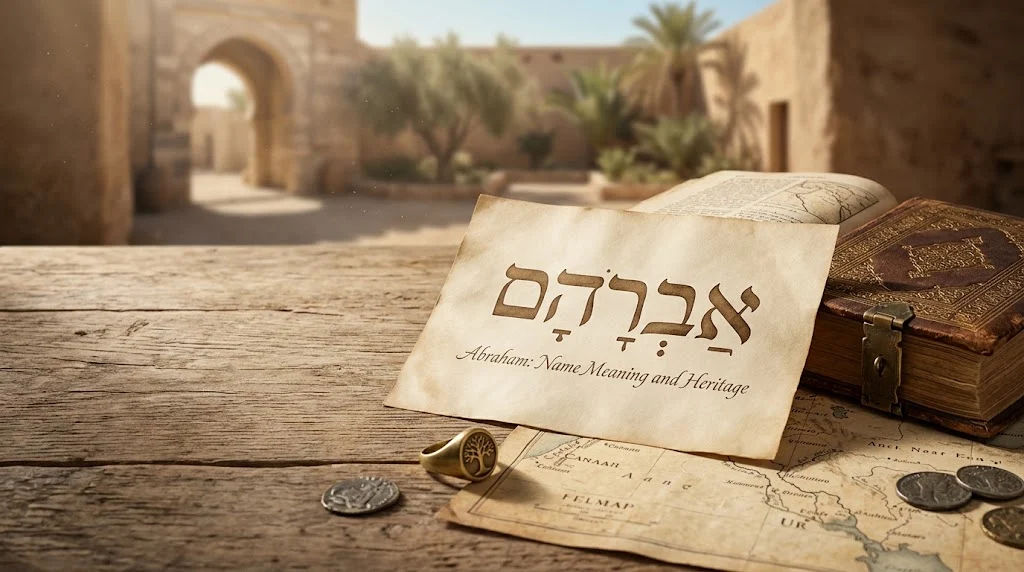
Abraham name meaning is commonly understood as “father of a multitude” or “father of many nations.” Abraham is a Hebrew biblical name associated with the patriarch Abraham in Genesis, a central figure in Judaism, Christianity, and Islam. The name carries strong associations with faith, covenant, ancestry, and leadership.
The name Abraham has an especially rich history because it is connected to one of the most influential figures in the biblical tradition. In the Hebrew Bible, Abraham is presented as the ancestor of the Israelites and a key figure in God’s covenant. His story also gives the name significance across the wider Abrahamic religious traditions.
What Is the Name Abraham?
Abraham is a traditional masculine given name of Hebrew origin. It is best known from the Hebrew Bible, where Abraham appears as a patriarch and an important figure in the Book of Genesis.
The name is particularly notable because Abraham was originally called Abram. According to Genesis, his name was changed to Abraham as part of the covenant narrative. This makes Abraham unusual among familiar given names because its biblical history includes a specific transformation from an earlier form.
Today, Abraham can function as both a religiously significant name and a traditional personal name. It is used by families from different cultural backgrounds, particularly those influenced by Jewish, Christian, or Islamic traditions.
Abraham Name Meaning
The Abraham name meaning is traditionally explained as “father of a multitude” or “father of many nations.”
This interpretation comes directly from the biblical account of Abraham’s name change. In Genesis 17:5, Abram is given the name Abraham in connection with God’s promise that he will become the father of many nations.
The traditional meaning can therefore be understood through several related ideas:
- Father of a multitude
- Father of many nations
- Ancestral father
- A name associated with numerous descendants
- A symbol of faith and covenant
The meaning is not simply a dictionary definition. In its biblical context, Abraham represents ancestry, promise, faith, and the formation of a people through covenant.
What Does Abraham Mean Spiritually?
In religious contexts, Abraham is strongly associated with faith, obedience, covenant, family, and divine promise.
For this reason, parents who choose Abraham may appreciate the name not only for its traditional meaning but also for the qualities associated with its biblical bearer. However, these symbolic associations are cultural and religious interpretations rather than literal personality traits guaranteed by a person’s name.
Abraham Name Origin and Etymology
Abraham comes from Hebrew, where the biblical form is written אַבְרָהָם (Avraham).
The etymology is closely connected with the biblical explanation of the name. Genesis connects Abraham with the idea of being a “father of a multitude” or “father of many nations.”
The earlier name Abram is generally understood as meaning something like “exalted father” or “father is exalted.” The relationship between Abram and Abraham is therefore important when discussing the history of the name.
There is some scholarly complexity surrounding the exact linguistic formation of Abraham. The biblical text itself provides a theological explanation for the name change, while historical-linguistic analysis can approach the form differently. For a name-meaning article, it is therefore more accurate to distinguish the traditional biblical interpretation from claims about an absolutely certain linguistic derivation.
Abram vs. Abraham
| Name | Traditional Meaning | Significance |
|---|---|---|
| Abram | “Exalted father” / “father is exalted” | Abraham’s earlier biblical name |
| Abraham | “Father of a multitude” / “father of many nations” | Name associated with the covenant promise |
This distinction is important because Abram and Abraham are not simply unrelated variations. They are two forms connected within the biblical narrative.
Abraham in the Bible
Abraham is one of the major patriarchs in the Book of Genesis. His story includes his departure from his homeland, God’s covenant with him, the promise of descendants, and major events involving his family.
One of the defining themes of Abraham’s story is faith.
In Genesis, Abraham responds to God’s call and becomes associated with a covenant promising descendants and a significant future for his lineage. His wife Sarah, his son Isaac, and his nephew Lot are also important figures in the narrative surrounding him.
Abraham’s significance extends beyond his individual story because later religious traditions understand him as an ancestral figure whose faith and covenant have lasting consequences.
Abraham and the Abrahamic Religions
It is important in all three major Abrahamic religions: Judaism, Christianity, and Islam.
Abraham in Judaism
In Judaism, Abraham is known as Avraham Avinu, meaning “Abraham our father.” He is regarded as one of the patriarchs and is closely connected with the covenant between God and the descendants of Abraham.
His story in Genesis is foundational to Jewish biblical tradition.
Abraham in Christianity
Christianity also regards Abraham as an important biblical patriarch. His story is frequently used in discussions of faith, righteousness, promise, and covenant.
The New Testament refers to Abraham in several contexts, making him an important figure in Christian theology as well as in the Old Testament tradition.
Abraham in Islam
In Islam, Abraham is known as Ibrahim and is regarded as an important prophet. His story appears throughout the Qur’an and Islamic tradition.
Ibrahim is associated with devotion to God, faith, obedience, and the establishment of the Kaaba together with his son Ismail according to Islamic tradition.
The English form Abraham and the Arabic form Ibrahim reflect different linguistic traditions surrounding the same major religious figure.
Historical and Cultural Significance of Abraham
The name Abraham has survived for centuries largely because of the continuing influence of the biblical patriarch.
Unlike names whose popularity depends mainly on modern fashion, Abraham has a deep historical foundation. Its use has been maintained through religious texts, family traditions, cultural inheritance, and naming practices.
The name has also crossed linguistic and cultural boundaries. Forms related to Abraham appear in numerous languages, including:
- Hebrew: Avraham
- English: Abraham
- Arabic: Ibrahim
- French: Abraham
- Spanish: Abraham
- Italian: Abramo
- Portuguese: Abraão
These forms demonstrate how a historically important name can change in pronunciation and spelling while retaining its connection to the same traditional figure.
Abraham Pronunciation
In English, Abraham is commonly pronounced:
AY-bruh-ham
A common phonetic representation is approximately:
/ˈeɪ.brə.hæm/
The pronunciation can vary by language and regional accent. Hebrew Avraham and Arabic Ibrahim, for example, do not sound exactly like the English form Abraham.
When choosing the name for a child, parents may therefore encounter different pronunciations depending on their linguistic or cultural background.
Abraham Name Symbolism
Because of Abraham’s biblical role, the name has developed several strong symbolic associations.
Faith
Abraham is frequently presented as an example of faith and trust in God. This makes faith one of the strongest symbolic qualities associated with the name.
Family and Ancestry
The traditional meaning involving a multitude and the biblical promise of descendants gives Abraham a strong connection with family, ancestry, and lineage.
Covenant
Abraham’s story is deeply connected with the idea of a covenant. This makes the name especially significant in religious contexts.
Leadership
Abraham’s position as a patriarch contributes to associations with leadership, responsibility, and guidance.
Heritage
For many families, Abraham represents an ancient religious and cultural heritage that connects generations.
These are symbolic associations derived from the name’s history. They should not be interpreted as predictions about the personality of someone named Abraham.
Is Abraham a Good Name?
Abraham can be a strong choice for parents looking for a name with biblical depth, historical longevity, and religious significance.
It has several advantages:
- Deep biblical history
- Strong Hebrew roots
- Recognizable internationally
- Significant in multiple religions
- Traditional without being tied to one modern trend
- Associated with faith and ancestry
- Several possible nicknames, including Abe and Abie
The main consideration is style. Abraham has a formal, traditional sound and may feel more substantial than short modern names. For families who value historic or biblical names, however, that can be one of its greatest strengths.
Nicknames for Abraham
Although Abraham is traditionally used in its full form, several shorter forms are possible.
Common or familiar possibilities include:
- Abe
- Abie
- Abram — historically related but technically a separate biblical name
- Ab — an informal shortening in some contexts
Abe is probably the best-known short form in English-speaking contexts. It gives the traditional name a much shorter and more casual everyday option.
Abraham vs. Abram
Abraham and Abram are closely related because Abram is the earlier name of the biblical patriarch before his name becomes Abraham.
| Feature | Abraham | Abram |
|---|---|---|
| Origin | Hebrew | Hebrew |
| Biblical connection | Patriarch Abraham | Abraham’s earlier name |
| Traditional meaning | Father of a multitude | Exalted father |
| Style | Formal, substantial, traditional | Shorter, distinctive, ancient |
| Common short form | Abe | Usually used as-is |
For parents choosing between the two, Abraham generally has the clearer connection to the familiar biblical figure and the traditional “father of a multitude” interpretation.
Famous Abraham: Abraham Lincoln
One of the most famous people to bear the name was Abraham Lincoln, the 16th president of the United States.
Lincoln’s prominence gave the name an additional cultural association in American history. However, his historical significance should be kept separate from the original etymological meaning of Abraham. The name itself predates Lincoln by thousands of years and has a much older biblical history.
Examples of the Name Abraham
The name works naturally in both traditional and modern naming contexts.
Traditional:
“Abraham was named after his grandfather.”
Biblical context:
“Abraham is an important patriarch in the Book of Genesis.”
Family naming:
“The parents chose Abraham because they wanted a name with strong biblical roots.”
Modern usage:
“Abraham is a classic name that can still be shortened to the friendly nickname Abe.”
These examples show how Abraham can work as a formal given name while also allowing a shorter everyday form.
Abraham Name Meaning in Different Contexts
The meaning and associations of Abraham can be viewed from several perspectives:
| Context | Meaning or Association |
|---|---|
| Hebrew tradition | Avraham; biblical patriarch |
| Biblical tradition | Father of a multitude / many nations |
| Judaism | Patriarch and covenant figure |
| Christianity | Model of faith and biblical patriarch |
| Islam | Ibrahim, an important prophet |
| Modern naming | Traditional masculine given name |
| Cultural symbolism | Faith, ancestry, family, heritage |
This broader context explains why Abraham remains meaningful well beyond its basic dictionary-style definition.
FAQs
What does the name Abraham mean?
Abraham is traditionally understood to mean “father of a multitude” or “father of many nations.”
Is Abraham a Hebrew name?
Yes. Abraham comes from the Hebrew biblical name Avraham (Avraham).
What is the biblical meaning of Abraham?
The biblical explanation connects Abraham with becoming the father of a multitude and many nations.
Is Abraham a religious name?
Yes. Abraham is an important figure in Judaism, Christianity, and Islam, although the name appears in different linguistic forms.
What was Abraham’s original name?
According to Genesis, Abraham was originally called Abram before his name was changed to Abraham.
What is the difference between Abraham and Abram?
Abram is Abraham’s earlier biblical name, while Abraham is the name associated with the later covenant promise and the meaning “father of a multitude.”
What is a nickname for Abraham?
The most familiar English nickname for Abraham is Abe; Abie is another possible affectionate form.
How do you pronounce Abraham?
In English, Abraham is commonly pronounced AY-bruh-ham, although pronunciation varies across languages and accents.
Conclusion
The Abraham name meaning is traditionally connected with “father of a multitude” or “father of many nations.” With Hebrew roots and a central place in the Book of Genesis, Abraham is one of the best-known biblical names in history.
Its significance extends across Judaism, Christianity, and Islam, where Abraham or Avraham and Ibrahim in related linguistic traditions is remembered as a major patriarch or prophet. For modern parents, the name offers a combination of ancient heritage, religious depth, recognizable pronunciation, and the friendly nickname Abe.
Discover More Related Articles:
- Franklin Name Meaning | Origin, History & History Behind the Name in 2026
- Frank Name Meaning | Origin, History & Significance In 2026
- Archer Name Meaning| Origin, History, Symbolism & Significance in 2026