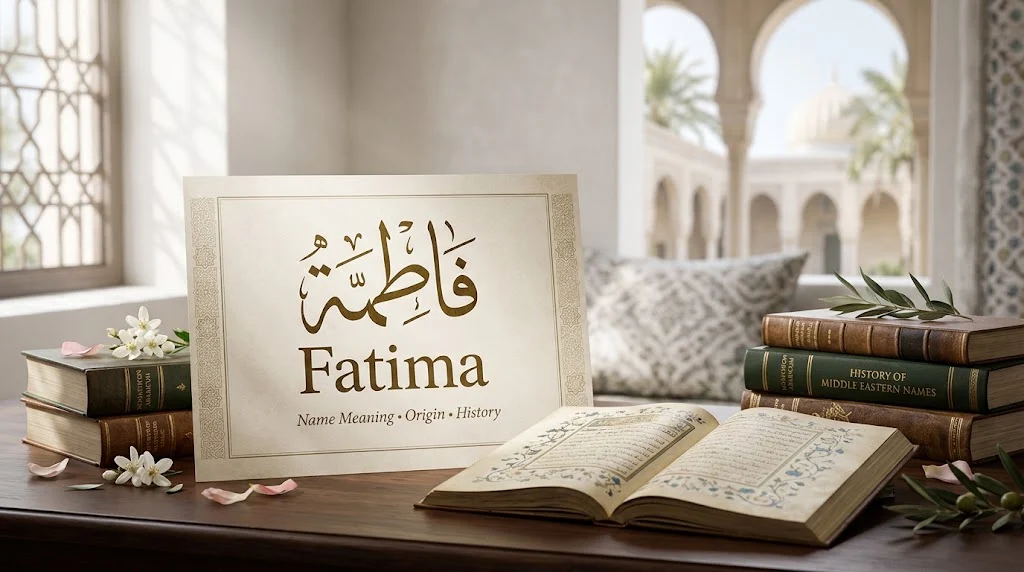
Fatima is a feminine Arabic name derived from Fāṭimah (فاطمة). It is traditionally connected with the Arabic root associated with weaning or abstaining, while the name carries deep cultural and religious significance because of Fatimah al-Zahra, the daughter of the Prophet Muhammad.
The Fatima name meaning is rooted in the Arabic name Fāṭimah (فاطمة), one of the most historically important feminine names in Islamic tradition. The name is especially recognized because Fatimah bint Muhammad, also known as Fatimah al-Zahra, was the daughter of the Prophet Muhammad and Khadijah.
Fatima is therefore more than a name with an Arabic linguistic origin. Across Muslim communities, it has become associated with religious heritage, family lineage, devotion, dignity, and virtue. Its widespread use has also produced several spelling and pronunciation variations, including Fatimah, Fatma, Fathima, and Fátima.
This guide explores the meaning of Fatima, its Arabic etymology, historical background, Islamic significance, pronunciation, variants, and the reasons the name remains meaningful across different cultures.
What Is the Fatima Name Meaning?
The name Fatima is the commonly used English and Latin-script form of the Arabic Fāṭimah (فاطمة). Traditional Arabic explanations connect the name with the root f-ṭ-m (ف ط م), which relates to weaning, separating, or abstaining from something.
Because personal names can acquire cultural and symbolic meanings beyond their literal linguistic roots, Fatima is often associated in naming contexts with ideas such as virtue, purity, devotion, and dignity. These associations should be understood as cultural or religious symbolism rather than as a strict dictionary translation.
In Islamic history, the name became particularly significant through Fatimah bint Muhammad, making it one of the most recognizable and enduring feminine names in Muslim cultures.
Fatima Name Meaning in Arabic
In Arabic, the name is written:
فاطمة
It is commonly transliterated as Fāṭimah or Fatimah, although Fatima is extremely common in English and many other languages.
The traditional linguistic connection comes from the Arabic root ف ط م (f-ṭ-m). The associated verb can refer to weaning a child or separating someone from something.
This explains why etymological discussions sometimes give Fatima meanings such as:
- One who weans
- One who abstains
- One who refrains
- One who is separated from something
However, modern baby-name descriptions sometimes simplify the meaning into positive qualities such as pure, virtuous, or chaste. Those descriptions reflect the name’s established religious and cultural associations more than a direct one-word translation of its Arabic root.
Literal Meaning vs. Cultural Meaning
It is useful to distinguish between the two:
| Aspect | Fatima |
|---|---|
| Arabic form | Fāṭimah (فاطمة) |
| Linguistic root | f-ṭ-m |
| Traditional root association | Weaning, separation, abstaining |
| Cultural associations | Virtue, devotion, dignity, religious heritage |
| Gender | Traditionally feminine |
| Main linguistic origin | Arabic |
This distinction helps explain why different sources may provide slightly different English interpretations of the same name.
Fatima Name Origin and Etymology
The Fatima name origin is Arabic. Its original form, Fāṭimah, belongs to the Arabic naming tradition and is connected to the root f-ṭ-m.
Arabic names often have relationships with verbal roots, and understanding the root can provide more context than translating a name into a single English word. In Fatima’s case, the root carries the idea of weaning or separation.
The name’s enormous historical importance, however, comes from its use in early Islamic history. Most notably, Fatimah bint Muhammad carried the name, and her life became central to Islamic history and genealogy.
Over centuries, the name spread beyond the Arabic-speaking world into communities across the Middle East, North Africa, South Asia, Central Asia, Europe, and other regions.
As the name moved between languages, its spelling and pronunciation naturally changed.
Fatima in Islamic History
One of the most important historical figures associated with the name is Fatimah bint Muhammad, the daughter of the Prophet Muhammad and Khadijah bint Khuwaylid.
She is widely known by the honorific Fatimah al-Zahra, commonly rendered as “Fatimah the Radiant” or “Fatimah the Luminous,” although translations of Arabic honorifics can vary.
Fatimah holds an especially important position in Islamic history. She was the wife of Ali ibn Abi Talib, who is regarded as the fourth caliph in Sunni tradition and the first Imam in Twelver Shia tradition. Their children included Hasan and Husayn, who are major figures in Islamic history.
Because of this family connection, Fatima is closely associated with the Ahl al-Bayt, meaning the household or family of the Prophet.
Her importance is particularly pronounced in Shia Islam, where Fatimah is revered as a central member of the Prophet’s family. She is also deeply respected among Sunni Muslims.
As a result, the name Fatima carries a strong connection to early Islamic history and the Prophet Muhammad’s family.
Fatima Name History and Cultural Significance
The history of Fatima extends far beyond its linguistic origin. The name became established throughout Muslim societies partly because of its connection to the Prophet Muhammad’s daughter.
Parents choosing Fatima may therefore be honoring several layers of heritage at once:
- Arabic linguistic heritage
- Islamic history
- Family and religious tradition
- Connection to the Ahl al-Bayt
- Values of devotion and dignity
The name’s popularity across different countries demonstrates how names can travel while retaining a recognizable cultural identity.
In Arabic-speaking societies, Fāṭimah remains familiar, while other communities have developed their own established forms. For example, Fatma is common in Turkish usage, while Fátima is an established form in Portuguese and Spanish contexts.
In South Asia, forms such as Fatima, Fatimah, and Fathima can all be encountered.
Fatima Pronunciation
The Arabic pronunciation of Fāṭimah is somewhat more precise than the English pronunciation of “Fatima.”
A simplified English pronunciation is:
fah-TEE-mah
The Arabic ṭ (ط) represents an emphatic consonant that does not have an exact equivalent in ordinary English pronunciation. The final -h of the Arabic form may also be less noticeable in some English pronunciations.
Common pronunciations can vary depending on the speaker’s language and regional tradition.
Common Forms
- Fatima
- Fatimah
- Fāṭimah
- Fathima
- Fatma
- Fátima
These forms generally refer to the same underlying Arabic name, although individual languages have their own spelling and pronunciation conventions.
Fatima vs. Fatimah: What’s the Difference?
Fatima and Fatimah are essentially different romanizations of the same Arabic name, فاطمة.
| Name Form | Explanation |
|---|---|
| Fatima | Common English and international spelling |
| Fatimah | Closer representation of the Arabic ending |
| Fāṭimah | Academic-style transliteration |
| Fátima | Common Spanish and Portuguese form |
| Fatma | Established Turkish form |
| Fathima | Variant commonly found in some South Asian communities |
The spelling a family chooses often depends on language, country, personal preference, and established family usage.
Why Is Fatima an Important Muslim Name?
Fatima is especially important in Islam because of Fatimah bint Muhammad, the daughter of the Prophet Muhammad.
Her position within the Prophet’s family gives the name exceptional historical significance. In many Muslim families, choosing Fatima can express admiration for her character and connection to the Prophet’s household.
The name is also used by Muslims from many different cultural backgrounds. It is not restricted to Arab families; its historical importance has allowed it to become a global Muslim name.
At the same time, it is important not to assume that every person named Fatima has the same reason for carrying the name. Some families choose it because of religious heritage, some because of family tradition, and others simply because they appreciate the name itself.
Symbolism Associated With the Name Fatima
The direct linguistic meaning of Fatima should be distinguished from the symbolic meanings that developed through history.
Because of Fatimah bint Muhammad’s place in Islamic tradition, the name can evoke qualities such as:
- Devotion
- Dignity
- Family heritage
- Faith
- Virtue
- Respect
- Strength
- Compassion
These are cultural and religious associations, rather than literal translations of the Arabic root.
This distinction is particularly important when researching baby-name meanings. A name can have one historical etymology while developing a much broader symbolic identity through the people and cultures associated with it.
Fatima in Different Cultures
One reason Fatima remains recognizable worldwide is its ability to cross linguistic and cultural boundaries.
Arabic-Speaking Communities
The original Arabic form Fāṭimah remains an established feminine name throughout Arabic-speaking communities.
South Asia
Fatima is widely recognizable in countries such as Pakistan, India, and Bangladesh, where Islamic naming traditions have influenced generations of families. Spellings may include Fatima, Fatimah, and Fathima.
Turkey
The form Fatma is particularly familiar in Turkish naming traditions.
Iberian and Portuguese-Speaking Traditions
Fátima is a well-established form in Portuguese and Spanish usage. The name also has a notable association with Fátima, Portugal, a place famous for its Catholic pilgrimage tradition.
This provides an interesting example of how a name with an Arabic origin can become established in a different religious and linguistic environment.
Fatima as a Baby Name
For parents considering Fatima as a baby name, its strongest appeal is often its combination of simple pronunciation, long historical continuity, and deep cultural significance.
It can work particularly well for families looking for a name that feels:
- Traditional
- Elegant
- International
- Religious
- Historically significant
- Easy to recognize
Unlike names that depend on a recent naming trend, Fatima has a history extending back many centuries.
Its many spelling forms also allow families to choose the version that best fits their language and cultural background.
Famous Historical Associations With Fatima
The most important historical association is Fatimah bint Muhammad, whose place in Islamic history gives the name much of its religious significance.
Another notable cultural association is Fátima in Portugal, whose name became connected with the famous Marian apparition tradition of the early 20th century. The Portuguese place name predates those events and is generally understood to derive from the Arabic name Fāṭimah, reflecting the region’s historical Muslim presence.
This demonstrates how a personal name can move between languages, communities, and historical contexts while retaining traces of its original identity.
What Makes Fatima a Timeless Name?
Several characteristics help explain the name’s longevity.
First, it has ancient linguistic roots. The name comes from Arabic and is connected to a well-established Arabic root.
Second, it has major historical importance. Fatimah bint Muhammad gave the name a lasting place in Islamic history.
Third, it is internationally adaptable. Fatima can appear as Fatimah, Fátima, Fatma, or Fathima depending on the language and cultural setting.
Finally, it combines personal and cultural meaning. For many families, the name represents not only its etymological history but also a connection to faith, family, and Islamic heritage.
Examples of the Name Fatima in Use
Here are a few natural examples:
- Fatima is a traditional feminine name with Arabic origins.
- The Arabic form of Fatima is Fāṭimah (فاطمة).
- Fatimah bint Muhammad is one of the most important historical figures associated with the name.
- Fatimah and Fatima are variant romanizations of the same Arabic name.
- Fátima is a common form of the name in Portuguese and Spanish contexts.
- A family may choose Fatima to honor Islamic heritage or a respected family tradition.
Fatima vs. Similar Arabic Names
Fatima is sometimes compared with other widely used Arabic or Islamic feminine names, but its history is distinctive because of its connection to the Prophet Muhammad’s family.
| Name | Origin | Key Association |
|---|---|---|
| Fatima | Arabic | Fatimah bint Muhammad and Islamic heritage |
| Aisha | Arabic | Aisha bint Abi Bakr and early Islamic history |
| Khadija | Arabic | Khadijah bint Khuwaylid, wife of the Prophet Muhammad |
| Maryam | Arabic/Hebrew tradition | Mary, mother of Jesus in Islamic and Christian traditions |
| Zaynab | Arabic | A traditional name with important figures in Islamic history |
These names share strong historical and religious connections, but their individual etymologies and historical associations are different.
FAQs
What does the name Fatima mean?
Fatima comes from the Arabic Fāṭimah, traditionally connected with weaning, separation, or abstaining.
What is the origin of Fatima?
Fatima is an Arabic feminine name derived from the Arabic form Fāṭimah (فاطمة).
Is Fatima an Islamic name?
Yes. Fatima is one of the most significant names in Islamic tradition because of Fatimah bint Muhammad, the Prophet Muhammad’s daughter.
What is the Arabic spelling of Fatima?
The Arabic spelling is فاطمة, commonly transliterated as Fāṭimah or Fatimah.
What is the difference between Fatima and Fatimah?
Fatima and Fatimah are different Latin-script spellings of the same Arabic name, with Fatimah representing the Arabic ending more explicitly.
How do you pronounce Fatima?
A common English pronunciation is fah-TEE-mah, although pronunciation varies across languages and regions.
Is Fatima a common Muslim name?
Fatima is widely recognized and used among Muslim communities around the world because of its strong historical and religious significance.
What are common variations of Fatima?
Common forms include Fatimah, Fátima, Fatma, and Fathima, depending on language and regional naming conventions.
Who was Fatimah al-Zahra?
Fatimah al-Zahra was Fatimah bint Muhammad, the daughter of the Prophet Muhammad and an important figure in Islamic history.
Is Fatima an Arabic name?
Yes. Fatima is the common international form of the Arabic feminine name Fāṭimah.
Conclusion
The Fatima name meaning begins with the Arabic Fāṭimah (فاطمة) and its connection to the Arabic root associated with weaning, separation, or abstaining. Over centuries, however, the name gained a much broader cultural identity through its association with Fatimah bint Muhammad, the daughter of the Prophet Muhammad.
Today, Fatima remains a globally recognized name that combines Arabic linguistic heritage with deep Islamic, historical, and family significance. Its international forms including Fatimah, Fátima, Fatma, and Fathima show how enduring names can adapt across languages while preserving their original identity.
Discover More Related Articles:
- Franklin Name Meaning | Origin, History & History Behind the Name in 2026
- Frank Name Meaning | Origin, History & Significance In 2026
- Archer Name Meaning| Origin, History, Symbolism & Significance in 2026