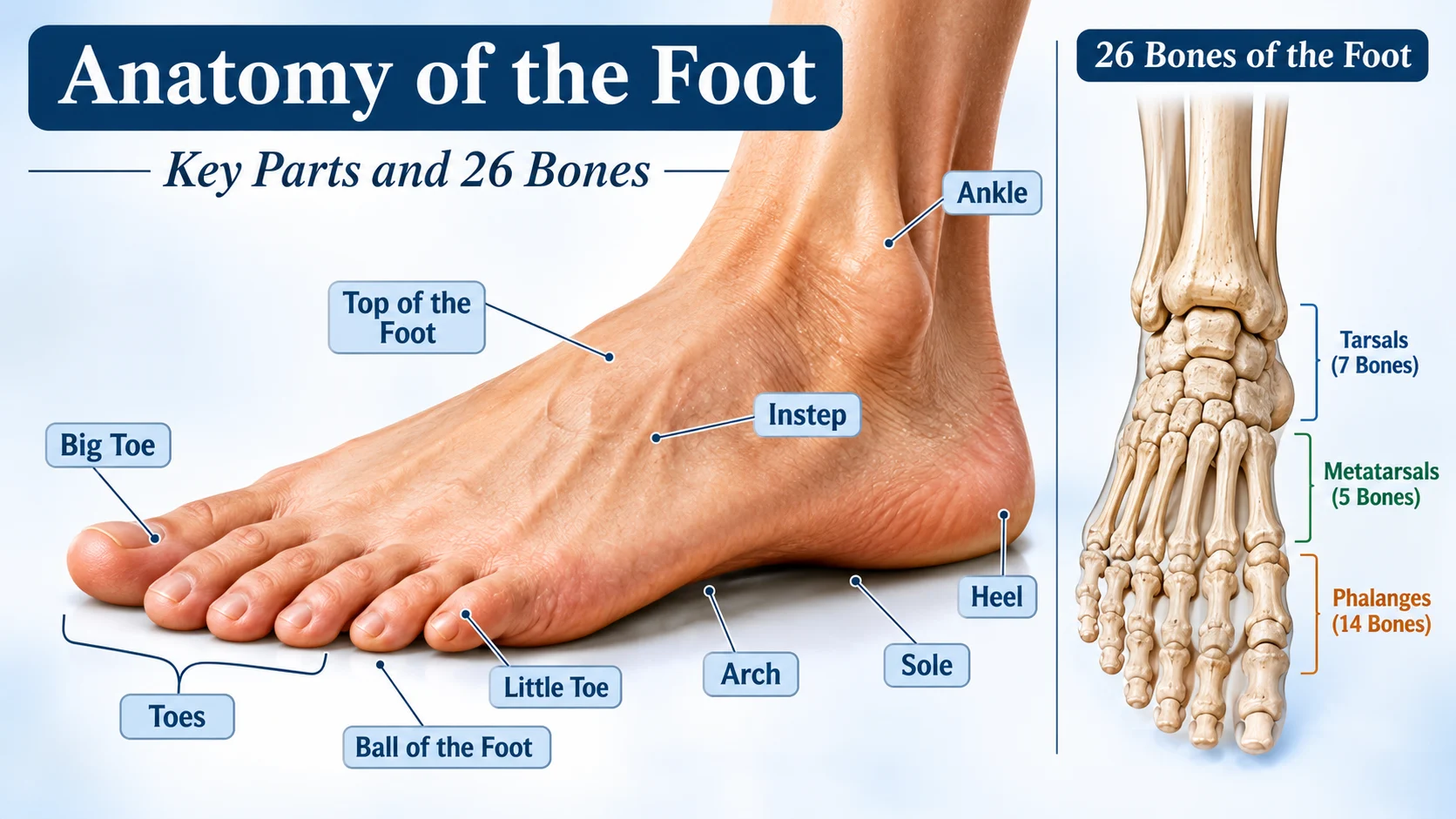
The foot is made up of several important parts, including the toes, heel, sole, arch, ball, instep, ankle, and top of the foot. Each part has a specific structure and function that helps the body maintain balance, support weight, absorb shock, and move comfortably.
Understanding the different foot parts names makes it easier to learn basic foot anatomy, describe foot pain, and understand how the feet work.
You are learning human body parts, studying anatomy, or simply curious about the names of different parts of the foot, this guide explains each section in simple language. You will learn the names of the external and internal foot parts, their locations, their functions, and how they work together during everyday activities such as walking, running, and standing.
What Are the Different Parts of the Foot?
The foot is the lower part of the leg that connects to the ankle and supports the body’s weight. It contains 26 bones, 33 joints, and more than 100 muscles, tendons, and ligaments when commonly counted together.
The different parts of the foot include:
- Toes: The five digits at the front of the foot.
- Big toe: The largest toe, which helps with balance and push-off.
- Heel: The rounded back portion of the foot.
- Sole: The bottom surface of the foot.
- Arch: The curved section between the heel and the ball of the foot.
- Ball of the foot: The padded area beneath the toe joints.
- Instep: The upper middle region of the foot.
- Top of the foot: The upper surface between the toes and ankle.
- Ankle: The joint connecting the foot to the lower leg.
These parts work together to provide stability, flexibility, and movement.
1. Toes
The toes are the five small digits located at the front of each foot. They help maintain balance, distribute body weight, and provide the final push needed when walking or running.
Each foot has five toes, and each has a specific name.
Names of the Five Toes
- Big Toe (Hallux): The largest toe, located closest to the body’s center. It plays an important role in balance and walking.
- Second Toe: The toe immediately beside the big toe. Its length varies between individuals.
- Middle Toe: The third toe, positioned between the second and fourth toes.
- Fourth Toe: The toe next to the smallest toe.
- Little Toe (Pinky Toe): The smallest toe, located on the outer edge of the foot.
Functions of the Toes
The toes perform several important functions:
- Help maintain balance while standing.
- Assist with walking and running.
- Help the body move forward during push-off.
- Improve stability when changing direction.
- Help distribute pressure across the front of the foot.
The big toe is particularly important because it carries significant pressure during the push-off phase of walking.
2. Heel
The heel is the back portion of the foot, located beneath the ankle. It is one of the main areas that receives impact when the foot touches the ground during walking.
The heel contains the calcaneus, which is the largest bone in the foot.
Functions of the Heel
- Supports body weight.
- Absorbs impact during walking and running.
- Helps maintain stability while standing.
- Provides attachment points for important tendons and ligaments.
A thick layer of fatty tissue beneath the heel helps cushion the foot and protect the underlying bone.
3. Sole of the Foot
The sole is the bottom surface of the foot that touches the ground when standing or walking. It is also known as the plantar surface.
The sole contains specialized skin, connective tissue, muscles, and fatty padding that protect the foot from pressure.
Main Sections of the Sole
The sole can be divided into three general areas:
- Forefoot: The front portion containing the ball of the foot and toes.
- Midfoot: The middle section that includes the foot’s arches.
- Hindfoot: The back portion containing the heel and talus region.
Functions of the Sole
The sole helps:
- Protect the bones and soft tissues.
- Distribute body weight.
- Absorb shock during movement.
- Provide grip and stability.
- Support comfortable walking and standing.
The skin on the sole is thicker than the skin on many other parts of the body because it experiences repeated pressure and friction.
4. Arch of the Foot
The arch is the curved structure along the bottom of the foot. It helps distribute body weight and allows the foot to adapt to different surfaces.
The arches are supported by bones, ligaments, muscles, and tendons.
Three Main Foot Arches
1. Medial Longitudinal Arch
This is the higher and more noticeable arch along the inner side of the foot. It extends from the heel toward the big toe.
2. Lateral Longitudinal Arch
This arch runs along the outer side of the foot. It is generally lower and flatter than the medial arch.
3. Transverse Arch
This arch runs across the width of the foot, helping maintain the foot’s shape and distribute pressure.
Functions of the Foot Arches
- Absorb and distribute forces during movement.
- Support body weight.
- Help maintain balance.
- Allow the foot to adapt to uneven surfaces.
- Contribute to efficient walking and running.
People have different arch heights. Some have low arches, while others have high arches. Neither shape automatically indicates a medical problem.
5. Ball of the Foot
The ball of the foot is the padded area on the bottom of the foot, located just behind the toes.
It lies beneath the metatarsophalangeal joints, where the long foot bones meet the toe bones.
Functions of the Ball of the Foot
- Supports weight during walking.
- Helps the foot push away from the ground.
- Distributes pressure beneath the toes.
- Provides cushioning during movement.
The ball of the foot experiences considerable pressure during activities such as running, jumping, and standing for extended periods.
6. Instep
The instep is the upper middle region of the foot, located between the toes and ankle.
It is associated with the upper surface of the midfoot and the area over the foot’s arch.
The instep is an important part of foot anatomy because it covers structures that help maintain the shape and stability of the foot.
Functions of the Instep
- Covers and protects underlying structures.
- Helps accommodate foot movement.
- Contributes to the overall shape of the foot.
- Provides an area over which footwear is fitted.
The term instep is commonly used when discussing shoe fit, especially when describing shoes feel tight across the upper middle part of the foot.
7. Top of the Foot
The top of the foot is called the dorsal surface. It is the upper side of the foot, opposite the sole.
This area extends from the base of the toes toward the ankle.
It contains several important structures, including:
- Extensor tendons.
- Metatarsal bones.
- Blood vessels.
- Nerves.
- Skin and connective tissue.
Functions of the Top of the Foot
The top of the foot protects and covers underlying structures. It also contains tendons that help lift and straighten the toes and contribute to movements of the foot.
Pain or swelling in this area may occur because of pressure from tight footwear, injuries, or other conditions.
8. Ankle
The ankle connects the foot to the lower leg. Although it is often discussed separately from the foot, it plays an essential role in foot movement.
The ankle joint is formed mainly by three bones:
- Tibia: The larger bone of the lower leg.
- Fibula: The smaller bone on the outer side of the lower leg.
- Talus: The bone that connects the ankle joint to the foot.
Functions of the Ankle
- Allows the foot to move up and down.
- Supports body weight.
- Helps maintain balance.
- Allows the body to adapt to different walking surfaces.
The ankle also contains ligaments that help stabilize the joint and prevent excessive movement.
9. Ball, Midfoot, and Hindfoot
Another useful way to understand foot anatomy is to divide the foot into three main anatomical regions.
Forefoot
The forefoot is the front section of the foot. It includes:
- Five metatarsal bones.
- Fourteen toe bones (phalanges).
- The joints connecting the toes to the metatarsals.
It helps with balance and forward movement.
Midfoot
The midfoot is the middle section of the foot. It contains five main bones:
- Navicular.
- Cuboid.
- Three cuneiform bones.
These bones help form the arches and provide stability.
Hindfoot
The hindfoot is the back section of the foot. It includes:
- Talus.
- Calcaneus.
These bones help transfer body weight from the leg to the foot and provide support during movement.
10. Important Bones of the Foot
The human foot contains 26 bones on each side. These bones are divided into three main groups.
| Bone Group | Number of Bones | Main Function |
|---|---|---|
| Tarsals | 7 | Form the ankle and rear and middle foot |
| Metatarsals | 5 | Support the middle and front of the foot |
| Phalanges | 14 | Form the toes |
Tarsal Bones
The seven tarsal bones are:
- Talus
- Calcaneus
- Navicular
- Cuboid
- Medial cuneiform
- Intermediate cuneiform
- Lateral cuneiform
Metatarsal Bones
There are five metatarsal bones in each foot. They are numbered from the big-toe side to the little-toe side.
They connect the midfoot to the toe bones.
Phalanges
Phalanges are the bones that form the toes.
The big toe has two phalanges, while each of the other four toes has three. This gives each foot a total of 14 toe bones.
11. Important Muscles, Tendons and Ligaments
The foot is not made up of bones alone. Muscles, tendons, and ligaments help it move, maintain its shape, and remain stable.
Muscles
Foot muscles help control toe movements and support the arches.
Some muscles are located inside the foot, while others originate in the lower leg and attach to the foot.
Tendons
Tendons connect muscles to bones.
Some important tendons associated with foot movement include:
- Achilles tendon: Connects the calf muscles to the heel bone.
- Extensor tendons: Help lift the toes and foot.
- Flexor tendons: Help bend the toes.
- Tibialis posterior tendon: Helps support the arch and control foot movement.
- Peroneal tendons: Help stabilize the outer side of the foot and ankle.
Ligaments
Ligaments connect bones to other bones. They help stabilize the joints and support the arches.
The plantar fascia is another important structure. It is a thick band of connective tissue running along the bottom of the foot, helping support the longitudinal arch.
12. Foot Parts Name With Their Functions
Here is a simple reference table showing the main external foot parts and what they do.
| Foot Part | Location | Main Function |
|---|---|---|
| Big toe | Front, inner side | Balance and push-off |
| Second toe | Beside big toe | Balance and stability |
| Middle toe | Center of toes | Helps distribute pressure |
| Fourth toe | Near little toe | Assists with stability |
| Little toe | Outer edge | Contributes to foot stability |
| Heel | Back of foot | Weight support and cushioning |
| Sole | Bottom of foot | Protection and weight distribution |
| Arch | Curved bottom section | Shock absorption and support |
| Ball | Behind the toes | Push-off and pressure distribution |
| Instep | Upper middle foot | Covers underlying structures |
| Top of foot | Upper surface | Contains tendons, nerves, and vessels |
| Ankle | Between leg and foot | Movement and stability |
13. Common Foot Problems and the Parts They Affect
Understanding the different foot parts can help you recognize the location of common foot problems. However, pain in a particular area does not always identify its exact cause.
Some common conditions include:
1. Plantar Fasciitis
This condition involves irritation or degeneration of the plantar fascia, often causing pain around the bottom of the heel or arch.
2. Bunions
A bunion is a bony prominence that develops near the joint at the base of the big toe. It can cause discomfort and changes in toe alignment.
3. Flat Feet
Flat feet describe a foot shape in which the arches are lower or less visible when standing.
4. High Arches
High arches are more pronounced than average and can affect how pressure is distributed across the foot.
5. Heel Pain
Heel pain can have several causes, including plantar fasciitis, heel injuries, and irritation of surrounding tissues.
6. Morton’s Neuroma
This condition involves irritation or thickening of tissue around a nerve, commonly between the third and fourth toes. It may cause burning pain or a sensation similar to having a small stone inside the shoe.
7. Ankle Sprain
An ankle sprain occurs when one or more ligaments around the ankle are stretched or torn, often following a sudden twisting movement.
Persistent, severe, or unexplained foot pain should be assessed by a qualified healthcare professional.
14. Why Is It Important to Know the Names of Foot Parts?
Learning the names of different foot parts is useful in everyday life, education, healthcare, and fitness.
Here are some important reasons:
- Better communication: You can describe exactly where you feel pain or discomfort.
- Understanding anatomy: You can learn how bones, muscles, and joints work together.
- Choosing footwear: Knowing your foot shape can help you understand shoe fitting.
- Recognizing injuries: Understanding foot anatomy can make it easier to identify the location of an injury.
- Educational purposes: Students can use foot-part names when studying human anatomy and biology.
- Fitness and sports: Athletes can better understand how their feet support movement and balance.
Knowing the correct anatomical terminology also helps people communicate more clearly with doctors, physiotherapists, and other healthcare professionals.
FAQs
1. What are the main parts of the foot?
The main parts include the toes, heel, sole, arch, ball, instep, top of the foot, and ankle.
2. How many toes does a human foot have?
Each human foot normally has five toes: the big toe, second toe, middle toe, fourth toe, and little toe.
3. What is the bottom of the foot called?
The bottom surface of the foot is called the sole or plantar surface.
4. What is the upper part of the foot called?
The upper surface is called the dorsal surface of the foot.
5. How many bones are in one foot?
An adult human foot normally contains 26 bones, including 7 tarsals, 5 metatarsals, and 14 phalanges.
6. What is the ball of the foot?
It is the padded area beneath the toe joints that helps support weight and push the body forward.
7. What is the arch of the foot?
The arch is the curved structure along the bottom of the foot that helps distribute weight and absorb forces.
8. What connects the foot to the leg?
The ankle joint connects the foot to the lower leg and allows important movements such as bending the foot upward and downward.
Conclusion
The human foot contains several important parts, including the toes, heel, sole, arch, ball, instep, top of the foot, and ankle. Each part has a different role in supporting body weight, maintaining balance, absorbing impact, and helping the body move. Together, the bones, muscles, tendons, and ligaments make the foot a flexible and strong structure.
Learning the different foot parts names is useful for students, parents, fitness enthusiasts, and anyone interested in human anatomy. By understanding where each part is located and what it does, you can better understand foot movement, footwear, and common foot problems.
Discover More Related Articles:
- Franklin Name Meaning | Origin, History & History Behind the Name in 2026
- Frank Name Meaning | Origin, History & Significance In 2026
- Archer Name Meaning| Origin, History, Symbolism & Significance in 2026