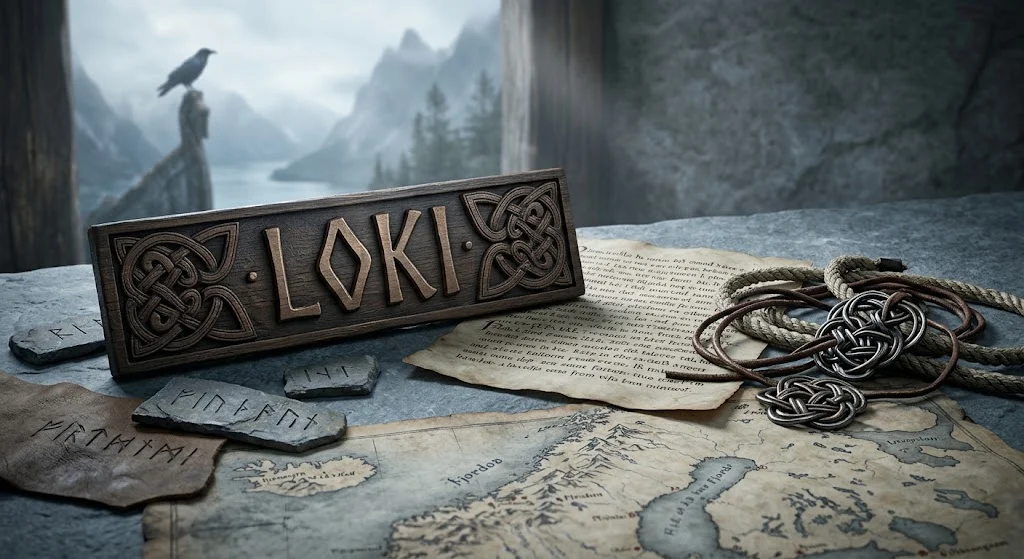
Loki is an Old Norse mythological name associated with the famous trickster figure of Norse mythology. Its exact etymology is debated, but one leading interpretation connects Loki with a Germanic root related to locks, loops, knots, or entanglement.
The name is especially recognized through the Loki of Norse mythology, a complex figure associated with cleverness, deception, transformation, disruption, and unpredictable change. Although Loki is often casually described as a “god,” the surviving Norse sources present him as a more complicated supernatural figure whose relationships with the gods and giants do not fit neatly into one category.
What Is the Loki Name?
Loki is an Old Norse personal name preserved in medieval Scandinavian literature, particularly in texts containing Norse mythological traditions. The name is most strongly associated with the supernatural figure Loki, who appears in both the Poetic Edda and Prose Edda.
As a modern given name, Loki carries strong associations with Norse heritage and mythology. Unlike many traditional names whose meanings have a single well-established dictionary definition, the Loki name meaning is less certain because scholars have proposed several different etymologies.
The safest way to describe Loki’s meaning is therefore to distinguish between its historical name origin and the meanings sometimes assigned to it in popular baby-name sources.
Loki Name Meaning
The exact meaning of Loki is not completely settled.
One important scholarly proposal connects the name with a Germanic root related to loops, knots, locks, or things that close or entangle. This interpretation fits linguistic evidence from later Scandinavian forms and words associated with webs, loops, and entanglement. Some scholars have consequently understood Loki as having an association with an “entangler” or “tangler.”
Another explanation sometimes encountered connects Loki with Old Norse logi, meaning “flame” or “blaze.” However, this has generally been treated with caution because the linguistic connection between Loki and logi is not considered secure.
For that reason, it is better not to state that Loki definitively means “fire.” The etymology remains debated.
Loki Meaning at a Glance
| Aspect | Information |
|---|---|
| Name | Loki |
| Language | Old Norse |
| Cultural association | Norse mythology |
| Gender association | Traditionally masculine |
| Most discussed meaning | Possibly connected with locks, loops, knots, or entanglement |
| Alternative interpretation | Sometimes associated with flame or fire, but disputed |
| Pronunciation | Approximately LOH-kee in modern English |
| Famous mythological bearer | Loki |
Loki Name Origin and Etymology
The Loki name origin reaches into the linguistic world of Old Norse, the North Germanic language used in medieval Scandinavia.
The etymology is unusual because the name does not have one universally accepted derivation. Later Scandinavian forms—including forms such as Loke, Lokke, Lokki, Luki, and Luku—have been used in discussions of the name’s development. These forms have helped scholars explore a possible relationship with the Germanic root luk-, associated with concepts such as loops, locks, knots, and closing.
This proposed connection is particularly interesting because Loki’s mythology repeatedly involves binding, transformation, deception, and complicated relationships. It is tempting to treat these mythological characteristics as proof of the etymology, but mythology and etymology should not automatically be treated as the same thing.
In other words, the stories surrounding Loki may fit an “entangler” interpretation remarkably well, but that does not by itself prove that the name originally meant “entangler.”
Was Loki Originally Connected With Fire?
The popular idea that Loki means “fire” has been repeated for generations. The association probably comes partly from the similarity between Loki and Old Norse logi, a word meaning flame or blaze.
However, similarity in sound is not enough to establish a historical linguistic relationship. Modern discussions of Loki’s etymology generally treat the direct “Loki = fire” explanation as uncertain or linguistically problematic.
Therefore, if you are researching the Loki name meaning, “fire” is best presented as a proposed or popular interpretation rather than an established definition.
Loki in Norse Mythology
The strongest cultural meaning of the name comes from Norse mythology.
Loki appears as an exceptionally clever and unpredictable figure who interacts closely with major Norse mythological characters, including Odin and Thor. His actions can help the gods in one story and cause serious problems in another.
This duality is one reason Loki remains such a fascinating figure.
He is not simply a villain. Nor is he consistently a hero. Instead, Loki occupies an unstable position between cooperation and opposition, order and disorder, and sometimes even between different categories of beings.
Scholarly discussions emphasize this ambiguity. Loki can be connected with the gods while also having giant ancestry, and his identity does not fit comfortably into a simple modern category such as “good” or “evil.”
The Personality Behind the Name Loki
When used as a modern personal name, Loki can carry symbolic associations inspired by the mythological figure.
Common symbolic qualities include:
- Cleverness
- Intelligence
- Resourcefulness
- Independence
- Transformation
- Unpredictability
- Creativity
- Mischief
- Adaptability
These are modern symbolic associations, rather than literal dictionary meanings of the name.
For example, someone choosing Loki as a baby name may be attracted to the mythology because it suggests a person who is clever, unconventional, and capable of thinking differently.
At the same time, parents should remember that Loki’s mythology also contains destructive and morally complicated episodes. The name therefore has a more complex symbolic profile than names associated exclusively with virtues such as peace or kindness.
Loki and the Poetic Edda
The Poetic Edda is one of the major medieval sources for Norse mythology. It preserves a collection of poems containing stories and mythological material about figures such as Odin, Thor, Loki, and other supernatural beings.
Loki appears in several of these traditions and is particularly prominent in poems involving conflict, insults, deception, and the relationships between the gods.
The famous poem Lokasenna, for example, centers on Loki’s confrontation with the gods.
These medieval sources are important for understanding the cultural background of the name, but they were written down centuries after the earliest periods in which the stories circulated orally. That distinction matters when discussing the history of Loki.
Loki and the Prose Edda
Another major source is the Prose Edda, traditionally associated with the Icelandic writer Snorri Sturluson.
The Prose Edda preserves numerous myths involving Loki and provides some of the most familiar narrative details about his relationships with the gods.
Loki is also referred to by the alternative name Loptr in Old Norse literary sources. Loptr is generally associated with Old Norse lopt, “air,” although scholars have also noted uncertainty about precisely what the alternative name signifies.
This illustrates an important point about Loki’s naming tradition: the mythological figure was known through more than one name or byname.
Loki, Transformation, and Symbolism
One of Loki’s most distinctive characteristics is transformation.
Norse stories frequently portray Loki changing appearance or taking on different forms. This makes transformation one of the strongest modern symbolic associations of the name.
As a result, Loki can represent the idea of someone who:
- Adapts quickly to changing circumstances
- Thinks outside conventional boundaries
- Uses intelligence instead of physical strength
- Challenges established expectations
- Can move between different social or symbolic worlds
This interpretation is particularly relevant to modern naming because parents sometimes select mythological names not simply for their literal meanings but for the stories and characteristics associated with the name.
How Do You Pronounce Loki?
The name Loki is commonly pronounced approximately:
LOH-kee
In English, the first syllable usually sounds like “low,” followed by “kee.”
The original Old Norse pronunciation was part of a different historical sound system, so the modern English pronunciation should not be assumed to perfectly reproduce medieval Scandinavian pronunciation.
If you are choosing Loki as a first name, LOH-kee is the pronunciation most English speakers are likely to recognize.
Is Loki a Scandinavian Name?
Yes. Loki has Old Norse and Scandinavian cultural roots, although its modern use has expanded far beyond Scandinavia.
The name is deeply connected with the mythology of medieval Iceland and the wider Norse cultural world. Its popularity as a modern given name is also influenced by contemporary interest in Norse mythology and popular entertainment.
It is useful to distinguish between:
Historical Loki:
The figure preserved in Old Norse mythology and medieval Scandinavian literature.
Modern Loki:
A contemporary given name that can be chosen because of Norse heritage, mythology, literature, entertainment, or simply its distinctive sound.
Loki Name Variations and Related Forms
Loki has several historical and regional forms associated with Scandinavian traditions.
| Form | Context |
|---|---|
| Loki | Old Norse and modern Icelandic form |
| Loke | Scandinavian variant/form |
| Lokke | Historical Scandinavian form |
| Lokki | Related Scandinavian form |
| Loptr | Mythological byname associated with Loki |
| Luki / Luku | Later Scandinavian forms discussed in etymological research |
These forms should not all be treated as exact equivalents in every historical context. Their spellings and uses developed across different languages and periods.
Loki vs. Loke: What’s the Difference?
Loki and Loke are closely related forms, but they should not automatically be treated as identical spellings in every context.
Loki is the familiar Old Norse form and remains especially recognizable in Icelandic and international usage. Loke appears in Scandinavian naming and linguistic traditions.
The difference is primarily one of language, spelling, and cultural usage rather than a completely different underlying name.
Loki as a Modern Baby Name
Today, Loki can be considered a distinctive choice for parents interested in mythology-inspired baby names.
It may appeal to families looking for a short name with:
- Strong mythological roots
- Scandinavian associations
- A memorable sound
- A distinctive cultural story
- Associations with intelligence and transformation
However, Loki is not a neutral mythological name. Its associations are strongly tied to the complex character from Norse mythology.
For some parents, that complexity is precisely what makes the name attractive. Others may prefer a Norse name with a more straightforward positive meaning.
What Does Loki Symbolize?
There is no single traditional symbolic definition of Loki, but the figure is commonly associated with cleverness, deception, transformation, ambiguity, and disruption.
The name can therefore symbolize someone who does not always follow conventional paths.
From a modern perspective, Loki can represent the idea of using intelligence and adaptability to navigate difficult situations. This interpretation comes from the mythology surrounding the figure rather than from a confirmed literal translation of the name.
Examples of Using the Name Loki
Here are a few natural examples:
- Loki is a short and memorable name with strong Norse mythological associations.
- The name Loki appeals to parents interested in Scandinavian mythology.
- Loki is associated with a complex supernatural figure rather than a straightforward hero or villain.
- Many people recognize Loki through modern adaptations of Norse mythology.
These examples demonstrate how the name can be discussed without claiming that its uncertain etymology has a single definitive translation.
Loki Name Meaning: Mythology vs. Etymology
One of the most important distinctions when researching Loki name meaning is the difference between what the name may linguistically mean and what the character represents culturally.
| Aspect | Loki |
|---|---|
| Linguistic meaning | Uncertain; often connected with loops, knots, locks, or entanglement |
| Popular interpretation | Sometimes “fire” or “flame” |
| Mythological identity | Complex Norse supernatural figure |
| Symbolism | Cleverness, transformation, mischief, ambiguity |
| Historical language | Old Norse |
| Cultural setting | Medieval Scandinavian/Norse tradition |
| Modern association | Mythology, Scandinavian heritage, popular culture |
Keeping these categories separate makes the explanation more historically responsible.
Is Loki a Good Name?
Loki is a good name depends on what you value in a name.
It can be a strong choice if you want something short, distinctive, memorable, mythological, and Scandinavian in character.
Its main consideration is its powerful association with the Norse mythological figure. Because Loki is morally complicated and often disruptive in the surviving stories, the name does not carry a universally positive symbolic message.
For families who appreciate mythology and complex characters, however, that ambiguity can make Loki especially appealing.
Loki Name Meaning and Cultural Significance
The lasting appeal of Loki comes from the unusual combination of linguistic uncertainty and strong mythological identity.
Unlike a name whose meaning can be reduced to one simple translation, Loki is connected to a large network of ideas: Old Norse language, Scandinavian mythology, transformation, trickery, conflict, relationships between gods and giants, and Ragnarök.
That makes the name particularly rich for people interested in mythology-inspired naming.
The modern use of Loki also demonstrates how ancient mythological names can move from medieval literature into contemporary naming culture. A person named Loki today does not necessarily carry the same cultural meaning that the name had in medieval Scandinavia; modern names often acquire new associations over time.
FAQs
What does the name Loki mean?
Loki’s exact meaning is debated, but a leading interpretation connects it with locks, loops, knots, or entanglement.
Is Loki a Norse name?
Yes. Loki is an Old Norse name strongly associated with Scandinavian and Norse mythology.
Does Loki mean fire?
“Fire” is a popular interpretation, but the proposed connection with Old Norse logi is not considered linguistically secure.
What is the origin of the name Loki?
The name comes from the Old Norse mythological tradition, although its deeper linguistic etymology remains debated.
How do you pronounce Loki?
In modern English, Loki is commonly pronounced LOH-kee.
Is Loki a boy’s name?
Loki is traditionally associated with a male mythological figure and is commonly used as a masculine given name.
What does Loki symbolize?
Loki is commonly associated with cleverness, transformation, mischief, adaptability, and unpredictability.
Is Loki a Scandinavian name?
Yes. Loki has strong Scandinavian and Old Norse roots and is especially connected with Icelandic and broader Norse literary traditions.
Conclusion
The Loki name meaning is best described as uncertain, with one important interpretation connecting the name to Old Norse and Germanic ideas involving locks, loops, knots, or entanglement. The frequently repeated “fire” meaning is better treated as a disputed interpretation rather than an established translation.
As a name, Loki has a powerful identity because of its connection with Norse mythology. It represents a fascinating mixture of cleverness, transformation, unpredictability, and ambiguity, making it an appealing choice for those drawn to distinctive Scandinavian and mythology-inspired names.
Discover More Related Articles:
- Franklin Name Meaning | Origin, History & History Behind the Name in 2026
- Frank Name Meaning | Origin, History & Significance In 2026
- Archer Name Meaning| Origin, History, Symbolism & Significance in 2026