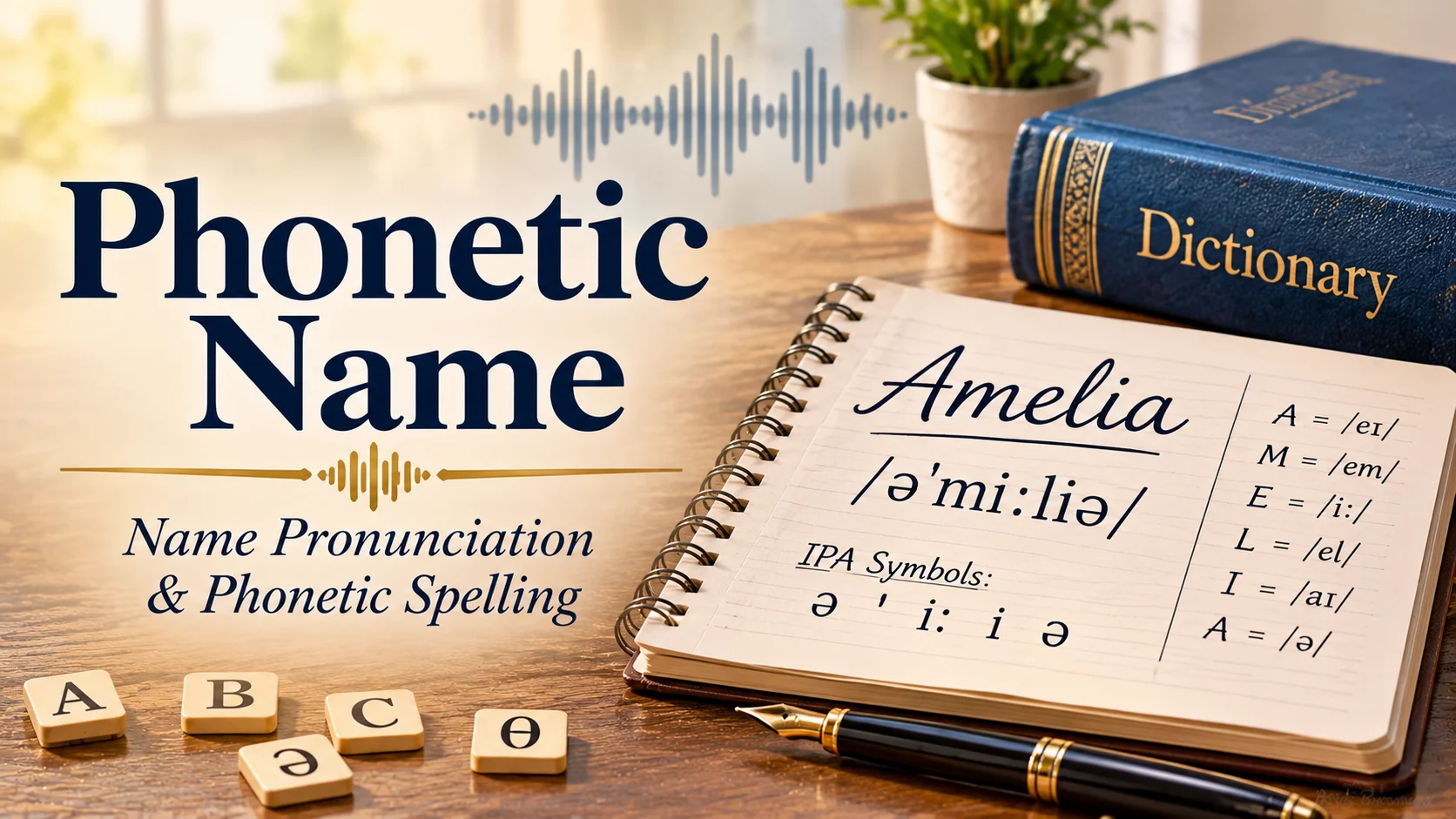
A phonetic name is the pronunciation of a name written using sounds or phonetic symbols. It helps people understand how to say a name correctly, even if its spelling is unfamiliar.
A phonetic name is a written representation of how a person’s name sounds when spoken. It helps other people understand the correct pronunciation of a name, especially when its spelling is unfamiliar, unusual, or different from common pronunciation patterns. For example, someone named Siobhan might write their phonetic name as “shi-VAWN” to help others pronounce it correctly.
Phonetic names are useful in schools, workplaces, professional introductions, public events, online profiles, and official settings where accurate name pronunciation matters. They provide a simple way to communicate spoken sounds through written text.
Understanding phonetic names involves learning about pronunciation, syllables, vowel and consonant sounds, and the relationship between written letters and spoken language. This guide explains what a phonetic name means, how it works, how to write your own, and how it differs from other pronunciation systems.
What Is a Phonetic Name?
A phonetic name is a name written or represented according to its pronunciation rather than relying entirely on its traditional spelling. It shows readers how to say a person’s name by breaking it into recognizable sounds, syllables, or pronunciation symbols.
For example:
- Name: Daniel
- Phonetic spelling: DAN-yuhl
- Name: Siobhan
- Phonetic spelling: shi-VAWN
- Name: Joaquin
- Phonetic spelling: wah-KEEN
The purpose is to make pronunciation easier and reduce confusion when someone encounters an unfamiliar name.
A phonetic name does not necessarily change the person’s actual name. It simply provides an additional pronunciation guide.
For example, a person named Niamh can continue using the traditional spelling while writing “NEEV” in a phonetic pronunciation field.
How Does a Phonetic Name Work?
Phonetic names work by connecting written symbols with the sounds people produce when speaking.
Instead of asking readers to guess how a name should sound from its spelling, a pronunciation guide gives them a clearer idea of the intended sounds.
This is especially useful because spelling and pronunciation do not always follow predictable patterns.
Consider these examples:
| Traditional Name | Phonetic Pronunciation |
|---|---|
| Sean | SHAWN |
| Niamh | NEEV |
| Siobhan | shi-VAWN |
| Joaquin | wah-KEEN |
| Phoebe | FEE-bee |
| Xenia | ZEE-nee-uh |
These spellings are approximate English-language pronunciation guides. Actual pronunciation can vary depending on a person’s language, accent, and preferred pronunciation.
Phonetic Name Meaning
The meaning of a phonetic name relates to the way a name is represented through speech sounds.
The word phonetic comes from the Greek word phōnētikos, associated with sound and speech. In linguistics, phonetics is the study of how speech sounds are produced, transmitted, and perceived.
When applied to personal names, phonetic representation focuses on how a name is spoken rather than how it appears in its original written form.
For example, the name “Cillian” may be written phonetically as “KIL-ee-an” to help an English-speaking reader understand its pronunciation.
A phonetic name can communicate several important details:
- Sound: How the name is actually spoken.
- Syllables: How the name is divided into pronunciation units.
- Stress: Which syllable receives the most emphasis.
- Vowel sounds: How the vowel sounds should be pronounced.
- Consonants: Which consonant sounds appear in the name.
The goal is not to provide a new meaning or translation of the name. It is to make the original pronunciation easier to understand.
Origin and Etymology of Phonetic Names
The concept of phonetic representation comes from the broader study of phonetics and language.
Human languages existed as spoken systems long before many writing systems developed. As writing evolved, people created different ways to represent speech using letters, characters, and symbols.
However, ordinary spelling does not always communicate pronunciation accurately. Different languages use different writing conventions, and the same letter can represent different sounds.
For example, the letter combination “ch” has different pronunciations in English words:
- Chair: /tʃ/
- School: /k/
- Chef: /ʃ/
This demonstrates why pronunciation cannot always be determined from spelling alone.
Development of Phonetic Writing
Linguists developed systematic methods to describe speech sounds more accurately.
One important development was the International Phonetic Alphabet (IPA), which was established by the International Phonetic Association in the late nineteenth century.
The IPA provides standardized symbols for representing speech sounds across languages.
Unlike informal pronunciation guides, IPA transcription uses specific symbols to identify individual sounds.
For example:
- Daniel: /ˈdænjəl/ (one common English pronunciation)
- Phoebe: /ˈfiːbi/
- Sean: /ʃɔːn/ (one common pronunciation)
These examples use IPA conventions, although exact transcriptions can differ according to accent.
Today, phonetic representation is used in dictionaries, language education, linguistic research, speech technology, and personal name pronunciation guides.
History and Cultural Importance of Phonetic Names
Names are closely connected to language, identity, family history, and culture. Their pronunciation often reflects the linguistic traditions from which they originated.
As people travel, migrate, study, and work across different countries, they regularly encounter names that follow unfamiliar pronunciation rules.
For example, an English speaker may find it difficult to pronounce an Irish, Welsh, Arabic, Japanese, or French name using familiar English spelling patterns.
Phonetic name guides help bridge these linguistic differences.
1. Cultural Name Preservation
Many traditional names have pronunciations that are not immediately obvious to people unfamiliar with their original language.
Writing a pronunciation guide helps preserve the intended sound while allowing the traditional spelling to remain unchanged.
For example:
- Niamh is traditionally pronounced approximately “NEEV” in Irish.
- Saoirse is commonly pronounced “SEER-shuh” or “SUR-shuh,” depending on the speaker and dialect.
- Aoife is commonly pronounced “EE-fa.”
These examples demonstrate why phonetic guidance can be valuable when introducing culturally specific names.
2. Education and Schools
Teachers frequently encounter students whose names have unfamiliar spellings or pronunciations.
A phonetic name field can help teachers pronounce students’ names correctly during attendance, classroom introductions, and school events.
It also helps create a more welcoming learning environment.
3. Professional Communication
In workplaces, phonetic name spellings can help colleagues, interviewers, managers, and event hosts address people correctly.
For example, an employee named Nguyen might provide a pronunciation guide such as “NGWIN” or another approximation that reflects their own pronunciation.
Because pronunciation varies, the individual should always be able to provide their preferred version.
4. Digital Platforms and Public Speaking
Some websites, conference registration systems, and professional platforms include pronunciation fields.
These fields allow people to share a pronunciation guide alongside their written name.
This is particularly helpful for virtual meetings, introductions, presentations, and networking events.
How to Write Your Name Phonetically
Writing your name phonetically is usually straightforward. You do not need advanced linguistic knowledge or specialized software to create a basic pronunciation guide.
The most important thing is to represent how you actually pronounce your name.
Follow these steps.
Step 1: Say Your Name Naturally
Start by saying your full name aloud at a normal speaking speed.
Avoid changing your pronunciation to match how you think other people expect it to sound.
Your pronunciation should reflect how you introduce yourself in everyday conversation.
Step 2: Divide Your Name Into Syllables
Syllables are individual sound units within a spoken word.
Breaking a name into syllables makes it easier to understand.
For example:
- Emily: EM-i-lee
- Jonathan: JON-uh-thun
- Isabella: iz-uh-BEL-uh
- Alexander: al-ig-ZAN-der
This approach helps readers identify the different parts of a name.
Step 3: Identify the Difficult Sounds
Think about which parts of your name might confuse someone unfamiliar with it.
Pay attention to:
- Unusual vowel combinations
- Silent letters
- Consonant combinations
- Sounds that do not exist in the reader’s language
- Letters pronounced differently in other languages
For example, the name “Jorge” is commonly pronounced “HOR-hay” in Spanish, rather than using the typical English pronunciation of the letter J.
Step 4: Highlight the Stressed Syllable
Some names contain syllables that receive more emphasis than others.
Capitalizing the stressed syllable can make an informal pronunciation guide easier to follow.
Examples:
- Olivia: oh-LIV-ee-uh
- Rebecca: ruh-BEK-uh
- Sebastian: suh-BAS-chun
Capitalization is a helpful convention, not a universal phonetic rule.
Step 5: Test Your Pronunciation Guide
Write your phonetic spelling and ask someone unfamiliar with your name to read it aloud.
If they pronounce it incorrectly, adjust the spelling until it communicates the intended sound more clearly.
You can also record yourself saying your name and compare the recording with the written guide.
Phonetic Name Examples
Examples make it easier to understand how traditional names can be represented through pronunciation.
Here are several names with approximate English-friendly phonetic spellings.
| Name | Phonetic Spelling |
|---|---|
| Aaron | AIR-un |
| Aisha | EYE-shuh |
| Amelia | uh-MEEL-yuh |
| Caleb | KAY-lub |
| Chloe | KLOH-ee |
| Daniel | DAN-yuhl |
| Elijah | ih-LY-juh |
| Fiona | fee-OH-nuh |
| Gabriel | GAY-bree-uhl |
| Isabella | iz-uh-BEL-uh |
| Joseph | JOH-sif |
| Liam | LEE-um |
| Naomi | nay-OH-mee |
| Noah | NOH-uh |
| Sophia | soh-FEE-uh |
These are illustrative English-language approximations. Some names have multiple accepted pronunciations, especially when used across different languages and cultures.
Phonetic Name Examples in Sentences
Here are some examples of how phonetic pronunciation guides can be used in everyday situations.
School introduction:
“My name is Niamh (pronounced NEEV).”
Professional meeting:
“Please call me Joaquin (wah-KEEN).”
Conference registration:
“Siobhan shi-VAWN.”
Online profile:
“Name: Saoirse | Pronunciation: SEER-shuh.”
These examples show how a small pronunciation note can make communication easier.
Phonetic Name vs. Phonetic Spelling vs. IPA
These terms are related, but they do not mean exactly the same thing.
| Term | Meaning | Main Purpose |
|---|---|---|
| Phonetic Name | A name represented with pronunciation guidance | Helps people say a personal name correctly |
| Phonetic Spelling | A written approximation of spoken sounds | Makes pronunciation easier to understand |
| IPA Transcription | A standardized representation using phonetic symbols | Describes speech sounds precisely |
| Traditional Spelling | The conventional written form of a name | Identifies the person’s actual name |
| Pronunciation Guide | Instructions explaining how to say a word or name | Helps readers pronounce unfamiliar terms |
Phonetic Name vs. Traditional Name
A traditional name is the actual written name used by an individual.
A phonetic name is an additional representation that explains how to pronounce it.
For example:
- Traditional name: Siobhan
- Phonetic spelling: shi-VAWN
The pronunciation guide does not replace the traditional spelling.
Phonetic Spelling vs. IPA
Phonetic spelling generally uses familiar letters and punctuation to approximate pronunciation.
IPA uses standardized symbols that represent specific speech sounds.
For example, the English word “cat” can be written as:
- Informal phonetic spelling: KAT
- IPA: /kæt/
Informal pronunciation guides are generally easier for everyday readers, while IPA is more precise and useful for linguistic study.
Why Is a Phonetic Name Important?
A phonetic name can improve communication in situations where correct pronunciation matters.
Its importance extends beyond convenience.
1. It Helps People Feel Respected
Names are an important part of personal identity. Making an effort to pronounce someone’s name correctly demonstrates consideration and respect.
A pronunciation guide gives others a practical way to learn the correct pronunciation.
2. It Reduces Miscommunication
Unfamiliar spellings can lead to repeated pronunciation mistakes.
A phonetic guide provides additional information that ordinary spelling may not communicate.
3. It Supports Cultural Awareness
Names from different linguistic backgrounds may follow different pronunciation conventions.
Phonetic representations help people understand these differences without requiring them to change their original names.
4. It Improves Professional Introductions
In interviews, meetings, conferences, and public presentations, correctly pronouncing someone’s name can make introductions smoother and more professional.
5. It Helps Language Learners
People learning a new language can use phonetic guides to understand sounds that are unfamiliar to them.
However, informal English pronunciation spellings may not accurately represent every sound in another language.
Common Mistakes When Writing a Phonetic Name
Although writing a phonetic name is relatively simple, some mistakes can make pronunciation guides confusing.
1. Relying Only on Traditional Spelling
A name’s spelling may not reveal its pronunciation. Always consider the actual sounds rather than assuming every letter is pronounced.
2. Ignoring Syllable Stress
Two names can contain similar sounds but have different stress patterns. Indicating the emphasized syllable can make a guide clearer.
3. Using Unfamiliar Symbols Without Explanation
Specialized phonetic symbols may confuse readers who have not studied linguistics. Use familiar pronunciation spellings when writing for a general audience.
4. Assuming One Pronunciation Fits Everyone
Some names have multiple valid pronunciations. Regional accents, family traditions, and individual preferences can all influence how a name is spoken.
5. Changing the Original Name
A pronunciation guide should explain the name, not replace or unnecessarily modify its traditional spelling.
6. Forgetting That Pronunciation Is Personal
The person who uses the name is the best source for their preferred pronunciation. When uncertain, politely ask rather than relying entirely on an online pronunciation guide.
Tools That Can Help With Phonetic Names
Several resources can help people create and understand pronunciation guides.
- Online dictionaries: Many dictionaries provide audio recordings and IPA transcriptions for common words and some personal names.
- International Phonetic Alphabet charts: These charts explain the symbols used to represent individual speech sounds.
- Text-to-speech tools: These tools can provide an approximate spoken version of text, although they may mispronounce unfamiliar names.
- Audio recordings: Recording yourself saying your name can help others learn its pronunciation directly.
- Pronunciation websites: Specialized resources may include name pronunciations submitted by speakers or verified through editorial review.
Remember that automated tools are not always reliable for personal names. Your preferred pronunciation should take priority over an automatically generated result.
FAQs
1. What is a phonetic name?
A phonetic name is a written guide that shows how a person’s name sounds when spoken. It helps others pronounce unfamiliar or complicated names correctly without changing the original spelling.
2. What does phonetic name mean on a form?
On a form, a phonetic name field asks you to write your name according to its pronunciation. It allows teachers, employers, event organizers, or other people to understand how to say your name.
3. How do I write my name phonetically?
Say your name aloud, divide it into syllables, identify difficult sounds, and write those sounds using familiar letters. You can capitalize the stressed syllable to make the pronunciation clearer.
4. What is an example of a phonetic name?
If your name is Siobhan, you might write its phonetic pronunciation as “shi-VAWN.” Similarly, Niamh can be represented as “NEEV” in an English-friendly pronunciation guide.
5. Is phonetic spelling the same as pronunciation?
They are closely related but not identical. Pronunciation refers to how a word or name is spoken, while phonetic spelling is a written representation that helps someone reproduce those sounds.
6. What is the difference between phonetic spelling and IPA?
Phonetic spelling usually uses familiar letters to approximate spoken sounds. The International Phonetic Alphabet (IPA) uses standardized symbols to represent speech sounds more precisely.
7. Why do people use phonetic names?
People use phonetic names to help others pronounce their names correctly. They are especially useful in schools, workplaces, professional introductions, public events, and online profiles.
8. Can a name have more than one phonetic pronunciation?
Yes. A name may have multiple accepted pronunciations depending on its language, region, dialect, family tradition, or the individual’s preference.
9. Do I need the International Phonetic Alphabet to write my name phonetically?
No. Most everyday pronunciation fields accept simple, familiar spelling approximations. IPA is useful when precise linguistic transcription is required, but it is not necessary for ordinary introductions.
10. Should I write my full name phonetically?
If a form requests your full name’s pronunciation, provide a guide for both your first and last names. If it requests only your first name, you can provide that separately.
Conclusion
A phonetic name is a practical way to communicate how a person’s name should sound when spoken. It connects written spelling with pronunciation and helps reduce confusion when people encounter unfamiliar names.
you are completing a school form, creating a professional profile, attending a conference, or introducing yourself online, a clear phonetic pronunciation guide can make communication easier.
The best phonetic spelling is one that accurately represents how you pronounce your name while remaining easy for other people to understand.
Discover More Related Articles:
- Name Calculator | Discover Your Name Number, Meaning & Numerology in 2026
- Charlie Kirk’s Book Stop in the Name of God | Meaning, Summary & Key Lessons In 2026
- Lina Name Meaning | Origin, History, & Cultural Significance In 2026