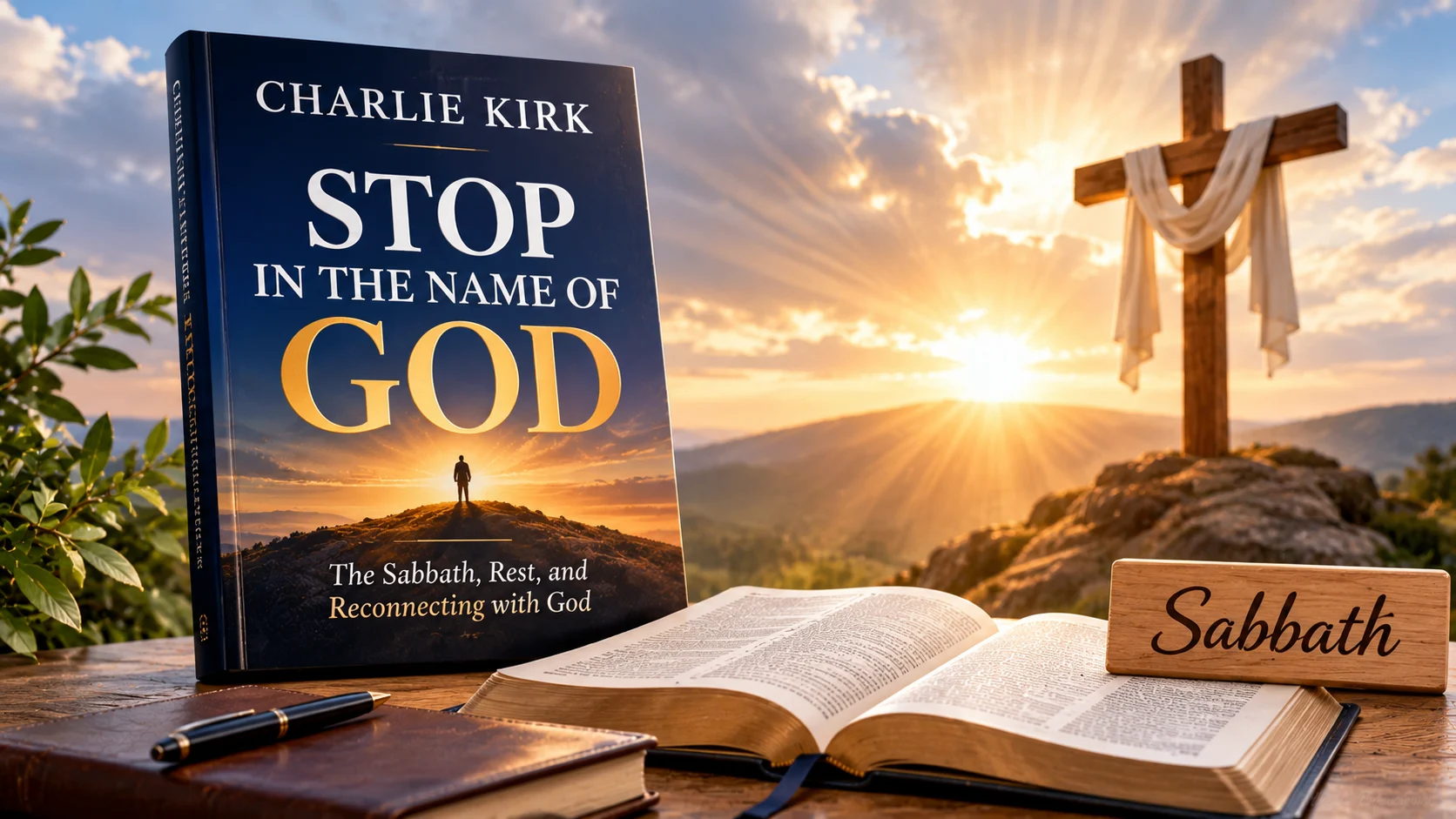
“Stop in the Name of God” is the title of Charlie Kirk’s final book, Stop, in the Name of God: Why Honoring the Sabbath Will Transform Your Life. It explores the religious and practical importance of observing the Sabbath a dedicated period of rest, worship, and reconnection with God and family.
Kirk’s central message is that people should step away from constant work and activity to make room for spiritual reflection and meaningful relationships.
Charlie Kirk’s Stop, in the Name of God is a book about the importance of taking a regular break from work and everyday demands to honor God, rest, and reconnect with family. Its full title is Stop, in the Name of God: Why Honoring the Sabbath Will Transform Your Life. The book presents the Sabbath as more than a religious custom: it is a deliberate way to place faith, relationships, and spiritual renewal ahead of constant productivity.
The phrase has attracted attention because it expresses the central argument of Kirk’s final book. Rather than encouraging people simply to slow down when they feel tired, Kirk calls readers to set aside a regular period for rest as an act of faith. This article explains the book’s message, the meaning of its title, Kirk’s personal experience with Sabbath observance, and the biblical background behind the subject.
What Is Charlie Kirk’s Stop in the Name of God?
Stop, in the Name of God is Charlie Kirk’s final book, focused on the Sabbath and the value of dedicating time to God. Its subtitle, Why Honoring the Sabbath Will Transform Your Life, makes its central subject clear: Kirk argues that observing a regular day of rest can change how people approach work, family, faith, and daily responsibilities.
The book was written before Kirk’s death and published posthumously in December 2025. It was released through Winning Team Publishing, and his wife, Erika Kirk, helped bring the completed project to readers after his death. PR Newswire+2
The book is not simply a general guide to relaxation or time management. It makes a religious argument rooted in the biblical Sabbath. Kirk encourages readers to consider whether modern life has become so focused on work, screens, ambition, and constant activity that people have lost the habit of setting aside meaningful time for God.
Its main themes include:
- The biblical idea of resting on the Sabbath.
- The relationship between faith and everyday life.
- The importance of time with family.
- The difference between healthy work and nonstop busyness.
- The spiritual value of pausing and reflecting.
- The idea that human worth is not measured only by productivity.
The official book website describes the Sabbath as a way to step away from modern distractions and reconnect with God, family, and oneself. STOP IN THE NAME OF GOD
Charlie Kirk Stop in the Name of God: Meaning of the Title
The title Stop, in the Name of God is a direct expression of the book’s central message. The word “stop” refers to deliberately ceasing ordinary work and activity for a dedicated period. The phrase “in the name of God” connects that pause to religious commitment rather than convenience alone.
In other words, Kirk is asking readers to stop treating every hour as an opportunity to work, earn, achieve, or consume. He presents rest as something with spiritual purpose.
The title also plays on a familiar expression, “Stop, in the name of the law,” replacing “the law” with “God.” This gives the title a memorable, commanding tone. In the context of the book, however, it is not a police command or a political slogan. It is a call to observe the Sabbath and recognize the importance of rest in a life centered on faith.
Kirk explained the connection in a 2025 discussion about the project. He linked the word “stop” with the idea of Shabbat, describing the Sabbath as a time of ceasing from ordinary activity. Transcript+1
What Does the Word Sabbath Mean?
The Sabbath is a recurring day or period of rest associated with Jewish and Christian religious traditions. The English word comes through Old English and Latin from Hebrew Shabbat, a word associated with ceasing or resting.
In the biblical account of creation in Genesis, God rests on the seventh day after creating the world. The Sabbath commandment also appears in the Ten Commandments, where people are instructed to remember the Sabbath and keep it holy.
The Sabbath is therefore not simply a day off from employment. In religious practice, it can include worship, prayer, family time, reflection, and avoiding ordinary work. The details differ among Jewish communities and Christian denominations.
Why Did Charlie Kirk Write Stop in the Name of God?
Kirk’s interest in the Sabbath developed partly from his experience of exhaustion and an increasingly demanding schedule. According to accounts of the book, he described feeling overwhelmed by work and responsibilities before a conversation with pastor David Engelhardt prompted him to reconsider whether he was making time for the Sabbath.
Kirk said that he initially believed he could honor God by working harder. However, the question about Sabbath observance led him to examine biblical passages on the subject. He later described the practice as having a significant effect on his life. Deseret News+1
This personal experience became an important reason for writing the book. Kirk wanted to explain why he believed a weekly pause could help people recover a sense of purpose and reconnect with what matters beyond professional success.
His argument was not that work is unimportant. Instead, he presented work and rest as complementary parts of a meaningful life. People should work responsibly, but they should also recognize that constant activity is not the ultimate purpose of human existence.
The book uses Kirk’s own experience to make a broader religious point: setting aside time for God is not necessarily wasted time. In his view, it can help people approach the rest of their responsibilities with greater clarity and a stronger sense of purpose.
The Biblical Origin of the Sabbath
The book’s main subject has a long history in the Bible and in Jewish and Christian religious traditions. Understanding this background helps explain why Kirk placed so much importance on Sabbath observance.
The Sabbath in Genesis
The biblical account in Genesis describes God creating the world over six days and resting on the seventh. The seventh day is blessed and made holy.
This account provides the foundation for the idea that rest is part of the created order. In this understanding, rest is not merely something people need after becoming tired. It is also a meaningful rhythm built into the biblical story of creation.
Kirk draws on this idea to argue that human beings should not organize their entire lives around production and achievement.
The Sabbath in the Ten Commandments
The Sabbath commandment appears in Exodus 20:8–11 and Deuteronomy 5:12–15. Both passages instruct the people to remember the Sabbath and set it apart.
The passages share the instruction to rest, but they emphasize different reasons. Exodus connects Sabbath observance with God’s rest after creation. Deuteronomy also connects it with Israel’s memory of slavery in Egypt and its liberation.
These passages are important because they present rest as a religious practice with meaning beyond personal comfort. The Sabbath is connected to creation, freedom, obedience, and the dignity of people who might otherwise be expected to work continuously.
The Sabbath in Jewish Tradition
In Judaism, Shabbat is traditionally observed from Friday evening until Saturday evening. It is a weekly sacred period involving rest, prayer, family gatherings, meals, and other religious practices.
The specific observances vary among Jewish communities and individuals. Traditional practices may include refraining from certain forms of work, attending synagogue, lighting candles, and sharing meals.
Kirk’s discussion of the seventh-day Sabbath draws attention to this older religious tradition. However, his book should not be mistaken for a complete guide to Jewish law or practice.
The Sabbath in Christianity
Christian traditions do not all observe the Sabbath in the same way. Many Christians gather for worship on Sunday, while some communities observe Saturday as the Sabbath. Other Christian groups emphasize the spiritual meaning of Sabbath rest without following the same detailed restrictions found in traditional Jewish observance.
This distinction matters when reading Kirk’s book. His personal interest centered on the seventh-day Sabbath, but his discussion also addresses a broad Christian audience and the wider biblical meaning of rest.
How the Sabbath Changed Charlie Kirk’s Perspective
Kirk described Sabbath observance as a major change in his personal routine. According to a review of the book, he began setting aside time from Friday evening to Saturday evening in 2021 to focus on God and family. Adventist Review
This change was significant because his professional life involved public speaking, media appearances, organizational responsibilities, and frequent travel. He had previously described a schedule that left little room for a complete break.
His experience illustrates one of the book’s central ideas: people can become so committed to their responsibilities that they begin to treat rest as optional. Kirk argued that a regular Sabbath creates a boundary around work and reminds people that their identity is not limited to their jobs or achievements.
The book presents this practice as a way to:
- Make time for prayer and spiritual reflection.
- Give family relationships greater attention.
- Step away from work-related pressure.
- Reduce the influence of constant digital distractions.
- Recognize that personal value is not determined by productivity.
- Develop a more intentional weekly routine.
These are the benefits Kirk advocates in the book. They should be understood as his religious and personal argument, not as a guarantee that Sabbath observance will resolve every person’s emotional, physical, or financial difficulties.
Main Themes and Ideas in the Book
Stop, in the Name of God develops its message through several connected themes. The book combines personal testimony, biblical discussion, and commentary on modern society.
1. Rest Is a Spiritual Practice
One of the most important ideas is that rest can be an expression of faith. Kirk argues that people should not wait until they are exhausted before taking time away from work.
In his view, the Sabbath is a deliberate act of recognizing God and accepting that human beings have limits. It gives people an opportunity to pause without feeling that every moment must be productive.
2. Work Has Value, but It Is Not Everything
The book does not present work as inherently bad. Kirk distinguishes meaningful effort from a lifestyle in which work consumes every part of the week.
He argues that productive activity can have purpose, but it should exist alongside rest, relationships, and spiritual commitments. A person can be ambitious and responsible without making professional success the only measure of a worthwhile life.
3. Family Relationships Need Protected Time
Another theme is the importance of being present with family. Modern schedules can make it difficult for people to spend uninterrupted time together.
A regular day of rest can create an opportunity for shared meals, conversation, worship, and activities that are not organized around work obligations.
The book treats these moments as valuable in their own right rather than as distractions from more important responsibilities.
4. Modern Technology Can Make Rest Difficult
Phones, computers, social media, and constant notifications can make it harder to disconnect. Even when people are physically away from work, they may remain mentally occupied by messages and online activity.
Kirk presents Sabbath observance as a way to challenge this pattern. A planned period away from ordinary digital demands can help people pay attention to their surroundings and relationships.
5. Human Worth Is Greater Than Productivity
The book also connects Sabbath rest with human dignity. Kirk argues that people should not be treated as machines whose value depends on how much they produce.
This is a theological argument about human identity and creation. It suggests that rest can remind people they have worth beyond their employment, income, public recognition, or achievements.
6. Sabbath Observance Has a Social Dimension
Kirk also discusses the broader implications of a society that makes room for regular rest. His argument extends beyond individual routines into cultural and political questions about work, commerce, and public life.
This is one reason the book may be read differently by different audiences. Some readers may focus on its religious message, while others may agree or disagree with the social and political conclusions he draws from it.
A review in Adventist Review notes that the book combines its Sabbath discussion with political commentary and critiques of movements and institutions. Readers should therefore distinguish the book’s biblical discussion from Kirk’s personal political interpretations. Adventist Review
What Is the Difference Between Sabbath, Shabbat, and a Regular Day Off?
These terms are related, but they are not identical. Understanding the differences helps explain the subject of Kirk’s book.
| Term | Meaning | Main distinction |
|---|---|---|
| Sabbath | A sacred period of rest in biblical religious traditions | Emphasizes religious meaning and observance |
| Shabbat | The Jewish Sabbath, traditionally observed Friday evening to Saturday evening | Refers specifically to Jewish weekly practice |
| Day off | A break from employment or routine responsibilities | Does not necessarily have a religious purpose |
| Sunday worship | Christian worship commonly held on Sunday | Worship day for many Christians, but not identical to every tradition’s Sabbath observance |
| Sabbath rest | The practice or spiritual principle of ceasing from ordinary work | Can refer to the religious practice or its wider meaning |
The key distinction is that a regular day off is generally a break from work, while Sabbath observance has a specific religious significance. For Kirk, the Sabbath is both a practical pause and an expression of faith.
Who Should Read Stop in the Name of God?
The book may interest readers who want to explore the relationship between religious faith and daily routines. It is especially relevant to people interested in biblical teachings about rest, Christian perspectives on the Sabbath, and the challenge of balancing work with personal and spiritual commitments.
Potential readers include:
- Christians interested in the biblical Sabbath.
- Readers exploring Jewish and Christian traditions of weekly rest.
- People curious about Charlie Kirk’s religious views.
- Readers interested in faith-based approaches to work and family life.
- People who want to think more carefully about technology, busyness, and personal priorities.
- Readers studying contemporary religious and political commentary.
It may be less suitable for someone seeking a neutral, purely academic introduction to the Sabbath. The book presents Kirk’s own convictions and interpretations, and it also includes political commentary. Readers looking for a broad overview of different religious perspectives may wish to consult additional sources.
FAQs
1. What is Charlie Kirk’s Stop in the Name of God about?
It is Charlie Kirk’s final book about the importance of honoring the Sabbath. It explores biblical rest, faith, family relationships, and the need to step away from constant work and modern distractions.
2. What is the full title of Charlie Kirk’s book?
The full title is Stop, in the Name of God: Why Honoring the Sabbath Will Transform Your Life.
3. Why did Charlie Kirk write Stop in the Name of God?
Kirk wrote the book to explain why he believed Sabbath observance was important. His interest grew after experiencing exhaustion and reconsidering the biblical teaching about setting aside a regular day for rest.
4. What does Stop in the Name of God mean?
The title is a call to stop ordinary work and activity as an expression of faith. It reflects the book’s message that people should dedicate time to God, rest, and meaningful relationships.
5. What is the Sabbath according to the Bible?
The Sabbath is a sacred day of rest rooted in the biblical account of creation and included in the Ten Commandments. It is associated with ceasing from ordinary work and honoring God.
6. Did Charlie Kirk observe the seventh-day Sabbath?
According to accounts of his book, Kirk began observing a weekly Sabbath from Friday evening to Saturday evening in 2021, dedicating that time to God and family. Adventist Review+1
7. When was Stop in the Name of God published?
The book was released in December 2025, after Charlie Kirk’s death. He had completed the manuscript before his death in September 2025. Deseret News+2
8. Is Stop in the Name of God a religious or political book?
Its central subject is religious: the Sabbath and biblical rest. However, it also includes Kirk’s political and cultural commentary. Readers may therefore encounter both theological arguments and political opinions. Adventist Review
9. Is the Sabbath the same as a regular day off?
Not exactly. A regular day off is usually a break from employment, while the Sabbath is a religious observance with spiritual meaning. It can involve rest, worship, prayer, and time with family.
10. Who published Charlie Kirk’s Stop in the Name of God?
The book was published by Winning Team Publishing.
Conclusion
Charlie Kirk’s Stop, in the Name of God explores the Sabbath as a meaningful part of religious life. Its central message is that people should make time to rest, focus on God, and strengthen their relationships instead of allowing work and daily distractions to control every part of their lives.
Whether readers agree with Kirk’s interpretation or not, the book raises important questions about faith, rest, family, and modern busyness. Understanding its biblical background and personal message helps explain why the title has attracted attention.
Discover More Related Articles:
- Lubiprostone Brand Name | Uses, Available Brands & Generic Information In 2026
- Font Name | Meaning, Types, Popular Examples & How to Identify Fonts In 2026
- Color Palette Generator From Name | Create Unique Color Combinations in 2026