Fake is a gender-neutral name and can be used for any gender. It is not commonly recognized as a traditional masculine or feminine given name.
A fake name gender refers to the gender commonly associated with a fictional, invented, or alternative personal name. Depending on its spelling, cultural background, and naming traditions, a fake name may sound masculine, feminine, or gender-neutral. For example, James is commonly associated with men, Emily with women, and Jordan can be used by people of different genders.
People look for fake names for many reasons, including creative writing, fictional characters, online usernames, role-playing, storytelling, and protecting personal privacy. Understanding gender associations can help you choose a name that matches a particular character or the impression you want a fictional identity to create.
However, names do not reliably reveal a person’s actual gender identity. A name may have different associations across cultures, languages, and generations. This guide explores male, female, and unisex fake names, explains how gender associations work, and provides practical examples to help you choose an appropriate fictional name.
What Is Fake Name Gender?
Fake name gender describes the gender association of an invented or alternative name. It generally refers to a name is commonly perceived as masculine, feminine, or gender-neutral within a particular cultural or linguistic context.
For example:
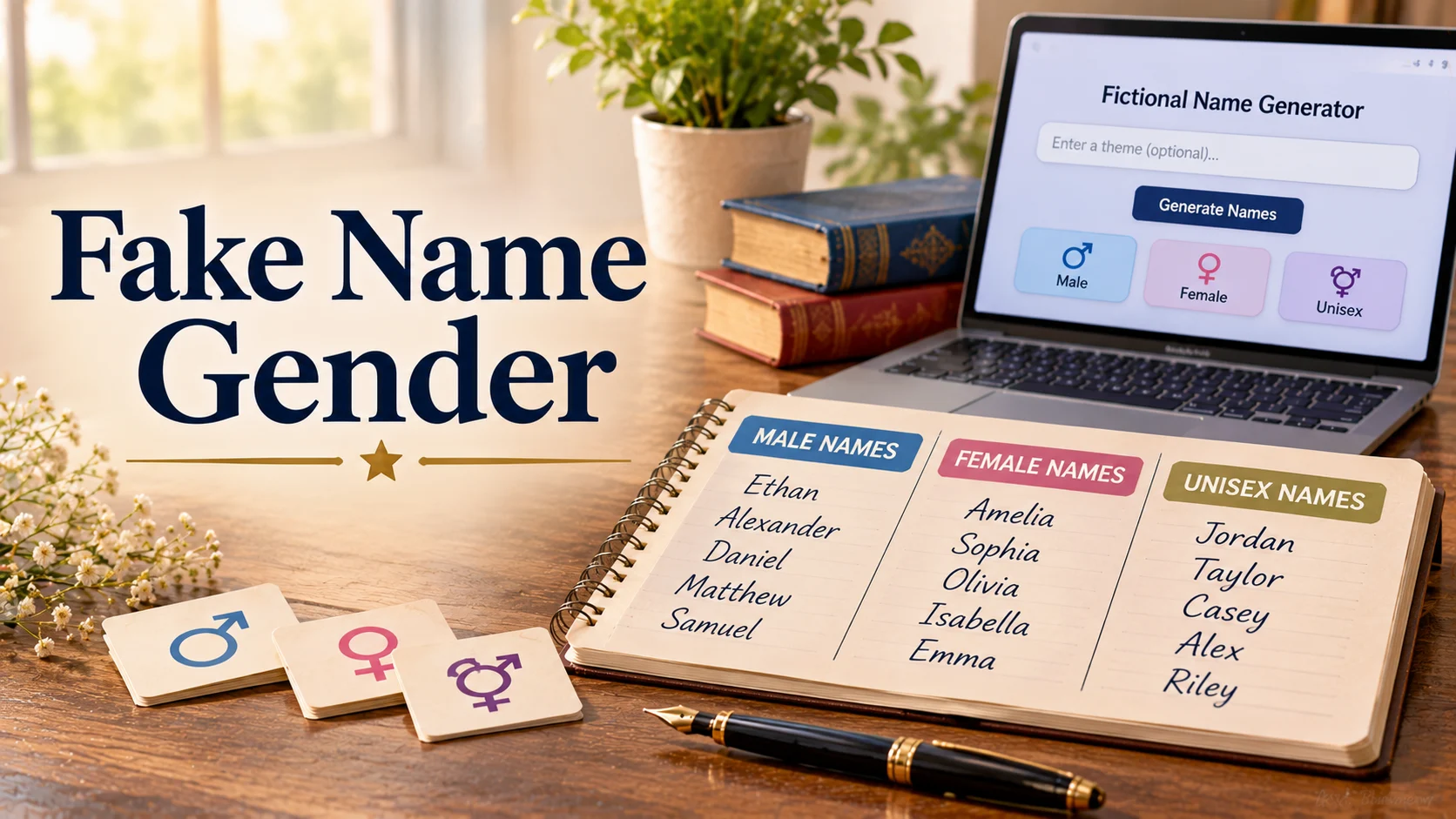
- Masculine-associated: Daniel, Michael, Alexander
- Feminine-associated: Olivia, Sophia, Isabella
- Gender-neutral: Taylor, Jordan, Morgan
A fake name does not have to be completely invented. It can be an existing personal name used as a pseudonym or an entirely fictional combination of first and last names.
The term is particularly relevant when creating fictional characters, choosing an alias for a story, developing a role-playing identity, or selecting an alternative name for an online profile.
How Does Gender Association Work in Names?
Names develop gender associations through cultural conventions, family traditions, historical usage, and popular media.
For example, in many English-speaking communities, names such as William and Henry are traditionally associated with boys, while Charlotte and Grace are traditionally associated with girls.
However, these associations are not universal rules.
A name that is predominantly masculine in one country may be feminine or unisex in another. Some names also become more gender-neutral as naming preferences change over time.
It is therefore important to distinguish between a name’s common cultural association and the actual gender identity of the person using it.
Fake Name Gender Meaning
The meaning of fake name gender depends on how the phrase is used.
In most cases, people use it to describe the gender category of a fictional or alternative name. They may want to know a name sounds male, female, or suitable for any gender.
There are three main categories.
1. Masculine Fake Names
Masculine-associated names are names traditionally given to boys or men in particular cultures.
Examples include:
- Ethan
- Alexander
- Benjamin
- Daniel
- Christopher
- Samuel
- Nathan
- Lucas
- Henry
- Sebastian
These names can be useful when creating fictional male characters, male pen names, or alternative identities for storytelling and role-playing.
Some masculine names also have strong historical, literary, or cultural associations.
For example, Alexander has a long history in Greek and European naming traditions, while William has been used in English-speaking royal and historical contexts.
2. Feminine Fake Names
Feminine-associated names are commonly used for girls and women in particular naming traditions.
Examples include:
- Amelia
- Sophia
- Isabella
- Charlotte
- Evelyn
- Victoria
- Lily
- Hannah
- Abigail
- Eleanor
These names can work well for fictional female characters, creative writing, stories, and role-playing profiles.
Some feminine names have traditional meanings associated with beauty, grace, nature, or historical figures. However, their meanings depend on their individual linguistic origins rather than their gender classification.
3. Gender-Neutral Fake Names
Gender-neutral names are names that can be used by people of different genders.
Examples include:
- Alex
- Jordan
- Taylor
- Morgan
- Riley
- Casey
- Avery
- Quinn
- Cameron
- Rowan
These names are useful when creating characters whose gender is not important to the story or when choosing a pseudonym that does not communicate a specific gender.
Gender-neutral names are also popular in modern creative naming because they offer flexibility without requiring a traditionally masculine or feminine association.
Origin and Etymology of Gender-Associated Names
The idea of masculine and feminine names has developed through different linguistic, cultural, and historical traditions.
Many societies have naming conventions influenced by language, religion, family history, and social customs.
Some languages have grammatical gender, which can influence the forms of personal names. Other naming traditions distinguish masculine and feminine names through different endings, spellings, or established cultural usage.
For example, several European naming traditions contain related masculine and feminine forms:
| Masculine Form | Feminine Form |
|---|---|
| Alexander | Alexandra |
| Daniel | Danielle |
| Gabriel | Gabrielle |
| Joseph | Josephine |
| Michael | Michaela |
| Nicholas | Nicole |
| Paul | Paula |
| Christian | Christina |
These pairs illustrate how some names develop related forms through linguistic and cultural naming conventions.
However, not every name has a corresponding form for another gender, and related names do not necessarily have identical histories or meanings.
Why Do Some Names Become Gender-Neutral?
A name may become gender-neutral when people from different genders begin using it over time.
This can happen for several reasons:
- A name may originally have been a surname.
- A traditional masculine or feminine name may become popular across genders.
- Popular culture may introduce the name to new audiences.
- Parents may prefer names that are not strongly associated with one gender.
- Regional naming traditions may use the same name differently.
For example, Taylor developed as a surname before becoming a widely used given name. Jordan and Morgan also have histories as surnames and given names, with usage that varies across regions and generations.
History and Cultural Context of Fake Names
People have used alternative names, aliases, pen names, and fictional identities for centuries.
Although the modern phrase “fake name gender” is relatively informal, the practice of choosing names that communicate particular characteristics has a much longer history.
1. Historical Pseudonyms
Writers have frequently used pseudonyms instead of their birth names.
Some authors adopted alternative names for privacy, professional identity, or literary reasons.
For example, George Eliot was the pen name of English novelist Mary Ann Evans. The masculine-associated pseudonym was used in a nineteenth-century literary environment where women writers faced particular social expectations.
This example demonstrates how names can influence public perception, although a pseudonym does not determine the author’s gender identity.
2. Fictional Characters
Authors, filmmakers, and game developers choose names that help establish a character’s identity.
A traditional masculine name might be selected for a male character, while a feminine-associated name may be used for a female character.
However, writers can also use unexpected or gender-neutral names to create distinctive characters.
For example:
- Ethan Carter: A fictional male character.
- Amelia Brooks: A fictional female character.
- Jordan Blake: A fictional character whose gender is not immediately indicated by the name.
3. Modern Online Naming
The internet has made alternative names increasingly common in everyday digital communication.
People may use pseudonyms, screen names, gaming aliases, and fictional usernames.
Some prefer gender-neutral names because they do not want their online identity to communicate a particular gender.
Others choose masculine or feminine names to match a fictional persona or character they are developing.
The appropriate choice depends on the platform, purpose, and context. A pseudonym used for creative expression is different from a false identity used to deceive someone or bypass verification requirements.
4. Cultural Differences in Gender Naming
Gender associations differ significantly across languages and regions.
For example:
- English: Jordan, Taylor, and Morgan can be used across genders.
- French: Names such as Jean and Jeanne have established masculine and feminine associations.
- Spanish: Alejandro and Alejandra are related masculine and feminine forms.
- Arabic: Names such as Omar and Aisha have commonly recognized masculine and feminine associations, respectively.
- Japanese: Personal names may have different gender associations depending on their pronunciation, kanji, and cultural usage.
These examples are broad illustrations rather than universal classifications. Individual names may have exceptions, and cultural naming practices change over time.
Fake Name Examples by Gender
If you are looking for fictional names, organizing them by gender association can make the selection process easier.
The following examples combine familiar first names with fictional surnames.
Male Fake Full Names
Here are some masculine-associated fictional full names:
| First Name | Last Name | Fictional Full Name |
|---|---|---|
| Ethan | Brooks | Ethan Brooks |
| Alexander | Reed | Alexander Reed |
| Daniel | Carter | Daniel Carter |
| Lucas | Bennett | Lucas Bennett |
| Henry | Parker | Henry Parker |
| Nathan | Collins | Nathan Collins |
| Sebastian | Hayes | Sebastian Hayes |
| Benjamin | Foster | Benjamin Foster |
| Samuel | Turner | Samuel Turner |
| Oliver | Morgan | Oliver Morgan |
These names can be used as starting points for fictional characters, stories, and creative projects.
Female Fake Full Names
Here are feminine-associated fictional full names:
| First Name | Last Name | Fictional Full Name |
|---|---|---|
| Amelia | Brooks | Amelia Brooks |
| Sophia | Bennett | Sophia Bennett |
| Isabella | Carter | Isabella Carter |
| Charlotte | Reed | Charlotte Reed |
| Olivia | Parker | Olivia Parker |
| Evelyn | Collins | Evelyn Collins |
| Victoria | Hayes | Victoria Hayes |
| Eleanor | Foster | Eleanor Foster |
| Abigail | Turner | Abigail Turner |
| Lily | Morgan | Lily Morgan |
These combinations are illustrative fictional examples, not claims that the names belong to specific real people.
Gender-Neutral Fake Full Names
If you prefer a name that does not strongly indicate gender, consider these examples:
| First Name | Last Name | Fictional Full Name |
|---|---|---|
| Jordan | Blake | Jordan Blake |
| Taylor | Reed | Taylor Reed |
| Morgan | Hayes | Morgan Hayes |
| Riley | Brooks | Riley Brooks |
| Avery | Collins | Avery Collins |
| Casey | Parker | Casey Parker |
| Quinn | Bennett | Quinn Bennett |
| Cameron | Foster | Cameron Foster |
| Rowan | Turner | Rowan Turner |
| Alex | Morgan | Alex Morgan |
Gender associations may vary depending on the country and audience.
How to Choose the Right Fake Name Gender
Choosing a fictional name is easier when you understand the purpose behind it.
A name for a historical novel may require different considerations from a gaming username or a modern fictional character.
Here are several practical steps.
Step 1: Decide the Character’s Purpose
First, identify why you need the name.
For example:
- A fictional male character
- A fictional female character
- A gender-neutral character
- A pen name for creative writing
- A role-playing identity
- A username for an online game
Your intended use will help determine the appropriate naming style.
Step 2: Choose a Gender Association
Decide the name should sound traditionally masculine, feminine, or gender-neutral within the intended cultural setting.
Remember that these are naming conventions, not strict categories.
Step 3: Consider the Cultural Background
If you are creating a character from a particular country or cultural background, research names commonly used in that region.
For example, a character from Spain may have a Spanish first and last name, while a character from Japan may require consideration of Japanese naming conventions.
Avoid combining names from unrelated traditions without considering the combination is plausible for your character.
Step 4: Select a First and Last Name
A convincing fictional identity often needs more than an interesting first name.
Choose a surname that fits the character’s setting, language, and background.
For example:
- Ethan Brooks
- Amelia Carter
- Jordan Blake
These combinations have a familiar English-language naming style.
Step 5: Check Pronunciation and Spelling
A name should be easy to read and suitable for its intended audience.
If your fictional name contains unfamiliar sounds or unusual spelling, consider providing a pronunciation guide.
Step 6: Consider the Name Is Too Similar to a Real Person
Before using a fictional full name publicly, search for existing people or businesses with the same name.
This is particularly important for commercial projects, published stories, and professional branding.
A fictional name can unintentionally match someone’s real identity.
Fake Name Gender vs. Related Naming Terms
Several terms are associated with fake names, but they describe different concepts.
| Term | Meaning | Main Difference |
|---|---|---|
| Fake Name | An invented or alternative name | Broad informal term |
| Pseudonym | An alternative name used instead of a person’s real name | Often used for writing or public identity |
| Alias | Another name by which someone is known | May be temporary or informal |
| Pen Name | A name used by an author for published work | Specifically associated with writing |
| Unisex Name | A name used by people of different genders | Describes gender usage |
| Gender-Neutral Name | A name without a strong association with one gender | Emphasizes neutrality |
| Fictional Name | A name created for an imaginary character | Used in creative works |
| Screen Name | A name used to identify someone online | Associated with digital platforms |
Fake Name vs. Pseudonym
A fake name is a broad everyday expression for an invented or alternative name.
A pseudonym is a more specific term for a name someone adopts instead of their real name, often for privacy, artistic, or professional reasons.
For example, an author publishing under a different name is using a pseudonym.
Gender-Neutral Name vs. Unisex Name
These terms overlap, but their emphasis can differ.
A unisex name is commonly used by people of different genders.
A gender-neutral name is generally understood as not strongly identifying one gender.
In everyday usage, people often use these expressions interchangeably.
Responsible Uses of Fake Names
There are many legitimate reasons to use fictional or alternative names.
Examples include:
- Creating characters for novels and short stories.
- Developing fictional profiles for creative projects.
- Choosing a pen name for publishing.
- Participating in role-playing games.
- Creating fictional examples for educational material.
- Protecting privacy in situations where a platform permits pseudonyms.
However, an important distinction exists between using a pseudonym and falsely representing yourself.
A fictional name should not be used to impersonate another person, commit fraud, evade legal requirements, or mislead institutions that require accurate identity information.
Some services allow usernames or pseudonyms, while others require verified legal names. Always follow the relevant platform’s rules and applicable laws.
FAQs
1. What does fake name gender mean?
Fake name gender refers to the gender commonly associated with an invented or alternative name. A name may be masculine, feminine, or gender-neutral depending on cultural and linguistic conventions.
2. What is a good fake male name?
Good fictional male names include Ethan Brooks, Alexander Reed, Daniel Carter, Lucas Bennett, and Henry Parker. These combinations work well for fictional characters and creative writing.
3. What is a good fake female name?
Popular choices for fictional female names include Amelia Brooks, Sophia Bennett, Isabella Carter, Olivia Parker, and Charlotte Reed.
4. What are gender-neutral fake names?
Gender-neutral fake names are names that can be used by people of different genders. Examples include Jordan, Taylor, Morgan, Riley, Avery, Casey, and Quinn.
5. Can a fake name be used for all genders?
Yes. Some names are commonly used across genders. Examples include Alex, Jordan, Taylor, Morgan, and Cameron. Their gender associations can vary depending on cultural and regional naming traditions.
6. How do I choose a fake name for a character?
Consider the character’s gender presentation, cultural background, age, personality, and historical setting. Choose a first and last name that sound natural together and fit the character’s fictional environment.
7. Is a pseudonym the same as a fake name?
Not exactly. A pseudonym is an alternative name adopted by someone instead of their real name, often for writing, privacy, or professional purposes. Fake name is a broader informal expression.
8. Are unisex names and gender-neutral names the same?
They are closely related. Unisex names are used by people of different genders, while gender-neutral names are not strongly associated with one particular gender. The terms often overlap.
9. Can I use a fake name online?
Many platforms allow usernames, screen names, or pseudonyms. However, some services require your legal identity for verification, financial transactions, or other official purposes. Always follow the platform’s requirements.
10. Do names determine someone’s gender?
No. Names can have masculine, feminine, or gender-neutral cultural associations, but they do not determine someone’s gender identity. A person’s identity and affirming name should always be respected.
Conclusion
Fake name gender is a useful way to think about the masculine, feminine, or gender-neutral associations of fictional and alternative names.
you need a name for a fictional character, a creative writing project, a pen name, or an online persona, understanding cultural naming conventions can help you make a suitable choice.
Masculine-associated names such as Ethan and Alexander, feminine-associated names such as Amelia and Sophia, and gender-neutral options such as Jordan and Taylor provide a variety of possibilities.
The best choice is one that fits your purpose, sounds natural in its intended cultural context, and communicates the identity you want to create without relying on assumptions about a real person’s gender.
Discover More Related Articles:
- Name Calculator | Discover Your Name Number, Meaning & Numerology in 2026
- Charlie Kirk’s Book Stop in the Name of God | Meaning, Summary & Key Lessons In 2026
- Lina Name Meaning | Origin, History, & Cultural Significance In 2026