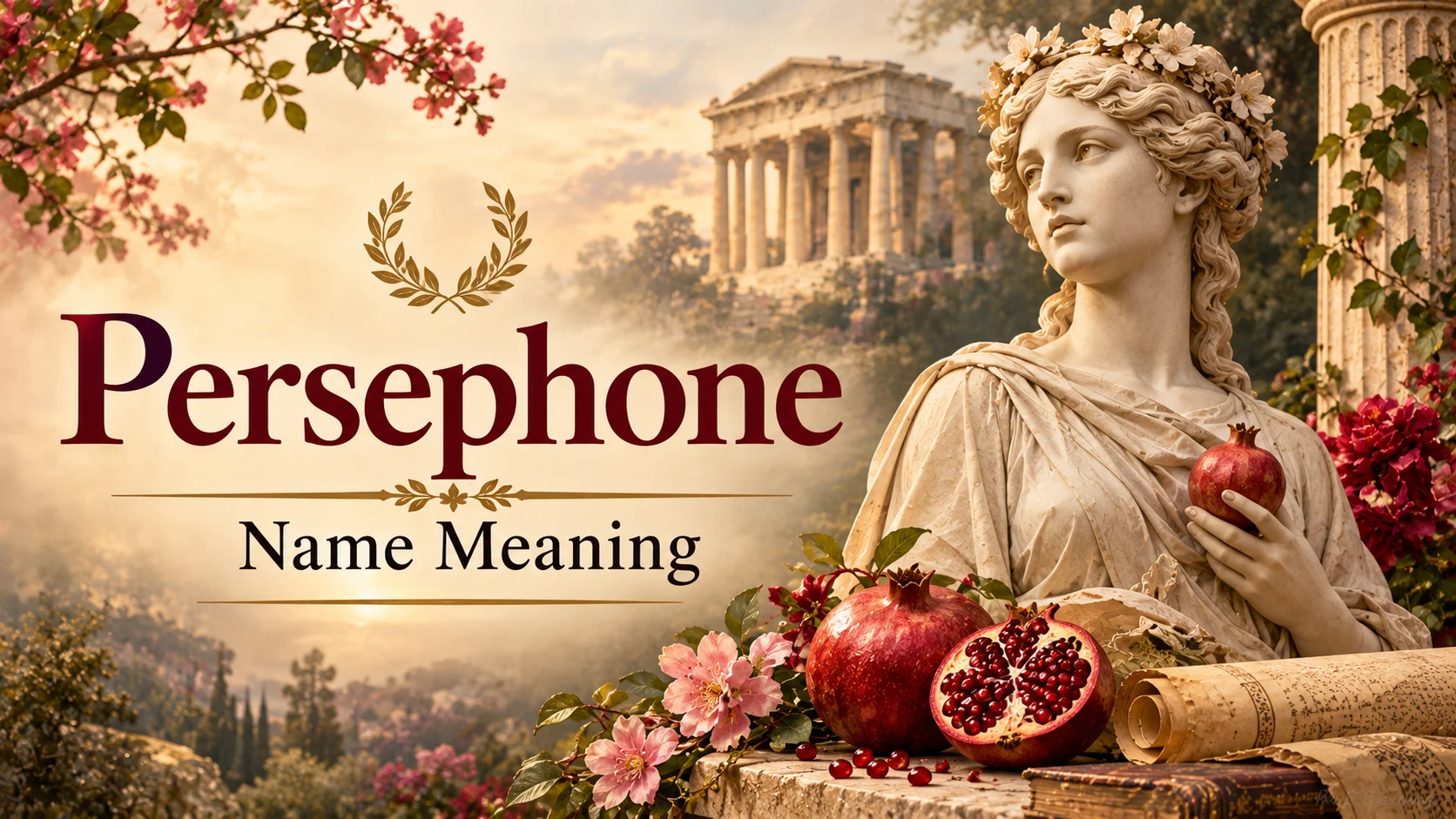
Persephone is a feminine name of ancient Greek origin associated with the Greek goddess of spring, vegetation, and the underworld. The name is commonly connected with themes of renewal, transformation, nature, and the changing seasons.
The name Persephone has a fascinating connection to ancient Greek mythology, nature, and the changing seasons. Persephone is traditionally associated with the Queen of the Underworld and the goddess connected with spring growth and vegetation. As a feminine given name, it carries symbolism related to transformation, renewal, life, and the balance between light and darkness.
The exact linguistic origin of the name remains uncertain, although its history is deeply rooted in ancient Greek religion and mythology. Persephone is best known through the myth involving her mother, Demeter, and Hades, the ruler of the Underworld. Their story became an important explanation of the seasonal cycle and the relationship between life, death, and renewal.
In this guide, we explore the Persephone name meaning, Greek origins, pronunciation, mythological history, symbolism, personality associations, nicknames, and modern naming appeal.
What Does the Name Persephone Mean?
Persephone is a feminine name from ancient Greek mythology, traditionally associated with spring growth, vegetation, and the Underworld. She is the daughter of Demeter and Zeus and the wife of Hades. Although the precise etymology of her name is uncertain, its mythological associations make it a symbol of transformation, renewal, and the connection between life and death.
Unlike names with straightforward translations, Persephone does not have one universally accepted literal meaning. Its significance comes primarily from the goddess’s mythology and her role in ancient Greek religious traditions.
The name is commonly associated with:
- Spring and renewal: Her return to the world above is connected with the revival of vegetation.
- Transformation: Her journey between two worlds represents change and transition.
- Life and death: Her dual role connects the living world with the Underworld.
- Mystery: Her association with the hidden realm gives the name a mysterious quality.
- Strength: Her position as Queen of the Underworld represents authority and power.
These are symbolic interpretations based on the mythology rather than literal translations of the name.
Persephone Name Meaning and Symbolism
The Persephone name meaning is closely connected with the contrast between springtime and the Underworld.
In Greek mythology, Persephone occupies two different roles. She is associated with the growth and renewal of nature, but she also becomes the queen of the realm of the dead.
This combination gives the name a distinctive symbolic depth.
1. Spring and New Beginnings
Persephone’s return from the Underworld is associated with the arrival of spring.
In the myth, her reunion with Demeter allows the earth to become fertile again. Flowers bloom, plants grow, and the natural world begins to recover.
Because of this connection, Persephone is often associated with:
- Fresh beginnings
- Growth
- Hope
- Renewal
- New opportunities
- The beauty of nature
Parents who appreciate nature-inspired names may find this symbolism especially meaningful.
2. Transformation and Personal Growth
Persephone’s myth describes a major transition in her life, from the daughter of Demeter to the powerful Queen of the Underworld.
This transformation can symbolize maturity, independence, and the ability to adapt to difficult circumstances.
In modern name symbolism, Persephone may represent someone who grows through change and develops strength through challenging experiences.
3. Mystery and Hidden Beauty
The Underworld gives Persephone a mysterious dimension.
Unlike mythological figures associated exclusively with sunlight or the heavens, Persephone belongs to two different realms.
This makes the name appealing to people who enjoy mythology, dark romantic aesthetics, fantasy literature, and names with layered meanings.
4. Strength and Authority
As Queen of the Underworld, Persephone holds an important position in Greek mythology.
Her association with Hades does not simply make her a passive figure in the story. In later literary and artistic interpretations, she is frequently portrayed as a powerful queen with authority over the Underworld.
Consequently, the name can symbolize dignity, independence, resilience, and inner strength.
Persephone Name Origin and Etymology
Persephone comes from ancient Greek mythology and has an ancient Greek form, commonly written Περσεφόνη.
Its precise linguistic etymology is debated. Scholars have not established a universally accepted translation of the name, so claims that it literally means a particular phrase should be treated cautiously.
The name’s mythological identity is much better documented than its original linguistic meaning.
Ancient Greek Roots
Persephone’s name belongs to the ancient Greek religious and literary tradition.
Some historical and linguistic discussions have explored possible pre-Greek influences or connections with older regional naming traditions. However, these theories do not provide a definitive explanation of the name.
It is therefore more accurate to describe Persephone as an ancient Greek mythological name with an uncertain etymology.
Persephone and Kore
An important name associated with Persephone is Kore, a Greek word meaning “maiden” or “young girl.”
In ancient Greek religious contexts, Kore was used as a title or name for Persephone, particularly in her association with youth and the living world.
The distinction between Kore and Persephone can reflect different aspects of the same goddess:
- Kore: The maiden or young daughter of Demeter.
- Persephone: The goddess and Queen of the Underworld.
These names are closely connected through mythology, although their usage and religious significance varied across traditions.
Roman Name: Proserpina
The Romans identified Persephone with Proserpina, a goddess whose mythology developed through Roman religious and literary traditions.
The Roman version shares important themes with the Greek story, particularly the connection between the Underworld, vegetation, and the seasonal cycle.
Proserpina is a related mythological name, but it has its own linguistic and cultural history.
History of Persephone in Greek Mythology
Persephone is one of the most recognizable female figures in ancient Greek mythology.
Her story is closely connected to her mother, Demeter, the goddess of agriculture and grain, and Hades, the ruler of the Underworld.
The myth explains the seasonal changes in nature and explores themes of motherhood, separation, loss, and reunion.
The Story of Persephone and Hades
According to a well-known version of the Greek myth, Persephone was gathering flowers when Hades carried her away to the Underworld.
Her mother, Demeter, searched throughout the world for her missing daughter.
During her search, Demeter became so consumed by grief that the earth stopped producing crops. This created a crisis because humans could no longer depend on the harvest.
Eventually, Zeus intervened and arranged for Persephone to return.
However, Persephone had eaten pomegranate seeds in the Underworld. In the familiar version of the myth, this meant that she could not remain permanently in the world above.
An agreement was reached in which she would spend part of the year with Hades and part with her mother.
Her return to Demeter was associated with the revival of vegetation, while her absence was connected with the period when the earth became less productive.
Different ancient sources tell the story with variations in detail.
Why Is Persephone Called the Queen of the Underworld?
Persephone becomes the wife of Hades and the Queen of the Underworld.
This title is one of her most recognizable mythological identities.
The Underworld in Greek mythology was the realm of the dead, ruled by Hades. Persephone’s role connected her with the mysterious processes of death and the afterlife.
Her position as queen gives the name associations with:
- Royal authority
- Mystery
- Power
- Independence
- The unseen world
- Transformation
Although modern popular culture sometimes presents Persephone primarily as a goddess of darkness, her ancient identity is more complex.
She is also connected with fertility, vegetation, and the renewal of life.
Persephone and Demeter
The relationship between Persephone and Demeter is central to the myth.
Demeter represents agriculture, grain, and the fertility of the earth, while Persephone’s seasonal journey explains the interruption and return of natural growth.
Their story is especially important in understanding the religious significance of the name.
It also became connected with the Eleusinian Mysteries, ancient religious rites associated with Demeter and Persephone at Eleusis in Greece.
These mysteries were among the important religious traditions of the ancient Greek world. Their precise rituals were kept secret, so many details remain unknown.
Persephone’s Symbols and Their Meanings
Several objects and natural elements are closely associated with Persephone in Greek mythology.
These symbols help explain why the name has such a distinctive identity.
1. Pomegranate
<AsyncImage query=”ancient Greek mythology pomegranate still life dark red fruit antique classical aesthetic” aspectRatio=”16:9″ width=”100%”/>
The pomegranate is one of Persephone’s most recognizable symbols.
In the myth, eating its seeds connects her to the Underworld and becomes part of the explanation for her periodic return there.
The fruit is often interpreted as representing life, fertility, attachment, and the relationship between different worlds.
2. Flowers
<AsyncImage query=”Greek mythology Persephone spring wildflowers narcissus daffodils classical painting” aspectRatio=”16:9″ width=”100%”/>
Flowers are associated with Persephone’s time in the living world.
The story of her gathering flowers before her descent into the Underworld is an important part of the familiar myth.
Flowers consequently symbolize spring, beauty, youth, and renewal.
3. Wheat and Grain
<AsyncImage query=”golden wheat fields classical Greek mythology Demeter Persephone symbolism” aspectRatio=”16:9″ width=”100%”/>
Wheat and grain are closely connected with Demeter and the agricultural themes of Persephone’s mythology.
They represent fertility, harvest, nourishment, and the natural cycle of growth.
4. The Underworld
<AsyncImage query=”ancient Greek underworld mythological dark stone palace underground classical fantasy art” aspectRatio=”16:9″ width=”100%”/>
The Underworld represents Persephone’s role as queen and her connection with death and the unseen realm.
In symbolic interpretations, it can represent mystery, inner transformation, hidden strength, and the unknown.
Persephone Name Pronunciation
The name Persephone is commonly pronounced:
per-SEF-uh-nee
Its pronunciation can be divided into three syllables:
- Per
- Seph
- o-nee
The middle syllable receives the main stress in this common English pronunciation.
In phonetic-style spelling, it may be written as “per-SEF-uh-nee.”
Because the name has an ancient Greek origin and is used in different modern languages, pronunciation can vary somewhat between speakers.
How Do You Spell Persephone?
The traditional English spelling is:
P-E-R-S-E-P-H-O-N-E
The name contains nine letters and three commonly pronounced syllables.
Its spelling is distinctive because the “ph” combination represents an /f/ sound in the usual English pronunciation.
Is Persephone a Popular Baby Name?
Persephone is an uncommon but recognizable mythological name in modern English-speaking naming culture.
Its distinctive sound and connection to Greek mythology make it attractive to parents looking for a classical, literary, or unusual feminine name.
It may appeal particularly to families who appreciate:
- Greek mythology
- Historical names
- Nature-inspired symbolism
- Classical literature
- Unique feminine names
- Names with strong cultural associations
Popularity varies by country and year. Without a specific current statistical source, it is better to describe Persephone as a distinctive choice rather than assign it an unsupported ranking.
Is Persephone a Good Name for a Baby Girl?
Persephone can be an appealing choice for parents who want a name with a rich mythological background.
Its main advantages include:
- A recognizable ancient Greek heritage.
- Strong associations with renewal and transformation.
- An unusual but elegant sound.
- Several possible nicknames.
- Connections to classical literature and mythology.
A possible consideration is pronunciation. Some people may be unfamiliar with the name and need help saying it correctly.
Its length may also make a shorter nickname attractive for everyday use.
Persephone Name Personality and Symbolic Traits
Names do not scientifically determine personality. However, parents and name enthusiasts often associate Persephone with certain qualities based on her mythology.
The name’s symbolic personality associations include:
| Symbolic Trait | Connection to Persephone |
|---|---|
| Strength | Her position as Queen of the Underworld |
| Resilience | Her journey through major life changes |
| Mystery | Her connection with the Underworld |
| Renewal | Her return and association with spring |
| Independence | Her powerful mythological identity |
| Grace | Her association with flowers and beauty |
| Transformation | Her movement between two realms |
| Wisdom | Her complex mythological role |
These qualities are modern symbolic interpretations rather than established characteristics of everyone with the name.
Nicknames and Variations of Persephone
Although Persephone is already distinctive, several shorter forms can make it easier to use in everyday conversation.
Popular Nickname Ideas
- Percy
- Persy
- Seph
- Sephy
- Perri
- Peri
- Effie
- Poppy
Some of these are creative nickname possibilities rather than historically established diminutives.
Related Names
If you like Persephone, you may also appreciate other names connected with Greek mythology and classical traditions.
| Name | Meaning or Association |
|---|---|
| Demeter | Greek goddess of agriculture and grain |
| Athena | Greek goddess associated with wisdom and strategy |
| Artemis | Greek goddess associated with hunting and wilderness |
| Selene | Greek goddess and personification of the moon |
| Calliope | One of the Muses in Greek mythology |
| Cassandra | Figure in Greek mythology associated with prophecy |
| Daphne | Mythological figure associated with a laurel tree |
| Proserpina | Roman counterpart of Persephone |
These names offer similar classical and mythological appeal, although their meanings and stories are different.
Is Persephone a Biblical Name?
No. Persephone is not a biblical name.
It originates in ancient Greek mythology rather than the Hebrew Bible or Christian biblical tradition.
Its historical background is associated with Greek religious beliefs, particularly the myths of Demeter, Hades, and the seasonal cycle.
However, parents from different religious and cultural backgrounds may still choose the name for its sound, symbolism, or historical interest.
Why Choose the Name Persephone?
Persephone stands out because it combines an elegant sound with a complex mythological background.
Unlike names with only one familiar association, Persephone connects several themes:
- Spring and nature
- Mystery and the Underworld
- Transformation and personal growth
- Classical Greek mythology
- Feminine strength and authority
For parents interested in meaningful mythological baby names, Persephone offers a distinctive option with a rich cultural history.
Its story also provides a memorable symbolic message: change and darkness do not necessarily mean an end, and renewal can follow difficult transitions.
FAQs
1. What does the name Persephone mean?
Persephone is an ancient Greek mythological name associated with spring growth, vegetation, and the Underworld. Its exact linguistic meaning is uncertain, but its symbolism includes renewal, transformation, mystery, and strength.
2. Is Persephone a Greek name?
Yes. Persephone comes from ancient Greek mythology. She is the daughter of Zeus and Demeter and the wife of Hades, the ruler of the Underworld.
3. How do you pronounce Persephone?
Persephone is commonly pronounced per-SEF-uh-nee in English. It has three syllables, with the strongest emphasis on the middle syllable.
4. Is Persephone a goddess?
Yes. Persephone is an ancient Greek goddess associated with vegetation, seasonal renewal, and the Underworld. She is also known as the Queen of the Underworld.
5. Who are Persephone’s parents?
Persephone is traditionally identified as the daughter of Zeus and Demeter. Demeter is the Greek goddess associated with agriculture, grain, and fertility.
6. Why is Persephone associated with pomegranates?
According to Greek mythology, Persephone ate pomegranate seeds while in the Underworld. This became part of the explanation for why she had to spend part of the year with Hades and part with her mother, Demeter.
7. Is Persephone a rare name?
Persephone is a relatively distinctive feminine name compared with more familiar choices such as Olivia, Emma, and Sophia. Its popularity varies by country and year.
8. What is a nickname for Persephone?
Commonly suggested nicknames include Percy, Persy, Seph, Sephy, Perri, Peri, and Effie.
9. Is Persephone a good baby name?
Persephone can be a beautiful choice for parents who appreciate Greek mythology, classical names, and meaningful symbolism. It offers associations with nature, transformation, renewal, and feminine strength.
10. Is Persephone a biblical name?
No. Persephone comes from ancient Greek mythology rather than biblical naming traditions. Its historical associations are connected with Greek religion and mythology.
11. What is Persephone’s Roman name?
Persephone’s Roman counterpart is Proserpina. The Roman goddess shares important mythological associations with the Greek Persephone, particularly the Underworld and seasonal renewal.
12. What flower is associated with Persephone?
Flowers, particularly those connected with spring and her mythological story, are associated with Persephone. The narcissus is especially notable in versions of the myth describing the circumstances of her abduction.
Conclusion
The Persephone name meaning is rooted in ancient Greek mythology rather than a clearly established literal translation. Best known as the daughter of Demeter and the Queen of the Underworld, Persephone is associated with spring, vegetation, mystery, transformation, and renewal.
Her story connects the natural cycle of the seasons with the relationship between life and death. The pomegranate, flowers, and wheat further enrich the name’s symbolism.
As a modern feminine given name, Persephone is a distinctive choice for parents who appreciate Greek mythology, classical history, and meaningful names. Its combination of beauty, mystery, and strength makes it a memorable name with a fascinating past.
Discover More Related Articles:
- How Much Is It to Change Your Last Name | Costs, Fees & Steps Explained In 2026
- I Sing Praises to Your Name Lyrics | Meaning, Worship Message & Song Overview In 2026
- Henry Name Meaning | Origin, History & Significance In 2026