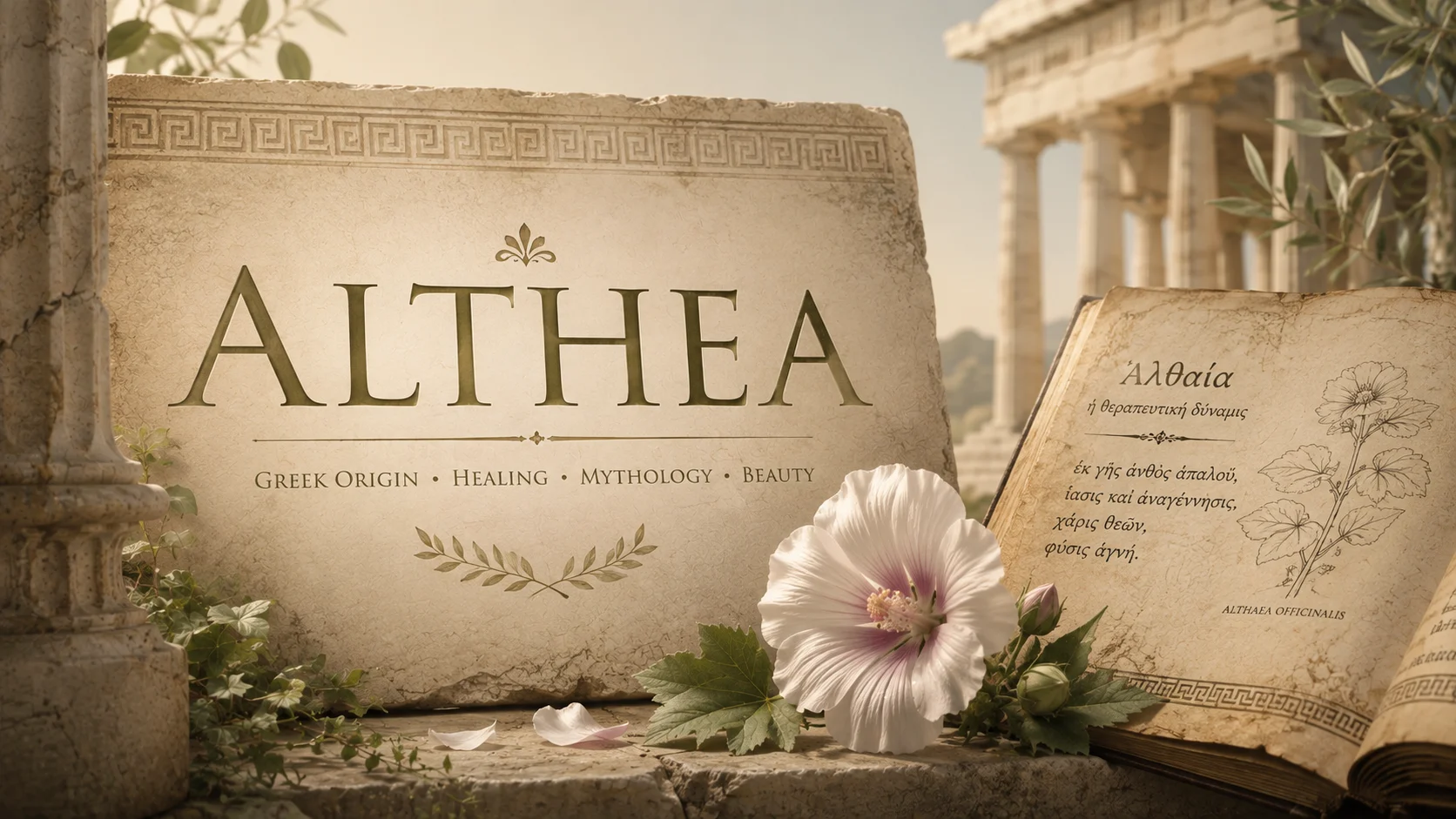
The Althea name meaning is commonly associated with “healing,” “healer,” or “wholesome.” Althea is a feminine given name derived from the Ancient Greek Althaia (Ἀλθαία), a name traditionally connected with Greek vocabulary relating to healing. It also has an interesting place in Greek mythology and later English literature.
For parents considering Althea as a baby name, its appeal comes from more than its elegant sound. It carries associations with restoration, care, strength, and classical heritage. The name has also been used in connection with the marsh-mallow plant, giving it an additional botanical dimension.
This guide explores the Althea name meaning, origin, etymology, mythology, pronunciation, variations, symbolism, nicknames, and modern use.
What Is the Althea Name?
Althea is a feminine personal name of Greek origin, usually understood as meaning “healing” or “wholesome.” Its historical form is the Ancient Greek Ἀλθαία (Althaia), which was Latinized as Althea or Althaea. The name is distinct from Alethea, another Greek-derived feminine name that means “truth.”
Today, Althea is generally recognized as a classic feminine given name. It has a soft, lyrical sound while retaining a strong connection to classical Greek language and mythology.
Quick Meaning
| Name Attribute | Details |
|---|---|
| Name | Althea |
| Gender | Feminine |
| Origin | Ancient Greek |
| Greek form | Althaia (Ἀλθαία) |
| Common meaning | Healing, healer, wholesome |
| Pronunciation | al-THEE-uh |
| Variants | Althaia, Althaea |
| Related name | Alethea, but with a different origin |
| Cultural association | Greek mythology and classical literature |
The exact linguistic pathway is sometimes described cautiously because historical Greek etymology can involve competing interpretations. A reliable name reference connects Althea with Greek althos, “healing,” while dictionary sources connect the botanical word althea with Greek althaia and a verb meaning “to heal.”
Althea Name Meaning
The central meaning associated with Althea is healing.
This meaning gives the name a naturally positive quality. Healing can suggest recovery after difficulty, care for others, emotional restoration, and the return of strength. For this reason, Althea is sometimes interpreted symbolically as a name connected with someone who brings comfort or renewal.
Some dictionaries give the related sense “wholesome,” which adds another layer to the name. Rather than suggesting only physical healing, “wholesome” can convey an overall sense of health, goodness, and well-being.
What Does Althea Mean?
In simple terms, Althea means “healing” or “wholesome,” with its roots in Ancient Greek.
Its traditional meaning can evoke ideas such as:
- Healing and restoration
- Health and well-being
- Compassion and care
- Strength after hardship
- Nurturing and comfort
- Wholesomeness and vitality
These are symbolic associations rather than predictions about a person’s personality. A name’s meaning can provide cultural or emotional significance, but it does not determine who someone will become.
Althea Name Origin and Etymology
The Althea name origin can be traced to Ancient Greek Ἀλθαία (Althaia). Behind the Name identifies Althea as a Latinized form used in the context of Greek mythology and suggests a relationship with Greek ἄλθος (althos), meaning “healing.”
The word althea also has a botanical history. English dictionaries trace the plant term through Latin althaea to Greek althaia, referring to a type of mallow. The plant connection is especially interesting because marsh mallow has a long history of medicinal associations.
This creates an appealing relationship between the personal name and the natural world:
Greek Althaia → healing association → Althea as a personal name and botanical term
However, it is important not to confuse Althea with Alethea. Alethea comes from Greek aletheia, meaning “truth,” and has a separate etymological history.
Althea in Greek Mythology
One of the oldest literary associations of Althea is Althaea, the mother of Meleager in Greek mythology.
Althaea appears in stories connected with the Calydonian Boar Hunt. According to versions of the myth, Meleager participated in the hunt and became involved in a conflict with his mother’s brothers. The mythology surrounding his death varies between sources, but one famous version centers on a piece of wood or brand whose destruction was connected with Meleager’s life.
In the version recorded by Ovid, the Fates declared that Meleager’s life would last as long as a particular log remained unconsumed. Althaea initially removed and preserved it. Later, after Meleager killed her brothers, she burned the brand, resulting in his death.
The myth is tragic, but it gives the name an unmistakable classical heritage.
Althea and Meleager
The relationship is significant because Althea and Althaea are variant forms of the same classical name tradition. Modern references commonly list Althaia and Althaea as variants of Althea.
The mythological Althaea is therefore an important historical reference when exploring the name’s ancient background.
Althea and the Marsh Mallow Plant
Althea has another fascinating connection: Althaea is a botanical genus in the mallow family.
Dictionary sources trace the botanical term althea to Greek althaia. In English, “althea” can refer to plants associated with the mallow family, including the rose of Sharon in American usage.
This botanical association is especially appropriate given the name’s traditional connection with healing.
The marsh-mallow plant, Althaea officinalis, is historically associated with medicinal use. That does not mean the personal name literally means “marsh mallow” in every naming context, but the botanical and linguistic histories overlap in a meaningful way.
For parents who enjoy names connected with flowers and nature, this gives Althea an additional attraction beyond its Greek heritage.
Althea Pronunciation
The most common English pronunciation is approximately:
al-THEE-uh
The middle syllable receives the strongest emphasis in this pronunciation. Behind the Name lists an English pronunciation of approximately /ˈæl.θi.ə/.
You may hear slight regional differences in English, particularly in where the stress falls.
How to Say Althea
Break it into three simple sounds:
Al + thee + uh
So:
Althea = al-THEE-uh
Because the name is relatively uncommon compared with many familiar English names, people may occasionally pronounce it differently when seeing it for the first time.
Althea Name History
Although its roots are ancient, Althea has traveled through several cultural settings.
Its earliest recognizable form belongs to Ancient Greek naming and mythology. Later, the Latinized form Althea entered literary and naming traditions in English-speaking contexts.
A particularly notable literary use appears in the work of English poet Richard Lovelace, who wrote the famous poem To Althea, from Prison. The poem is associated with Lovelace’s 17th-century literary career and helped preserve Althea as a recognizable poetic name in English literature.
This literary connection gives Althea a distinctive place between classical mythology and English poetry.
Althea in Literature and Popular Culture
Richard Lovelace’s To Althea, from Prison is one of the most recognizable historical literary references to the name. The poem uses “Althea” as the name of the poet’s beloved and connects love, freedom, and inner liberty.
The name also became associated with prominent modern figures.
One especially notable namesake is Althea Gibson, the American tennis champion. Her prominence helped bring the name into wider cultural awareness during the 20th century.
These associations show that Althea is not limited to ancient mythology. It has continued appearing in literature, sport, entertainment, and everyday naming.
Althea Name Symbolism
Because Althea is associated with healing, the name often inspires symbolism centered on renewal and care.
Parents may choose it because they like the idea of a name representing:
- Healing
- Hope
- Compassion
- Strength
- Restoration
- Wellness
- Gentleness
- Inner resilience
The combination of a delicate sound and a powerful meaning is one of Althea’s strongest qualities.
It does not sound overly traditional, yet its history reaches back to Ancient Greece. That balance can make it attractive to families looking for a name that feels classic without being overly common.
Is Althea a Good Name for a Girl?
Althea can be a strong choice for parents looking for a feminine name with historical depth and an uplifting meaning.
Its advantages include:
- A well-established classical origin
- A positive healing association
- An elegant three-syllable sound
- Connections to Greek mythology
- A botanical connection
- A literary history
- Several nickname possibilities
- A distinctive but recognizable spelling
The name also avoids the problem of having a completely invented modern meaning. Its associations with Greek language, mythology, and botanical terminology have historical foundations.
Althea Nicknames
Althea offers several natural nickname possibilities.
Popular choices can include:
- Thea
- Thee
- Al
- Ally
- Althee
- Tea
Thea is particularly appealing because it works naturally as a short form while also functioning independently as a feminine given name.
Parents who prefer the full name can simply use Althea without a nickname. Its three-syllable structure is already easy to say and has a graceful rhythm.
Althea Name Variations
Several forms of the name appear across historical and modern naming traditions.
| Variant | Description |
|---|---|
| Althea | Common English form |
| Althaea | Classical-looking variant |
| Althaia | Ancient Greek form/transliteration |
| Althéa | French form |
| Altheia | A less common variant spelling |
Behind the Name lists Althaia and Althaea as related variants of Althea.
One spelling deserves special attention: Alethea.
Alethea looks very similar to Althea, but the two names have different roots. Alethea comes from Greek aletheia, meaning “truth.” Althea is instead associated with the Greek name Althaia and healing-related etymology.
Althea vs. Alethea
| Name | Origin | Meaning | Main Distinction |
|---|---|---|---|
| Althea | Greek | Healing, wholesome | Associated with Althaia and healing |
| Alethea | Greek | Truth | Derived from aletheia, “truth” |
| Althaea | Greek | Healing-related | Variant form of Althea |
| Althaia | Ancient Greek | Healing-related | Greek form of Althea |
The visual similarity between Althea and Alethea can cause confusion, but they should not be treated as the same name.
Names Similar to Althea
If you like Althea, several names may appeal for their sound, style, or classical background.
Thea is the most obvious short-form connection and has a clean, modern sound.
Alethea has a similarly elegant rhythm but represents the different idea of truth.
Altheia offers a spelling that remains close to Althea while looking slightly more elaborate.
Other names with a similarly classical or lyrical character include:
- Athena
- Anthea
- Theodora
- Aurelia
- Ophelia
- Elara
- Calliope
- Lydia
These names are not necessarily etymological relatives of Althea. They are simply stylistic alternatives that may appeal to someone who likes Althea’s classical character.
Althea Name Meaning in Different Contexts
The name’s meaning can be understood differently depending on the context in which it is discussed.
Greek Context
The strongest historical connection is to the Greek name Althaia, associated with healing-related vocabulary.
Mythological Context
Althea or Althaea refers to the mythological figure who was the mother of Meleager. Her story is one of the most important ancient associations of the name.
Botanical Context
Althaea is also a botanical genus, and the word has a Greek-to-Latin history connected with mallow plants.
Modern Naming Context
As a contemporary personal name, Althea is generally appreciated for its combination of classic history, feminine sound, and healing symbolism.
Is Althea a Biblical Name?
Althea is not traditionally classified as a biblical name. Its documented historical roots are associated with Ancient Greek language and Greek mythology rather than the biblical naming tradition.
This distinction matters because names with Greek origins can sometimes be incorrectly described as biblical simply because Greek was an important language in early Christian history.
If you are specifically looking for a biblical name, Althea should be considered a Greek classical name rather than a traditional biblical one.
What Does the Name Althea Say About Personality?
A name’s etymological meaning does not scientifically determine someone’s personality. However, parents often enjoy interpreting names symbolically.
Because Althea is connected with healing and wholeness, it can poetically suggest qualities such as:
- Caring
- Empathetic
- Resilient
- Calm
- Supportive
- Warm-hearted
- Strong
- Nurturing
These are symbolic interpretations, not established personality traits. The value of the meaning is primarily cultural and personal.
Why Parents May Choose the Name Althea
Althea has several qualities that make it stand out among feminine names.
It is historical without feeling dated. Its Greek mythology connection gives it depth, while its soft pronunciation makes it approachable in modern English.
Its meaning is another major attraction. “Healing” is an inherently positive concept, and the botanical connection adds a subtle nature-inspired quality.
The name also has literary credentials through Richard Lovelace’s To Althea, from Prison, giving it a connection to English poetry as well as Greek tradition.
For someone searching for a girl name that combines meaning, mythology, nature, and literary history, Althea offers an unusually rich story.
Althea Name Meaning: A Simple Summary
Althea is a feminine Greek name associated with “healing,” “healer,” and “wholesome.” Its historical form is Althaia, and it is connected with the mythological Althaea, mother of Meleager. The name also shares its historical roots with the botanical word Althaea, used for a group of mallow plants.
Its overall character can be summarized as:
Althea = Greek heritage + healing + classical beauty + botanical connection.
That combination makes the name both meaningful and distinctive.
FAQs
What does Althea mean?
Althea is generally associated with “healing,” “healer,” or “wholesome.” The name comes from the Ancient Greek Althaia and has a long-standing connection with healing-related Greek vocabulary.
Is Althea a Greek name?
Yes. Althea is derived from the Ancient Greek name Ἀλθαία (Althaia). The English form is a Latinized development of the Greek name.
How do you pronounce Althea?
Althea is commonly pronounced al-THEE-uh, with the emphasis on the middle syllable. Some English speakers may use slight regional variations.
Is Althea a biblical name?
No. Althea is generally considered a Greek classical name, with roots in Ancient Greek language and mythology rather than the biblical naming tradition.
Is Althea the same as Alethea?
No. Although the spellings look similar, they have different origins and meanings. Althea is associated with healing, while Alethea comes from Greek aletheia, meaning “truth.”
What is the nickname for Althea?
Common nickname possibilities include Thea, Al, Ally, Althee, and Tea. Thea is probably the most natural short form.
What is the Greek spelling of Althea?
The Ancient Greek form is Ἀλθαία (Althaia). Althaea and Althea are later forms used in different naming and literary traditions.
Is Althea a flower name?
Althea has a botanical connection. Althaea is a plant genus in the mallow family, and “althea” can also refer to plants such as rose of Sharon in American English usage.
Who was Althaea in Greek mythology?
Althaea was the mother of Meleager in Greek mythology. Her story is closely connected with the Calydonian Boar Hunt and the prophecy concerning the brand that determined the length of Meleager’s life.
Conclusion
Althea is a name with an unusually layered history. Its story begins in Ancient Greek tradition, continues through mythology, appears in botanical terminology, and later finds a place in English literature.
The name’s central association with healing and wholeness gives it a positive emotional quality, while its classical roots provide historical depth.
For parents, writers, or anyone researching the name, Althea represents more than a pleasant-sounding word. It connects language, mythology, nature, and literature in one elegant name.
Most importantly, the name remains distinct from Alethea. Althea is associated with healing; Alethea is associated with truth.
Discover More Related Articles:
- Teagan Name Meaning | Origin, History, Pronunciation & More In 2026
- Isadora Name Meaning | Origin, History & Pronunciation In 2026
- Dakota Name Meaning | Origin, History & Significance In 2026











2 thoughts on “Althea Name Meaning | Greek Origin, History & Symbolism In 2026”