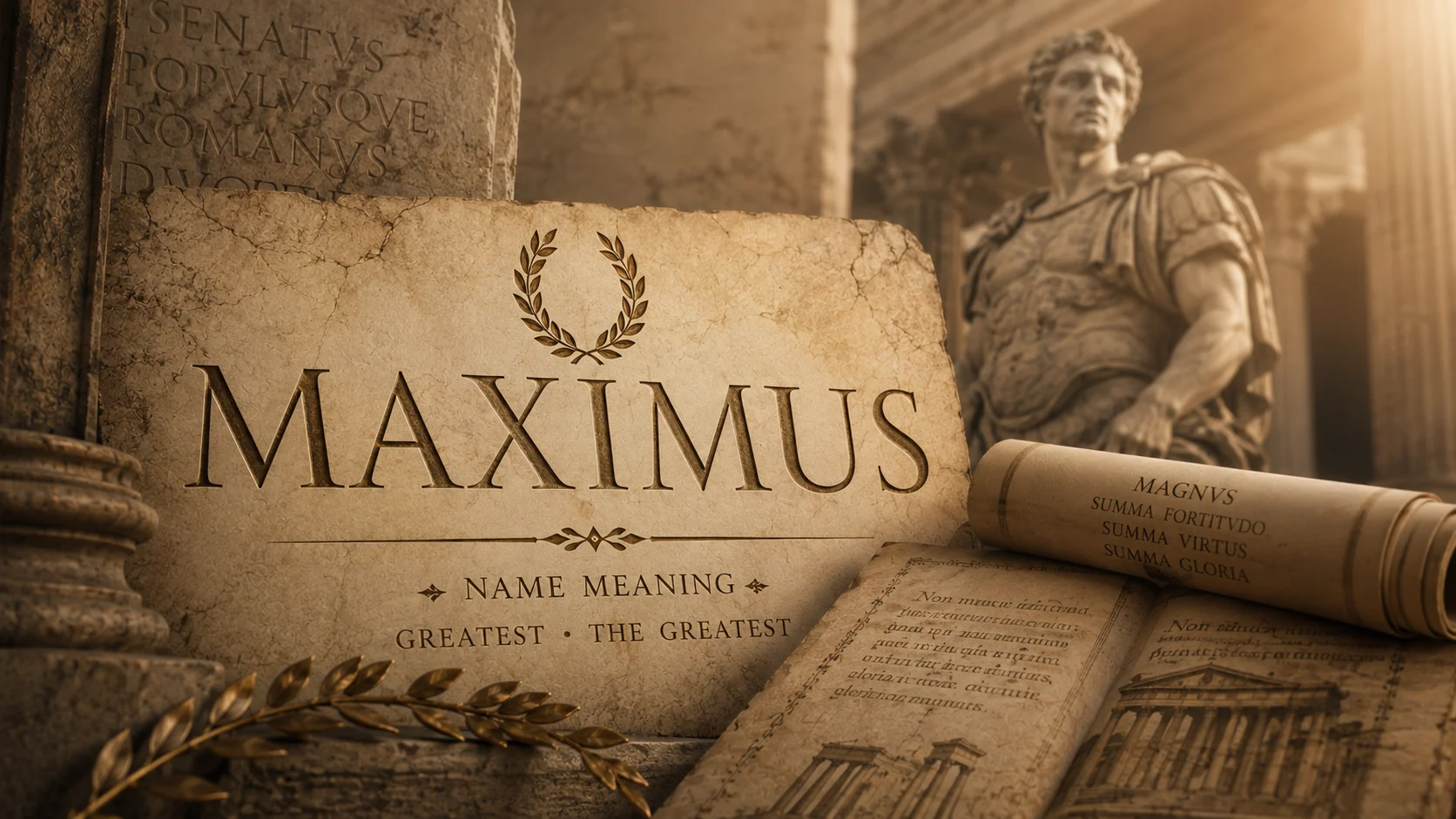
The Maximus name meaning is “greatest.” Maximus comes from Latin and has strong connections to Ancient Roman naming traditions. It carries an impressive sense of greatness, distinction, strength, and ambition, making it a name with both historical depth and a bold modern character. The name was used as a Roman cognomen and was also carried by Christian saints, helping it survive beyond the ancient Roman world.
Today, Maximus is often chosen as a masculine given name, particularly by parents who like traditional names with a powerful sound and an ancient background. It can also be shortened to Max, while related forms appear in languages such as Spanish, Italian, French, Russian, Polish, and Ukrainian.
This guide explores the meaning, Latin roots, Roman history, pronunciation, variations, symbolism, related names, and modern appeal of Maximus.
What Is the Maximus Name?
Maximus is a masculine name of Latin origin meaning “greatest.” In Ancient Rome, Maximus was used as a cognomen, or name element, rather than functioning exactly like a modern first name. The name ultimately comes from the Latin adjective maximus, the superlative form associated with magnus, meaning “great” or “large.”
The literal idea behind Maximus is therefore one of the highest degree:
- Greatest
- Very great
- Most excellent
- Highest in rank or degree
- Distinguished
- Outstanding
Because of this meaning, Maximus naturally has a strong and ambitious quality.
Unlike some modern names whose meanings are uncertain or based on later interpretations, the linguistic meaning of Maximus is relatively straightforward. Historical name references identify it directly with the Latin word meaning “greatest.”
Maximus Name Meaning
The central Maximus name meaning is “greatest.”
This meaning comes directly from Latin. The word maximus expresses the highest degree of greatness, making the name stronger in meaning than a name that simply means “great.”
For parents considering Maximus, the name can symbolically suggest qualities such as:
- Greatness
- Strength
- Excellence
- Confidence
- Leadership
- Ambition
- Distinction
- Achievement
These symbolic associations should be understood as modern interpretations of the name’s literal meaning rather than fixed personality traits. A person’s name does not determine their character.
The name’s appeal partly comes from the contrast between its ancient origin and its very direct modern message. “Greatest” is easy to understand across cultures, while the Roman background gives the name an additional sense of history.
Does Maximus Mean “Great”?
Yes, but “greatest” is more precise.
The Latin word maximus is associated with the superlative degree, so it conveys the idea of being the greatest or largest rather than simply being great. The related Latin word magnus means “great,” while maximus represents a higher degree.
This distinction explains why Maximus often feels particularly bold as a name.
Maximus Name Origin and Etymology
Maximus has a Latin origin and is strongly associated with Ancient Roman naming practices. Historical name sources classify it as an Ancient Roman masculine name and describe it as a Roman cognomen meaning “greatest.”
The important linguistic element is the Latin word maximus.
In Latin, adjectives could change according to degree. The basic concept of “great” is connected with magnus, while maximus expresses the superlative idea of “greatest.” This is why the name has such an emphatic meaning.
The word was not invented specifically as a modern baby name. Instead, it existed as part of the Latin vocabulary and became associated with Roman personal naming traditions.
What Is a Roman Cognomen?
A cognomen was an element of the naming system used in Ancient Rome. Roman names could contain several components, and the cognomen could help distinguish individuals or identify family branches.
Maximus therefore has an important historical distinction: its ancient use belongs to a Roman naming system that was different from the first-name and surname structure commonly used today.
Over time, names from the Roman world were adopted, adapted, and preserved in different cultures. Maximus eventually developed a life beyond Ancient Rome through historical, religious, literary, and cultural use.
History of the Name Maximus
The history of Maximus stretches back to the Roman world. It was used as a Roman cognomen, and historical references list it among Ancient Roman names.
The name’s historical significance is not limited to one individual. Its appearance within Roman naming traditions reflects the importance of Latin vocabulary in personal names.
The meaning “greatest” would also have carried an obvious sense of distinction. Roman names could preserve descriptions, family associations, achievements, or other identifying elements, although the exact significance of an individual cognomen could vary.
Maximus also continued into Christian history. One notable bearer was Saint Maximus, a monk and theologian from Constantinople who lived in the 7th century. His association with the name helped connect Maximus with Christian religious history as well as its earlier Roman background.
This gives the name multiple historical layers:
Latin language → Ancient Roman naming → Christian history → modern personal name
That long historical journey is one reason Maximus feels more substantial than a newly created modern name.
Maximus in Ancient Roman Culture
The Roman connection is one of the most distinctive features of Maximus.
Ancient Roman names were structured differently from most contemporary Western naming systems. Roman men could have a praenomen, nomen, and cognomen, although naming practices changed over time and were not identical for every individual.
Maximus belonged to the category of cognomina. Its meaning, “greatest,” fits a broader pattern in Roman naming where Latin words and descriptive terms became associated with individuals and families.
The name should not, however, be interpreted as proof that every ancient bearer was literally considered “the greatest.” A name’s original lexical meaning and the reason a particular person received or used it are not necessarily the same thing.
That distinction is important when discussing historical names. Etymology tells us what the word means; it does not automatically tell us why every individual received the name.
Maximus and Christian History
Maximus also has a place in Christian history.
One especially notable figure was Saint Maximus the Confessor, a Byzantine Christian monk and theologian associated with Constantinople in the 7th century. Historical name references specifically connect Saint Maximus with the name.
Because of figures such as Saint Maximus, the name did not remain exclusively associated with the ancient Roman world. It became part of a wider historical tradition that included Christian communities.
This makes Maximus particularly interesting for people who appreciate names that combine:
- Ancient Roman roots
- Latin language
- Historical depth
- Christian associations
- Traditional masculine naming
However, the name itself is fundamentally Latin and Roman in origin. Its later Christian use should not be confused with its original etymology.
How Do You Pronounce Maximus?
Maximus is commonly pronounced approximately:
MAK-si-mus
A simple phonetic guide is:
MAK-sih-mus
The name has three syllables:
Max-i-mus
The pronunciation is fairly intuitive for English speakers because the spelling closely reflects its common pronunciation.
In different languages, pronunciation can vary. Related forms such as Maksim, Maxim, Massimo, and Máximo have their own language-specific pronunciations.
Is Maximus a Boy’s Name?
Yes. Maximus is traditionally a masculine name. Historical sources classify it as masculine and associate its ancient usage with Roman naming traditions.
For modern parents, Maximus can fit several naming styles:
- Classical
- Strong
- Formal
- Historical
- Traditional
- Bold
- Distinctive
The short form Max gives parents an informal everyday option while preserving the longer historical form on official documents.
This combination is one of the name’s practical advantages. A child can be called Maximus formally while using Max casually with friends and family.
Maximus Nicknames and Short Forms
The most obvious nickname for Maximus is Max.
Other possible informal forms include:
- Max
- Maxi
- Maxie
- M
- Maxy
Not every nickname is traditionally established, so families may create their own preferred short form.
Max is particularly attractive because it is simple, familiar, and easy to pronounce. It also allows Maximus to feel both grand and approachable.
A parent may choose Maximus for its historical character while using Max in everyday conversation.
Maximus Name Variations in Other Languages
Maximus has several related forms across different languages and naming traditions.
| Name | Language or tradition | Relationship |
|---|---|---|
| Maximus | Latin, Ancient Roman | Original historical form |
| Maxima | Latin, Ancient Roman | Feminine form |
| Maxim | Several European languages | Related form |
| Maksim | Slavic languages | Related form |
| Massimo | Italian | Related form |
| Máximo | Spanish and Portuguese | Related form |
| Maxime | French | Related form |
| Maximilian | European languages | Related but distinct extended name |
| Max | Multiple languages | Common short form |
Historical references list related forms including Maksim, Maxim, Massimo, Máximo, Maxime, and others. They also identify Maxima as the feminine form of Maximus.
It is useful to distinguish between a true linguistic variant and a merely similar name. For example, Maximilian is closely related in appearance and historical association but is not simply another spelling of Maximus.
Maximus vs. Maximilian
Maximus and Maximilian are often confused because both begin with “Maxim,” but they are separate names.
It comes directly from the Latin maximus, meaning “greatest.”
Maximilian, meanwhile, has a different historical development. The two names share related Latin elements but should not be treated as identical forms.
| Feature | Maximus | Maximilian |
|---|---|---|
| Main origin | Latin | Latin and later European development |
| Core meaning | Greatest | Historically associated with Maximus and Aemilianus |
| Ancient Roman connection | Direct | Related historical form |
| Common nickname | Max | Max |
| Style | Strong and classical | Formal and elaborate |
If the goal is a name with the most direct connection to the meaning “greatest,” Maximus is the clearer choice.
Maximus vs. Max
Max and Maximus are closely connected in everyday use, but they are not identical.
Maximus is the full historical name, while Max is a short form that can also function independently as a given name.
This creates two different naming styles:
Maximus:
Long, formal, ancient, dramatic, distinctive.
Max:
Short, modern, friendly, simple, versatile.
Parents who like both styles can use Maximus as the official name and Max as the everyday nickname.
Is Maximus a Strong Name?
Maximus is widely perceived as a strong-sounding name because of both its literal meaning and its phonetic structure.
Its meaning, “greatest,” naturally creates associations with excellence and achievement. Its Roman background adds an established historical character.
The name can therefore appeal to parents looking for something that sounds:
- Confident
- Masculine
- Powerful
- Classical
- Distinguished
- Ambitious
- Memorable
These are associations rather than guarantees. A name can suggest an idea without determining someone’s personality or future.
Is Maximus a Good Baby Name?
Maximus is a good baby name depends on personal taste, but it has several qualities that make it appealing.
Reasons parents may like Maximus
Strong meaning:
“Greatest” is positive, memorable, and easy to explain.
Historical roots:
The name has clear connections to Latin and Ancient Rome.
Nickname flexibility:
Max provides a short and familiar everyday option.
International variations:
Related forms appear in several European languages.
Distinctive sound:
Maximus is less ordinary than simply choosing Max while remaining recognizable.
Possible drawbacks
The same qualities that make Maximus distinctive may not appeal to everyone.
The full name can feel formal or dramatic compared with shorter names. Some parents may also prefer names with less obvious historical or heroic associations.
The best choice depends on how Maximus sounds with the family’s surname, middle name, and naming style.
What Does Maximus Symbolize?
Because Maximus means “greatest,” its strongest symbolic associations are greatness, excellence, distinction, and aspiration.
A family choosing the name may interpret it as expressing a wish for a child to:
- Pursue excellence
- Aim high
- Grow with confidence
- Stand out positively
- Accomplish meaningful goals
- Live with strength and purpose
These are symbolic interpretations rather than historical definitions.
The actual etymological meaning remains simply “greatest.”
Does Maximus Have a Biblical Meaning?
Maximus is not originally a Biblical Hebrew name. Its etymological origin is Latin and its historical classification is Ancient Roman.
However, Maximus does have a later Christian history through saints and theologians who bore the name, including Saint Maximus of Constantinople.
Therefore, it is more accurate to describe Maximus as a Latin Roman name with Christian historical associations rather than as a Biblical name.
This distinction matters because many baby-name websites loosely label historically Christian names as “Biblical” even when the names themselves do not originate in the Bible.
Is Maximus a Rare Name?
Maximus has an uncommon or distinctive feel in many English-speaking naming contexts, especially compared with the much shorter Max.
However, popularity changes by country and year, so it is best not to describe Maximus as universally rare or universally popular without a specific national birth-registration dataset.
The name’s historical roots are well established even if its modern frequency varies.
Parents who want a name that feels recognizable but more distinctive than Max may find Maximus appealing.
Famous and Historical Associations With Maximus
The name has appeared throughout history in connection with Roman and Christian figures.
One important historical association is Saint Maximus, the 7th-century monk and theologian associated with Constantinople.
The name has also appeared in Roman historical contexts, where Maximus functioned as a cognomen.
Modern popular culture has further contributed to recognition of the name. However, fictional characters and entertainment uses should be separated from the name’s actual Latin etymology and historical origin.
The name existed long before modern films, novels, television, or games used it.
Maximus Feminine Form
The traditional feminine form is Maxima.
Historical name references identify Maxima as the feminine form of Maximus in Ancient Roman usage.
The two names share the same Latin root and therefore express the same basic concept of greatness.
Maximus: masculine
Maxima: feminine
Maxima is considerably less familiar to many modern English speakers, but it retains the same classical Latin character.
Names Similar to Maximus
If you like Maximus, several names may also appeal to you.
Magnus
Magnus is a Latin name meaning “great.” It is closely related conceptually to Maximus because both express greatness.
Maximilian
Maximilian has a longer, formal structure and shares part of its historical naming background with Maximus.
Max
Max is the simplest and most familiar short form associated with Maximus.
Maxim
Maxim is a related form found in several European languages.
Marcus
Marcus is another well-known masculine name with strong Ancient Roman associations, although its meaning and etymology are different.
Maximus Name Meaning at a Glance
| Attribute | Details |
|---|---|
| Name | Maximus |
| Gender | Masculine |
| Origin | Latin |
| Historical usage | Ancient Roman |
| Meaning | Greatest |
| Name type | Roman cognomen, later given name |
| Pronunciation | MAK-si-mus |
| Common nickname | Max |
| Feminine form | Maxima |
| Related forms | Maxim, Maksim, Massimo, Máximo |
| Style | Classical, strong, formal |
| Religious association | Christian historical usage |
| Main symbolic idea | Greatness and excellence |
Why the Name Maximus Still Appeals Today
Maximus combines several qualities that can make a name memorable.
First, its meaning is exceptionally direct. A parent does not need a complicated explanation to understand what the name represents: greatest.
Second, the name has genuine historical depth. It is connected to Latin and Ancient Roman naming traditions rather than being a modern invention.
Third, Maximus has flexibility. The formal version sounds distinctive, while Max is short and familiar.
Finally, its related forms allow the name to connect naturally with different linguistic traditions. Forms such as Maxim, Maksim, Massimo, Máximo, and Maxime demonstrate how the broader name family appears across Europe.
For parents seeking a masculine name with an ancient origin, powerful meaning, and an easy nickname, Maximus offers a balanced combination of history and modern usability.
FAQs
What does the name Maximus mean?
Maximus means “greatest” in Latin. It comes from the Latin word maximus and was used as a Roman cognomen in Ancient Roman naming traditions.
Is Maximus a Latin name?
Yes. Maximus is a Latin name of Ancient Roman usage. Its meaning comes directly from the Latin word maximus, meaning “greatest.”
What is the nickname for Maximus?
The most common and natural nickname for Maximus is Max. Other informal possibilities include Maxi and Maxie, although families may create their own preferred nickname.
Is Maximus a Biblical name?
Maximus is not originally a Biblical name. It comes from Latin and has Ancient Roman roots. However, the name later became associated with Christian history through figures such as Saint Maximus.
What is the feminine form of Maximus?
The traditional feminine form is Maxima. Historical references identify Maxima as the feminine form of Maximus in Ancient Roman usage.
How do you pronounce Maximus?
Maximus is commonly pronounced MAK-si-mus, with three syllables. The exact pronunciation can vary slightly depending on language and accent.
What names are similar to Maximus?
Names related or similar to Maximus include Max, Maxim, Maksim, Massimo, Máximo, Maxime, Maximilian, Magnus, and Maxima. Some are direct linguistic relatives, while others are simply similar in sound or meaning.
Is Maximus a strong name?
Yes, Maximus has a strong symbolic quality because its literal meaning is “greatest.” Its Ancient Roman background and bold sound can also give it a powerful, classical character.
Conclusion
The Maximus name meaning is “greatest,” and that simple definition explains much of the name’s enduring appeal. Its roots are Latin, its historical use is connected to Ancient Rome, and its later history includes Christian figures such as Saint Maximus.
Maximus is more than a strong-sounding name. It represents a genuine Latin word with a superlative meaning and a documented place in Roman naming history. Its related forms, including Maxim, Maksim, Massimo, and Máximo, show how the name family developed across different cultures and languages.
For modern parents, Maximus offers a distinctive formal name with the familiar nickname Max. It can suit families drawn to classical names, Roman history, Latin language, or names associated with greatness and achievement.
Discover More Related Articles:
- Teagan Name Meaning | Origin, History, Pronunciation & More In 2026
- Isadora Name Meaning | Origin, History & Pronunciation In 2026
- Dakota Name Meaning | Origin, History & Significance In 2026