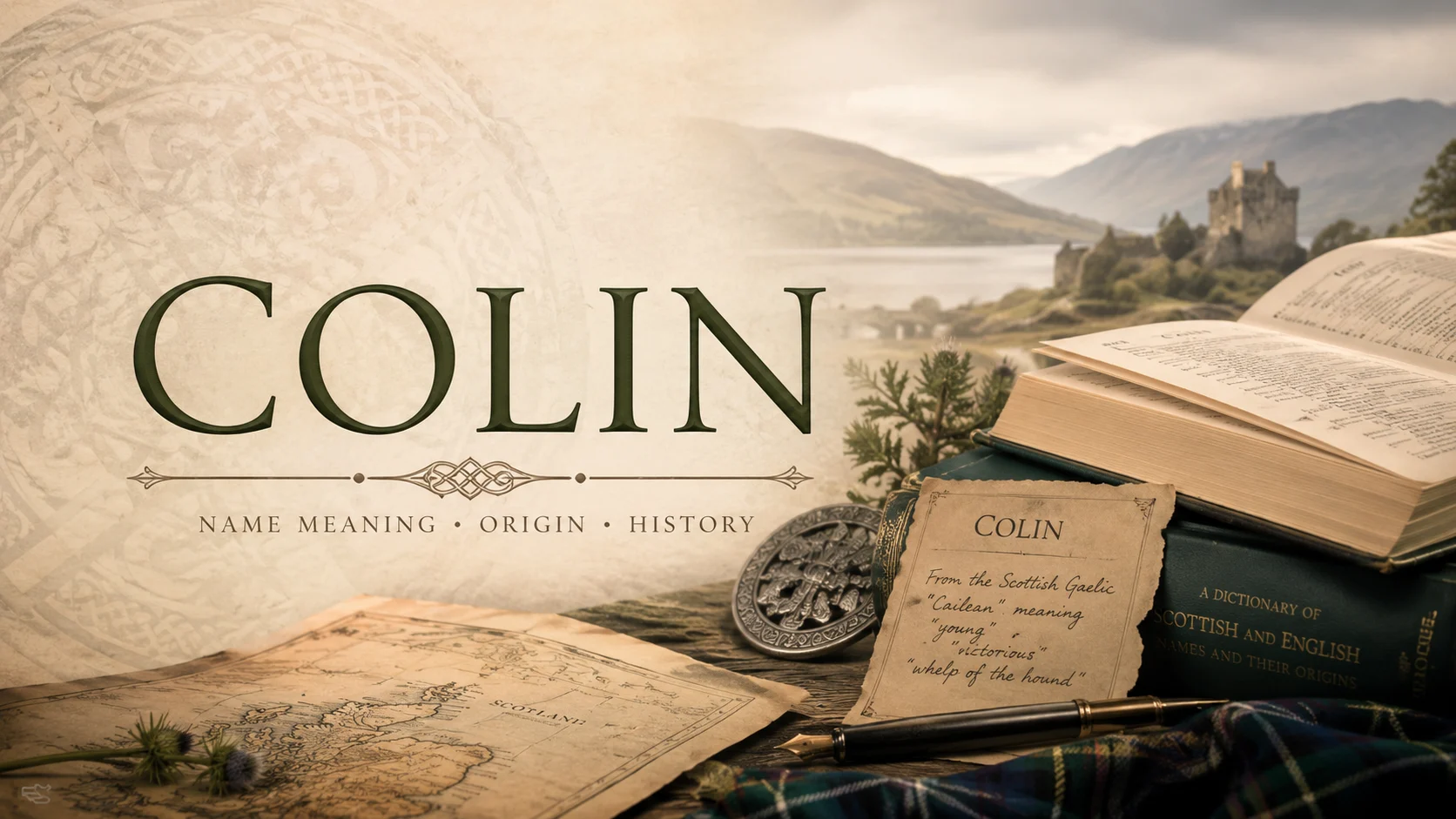
The Colin name meaning has more than one established linguistic pathway, which makes this classic masculine name especially interesting. Colin is used in both Scottish and English naming traditions. In Scottish usage, it is an Anglicized form of the Gaelic name Cailean, meaning “whelp” or “young dog.” In English, Colin also developed as a medieval diminutive of Col, a short form of Nicholas.
Because of these two histories, Colin can carry different layers of meaning depending on the tradition being considered. Its Scottish connection gives it a distinctly Celtic character, while its connection with Nicholas links it indirectly to the Greek meaning “victory of the people.” This guide explores the name’s meanings, origins, pronunciation, history, variants, cultural associations, and modern appeal.
What Is the Name Colin?
Colin is a masculine given name used primarily in English-speaking naming traditions, especially Scottish and English contexts. It has two documented origins: Scottish Colin comes from the Anglicized Gaelic Cailean, while another English Colin developed as a medieval diminutive of Col, a short form of Nicholas.
This distinction is important because the two forms do not have exactly the same etymological meaning.
The Scottish form is connected with Cailean, a Scottish Gaelic name meaning “whelp” or “young dog.” Cailean is itself associated with the medieval Irish form Coileán.
The other pathway begins with Nicholas. Colin developed through the medieval short form Col, with Colin eventually becoming established as an independent English given name.
So, when someone asks, “What does Colin mean?” the most accurate answer depends on which historical form is being discussed.
Colin Name Meaning
The most direct Scottish meaning of Colin is “whelp” or “young dog,” through the Scottish Gaelic name Cailean.
At first, that meaning may sound unusual for a modern baby name. In historical naming traditions, however, animal-related names could carry associations that are quite different from their modern everyday interpretations. A young dog or whelp can suggest youth, vitality, loyalty, and a spirited nature.
There is also a second meaning pathway through Nicholas.
The Greek name Nikolaos, from which Nicholas derives, is formed from Greek elements associated with victory and people, giving the traditional meaning “victory of the people.”
Because Colin can historically derive from a short form of Nicholas, some name resources therefore connect Colin with the broader Nicholas family and its “victory of the people” meaning. However, it is better to describe this as an indirect etymological connection, rather than claiming that every Colin literally means “victory of the people.”
Quick Meaning Guide
| Name pathway | Language or tradition | Meaning |
|---|---|---|
| Colin → Cailean | Scottish Gaelic | “Whelp” or “young dog” |
| Colin → Col → Nicholas | English | Indirectly connected with “victory of the people” |
| Nicholas → Nikolaos | Ancient Greek | “Victory of the people” |
This makes Colin an excellent example of how a single modern spelling can represent more than one historical naming tradition.
Colin Name Origin and Etymology
The Colin name origin is primarily associated with Scottish and English usage.
Scottish Gaelic Origin
In Scottish naming tradition, Colin is an Anglicized form of Cailean. The Gaelic name means “whelp” or “young dog,” and its related medieval Irish form is Coileán.
The name Cailean has an important historical Scottish association through Cailean Mór, a 13th-century Scottish lord who is identified as an ancestor of Clan Campbell.
This connection helps explain why Colin can feel strongly Scottish even though the spelling itself is familiar across many English-speaking countries.
English Medieval Origin
A separate English development traces Colin to Col, a short form of Nicholas. Colin was used as a medieval diminutive before becoming established as an independent name.
This pathway connects Colin to one of Europe’s longstanding Christian names, Nicholas.
Nicholas comes from the Ancient Greek Nikolaos, traditionally interpreted as “victory of the people,” from Greek elements meaning “victory” and “people.”
Therefore, the etymology of Colin is more nuanced than a single dictionary-style translation might suggest.
History and Cultural Context of Colin
Colin has a particularly strong association with Scotland because of its relationship to the Gaelic Cailean.
Scottish Gaelic was historically spoken throughout large parts of Scotland, and many traditional Gaelic names developed Anglicized forms as English became increasingly dominant in written and administrative contexts. Colin is one example of this broader process of adapting Gaelic names into English spelling and usage.
The historical Cailean tradition also connects the name with Scottish nobility and clan history. Cailean Mór, a 13th-century Scottish lord, is associated with the ancestry of Clan Campbell, giving the name a notable place in Scottish historical naming traditions.
At the same time, the English form of Colin developed independently through medieval diminutive naming practices. That means the modern name has both a Celtic-Scottish identity and an English medieval identity.
This dual background is one reason Colin has remained recognizable internationally without losing its traditional character.
How Do You Pronounce Colin?
Colin has a few pronunciation patterns depending on the variety of English being spoken.
Common English pronunciations include:
- KOL-in
- KOH-lin
- British English commonly uses a pronunciation close to KOL-in
- American English can also use KAH-lin or KOH-lin
The exact pronunciation can vary by speaker and region. The name is generally short, simple, and easy to recognize once heard.
The Scottish Gaelic form Cailean is pronounced differently from the Anglicized Colin, so the two should not automatically be treated as having identical pronunciation.
Is Colin a Scottish Name?
Yes, Colin can be considered a Scottish name, particularly because Colin is an Anglicized form of the Scottish Gaelic Cailean.
However, it is not exclusively Scottish.
The name also has an English history through its development as a medieval diminutive of Col, from Nicholas.
This is why describing Colin simply as “a Scottish name” is accurate in one important tradition but incomplete as a full explanation of its history.
A better description is:
Colin is a Scottish and English masculine name with both Gaelic and medieval English roots.
That wording captures the name’s documented history without reducing it to a single origin.
Colin as a Modern Baby Name
Colin has several qualities that make it attractive to parents looking for a traditional name.
It is:
- Short and easy to spell
- Familiar without being overly elaborate
- Strongly connected with Scottish heritage
- Established in English-speaking countries
- Traditional but still suitable for a modern child
- Easy to combine with many middle names
- Recognizable across different age groups
Unlike some newly created names, Colin has a long historical background. Yet its straightforward spelling and two-syllable pronunciation keep it accessible.
For parents interested in Celtic or Scottish-inspired names, Colin can provide that connection without requiring a highly unusual spelling.
Colin Name Variations
Several names are closely associated with Colin.
| Name | Relationship to Colin |
|---|---|
| Cailean | Scottish Gaelic form behind Scottish Colin |
| Collin | English spelling variant of Colin |
| Col | Medieval short form connected with the Nicholas pathway |
| Nicholas | Name from which the English diminutive pathway developed |
| Coileán | Medieval Irish form related to Cailean |
| MacCailein | Scottish Gaelic surname derived from Cailean |
The spelling Collin is particularly easy to confuse with Colin. It is generally treated as a variant spelling rather than a completely separate naming tradition.
Meanwhile, Cailean should be viewed as the Gaelic form rather than simply an alternative English spelling.
Colin vs. Collin
Colin and Collin are visually similar, and they are often pronounced the same or nearly the same in English.
The main difference is spelling.
Colin is the more traditional spelling and has documented Scottish and English histories. Collin is listed as an English variant of Colin’s medieval English form.
If a family wants the more established traditional spelling, Colin is the straightforward choice.
If the extra “l” has family significance or simply appeals visually, Collin offers a familiar alternative.
Neither spelling automatically changes the personality of the name; the difference is primarily orthographic and historical.
Colin vs. Cailean
Colin and Cailean are much more closely connected historically than their spellings might suggest.
Cailean is the Scottish Gaelic name, while Colin is its Anglicized form.
Cailean retains a stronger Gaelic appearance and pronunciation, making it particularly suitable for families who want to preserve a Scottish Gaelic naming tradition.
Colin, by contrast, is easier for most English speakers to read and pronounce immediately.
| Feature | Colin | Cailean |
|---|---|---|
| Form | Anglicized | Scottish Gaelic |
| Usage | Scottish, English | Scottish Gaelic |
| Pronunciation | English Colin pronunciations | Gaelic pronunciation |
| Appearance | Familiar internationally | Distinctively Gaelic |
| Historical connection | Anglicized form of Cailean | Original Gaelic form |
Colin vs. Nicholas
They are connected through one historical pathway, but they are not simply interchangeable names.
It can derive from Col, a medieval short form of Nicholas. Nicholas itself comes from the Greek Nikolaos, meaning “victory of the people.”
Nicholas therefore has the longer and more direct Greek etymology, while Colin developed through a shorter medieval form.
This distinction matters when discussing name meanings. Saying that Colin directly means “victory of the people” leaves out the intermediate historical development. It is more precise to say that one Colin etymology ultimately connects to Nicholas.
Personality Associations With the Name Colin
Names do not scientifically determine personality, so personality descriptions should be understood as cultural or stylistic associations rather than facts about people named Colin.
Because Colin has a long history and relatively simple sound, it is often perceived as:
- Classic
- Friendly
- Mature
- Refined
- Strong
- Approachable
- Traditional
- Calm
- Familiar
- Scottish-inspired
The name’s Scottish background can also give it a distinctly Celtic feel, while its English usage makes it broadly familiar.
These impressions are subjective and can vary significantly between cultures and individuals.
Famous and Cultural Connections
Colin has appeared widely in English-speaking culture, including literature, television, film, music, sport, and public life. The name’s long history means that it is not associated with just one era or profession.
One useful way to understand its cultural reach is to look at how comfortably the name works in both historical and modern settings.
It can sound natural for:
- A medieval Scottish character
- A contemporary professional
- A fictional schoolchild
- A novelist’s protagonist
- A musician or athlete
- A family choosing a traditional baby name
This flexibility is part of the reason Colin feels both established and adaptable.
Is Colin a Good Name for a Baby?
For parents considering Colin, the name offers a strong combination of tradition, simplicity, and heritage.
Its advantages include:
- Easy pronunciation: Most English speakers can pronounce it without difficulty.
- Simple spelling: Colin is short and straightforward.
- Historical depth: Its Scottish and English histories give it substantial cultural background.
- International familiarity: It is recognizable in many English-speaking environments.
- Traditional character: It does not depend on a recent naming trend.
- Celtic connection: The Scottish Gaelic Cailean gives it a meaningful Scottish heritage.
The main consideration is that its exact meaning depends on which historical pathway a parent wants to emphasize. Families drawn to Scottish Gaelic history may prefer the Cailean connection, while those interested in the Nicholas family may appreciate the medieval English pathway.
What Middle Names Go With Colin?
Because Colin is short and balanced, it pairs naturally with both traditional and modern middle names.
Some combinations that have a classic sound include:
- Colin James
- Colin Alexander
- Colin Thomas
- Colin Edward
- Colin William
- Colin Andrew
- Colin Daniel
- Colin Benjamin
- Colin Samuel
- Colin Matthew
For a stronger Scottish or Celtic feel, parents might explore middle names with Scottish, Gaelic, Welsh, or Irish associations.
The best combination usually depends on the surname’s length and rhythm. A short first name such as Colin can work particularly well with a longer middle name.
Names Similar to Colin
If you like Colin but want alternatives, several names share similar sounds, histories, or cultural associations.
Similar in Sound
- Collin
- Callum
- Calvin
- Nolan
- Connor
- Dylan
- Cullen
Similar in Scottish or Celtic Character
- Callum
- Alistair
- Ewan
- Malcolm
- Angus
- Duncan
- Lachlan
And similar in Traditional Style
- Nicholas
- Simon
- Daniel
- Andrew
- Thomas
- Martin
These names are not all etymological relatives of Colin. They are simply useful alternatives based on sound, cultural style, or traditional appeal.
Colin Name Meaning in Different Contexts
The meaning of a name can be discussed from several perspectives, and Colin demonstrates why context matters.
Linguistic context: The Scottish Gaelic pathway connects Colin with Cailean, meaning “whelp” or “young dog.”
English historical context: Another Colin developed as a medieval diminutive of Col, a short form of Nicholas.
Greek connection: Nicholas comes from Nikolaos, meaning “victory of the people.”
Cultural context: The Scottish form gives Colin a recognizable connection to Gaelic Scotland and Scottish history.
These contexts should not be blended into one simplified definition. Instead, they show how names can develop through different linguistic routes and acquire layers of meaning over time.
Colin Name: A Simple Summary
If you want the answer in one quick reference, here is the essential information:
| Attribute | Colin |
|---|---|
| Name | Colin |
| Gender | Masculine |
| Main usage | Scottish and English |
| Scottish Gaelic form | Cailean |
| Scottish meaning | “Whelp” or “young dog” |
| English pathway | Medieval diminutive of Col |
| Related full name | Nicholas |
| Nicholas meaning | “Victory of the people” |
| Variant | Collin |
| Related Gaelic form | Coileán |
| Style | Classic, simple, traditional |
Overall, Colin is a name with more historical depth than its simple appearance suggests. Its Scottish Gaelic connection gives it a distinctive Celtic heritage, while its English medieval development connects it with the enduring name Nicholas.
FAQs
What does Colin name mean?
The Colin name meaning depends on its historical origin. In Scottish usage, Colin is an Anglicized form of Cailean, meaning “whelp” or “young dog.” Another English Colin developed as a medieval diminutive of Col, a short form of Nicholas.
Is Colin a Scottish name?
Yes. Colin is an Anglicized form of the Scottish Gaelic name Cailean, making it a well-established Scottish name. It also has a separate English historical pathway, so it is not exclusively Scottish.
Is Colin an Irish name?
Colin is more directly documented as Scottish and English. Its Scottish Gaelic form, Cailean, is related to the medieval Irish name Coileán, so there is an Irish linguistic connection, but Colin itself is not best described as exclusively an Irish name.
Is Colin short for Nicholas?
Historically, one form of Colin developed from Col, a medieval short form of Nicholas. Colin later became an independent given name. However, not every Colin necessarily has Nicholas as its origin because Scottish Colin comes from Cailean.
What is the difference between Colin and Collin?
Colin is the traditional spelling, while Collin is a recognized English variant. Both are commonly pronounced similarly, although pronunciation can vary by region and individual preference.
What is the Gaelic version of Colin?
The Scottish Gaelic form associated with Colin is Cailean. It means “whelp” or “young dog” and has historical roots connected with the medieval Irish form Coileán.
How do you pronounce Colin?
In English, Colin is commonly pronounced approximately KOL-in or KOH-lin, with regional variation. The Scottish Gaelic Cailean has a different pronunciation because it belongs to a different linguistic form.
Is Colin a good baby name?
Colin can be a strong choice for parents who want a classic, familiar masculine name with Scottish and English heritage. It is short, easy to spell, and has a long documented history rather than being a recently created name.
What names are similar to Colin?
Names that may appeal to someone who likes Colin include Collin, Callum, Calvin, Nolan, Connor, Ewan, Duncan, Malcolm, and Lachlan. These names are alternatives based on sound, style, or Celtic associations rather than all being direct linguistic relatives.
Does Colin have a biblical meaning?
Colin itself is not a biblical name in the sense of being a name found directly in the Bible. However, one of its historical pathways leads through Nicholas, a Christian name associated with Saint Nicholas. Nicholas comes from the Greek Nikolaos, meaning “victory of the people.”
Conclusion
Colin is a classic name with a rich Scottish and English history. Its strongest Scottish connection comes from Cailean, while another historical pathway links Colin to Nicholas. This gives the name a blend of Celtic heritage, traditional character, and enduring appeal.
For parents choosing Colin, it offers a simple, familiar sound with meaningful historical roots. You appreciate its Gaelic background or its connection to Nicholas, Colin remains a timeless choice with a distinctive story behind it.
Discover More Related Articles:
- Althea Name Meaning | Greek Origin, History & Symbolism In 2026
- Raya Name Meaning| Origins, History & Hidden Beauty In 2026
- Pen Name Meaning | Why Writers Choose These Powerful Names In 2026











2 thoughts on “Colin Name Meaning | Celtic Roots & Modern Elegance In 2026”