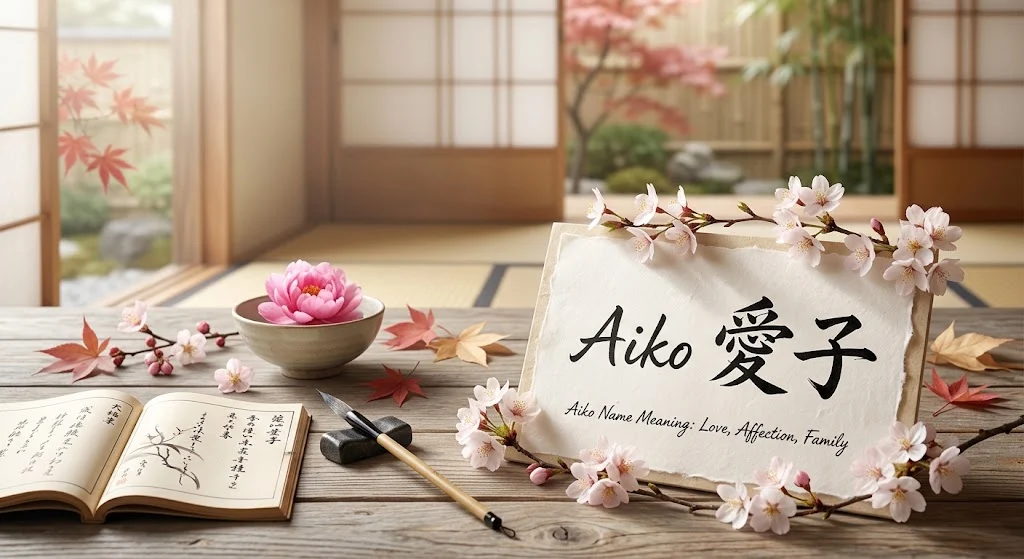
Aiko is a Japanese feminine given name most commonly written as 愛子, combining 愛 (ai), meaning “love” or “affection,” with 子 (ko), meaning “child.” As a result, Aiko is commonly understood as “beloved child” or “child of love.” However, the exact meaning can change when different kanji are used to write the name.
The Aiko name meaning is closely connected with Japanese language, kanji, and naming traditions. In its best-known form, 愛子, the name combines 愛 (ai), meaning love or affection, with 子 (ko), meaning child. This gives Aiko a warm interpretation such as “beloved child” or “child of love.”
Aiko is a distinctly Japanese name with a soft sound and a traditional structure. The ending -ko has a long history in Japanese feminine given names, while the first element can change the meaning depending on the kanji selected. This is important because Japanese names are not defined by pronunciation alone: the characters chosen to write a name often carry much of its intended meaning.
In this guide, we will explore the Aiko name meaning, Japanese origin, kanji variations, pronunciation, cultural background, symbolism, history, related names, and common questions about the name. The goal is to provide a balanced explanation without assuming that every person named Aiko has exactly the same intended meaning.
What Is the Aiko Name?
Aiko is generally used as a feminine Japanese given name. It is written in several possible ways, including 愛子 (Aiko), 藍子, and other kanji combinations. It can also be written phonetically in hiragana as あいこ or katakana as アイコ.
The most familiar interpretation comes from 愛子:
- 愛 (ai) — love, affection, fondness
- 子 (ko) — child
Together, 愛子 can be interpreted naturally as “beloved child” or “child of love.”
The phrase should not be confused with the English expression “love child,” which can have a completely different social meaning. In the context of Japanese personal names, the interpretation is about affection and a loved child rather than a particular family circumstance.
Aiko is also an example of why Japanese names require attention to their written form. Two people may both be called Aiko while using different kanji and therefore having different intended meanings.
Aiko Name Meaning
The most commonly discussed Aiko name meaning is associated with 愛子, or “beloved child.”
The first kanji, 愛, has a strong connection with love, affection, and caring. The second character, 子, means child and has also been widely used as a name element in traditional Japanese feminine names.
When these characters are combined, the name creates an affectionate image of a child who is loved and cherished.
What Does Aiko Mean?
Aiko can mean:
- Beloved child
- Child of love
- Loved child
- Child associated with affection
These interpretations are closely related rather than completely separate definitions.
However, it is important not to treat “Aiko” as having only one universal meaning. Japanese names can be created with different kanji while retaining the same pronunciation. Therefore, the exact meaning depends on the characters selected by the family.
Is Aiko a Japanese Name?
Yes. Aiko is primarily recognized as a Japanese given name, particularly in feminine naming traditions.
Its Japanese identity becomes especially clear when it is written with kanji such as 愛子. The pronunciation is usually romanized as Aiko, while Japanese writing may use hiragana, katakana, or kanji depending on context.
Aiko Origin and Etymology
The origin of Aiko is Japanese, but its etymology needs to be understood through the Japanese writing system rather than through a single Western-style root.
The form 愛子 is made from two kanji:
愛 — Ai
The character 愛 is associated with love, affection, and fondness. As part of a personal name, it can express a positive emotional quality or a parent’s affectionate hopes for a child.
子 — Ko
The character 子 literally relates to a child. In Japanese personal names, -ko has historically been a very recognizable feminine name element.
This combination makes 愛子 semantically transparent: love + child.
At the same time, the spoken name Aiko does not automatically determine these characters. Other kanji combinations can be pronounced Aiko, which means the name’s written form matters when determining its precise meaning.
The Importance of Kanji in the Name Aiko
One of the most important aspects of Japanese names is kanji selection.
In English, a name’s spelling usually provides a relatively fixed visual identity. Japanese names can work differently. The same pronunciation may be represented by different kanji, and each kanji can contribute a different meaning.
For example:
| Written Form | General Components | Possible Meaning |
|---|---|---|
| 愛子 | love + child | Beloved child |
| 藍子 | indigo + child | Child associated with indigo |
| 葵子 | hollyhock + child | Child associated with hollyhock |
| 亜依子 | multiple kanji elements | Meaning depends on the intended character associations |
These should not be treated as interchangeable definitions. If someone is specifically named 愛子, the “love + child” interpretation is appropriate. If a different spelling is used, its meaning should be explained from that particular kanji combination.
This distinction is especially important for accurate name research.
Aiko Pronunciation
In Japanese, Aiko is generally pronounced with three morae: A-i-ko.
For English speakers, a simple approximation is:
AH-ee-koh
The Japanese pronunciation is smoother and more evenly timed than many English pronunciations. The first two vowel sounds are separate rather than being compressed into one sound.
How Do You Pronounce Aiko?
A practical pronunciation guide is:
Aiko = AH-ee-koh
The name is commonly written:
- Aiko — Romanized spelling
- あいこ — Hiragana
- アイコ — Katakana
- 愛子 — One common kanji form
Pronunciation alone, however, does not tell you which kanji meaning is intended.
History and Cultural Context of Aiko
The history of Aiko is closely connected with the broader history of Japanese naming conventions.
The suffix -ko has traditionally been associated with feminine given names in Japan. Many names formed with this ending became especially recognizable during the modern period. As naming preferences changed, newer naming patterns increasingly appeared, but traditional -ko names remain culturally recognizable.
Aiko therefore has an interesting balance of qualities. Its sound is short and internationally accessible, while its structure can feel distinctly traditional in Japanese.
The name is also associated with notable Japanese women. One especially prominent modern bearer is Princess Aiko, the daughter of Emperor Naruhito and Empress Masako. The Imperial Household Agency continues to document Princess Aiko’s official activities and public appearances.
This association gives the name additional visibility outside Japan, although the meaning of a personal name should still be considered separately from the biography of any individual who carries it.
Aiko and Japanese Naming Traditions
Japanese naming practices place considerable importance on the written characters used in a name.
Parents may consider factors such as:
- The meaning of individual kanji
- Sound and pronunciation
- Visual appearance
- Family preferences
- Traditional naming patterns
- Cultural associations
- How the characters work with the family name
Because of this, asking only “What does Aiko mean?” can produce an incomplete answer.
A more accurate question is:
“What does Aiko mean in the specific kanji used to write it?”
If the name is 愛子, its central interpretation is connected with love and child. If another kanji combination is used, the intended symbolism can be different.
Symbolism Behind the Name Aiko
The symbolism of 愛子 is naturally warm and affectionate.
Love and Affection
The character 愛 creates the strongest symbolic association. It can represent love, affection, care, and emotional warmth.
Family and Childhood
The character 子 represents a child, giving the name a strong connection to family and childhood.
Being Cherished
When the two characters are understood together, Aiko can symbolically suggest a child who is cherished and deeply valued.
These are interpretations of the name’s linguistic components, not predictions about a person’s personality. A name can carry a beautiful meaning without determining the character or future of the person who bears it.
Aiko as a Baby Name
For parents researching Japanese baby names, Aiko can be appealing because it combines a short, elegant pronunciation with a meaningful traditional structure.
The name may particularly appeal to families looking for a name associated with:
- Love
- Family
- Affection
- Japanese heritage
- Traditional naming
- Simplicity
- Soft pronunciation
One advantage of researching Aiko through its kanji is that parents can distinguish between the sound of the name and the specific meaning they want the written name to communicate.
If selecting Aiko for a child, it is therefore useful to decide on the intended Japanese characters rather than relying only on the Romanized spelling.
Aiko vs. Similar Japanese Names
Aiko belongs to a broader group of Japanese feminine names that may contain Ai or -ko.
| Name | Common Association | Difference |
|---|---|---|
| Aiko | Love + child in 愛子 | Combines affection with the traditional -ko element |
| Ai | Love | Shorter and directly associated with love |
| Aimi | Love + beauty or other kanji combinations | Meaning depends strongly on kanji |
| Akiko | Multiple possible kanji meanings | Shares the traditional -ko ending |
| Yoko | Multiple kanji possibilities | Another familiar -ko feminine name |
| Keiko | Multiple kanji possibilities | Traditional feminine structure |
The comparison shows why Japanese name meanings should not be determined solely from sound. A similar pronunciation or shared suffix does not necessarily mean the names have the same meaning.
Aiko in Modern Usage
Aiko remains recognizable as a Japanese personal name, but naming trends in Japan have changed considerably over time.
Names ending in -ko have a strong traditional association, while contemporary Japanese parents also use many newer naming styles and kanji combinations.
Aiko therefore has a distinctive quality: it can feel both familiar and traditional while still being easy to pronounce internationally.
Its visibility has also been supported by well-known bearers, including Princess Aiko of Japan. Official Imperial Household Agency records identify her as a member of the Imperial Family and continue to document her public duties.
Famous and Notable People Named Aiko
One of the most internationally recognizable people with this name is Princess Aiko of Japan, whose full title is Princess Toshi.
She is the daughter of Emperor Naruhito and Empress Masako and is a prominent modern bearer of the name Aiko. Official records from Japan’s Imperial Household Agency document her education, public activities, overseas-related experiences, and official appearances.
There are also other people named Aiko in Japanese cultural and professional history. However, it is important not to assume that all bearers use the same kanji or share the same intended name meaning.
What Makes the Name Aiko Special?
Aiko stands out because its meaning can be both simple and layered.
At the most familiar level, 愛子 expresses the idea of a beloved child. Yet the broader story of the name also introduces readers to an important feature of Japanese culture: names can combine sound, written characters, symbolism, and family intentions.
The name is:
- Short and memorable
- Clearly associated with Japan
- Easy to transliterate
- Traditionally structured
- Associated with love when written as 愛子
- Flexible enough to be written with different kanji
For someone choosing a baby name, studying Japanese names, or researching a family name, these characteristics make Aiko particularly interesting.
Aiko Name Meaning in Different Contexts
The meaning of Aiko can be explained differently depending on what the searcher wants to know.
Linguistic Context
In the common 愛子 spelling, Aiko combines “love” and “child.”
Cultural Context
The name reflects Japanese naming practices in which kanji carry semantic and symbolic significance.
Family Context
For parents, the name may express affection toward a child or a wish that the child be surrounded by love.
Modern Context
Today, Aiko can be recognized internationally as a Japanese feminine given name, with additional visibility through prominent bearers such as Princess Aiko.
This distinction helps prevent a common SEO and naming mistake: presenting one translation as though it were the only possible meaning for every Aiko.
Aiko Name Meaning: Key Facts at a Glance
| Attribute | Details |
|---|---|
| Name | Aiko |
| Primary language | Japanese |
| Common gender association | Feminine |
| Common kanji | 愛子 |
| Meaning of 愛 | Love, affection |
| Meaning of 子 | Child |
| Common interpretation | Beloved child / child of love |
| Hiragana | あいこ |
| Katakana | アイコ |
| Pronunciation | AH-ee-koh |
| Name type | Given name |
| Meaning flexibility | Yes, depending on kanji |
FAQs
1. What does Aiko mean in Japanese?
Aiko commonly means “beloved child” when written as 愛子.
The characters 愛 mean love or affection, while 子 means child.
2. Is Aiko a Japanese name?
Yes, Aiko is primarily recognized as a Japanese given name.
Its exact meaning depends on the kanji used to write it.
3. What does the name Aiko mean in English?
The common 愛子 interpretation is “beloved child” or “child of love.”
This meaning comes from the combination of love and child.
4. How do you pronounce Aiko?
Aiko is commonly pronounced approximately AH-ee-koh.
In Japanese, the name has three clear sound units: A-i-ko.
5. Is Aiko a girl’s name?
Aiko is traditionally recognized as a feminine Japanese given name.
The specific use and meaning can vary depending on the characters selected.
6. What is Aiko written in Japanese?
Aiko can be written 愛子 in kanji and あいこ in hiragana.
Other kanji combinations can also represent the pronunciation Aiko.
Conclusion
The Aiko name meaning is most commonly connected with the Japanese form 愛子, where 愛 represents love or affection and 子 represents child. Together, the name can be naturally understood as “beloved child” or “child of love.”
Aiko is also a good example of how Japanese names work: the pronunciation does not always determine the complete meaning. Different kanji can create different interpretations, so the exact written form should always be considered when researching the name.
For anyone looking for a name with Japanese heritage, a gentle sound, and symbolism connected with affection and family, Aiko offers a meaningful and culturally rich choice.
Discover More Related Articles:
- Garrett Name Meaning | Origin, History & What It Represents In 2026
- Melody Name Meaning | Origin, History, Symbolism & the Beauty of This Musical Name In 2026
- Odessa Name Meaning | Origin, History & the Story Behind the Name In 2026











10 thoughts on “Aiko Name Meaning | Japanese Origin, History & Symbolism In 2026”