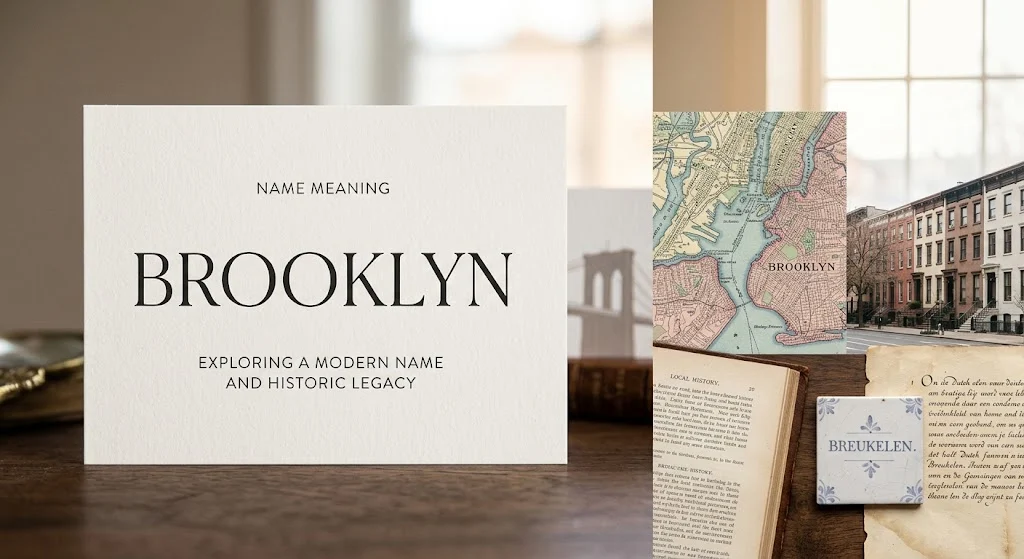
The Brooklyn name meaning is closely connected to the New York City borough of Brooklyn, whose name comes from the Dutch settlement Breuckelen, named after the town of Breukelen in the Netherlands. The deeper etymology is associated with wetland or marshy land, although historical explanations vary. As a modern given name, Brooklyn is a contemporary place name with strong associations with New York, individuality, urban culture, and modern American naming.
The name Brooklyn is especially interesting because it has more than one layer of meaning. Its historical roots come from Dutch colonial history, while its modern identity comes largely from the famous New York City borough. For parents choosing Brooklyn as a baby name, it can therefore suggest a connection to place, modern culture, independence, and a distinctive urban character.
This guide explores the Brooklyn name meaning, origin, pronunciation, history, cultural associations, spelling variations, symbolism, and modern use.
What Is the Brooklyn Name?
Brooklyn is a modern given name derived primarily from the place name Brooklyn, the New York City borough. It is used for both kids, although its modern usage can vary by country and period.
Unlike many traditional personal names that originated as ancient personal names, religious names, occupational surnames, or descriptive words, Brooklyn is fundamentally a place name that became a personal name. This places it in the same broad naming tradition as names such as London, Austin, Savannah, Dakota, and similar geographic names.
The name has a particularly strong American identity because of its association with Brooklyn, New York. At the same time, its historical path reaches further back to Dutch settlement in North America and ultimately to Breukelen, a town in the Netherlands.
As a result, Brooklyn can be understood on two levels:
- Historical level: a place name connected with Dutch Breukelen.
- Modern naming level: a contemporary given name associated with Brooklyn, New York.
This distinction is important because the meaning of a place name and the symbolic meaning people attach to a modern baby name are not always identical.
Brooklyn Name Meaning
The Brooklyn name meaning is generally explained through the historical place name Breukelen. Sources give somewhat different interpretations of the deeper Dutch etymology, with “marshland” or “wetland” being one of the better-supported explanations. Another interpretation sometimes encountered is “broken land,” but this explanation should be treated cautiously rather than presented as an unquestionable literal translation.
Historical documentation also shows that the name went through several forms, including Breuckelen, Brookland, and other spellings before the modern form Brooklyn became established.
For modern parents, however, Brooklyn usually carries a broader symbolic meaning than its original Dutch etymology.
Today, the name can evoke ideas such as:
- Place and belonging
- Urban energy
- Independence
- Modernity
- Creativity
- Cultural diversity
- Confidence
- Individuality
- Connection to New York
Therefore, someone searching for the meaning of Brooklyn may encounter both a historical geographical meaning and a modern cultural interpretation.
Is Brooklyn a Nature Name?
Brooklyn can sometimes feel like a nature-inspired name because of its visual resemblance to the English word brook, meaning a small stream. However, this should not automatically be treated as the historical etymology of Brooklyn.
The spelling of the English place name was influenced by English-language forms such as “brook,” and modern speakers may naturally perceive the beginning of Brooklyn as being connected with a stream.
This creates an interesting modern association: Brooklyn can sound both geographical and nature-inspired, even though its historical origin is more complicated.
Brooklyn Name Origin and Etymology
The historical origin of Brooklyn leads to Breukelen, a Dutch town in the province of Utrecht in the Netherlands.
Dutch settlers established a community on western Long Island and named it after the Dutch settlement. The Town of Breuckelen was formally established in 1646. Historical records from New York City confirm the connection between the colonial settlement and the Dutch town.
Over time, the name changed in spelling as Dutch and English linguistic influences interacted. Historical forms included:
- Breuckelen
- Breukelen
- Breucklyn
- Brucklyn
- Broucklyn
- Brookland
- Brookline
- Brooklyn
The transition from Dutch forms to the English-looking Brooklyn illustrates how place names can change naturally as languages, governments, and populations change.
What Does Breukelen Mean?
The deeper meaning of Breukelen is not completely straightforward.
Some etymological sources connect it with Dutch or older Germanic terms associated with marshes, bogs, or wetland, while other popular explanations have connected the name with “broken land.” Etymological references should therefore be handled carefully rather than reducing the history to one certain English translation.
An important historical distinction is that “broken land” is sometimes associated with another description of Long Island and should not automatically be treated as the definitive translation of Brooklyn. Historical scholarship has noted that the connection between Brooklyn and “broken land” is often overstated.
For an accurate modern article, wetland or marshland association is the safer description of the deeper linguistic tradition, while acknowledging that the etymology has been debated.
History of the Brooklyn Name
Brooklyn’s history begins long before it became a fashionable modern baby name.
The area now known as Brooklyn was inhabited by Indigenous peoples before European colonization. Dutch settlement expanded in the seventeenth century, and the community that became Breuckelen was established as part of the Dutch colony of New Netherland.
In 1646, the settlement was formally organized as Breuckelen. When the English took control of New Netherland in 1664, the Dutch place name was gradually adapted to English usage. Historical records show forms such as Brookland before the spelling eventually settled into Brooklyn.
Brooklyn later developed into a major independent city. In 1834, the City of Brooklyn was incorporated, and during the nineteenth century it grew significantly through population expansion and annexation of surrounding communities. In 1898, Brooklyn became one of the five boroughs of the consolidated City of New York.
That history gave the word Brooklyn a cultural identity far beyond its original geographical meaning.
It became associated with:
- New York City
- Immigration and urban development
- Neighborhood identity
- Arts and culture
- Architecture
- Music
- Food
- Independent creative communities
- A distinctly modern American city experience
When Brooklyn became a personal name, these cultural associations became part of the name’s modern identity.
Brooklyn as a Baby Name
Brooklyn is a relatively modern personal name rather than an ancient traditional given name.
Its development reflects a broader trend in English-speaking naming culture: place names becoming personal names. Parents may choose a place name because it represents a meaningful location, a personal memory, a cultural connection, or simply a distinctive sound.
Brooklyn is particularly attractive because it combines several naming qualities.
It has a recognizable pronunciation, a familiar spelling, and a strong geographical association. At the same time, it does not sound like an ordinary place name when used as a first name.
The name can also work in different naming styles. It can feel:
- Contemporary
- Stylish
- Urban
- Friendly
- Strong
- Gender-flexible
- Distinctive without being difficult to pronounce
The popularity of place-based names has also helped make Brooklyn feel natural as a given name rather than unusual or experimental.
Is Brooklyn a Boy or Girl Name?
Brooklyn is best described as a unisex or gender-neutral name, although its usage patterns differ across countries and time periods.
In the United States, Brooklyn has been especially associated with girls in modern naming, while it can also be used for boys. Name references likewise classify Brooklyn as both feminine and masculine, with usage differing by region.
This flexibility can be appealing to parents who want a contemporary name without a strictly traditional gender association.
The name’s gender perception can also change over time. A name that is strongly associated with one gender in one country may have a different pattern elsewhere.
How Do You Pronounce Brooklyn?
Brooklyn is commonly pronounced:
BROOK-lin
It has two syllables:
Brook · lyn
The pronunciation is relatively straightforward for English speakers because the spelling closely suggests the spoken form.
Brooklyn Pronunciation Guide
- Spelling: Brooklyn
- Syllables: 2
- Common pronunciation: BROOK-lin
- IPA: /ˈbrʊklɪn/
The final -lyn is pronounced like “lin,” rather than “line.”
Brooklyn Name Variations
Several spelling and naming variations are associated with Brooklyn.
Brooklynn
Brooklynn is a modern spelling variation that adds an additional “n.” It preserves the same basic pronunciation while giving the name a slightly different visual appearance.
Brooklyne
Brooklyne is another less common spelling variation. Like Brooklynn, it can be viewed as a contemporary adaptation rather than an ancient historical form.
Brooke
Brooke is not simply another spelling of Brooklyn, but it is sometimes considered related in modern naming because Brooklyn visually begins with “Brook” and may be interpreted through the English word or name Brooke.
Lynn / Lyn
The ending of Brooklyn can also remind readers of names such as Lynn or Lyn, although Brooklyn’s historical etymology should not be reduced to a literal combination of Brooke + Lynn.
This is an important distinction between historical etymology and modern name interpretation.
Brooklyn Name Symbolism
The symbolic meaning of a modern name is often different from its dictionary or etymological meaning.
For Brooklyn, the strongest symbolism comes from the identity of Brooklyn, New York.
1. Independence
Brooklyn has a strong urban identity and can symbolize confidence and independence.
2. Creativity
Brooklyn is internationally associated with artistic, musical, literary, culinary, and design cultures. Because of this, the name can carry a creative and expressive feeling.
3. Diversity
Brooklyn is known for its diverse communities and neighborhoods. As a modern name, Brooklyn may therefore evoke openness and multicultural identity.
4. Modernity
Unlike many ancient names, Brooklyn has a distinctly contemporary feel. It can appeal to parents looking for a name that sounds current without being invented.
5. Connection to Place
A place-name can represent belonging. Parents may choose Brooklyn because of a personal connection to New York, a memorable trip, family history, or simply an emotional appreciation of the city.
Brooklyn vs. Brook and Brooke
Brooklyn is sometimes confused with names based directly on the English word “brook.”
| Name | General association | Main difference |
|---|---|---|
| Brooklyn | New York place name and modern given name | Historically connected to Dutch Breukelen |
| Brook | Small stream or nature-related word/name | Directly connected to the English word |
| Brooke | Modern personal name | Commonly associated with the English word “brook” |
| Lynn | Traditional personal name/place element | Separate name with its own history |
The key point is that Brooklyn should not automatically be defined as “brook + Lynn.” That interpretation may explain how some modern speakers perceive the name, but it is not the complete historical origin.
What Makes Brooklyn a Distinctive Name?
Brooklyn stands out because it combines history and modern culture.
Its earliest recognizable roots are connected with Dutch colonial settlement, while its present-day identity is strongly shaped by New York City. Few contemporary given names have such a clear connection to a globally recognized urban place.
It also offers a balance between familiarity and individuality.
Most English speakers can pronounce Brooklyn immediately, yet the name still has a strong personality. It is recognizable without requiring an explanation every time someone hears it.
For parents, this can make Brooklyn attractive when they want a name that feels:
- Modern but established
- Geographic but personal
- Stylish but approachable
- Strong but not harsh
- Distinctive but easy to spell
Examples of Using Brooklyn as a Name
Here are a few natural examples:
- Brooklyn is a beautiful name with a strong connection to New York City.
- They chose Brooklyn because they loved the name’s modern, urban character.
- Brooklyn combines a historic place-name origin with contemporary American usage.
- The name Brooklyn can work for both kids.
These examples show that Brooklyn functions naturally as a personal name while retaining its geographical identity.
Cultural Meaning of Brooklyn
The cultural meaning of Brooklyn is particularly powerful because the borough itself has become an internationally recognizable symbol.
Brooklyn is often associated with a mixture of old and new: historic neighborhoods alongside modern architecture, long-established communities alongside newer cultural movements, and local traditions alongside global influences.
Consequently, the name can suggest a personality that is:
- Independent
- Creative
- Energetic
- Open-minded
- Modern
- Confident
- Connected to community
These are symbolic associations, not literal personality predictions. A person’s name does not determine their character. The symbolism simply reflects the cultural impressions that a name can evoke.
Is Brooklyn a Good Name for a Baby?
For parents considering Brooklyn, the answer depends on personal taste and the kind of identity they want the name to convey.
Brooklyn may be a strong choice if you prefer:
- Place-inspired names
- Modern American names
- Gender-neutral names
- City names
- Names with cultural associations
- Easy-to-pronounce names
- Contemporary names with historical depth
It may be less appealing if you prefer very traditional names with ancient religious, royal, or classical origins.
One of Brooklyn’s biggest strengths is that it does not require the parent to choose between a meaningful history and a modern sound. It offers both.
FAQs
What does the name Brooklyn mean?
Brooklyn is historically connected to Dutch Breukelen, with the deeper meaning commonly associated with wetland or marshland.
Is Brooklyn a girl or boy name?
Brooklyn is a unisex name, although it has been particularly associated with girls in modern U.S. usage.
What is the origin of Brooklyn?
The name comes from the New York City borough, which was named after the Dutch town of Breukelen.
How do you pronounce Brooklyn?
Brooklyn is commonly pronounced BROOK-lin, with two syllables.
Is Brooklyn a nature name?
It can feel nature-inspired because of its resemblance to “brook,” but its historical origin is connected to the Dutch place name Breukelen.
Is Brooklyn a modern name?
Yes. Brooklyn became a modern given name after its long history as a geographic place name.
What are common Brooklyn name variations?
Common modern variations include Brooklynn and Brooklyne, while Brooke and Lynn are related-looking names rather than direct historical forms.
What does Brooklyn symbolize?
As a modern given name, Brooklyn can symbolize individuality, creativity, independence, diversity, and a strong connection to place.
Conclusion
The Brooklyn name meaning has a layered history. Its most important historical connection is to Breuckelen, the Dutch settlement that gave its name to the Brooklyn area of New York. The deeper etymology is associated with wetland or marshland, although explanations of the original Dutch name vary. Over centuries, different spellings evolved until Brooklyn became the established English form.
As a modern baby name, Brooklyn carries a different but equally meaningful identity. It evokes New York City, individuality, creativity, diversity, confidence, and a strong sense of place. Its combination of historical roots and contemporary style makes Brooklyn a distinctive choice for parents looking for a name that feels both recognizable and modern.
Discover More Related Articles:
- Aiko Name Meaning | Japanese Origin, History & Symbolism In 2026
- Octavia Name Meaning | Origin, History & Symbolism In 2026
- Erika Name Meaning | Origin, History, Personality & Symbolism In 2026










