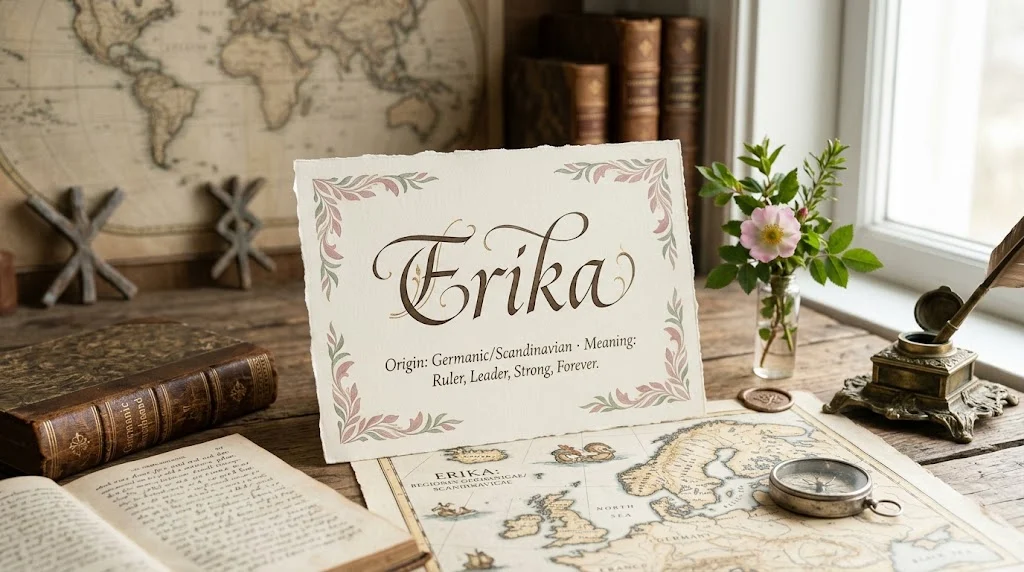
Erika is a feminine given name of Scandinavian and Germanic origin, commonly understood to mean “eternal ruler,” “ever-ruler,” or “ruler forever.” It is the feminine form of Erik/Eric, a name derived from Old Norse elements associated with “ever” or “always” and “ruler” or “power.” Erika is especially associated with Scandinavian, German, and European naming traditions.
The Erika name meaning is commonly connected with ideas of eternal leadership, strength, authority, and lasting influence. As the feminine form of Erik or Eric, Erika has deep Germanic and Old Norse linguistic roots and has been used across several European cultures.
The name has a particularly strong connection to Scandinavia, where related forms of Erik have a long history. Over time, Erika became established as a feminine form in German-speaking and other European regions before gaining wider international use. Its elegant sound and strong meaning have helped it remain recognizable across generations.
In this guide, we will explore the Erika name meaning, origin, etymology, history, pronunciation, variations, symbolism, cultural associations, and common questions about the name.
What Is the Erika Name Meaning?
The name Erika is generally interpreted as “eternal ruler,” “ever-ruler,” or “ruler forever.” It is the feminine counterpart of Erik or Eric and ultimately belongs to the Germanic and Old Norse naming tradition.
The traditional interpretation comes from elements associated with:
- “Ever” or “always” — suggesting permanence or continuity
- “Ruler” or “power” — referring to leadership, authority, or governance
Because historical names can develop through different languages and spelling traditions, translations may vary slightly. Rather than treating one English translation as the only possible definition, it is more accurate to understand Erika as a name associated with lasting leadership and enduring strength.
Erika at a Glance
| Attribute | Details |
|---|---|
| Name | Erika |
| Gender | Traditionally feminine |
| Main origin | Germanic / Old Norse |
| Related masculine name | Erik / Eric |
| Common meaning | Eternal ruler / Ever-ruler |
| Pronunciation | eh-REE-kah or uh-REE-kah, depending on language |
| Related forms | Erica, Ericka, Erika |
| Cultural associations | Scandinavian, German, European |
| Name style | Classic, elegant, strong |
Erika Name Meaning and Symbolism
Beyond its literal etymology, Erika can carry symbolic qualities connected with strength, leadership, independence, and endurance.
The idea of an “eternal ruler” does not necessarily mean someone who literally rules others. In modern naming, such meanings are often interpreted symbolically. Parents may associate Erika with a person who is confident, resilient, dependable, or capable of taking responsibility.
Some symbolic qualities commonly associated with the traditional meaning include:
- Strength — the ability to remain steady through challenges
- Leadership — confidence in guiding or supporting others
- Endurance — something lasting over time
- Independence — a strong sense of identity
- Stability — reliability and consistency
- Confidence — a positive association with authority and self-assurance
These qualities are interpretations of the name’s traditional meaning rather than predictions about a person’s personality. A person’s character develops from many influences, including family, culture, experiences, and individual choices.
Origin and Etymology of Erika
The Erika name origin can be traced to the broader Germanic and Old Norse naming tradition. Erika is closely related to Erik, Eirik, and Eric, all of which belong to a family of historically connected names.
The Old Norse form Eiríkr is particularly important in understanding the name family. It is generally analyzed through Germanic elements associated with concepts such as ever/always and ruler/leader.
The feminine form Erika developed as languages and naming conventions changed. In some European traditions, Erika became the feminine counterpart of Erik or Eric, while Erica became another widely recognized spelling.
The Meaning of the Name’s Elements
The first element is associated with the idea of ever, always, or perpetual. This gives the name a sense of continuity or permanence.
The second element is related to ruler, leader, or powerful authority.
Together, these elements produce the traditional interpretation of “eternal ruler” or “ever-ruler.”
It is worth noting that historical etymologies can be represented differently in dictionaries and linguistic references. The safest interpretation is therefore the broad traditional meaning rather than claiming that every historical spelling had exactly the same linguistic development.
History of the Name Erika
The history of Erika is connected to the much older history of Erik and related Scandinavian names.
Erik was particularly important in Scandinavian history. Several medieval Scandinavian kings and other prominent historical figures carried forms of the name, helping establish it as a traditional and recognizable name in the region.
The feminine form Erika became more visible in European naming traditions later. Its relationship to both Scandinavian and Germanic naming systems helped it cross linguistic and cultural boundaries.
Over the centuries, names frequently changed spelling when they moved from one language into another. This helps explain why related forms such as Erik, Eric, Eirik, Erica, and Erika can appear in different countries and historical contexts.
Erika in European Naming Traditions
Erika has associations with several European language communities, particularly those influenced by Germanic and Scandinavian naming traditions.
The name may be encountered in:
- Scandinavia
- Germany
- Austria
- Switzerland
- Central Europe
- English-speaking countries
- Other regions influenced by European naming traditions
Its international familiarity is one reason Erika has remained recognizable even when naming fashions have changed.
Erika vs. Erica: What Is the Difference?
One of the most common questions about the name is Erika and Erica mean different things.
In most naming contexts, they are considered feminine forms related to Erik/Eric and therefore share essentially the same traditional meaning. The main difference is spelling and cultural or linguistic preference.
| Name | Relationship | Common association |
|---|---|---|
| Erika | Feminine form related to Erik/Eric | Scandinavian/Germanic |
| Erica | Feminine form related to Eric | English/European usage |
| Erik | Masculine related form | Scandinavian |
| Eric | Masculine related form | English/French and broader European usage |
| Eirik | Historical/Scandinavian form | Old Norse/Norwegian traditions |
The spelling Erika can give the name a distinctly European or Scandinavian appearance, while Erica is especially familiar in English-speaking contexts.
How Do You Pronounce Erika?
The pronunciation of Erika can vary depending on the speaker’s language and regional accent.
Common English pronunciations include:
eh-REE-kah
uh-REE-kah
In different European languages, pronunciation may shift slightly because vowel sounds and stress patterns differ.
If you are choosing the name for a child, the pronunciation you prefer can be stated clearly when introducing the name. Both pronunciation and spelling may vary internationally without changing the basic identity of the name.
Erika Name Variations and Related Names
Erika belongs to a broad family of names that developed through different languages and spelling traditions.
Common Variations
Erica — A widely used feminine spelling, particularly familiar in English-speaking countries.
Ericka — A variant spelling that adds a “k” sound visually associated with Erika.
Erik — A Scandinavian masculine form closely connected with Erika.
Eric — A widespread masculine form found in English and several European languages.
Eirik — A Scandinavian form connected to the Old Norse name tradition.
Eiríkr — A historically significant Old Norse form associated with the broader name family.
These forms are related, but they should not automatically be treated as identical in every linguistic or historical context.
Is Erika a Strong Name?
The traditional meaning of Erika gives the name a distinctly strong character. The association with an everlasting ruler naturally evokes qualities such as confidence, authority, resilience, and stability.
At the same time, Erika has a softer and more elegant sound than some names with similarly powerful meanings. This combination can make it appealing to parents who want a name that feels both feminine and strong.
The name can therefore communicate two complementary impressions:
- Traditional strength through its meaning
- Grace and elegance through its sound
These are cultural and stylistic impressions rather than fixed personality traits.
Cultural and Literary Associations
Erika has appeared in European and international cultural contexts, including literature, music, film, and other forms of popular culture. However, individual references should not be confused with the historical origin of the name itself.
The name’s European character often contributes to associations with:
- Classical European naming
- Scandinavian heritage
- Germanic linguistic history
- Traditional feminine names
- Elegance and simplicity
Because Erika is an established personal name rather than a modern invented term, its strongest cultural foundation remains its historical relationship with Erik and the wider Germanic naming tradition.
What Does Erika Symbolize?
If you are interested in the symbolic meaning behind the name, Erika can be understood through several themes.
1. Endurance
The concept of being “ever” or “eternal” suggests something that continues over time. Erika can therefore symbolize lasting strength and endurance.
2. Leadership
The “ruler” element connects the name with leadership and authority. Symbolically, this can represent someone who takes responsibility and confidently supports others.
3. Stability
A name associated with lasting leadership can also evoke dependability and stability.
4. Independence
The traditional strength of the name can be interpreted as a symbol of independence and self-confidence.
5. Legacy
The connection between permanence and leadership may also suggest the idea of leaving a meaningful legacy.
Again, these are symbolic interpretations rather than claims that every person named Erika will possess these qualities.
Is Erika a Good Name for a Baby Girl?
For parents looking for a traditional feminine name with a strong historical background, Erika can be an appealing choice.
It offers several advantages:
- It has a long European naming history.
- Its meaning is associated with strength and leadership.
- It has recognizable spelling and pronunciation.
- It has several related forms and nicknames.
- It works across different cultural and linguistic settings.
- It combines a classic foundation with a relatively simple sound.
The choice ultimately depends on personal preference, family background, pronunciation, and how the name fits with the child’s surname and other family names.
Nicknames for Erika
Erika is already relatively short, but several informal forms can be used depending on personal preference.
Possible nicknames include:
- Eri
- Erika
- Rika
- Rikki
- Kika
- Kiki
Not every nickname is traditionally associated with Erika in every culture. Nicknames are often personal or family-specific, so parents can choose whichever form feels natural.
Erika in Different Languages and Cultures
Because the name belongs to a large European name family, related forms appear across different languages.
| Language/Cultural Context | Related Form |
|---|---|
| Scandinavian | Erik / Eirik |
| Old Norse | Eiríkr |
| English | Eric / Erica |
| German-speaking traditions | Erik / Erika |
| European usage | Erika / Erica |
The exact form used depends on local spelling conventions and historical development.
This is an important distinction: Erika should not be treated as a name belonging exclusively to one modern country. Its linguistic history is broader and is connected to Germanic and Scandinavian naming traditions.
Erika Name Meaning in Modern Use
Today, Erika is generally understood as a feminine personal name rather than as a literal title meaning “ruler.” Modern parents typically choose names for a combination of sound, family meaning, cultural connection, and personal preference.
For some families, the name’s traditional meaning may be especially attractive because it conveys:
strength + endurance + leadership + heritage
For others, the appeal may simply come from the name’s elegant pronunciation and established European character.
This illustrates an important point about name meanings: a traditional etymological meaning provides historical context, but the personal meaning of a name can be much more individual.
Examples of How Erika Can Be Used
Here are a few natural examples of the name in everyday contexts:
- Erika is joining us for dinner tonight.
- Erika chose a traditional Scandinavian-inspired name for her daughter.
- The name Erika has roots connected to the older name Erik.
- Erika is a feminine name traditionally associated with an eternal ruler.
These examples show how the name functions as an ordinary personal name while still carrying historical and linguistic significance.
Erika Name Meaning vs. Similar Names
Names related to Erika can have similar meanings but different origins, sounds, or cultural associations.
| Name | Meaning/Association | Main Difference |
|---|---|---|
| Erika | Eternal ruler / ever-ruler | Feminine form related to Erik |
| Erica | Eternal ruler / ever-ruler | Alternative feminine spelling |
| Erik | Eternal ruler / ever-ruler | Masculine Scandinavian form |
| Eric | Eternal ruler / ever-ruler | Widespread European masculine form |
| Victoria | Victory | Different Latin origin and meaning |
| Freya | Lady / noble woman | Different Old Norse origin and tradition |
This comparison shows why a name’s sound alone does not determine its meaning. Etymology and historical language development are more useful for understanding the connection.
Why Parents May Choose the Name Erika
Parents may choose Erika for a variety of reasons. Some may appreciate its Scandinavian or Germanic heritage, while others may like its classic sound and straightforward spelling.
The name can be particularly appealing to families who value:
- European heritage
- Traditional names
- Strong meanings
- Feminine but confident names
- Short and recognizable names
- Historical name origins
- Names with international usability
Ultimately, the strongest reason to choose a name is personal significance. Historical meaning can provide inspiration, but family traditions and individual preferences often make a name meaningful.
FAQs
What does the name Erika mean?
Erika traditionally means “eternal ruler,” “ever-ruler,” or “ruler forever,” reflecting its connection with Erik and older Germanic and Old Norse naming elements.
What is the origin of Erika?
Erika has Germanic and Old Norse roots and is the feminine form associated with the masculine names Erik and Eric.
Is Erika a Scandinavian name?
Yes, Erika is strongly associated with Scandinavian and Germanic naming traditions, although the name is also used widely in other European and international cultures.
Is Erika the same as Erica?
Erika and Erica are closely related feminine forms and generally share the same traditional meaning, with the main difference being spelling and regional usage.
How do you pronounce Erika?
A common English pronunciation is eh-REE-kah, although pronunciation can vary by language and region.
Is Erika a biblical name?
No. Erika is generally considered a Germanic/Old Norse name, rather than a name originating from the Bible.
What are nicknames for Erika?
Common informal forms can include Eri, Rika, Rikki, Kika, and Kiki, although nickname preferences vary by family and culture.
Is Erika a good name for a girl?
Erika can be a strong choice for a girl because it combines a feminine sound with a traditional meaning associated with lasting leadership, strength, and endurance.
Conclusion
The Erika name meaning is traditionally connected with “eternal ruler,” “ever-ruler,” or “ruler forever.” Its roots belong to the broader Germanic and Old Norse naming tradition and are closely connected with Erik, Eric, Eirik, and related forms.
With its combination of historical depth, feminine elegance, and symbolism associated with strength and endurance, Erika remains a distinctive choice for anyone interested in a classic European name. Its variations across languages also give it an international character while preserving its connection to a much older naming tradition.
Discover More Related Articles:
- Garrett Name Meaning | Origin, History & What It Represents In 2026
- Melody Name Meaning | Origin, History, Symbolism & the Beauty of This Musical Name In 2026
- Odessa Name Meaning | Origin, History & the Story Behind the Name In 2026











2 thoughts on “Erika Name Meaning | Origin, History, Personality & Symbolism In 2026”