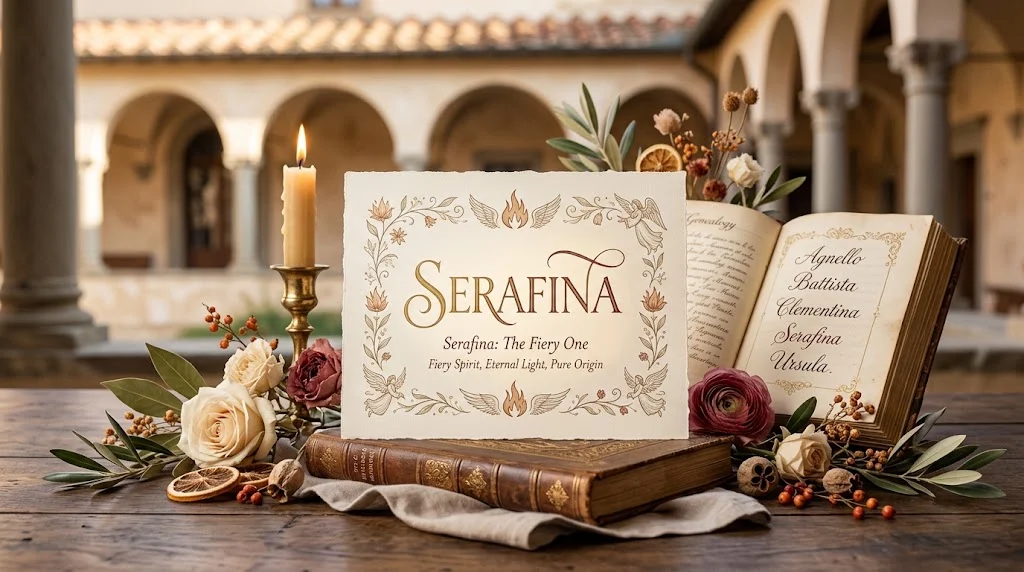
Serafina name meaning is commonly connected with “fiery,” “burning,” or “ardent.” The name comes through the Latin Seraphinus, ultimately related to the Hebrew word seraphim, traditionally understood as “burning ones.” Serafina has an elegant, feminine character and is strongly associated with warmth, passion, spirituality, and angelic imagery.
The Serafina name meaning has deep linguistic and religious roots, giving this graceful feminine name a combination of beauty, warmth, and spiritual symbolism. Serafina is generally understood as the feminine form related to Serafino or Seraphinus, names connected with the biblical term seraphim. The traditional interpretation of the underlying Hebrew term is “burning ones”, which has led to meanings such as “fiery” and “ardent.”
Unlike names whose meanings are based on a single modern English word, Serafina carries a long linguistic history involving Hebrew, Greek, Latin, and later European naming traditions. It has also developed strong associations with the seraphim of the Bible and Christian tradition, making it particularly appealing to families looking for a name with an elegant sound and spiritual background.
This guide explores the Serafina name meaning, origin, etymology, pronunciation, history, cultural associations, variations, symbolism, and commonly asked questions.
What Is the Serafina Name?
Serafina is a feminine given name associated with the name family of Seraphinus, Serafino, Seraphim, and related forms. It is particularly associated with Italian and other European naming traditions.
The name is recognizable for its flowing sound and distinctive ending -ina, which gives it a distinctly feminine form in many European languages. Its connection to seraphim gives it an additional religious and symbolic dimension.
In modern naming, Serafina can be chosen simply because of its melodic sound, while others may appreciate its traditional associations with fire, devotion, spirituality, and heavenly beings.
Key facts about Serafina
| Attribute | Detail |
|---|---|
| Name | Serafina |
| Gender | Traditionally feminine |
| Primary associations | Fiery, burning, ardent, spiritual |
| Related form | Serafino |
| Deeper root | Hebrew seraphim |
| Latin form | Seraphinus |
| Common cultural association | Seraphim and Christian tradition |
| Style | Elegant, classical, romantic |
| Pronunciation | Commonly pronounced seh-rah-FEE-nah |
Because names can develop differently across languages, the exact pronunciation and spelling can vary by region.
Serafina Name Meaning
The central Serafina name meaning is generally associated with “fiery,” “burning,” or “ardent.”
These meanings ultimately relate to the Hebrew term seraphim, traditionally interpreted as “burning ones.” In biblical tradition, seraphim are heavenly beings associated with the presence of God.
The idea of “fire” in this context does not necessarily refer to ordinary physical flames. It has also been understood symbolically, particularly in religious interpretation, as representing qualities such as:
- Spiritual intensity
- Devotion
- Passion
- Purity
- Radiance
- Divine presence
- Zeal
For parents choosing the name today, Serafina can therefore carry both a literal etymological association with burning or fiery imagery and a broader symbolic association with spiritual warmth and strength.
Is Serafina an angelic name?
Serafina is often described as an angelic name because of its connection to the seraphim. In the biblical tradition, seraphim are heavenly beings described in Isaiah 6 as attending the divine throne.
It is important to distinguish the name itself from the biblical beings. Serafina does not literally mean “angel.” Its etymological connection is more specifically with seraphim, traditionally interpreted as “burning ones.”
That distinction makes the name particularly interesting: its angelic association comes from its historical and religious connection rather than from a direct translation of the word “angel.”
Origin and Etymology of Serafina
The linguistic history of Serafina is ancient and crosses several languages.
The deeper root is generally traced to the Hebrew שְׂרָפִים (seraphim), the plural form of seraph. The term is traditionally associated with the idea of burning or fiery beings.
The word entered Greek and Latin religious vocabulary, with the Latin form Seraphinus becoming associated with the name. From this naming tradition developed masculine and feminine forms in various European languages.
One important form is the Italian Serafino, while Serafina is its feminine counterpart.
A simplified development can be represented as:
Hebrew seraphim → Greek/Latin religious usage → Seraphinus → European forms such as Serafino and Serafina
The exact linguistic development of personal names can be more complicated than this simplified chain suggests, because religious terms, names, translations, and local naming traditions influenced one another over centuries.
Biblical and Religious Connection
One of the most important associations behind Serafina comes from the seraphim described in the Hebrew Bible.
In Isaiah 6, the prophet Isaiah describes seraphim in a vision of the divine throne. They are depicted as heavenly beings with six wings who proclaim the holiness of God.
This biblical association contributes significantly to the spiritual symbolism surrounding names derived from seraphim.
The connection can give Serafina associations with:
- Holiness
- Spiritual devotion
- Divine presence
- Fire and radiance
- Reverence
- Purity
- Heavenly imagery
However, the name should not be interpreted as having only one religious meaning. A person named Serafina may appreciate its biblical background, its European history, its elegant sound, or simply its distinctive character.
History and Cultural Context
Serafina belongs to a broader family of names influenced by biblical and Christian vocabulary. Such names became part of European naming traditions as Christian culture spread and religious names became established across different regions.
The masculine form Serafino has a particularly recognizable place in Italian naming tradition, while Serafina developed as the feminine form.
The name also appears in historical religious contexts through individuals who bore related forms. One notable example is Saint Seraphim of Sarov, although Seraphim and Serafina are not identical names. The association demonstrates how the broader seraphim name family became connected with Christian devotional traditions.
Over time, names related to seraphim acquired associations beyond their original linguistic meaning. Their connection to heavenly beings made them appealing within religious communities, while their distinctive sound allowed them to remain recognizable as personal names.
Serafina in Italian and European Naming Traditions
Serafina is particularly associated with Italian naming traditions. The Italian masculine form is Serafino, while Serafina is the corresponding feminine form.
Related forms can be found across languages and naming systems, although spelling and pronunciation may differ.
Some related forms include:
- Serafina — feminine form, especially associated with Italian usage
- Serafino — Italian masculine form
- Seraphina — spelling variant used in some languages
- Seraphine — French-associated form
- Seraphim — biblical and ecclesiastical form
These names share a historical connection but should not be treated as completely interchangeable. Language, pronunciation, cultural usage, and naming traditions differ between forms.
Serafina Pronunciation
In English, Serafina is commonly pronounced approximately as:
seh-rah-FEE-nah
The emphasis generally falls on the “fee” syllable.
In Italian, pronunciation follows Italian phonetic patterns and has a similarly flowing quality:
seh-rah-FEE-nah
Pronunciation can vary slightly depending on the speaker’s language and regional accent.
How do you pronounce Serafina?
A simple pronunciation guide is:
Serafina = seh-rah-FEE-nah
The name has four syllables and a soft, melodic rhythm, which contributes to its elegant character.
Symbolism and Personality Associations
Names do not scientifically determine personality, so qualities associated with Serafina should be understood as symbolic impressions, not predictions about someone’s character.
Because of its etymology and religious associations, Serafina is often symbolically connected with:
Fire and passion
The traditional “burning” interpretation naturally creates imagery of fire, energy, enthusiasm, and inner strength.
Spirituality
Its connection with the seraphim gives Serafina a strong spiritual and religious dimension.
Radiance
Fire and heavenly imagery can also suggest light, brilliance, and radiance.
Devotion
The religious context of the seraphim can inspire associations with dedication, reverence, and devotion.
Elegance
The name’s Italian form and flowing pronunciation give it a romantic and sophisticated quality in modern naming.
These are cultural and symbolic associations rather than established meanings of personality.
Variations and Related Names
Serafina has several related forms and spelling variants.
| Name | Language or Context | Relationship |
|---|---|---|
| Serafina | Italian and European usage | Feminine form |
| Serafino | Italian | Masculine counterpart |
| Seraphina | Various English-language usage | Spelling variant |
| Seraphine | French | Related feminine form |
| Seraphim | Biblical/Christian tradition | Root-related term |
| Seraphinus | Latin | Historical name form |
The spelling Seraphina is especially important because the additional ph reflects the spelling seen in seraphim and related forms. Both Serafina and Seraphina can therefore be encountered as feminine names, although their usage varies by language and culture.
Serafina vs. Seraphina
Serafina and Seraphina are closely related names, but their spelling gives them somewhat different visual and cultural impressions.
| Feature | Serafina | Seraphina |
|---|---|---|
| Appearance | Simpler | More elaborate |
| Major association | Italian/European | English and broader international usage |
| Pronunciation | Similar | Similar |
| Root association | Seraphim/Seraphinus | Seraphim/Seraphinus |
| Style | Romantic, Italian | Classical, ornate |
Neither spelling is universally “correct.” The preferred form depends on language, family tradition, and personal preference.
Why Parents May Choose the Name Serafina
Serafina offers several qualities that can make it appealing as a baby name.
1. It has an ancient background
The name ultimately connects with an ancient biblical term, giving it considerable historical depth.
2. It has a meaningful interpretation
Meanings such as “fiery” and “burning” can symbolize passion, strength, and spiritual intensity.
3. It has a graceful sound
The four-syllable structure and flowing vowels make Serafina sound elegant and distinctive.
4. It has international connections
Serafina can fit naturally into conversations about Italian, European, biblical, and Christian naming traditions.
5. It offers nickname possibilities
Depending on family preference, possible informal forms may include Sera, Fina, or Fifi. Nicknames are personal and can vary considerably between families.
Serafina in Modern Naming
Today, Serafina can appeal to parents who prefer names that feel classic but uncommon, feminine but strong, and traditional without sounding overly dated.
Its appeal also comes from the combination of different naming qualities. It has an ancient religious background, a recognizable European character, and a lyrical modern sound.
At the same time, families should avoid assuming that every person named Serafina shares the same cultural or religious identity. A name can travel between countries and communities, taking on new meanings and associations.
What Does Serafina Symbolize?
Symbolically, Serafina can represent:
- Fire — energy and passion
- Light — radiance and illumination
- Devotion — spiritual dedication
- Strength — inner intensity
- Purity — religious and symbolic associations
- Grace — an elegant feminine quality
The strongest traditional symbolism comes from the connection between seraphim and the concept of burning or fiery heavenly beings.
Examples of Using the Name Serafina
Here are a few natural examples:
Baby-name example:
“Serafina was chosen because her parents loved its Italian sound and its traditional connection with the seraphim.”
Name-meaning example:
“The name Serafina is associated with the meaning ‘fiery’ or ‘burning.’”
Introduction example:
“Serafina is an elegant feminine name with ancient biblical roots and strong European naming associations.”
Nickname example:
“Her family sometimes calls Serafina ‘Sera’ for short.”
These examples show how the name can be discussed without treating its symbolic associations as fixed personality traits.
Is Serafina a Rare Name?
Serafina is considered rare depends on the country, time period, and naming database being examined.
A name may be relatively uncommon in one country while being more familiar in another. Popularity also changes over time, so it is better to consult current national birth-registration statistics when an exact ranking or popularity figure is needed.
For parents, the practical takeaway is that Serafina generally has a distinctive and recognizable quality without being an invented modern name. It combines historical depth with a relatively uncommon feel in many English-speaking contexts.
Serafina Name Meaning in Different Contexts
The meaning of Serafina can be understood at several levels:
Linguistic meaning:
Associated with the idea of burning or being fiery.
Biblical association:
Connected to the seraphim described in Isaiah 6.
Religious symbolism:
Associated with holiness, devotion, heavenly presence, and spiritual fire.
Cultural identity:
Strongly connected with Italian and broader European naming traditions.
Modern naming appeal:
Often perceived as elegant, romantic, distinctive, and feminine.
This layered meaning is one reason Serafina can be more interesting than a simple dictionary-style name definition.
Common Misunderstandings About Serafina
One common misunderstanding is that Serafina directly means “angel.” More precisely, the name is related to seraphim, a specific class of heavenly beings in biblical tradition. “Angel” is therefore a broader association rather than the literal etymological translation.
Another misconception is that the name has one universally fixed interpretation. Name meanings can change through language, historical usage, translation, and cultural interpretation. “Fiery” or “burning” is the strongest traditional etymological association, while qualities such as grace, passion, and spirituality are later symbolic interpretations.
FAQs
What does the name Serafina mean?
Serafina is generally associated with “fiery,” “burning,” or “ardent,” through its connection with the Hebrew term seraphim.
Is Serafina an angel name?
Serafina is associated with the seraphim, biblical heavenly beings, but its literal meaning is closer to “burning” or “fiery” than simply “angel.”
What is the origin of Serafina?
Serafina is associated especially with Italian naming traditions and ultimately traces its name family to Seraphinus and the Hebrew seraphim.
How do you pronounce Serafina?
Serafina is commonly pronounced seh-rah-FEE-nah, although pronunciation can vary slightly by language and accent.
Is Serafina a biblical name?
Serafina itself is not the name of a biblical person; it is a later personal name connected etymologically with the biblical term seraphim.
What is the difference between Serafina and Seraphina?
They are closely related feminine forms, with Serafina having a particularly Italian character and Seraphina preserving the “ph” spelling associated with seraphim.
Conclusion
The Serafina name meaning is rooted in an ancient linguistic and biblical tradition, with the central interpretation connected to “fiery,” “burning,” or “ardent.” Its relationship to the seraphim gives the name a distinctive spiritual dimension, while its Italian and European forms contribute to its elegant and romantic character.
For parents searching for a name with historical depth, graceful pronunciation, and meaningful symbolism, Serafina offers a compelling combination of tradition and individuality. Its associations with fire, devotion, radiance, and spirituality make it a memorable name with a rich story behind it.
Discover More Related Articles:
- Garrett Name Meaning | Origin, History & What It Represents In 2026
- Melody Name Meaning | Origin, History, Symbolism & the Beauty of This Musical Name In 2026
- Odessa Name Meaning | Origin, History & the Story Behind the Name In 2026










