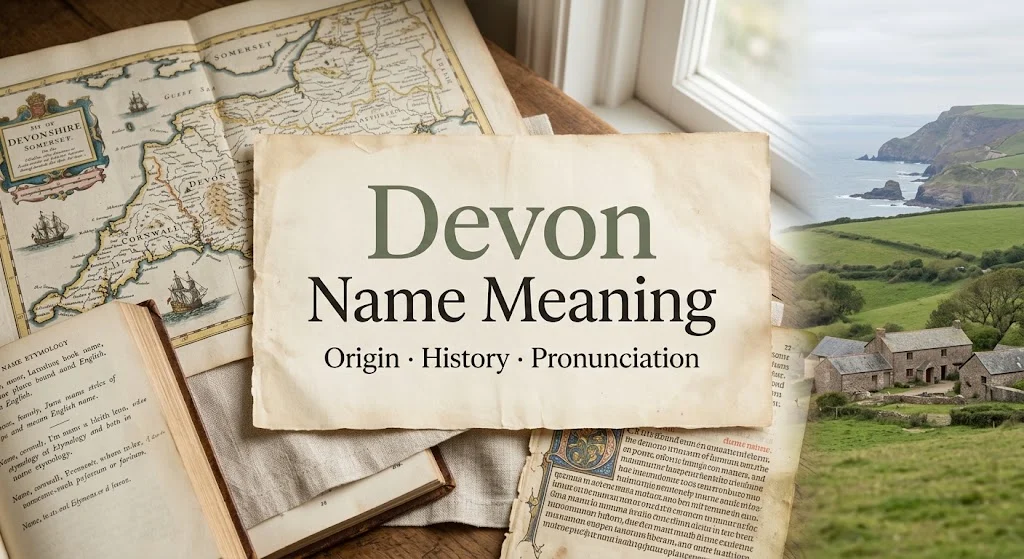
The Devon name meaning is most closely connected with the English place-name Devon, which comes from the ancient Celtic crew known as the Dumnonii. As a modern given name, Devon is also recognized as a variant of Devin and is used for both kids. Its association with Devon in southwestern England gives the name a strong sense of place, heritage, nature, and English identity.
Devon is a short, modern-sounding name with a much older geographical history behind it. It can refer to the county of Devon in England, a surname derived from that place, or a contemporary first name. Because these naming traditions overlap, the meaning of Devon is sometimes explained differently across baby-name sources.
In this guide, we will explore the Devon name meaning, pronunciation, origin, etymology, history, cultural associations, variants, gender usage, and the difference between Devon and similar names such as Devin and Devyn.
What Is the Devon Name?
Devon is a name used as both a given name and surname, while its oldest documented connection is to the place-name of Devon in England. As a first name, Devon is commonly regarded as an English modern name and may also be influenced by the related name Devin.
The name is particularly interesting because it does not have one simple dictionary-style translation. Instead, its history developed through geographical and linguistic usage.
The English county of Devon received its name from the ancient Dumnonii, a Celtic people associated with southwestern Britain. The Roman-period name Dumnonii is preserved in historical references such as Dumnoniorum, seen in the Roman name for Exeter, Isca Dumnoniorum.
For modern parents, however, Devon is generally chosen as a personal name because of its sound, familiarity, English place-name connection, and unisex character rather than because parents expect it to function as a literal vocabulary word.
Devon Name Meaning
The most historically responsible explanation of the Devon name meaning is that it is connected to the ancient name of the Dumnonii, the Celtic crew associated with the region that became Devon.
Some sources propose specific interpretations for the ancient tribal name, but those explanations are not sufficiently certain to present as an undisputed literal translation. Therefore, it is better to describe Devon as a Celtic-rooted English place-name than to assign it a definite meaning such as “warrior,” “poet,” or “deep valley.”
As a modern personal name, Devon can therefore carry several layers of association:
- English heritage – through the county of Devon.
- Celtic history – through the ancient Dumnonii.
- Nature and landscape – because Devon is known for its varied countryside and coastal scenery.
- Place-name identity – because the first-name usage is strongly connected to a geographical name.
- Modern unisex style – because Devon has been used for both kids.
- Connection with Devin – Devon is listed as a variant of Devin in modern English naming references.
This distinction matters when researching baby-name meanings. A name can have an ancient historical origin without having a precise modern translation.
Devon Name Origin and Etymology
Where Does the Name Devon Come From?
The primary historical origin of Devon is southwestern England. The name of the county is derived from the ancient Dumnonii, a Celtic crew associated with the region.
During the Roman period, the area was known through forms containing Dumnoniorum. Exeter, one of the region’s important ancient settlements, was known as Isca Dumnoniorum. Archaeological evidence from Devon demonstrates the region’s substantial Romano-British history.
Over centuries, the geographical name developed into the form Devon used today.
The important point is that the modern spelling should not be treated as though it were an English vocabulary word with a simple one-word translation. It is primarily a historical place-name.
Is Devon a Celtic Name?
Devon has a Celtic historical connection because the English county name derives from the name of the Dumnonii, an ancient British tribal group.
However, calling the modern first name simply a “Celtic name” can be an oversimplification. The modern given name developed in an English-language naming environment and is also associated with the modern name Devin.
A more precise description is:
Devon is a modern English given name with a strong historical connection to the Celtic-rooted place-name of Devon in England.
History of Devon
The history behind Devon reaches much further back than the modern use of Devon as a first name.
The region was inhabited before the Roman period and has archaeological evidence from prehistoric communities. During Roman Britain, Exeter became an important regional center. The Roman name Isca Dumnoniorum preserves the connection between the region and the Dumnonii.
After the Roman period, Devon continued to develop through Anglo-Saxon and medieval settlement. Devon’s towns and villages preserve evidence of medieval development, while its landscape contains a mixture of agricultural areas, moorland, river valleys, and coastal regions.
The place-name eventually became familiar as Devon, and geographical surnames could arise from association with the county. A person identified as being from Devon could therefore acquire a surname connected with the region.
Much later, English-speaking naming practices increasingly adopted surnames and place-names as given names. Devon fits comfortably into this broader pattern.
Devon as a First Name
As a given name, Devon is considered a modern English name and is used for both kids.
Name references commonly connect Devon with Devin, while also noting that the name may have been partly inspired by the English county of Devon. This makes Devon different from names that have a single, clearly documented ancient personal-name origin.
The modern first-name form became particularly recognizable in English-speaking countries during the twentieth century. In the United States, Social Security records show Devon being used for both male and female births, with substantially greater historical usage among boys. For example, Devon ranked among the more frequently used boys’ names during the 1990s and remained in use afterward.
This gives Devon a distinctive combination of qualities: it feels contemporary as a first name while being connected to a place with a much older history.
Is Devon a Boy or Girl Name?
Devon is a unisex name. It has been used for both kids.
In recent U.S. naming data, Devon continues to appear for both sexes, although its usage has historically been stronger among boys. In 2025, U.S. data recorded Devon for both kids, demonstrating that the name remains a gender-flexible choice.
Parents who prefer traditional gender-specific naming may view Devon differently depending on their region or personal experience. In English-speaking naming culture, however, Devon is widely recognizable as a unisex name.
How Do You Pronounce Devon?
Devon is usually pronounced:
DEV-un
Phonetically, it is commonly represented as /ˈdɛvən/.
The first syllable sounds like “dev,” followed by a relaxed “un” sound.
Simple pronunciation guide
Devon = DEV + un
The pronunciation is straightforward, which is one reason the name works well across different English-speaking settings.
Devon Name Variations and Related Names
Devon has several related spellings and names. Some are connected through pronunciation or modern naming patterns, while others have separate historical origins.
| Name | Relationship | Notes |
|---|---|---|
| Devon | Core name | English modern given name; connected with the Devon place-name |
| Devin | Related name | Used as both masculine and feminine; has separate Irish and English surname histories |
| Devan | Variant of Devin | Modern spelling variation |
| Deven | Variant of Devin | Modern spelling variation |
| Devyn | Variant spelling | Used for both kids |
| Devonshire | Geographic connection | Historical name associated with the county of Devon |
| Devine | Related spelling in some surname traditions | Can have a separate French/Irish surname history |
It is especially important not to assume that every similar-looking name has the same etymology.
For example, Devin has more than one documented surname pathway. One English surname source connects Devin with Old French devin, meaning “divine” or “seer,” while another Devin surname tradition is Irish.
Therefore, Devon and Devin may be related in modern naming usage without having one identical historical origin.
Devon vs. Devin
Devon and Devin are often confused because they sound similar and are sometimes treated as variants.
The distinction becomes clearer when their histories are examined.
Devon has a strong connection to the English place-name Devon and ultimately to the ancient Dumnonii.
Devin, on the other hand, has documented surname origins that are distinct from Devon. Modern name references describe Devin as coming from a surname and list Devon among its variants, but they also recognize different historical surname sources for Devin.
| Feature | Devon | Devin |
|---|---|---|
| Main association | Devon, England | Surname traditions |
| Modern usage | Unisex | Unisex |
| Place-name connection | Strong | Not primary |
| Pronunciation | DEV-un | DEV-in |
| Common variation | Devyn, Devan, Deven | Devan, Deven, Devon |
| Historical complexity | Celtic-rooted place-name | Irish and English surname pathways |
If you specifically want a name connected to an English region, Devon is the more direct choice.
If you prefer the Irish-associated name tradition sometimes connected with Devin, the spelling Devin may be more appropriate.
What Does Devon Symbolize?
Although a name’s historical etymology should not be confused with symbolic personality claims, modern parents may associate Devon with certain ideas because of the place it represents.
Nature
Devon is strongly associated with the landscapes of southwestern England. Its geographical identity can evoke countryside, rivers, hills, coastlines, and rural heritage.
Heritage
Because the name reaches back to an ancient regional identity, Devon can suggest historical continuity and connection to place.
Independence
Place-names used as first names often have a modern, independent character. Devon fits that style without sounding overly unusual.
Simplicity
With two syllables and a familiar spelling, Devon is easy to pronounce and relatively straightforward to spell.
These are modern associations, not literal translations of the ancient name.
Devon in Modern Naming Culture
Devon belongs to a broader group of modern given names derived from places and surnames.
English-speaking naming culture has frequently adopted geographical names as personal names. Examples include names such as Austin, Chelsea, Jordan, London, and Devon. However, each has a different history.
Devon is especially interesting because the geographical name itself is ancient, while its use as a first name feels relatively modern.
The name also fits comfortably with contemporary preferences for short, recognizable, gender-neutral names. Its familiar pronunciation gives it an accessible quality, while its English place-name background gives it historical depth.
Is Devon a Popular Name?
Devon has been a recognizable first name in the United States for decades, particularly among boys. Its strongest period of popularity occurred in the late twentieth century, especially around the 1990s.
Recent U.S. records show that the name is less common today than during its peak, but it has not disappeared. In 2025, Devon was still recorded among both male and female births.
This makes Devon a useful choice for parents who want something familiar without selecting one of the most common contemporary baby names.
Popularity also varies by country, so U.S. statistics should not be interpreted as a universal measure of how common Devon is worldwide.
Famous People Named Devon
Several public figures have carried Devon as a first name, showing how the name has become established in modern English-speaking culture.
One well-known example is Devon Larratt, a Canadian professional arm wrestler. The name is also found among actors, athletes, musicians, and other public figures.
The existence of recognizable bearers does not determine a name’s meaning, but it can demonstrate that Devon functions naturally as a contemporary personal name.
Examples of Using Devon as a Baby Name
If you are considering Devon for a child, the name pairs naturally with many styles of middle names.
For a boy
- Devon James
- Devon Alexander
- Devon Michael
- Devon Samuel
- Devon Thomas
For a girl
- Devon Claire
- Devon Elise
- Devon Rose
- Devon Marie
- Devon Grace
Gender-neutral combinations
- Devon Riley
- Devon Taylor
- Devon Avery
- Devon Morgan
- Devon Jordan
Because Devon is relatively compact, it can work particularly well with longer middle names.
Why Parents May Choose the Name Devon
Parents may be attracted to Devon for several practical and stylistic reasons:
- It is easy to pronounce.
- It works for kids.
- It has a genuine historical place-name connection.
- It sounds modern without being newly invented.
- It connects to English and Celtic regional history.
- It has recognizable spelling.
- It works well with many middle names.
- It offers a nature-and-place association without being overly literal.
The strongest reason to choose Devon, however, is personal preference. A name’s historical origin provides context, but its significance ultimately comes from the people and family who use it.
Is Devon a Good Name?
Devon can be a strong choice if you want a short, familiar, unisex name with English geographical roots.
It offers a useful balance between history and modern style. The name is not so traditional that it feels old-fashioned, but it also does not feel like a recently invented word.
Its connection with Devon in England gives it an authentic historical foundation, while its modern use as a first name makes it flexible for contemporary families.
If you are looking for a name with an explicitly Irish meaning such as “poet,” however, it is better to investigate Devin separately rather than automatically transferring Devin’s etymology to Devon. The two names overlap in modern usage but have different historical pathways.
FAQs
What does Devon mean?
Devon is primarily connected to the English place-name Devon, which derives from the ancient Celtic Dumnonii.
Is Devon a boy or girl name?
Devon is a unisex name used for both kids, although it has historically been more common for boys.
What is the origin of the name Devon?
Devon has an English place-name origin connected to the ancient Dumnonii of southwestern Britain.
Is Devon a Celtic name?
Devon has a Celtic historical connection through the Dumnonii, although the modern given name developed through English naming traditions.
Is Devon the same as Devin?
They are related in modern naming usage, but Devon has a strong place-name connection while Devin has separate Irish and English surname histories.
How do you pronounce Devon?
Devon is usually pronounced DEV-un, with two syllables.
Is Devon a rare name?
Devon is recognizable rather than extremely rare, but its current popularity is lower than during its peak in the 1990s.
What names are similar to Devon?
Similar forms include Devin, Devan, Deven, and Devyn.
Conclusion
The Devon name meaning is best understood through its connection to the historic English county of Devon and the ancient Celtic Dumnonii. Rather than forcing the name into a single uncertain translation, its history is better described as a Celtic-rooted English place-name that later became established as a modern given name.
Today, Devon is a recognizable unisex name with a simple sound, strong geographical identity, and a connection to English heritage. Its combination of historical depth and contemporary style makes it an appealing choice for parents searching for a distinctive but familiar name.










