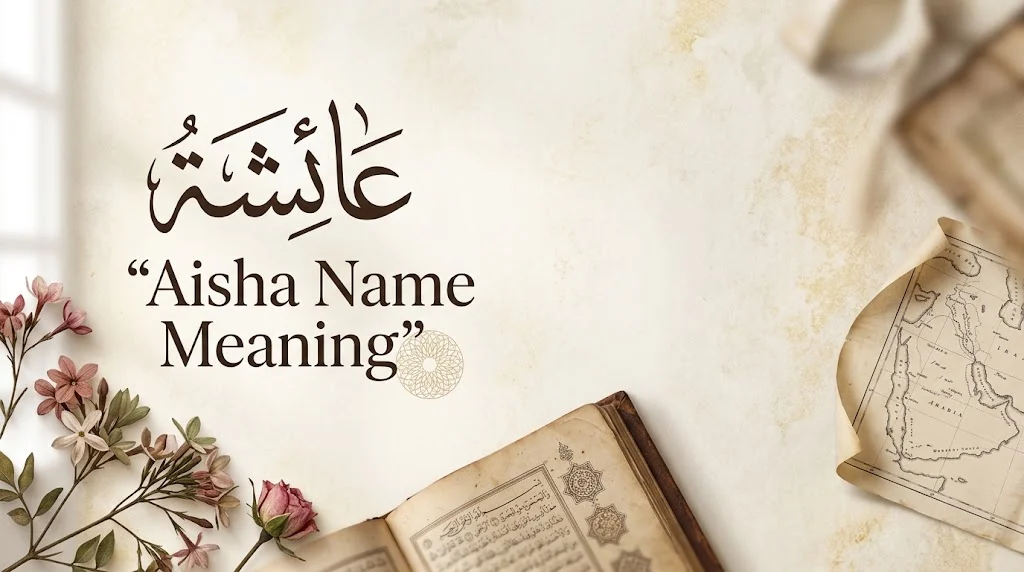
Aisha name meaning is commonly given as “living,” “alive,” or “one who is full of life.” Aisha is an Arabic feminine name written as عائشة and is associated with the Arabic root ʿāsha, meaning “to live.” The name has deep historical and cultural significance in the Muslim world because it was borne by Aisha bint Abu Bakr, the wife of the Prophet Muhammad and daughter of Abu Bakr.
Aisha is also spelled Ayesha, Ayesha, Aishah, Aysha, Ayishah, and A’isha, depending on language, transliteration, and regional convention. It is widely used in Arabic, Urdu, Bengali, Malay, Indonesian, Hausa, Swahili, and several other languages and cultures.
Aisha Name Meaning
The name Aisha comes from Arabic and is traditionally connected with the idea of life, being alive, or living. Its Arabic form is عائشة (ʿĀʾisha), and the name is derived from the root عاش (ʿāsha), meaning “to live.”
Because of this origin, Aisha has a naturally positive meaning. It can suggest:
- Life
- Living
- Vitality
- Liveliness
- Fullness of life
- A thriving or flourishing existence
For parents choosing a meaningful name, this association with life gives Aisha an uplifting quality. Rather than referring to a physical object or a specific occupation, the name expresses a broad idea connected with being alive and flourishing.
What Does Aisha Mean in Arabic?
In Arabic, Aisha (عائشة) is traditionally understood as “living” or “alive.” It is related to the verb ʿāsha, meaning “to live.”
The feminine form became an established personal name and has been used across generations. Its meaning is especially significant because of the famous historical figure who carried the name in early Islamic history.
Aisha Name Origin and Etymology
The origin of Aisha is Arabic. The Arabic spelling is عائشة, commonly transliterated into English as Aisha or A’isha.
The name is connected to the Arabic root ʿāsha, meaning “to live.” This relationship gives Aisha its central semantic association with life and being alive.
Arabic names can appear in different Latin-script spellings because Arabic sounds do not always map neatly onto English letters. As a result, the same Arabic name may be written as Aisha, A’isha, Aishah, Aysha, or Ayesha.
These spellings generally refer to the same underlying Arabic name rather than completely different names.
Aisha in Arabic and Urdu
In Arabic, Aisha is written:
عائشة
In Urdu, it is commonly written:
عائشہ
The difference in spelling reflects writing conventions between Arabic and Urdu rather than a fundamental change in the name’s identity.
Historical Significance of the Name Aisha
One of the most important reasons Aisha became such a prominent name in Muslim cultures is Aisha bint Abu Bakr.
She was the daughter of Abu Bakr, an important early Muslim figure and the first caliph according to Sunni tradition. She was also the wife of the Prophet Muhammad. Her life is an important part of early Islamic history, and she is remembered in Islamic scholarship and historical literature.
Her association with the name helped establish Aisha as a name of considerable religious and historical importance. The name subsequently became deeply rooted in Muslim naming traditions.
Aisha’s historical legacy is also connected with the intellectual and religious traditions of early Islam. Accounts of her life and teachings have contributed to the continuing importance of the name among Muslim communities.
Historical traditions concerning Aisha also intersect with the political conflicts of the first Islamic civil war. The Battle of the Camel, in which she was present, became an important event in early Islamic history.
Because interpretations of early Islamic history can differ among religious traditions, it is best to distinguish the historical person from later cultural interpretations of her legacy.
Cultural and Religious Significance
Aisha is more than a name with a pleasant definition. It carries strong cultural associations because of its connection to early Islamic history.
For many Muslim families, naming a daughter Aisha can reflect appreciation for:
- Islamic heritage
- Early Muslim history
- Religious scholarship
- Family tradition
- The historical legacy associated with Aisha bint Abu Bakr
- The positive concept of life represented by the name
The name is particularly established in Muslim communities, although its use is not limited to Arabic-speaking countries.
Aisha appears in naming traditions across South Asia, Africa, Southeast Asia, Central Asia, and communities throughout the world.
Aisha Name Pronunciation
It can be pronounced somewhat differently depending on the language and region.
A common English pronunciation is:
eye-EE-sha
The Arabic pronunciation is more closely represented by:
ʿĀʾisha
The initial Arabic sound and the glottal stop are difficult to represent perfectly using ordinary English spelling, which is one reason different transliterations exist.
Common Pronunciation Variations
You may hear the name pronounced as:
- eye-EE-sha
- eye-SHA
- ay-EE-sha
- ah-EE-sha
Regional pronunciation can vary, particularly when the name moves between Arabic, Urdu, English, Turkish, and other languages.
Aisha Name Variations and Spellings
Aisha has many established spellings and related forms. The variation usually results from differences in transliteration or language.
| Variant | Common Usage |
|---|---|
| Aisha | English and international usage |
| A’isha | Transliteration emphasizing the Arabic structure |
| Aishah | Common alternative spelling |
| Ayesha | Widely used in Urdu and South Asian contexts |
| Aysha | Alternative transliteration |
| Ayishah | More phonetic/transliterated form |
| Aïcha | Common in Maghrebi and French-influenced contexts |
| Aisyah | Indonesian and Malay form |
| Ayşe | Turkish form |
| Ajša | Bosnian form |
| Aishatu | Hausa form |
| Aishath | Dhivehi form |
These forms are documented across different linguistic and cultural traditions.
Aisha in Different Cultures
The name Aisha has traveled far beyond its original Arabic-language setting.
Aisha in South Asia
Aisha and Ayesha are especially familiar in Muslim communities in countries such as Pakistan, India, and Bangladesh. In Urdu and Bengali contexts, Ayesha is a particularly recognizable spelling.
Aisha in Southeast Asia
The name also appears in Malay and Indonesian naming traditions. Aisyah is a common regional form.
Aisha in Africa
Aisha and related forms are used in several African cultures, including Hausa- and Swahili-speaking communities. Variants such as Aishatu also occur in Hausa usage.
Aisha in Turkey
The Turkish form is commonly written Ayşe. Although the spelling and pronunciation are different, it is a traditional form of the same Arabic-origin name.
Aisha in North Africa
Aïcha is a well-known form in Maghrebi Arabic and French-influenced contexts.
This international range demonstrates how a name can maintain its historical identity while adapting naturally to different writing systems and pronunciation patterns.
Is Aisha a Muslim Name?
Aisha is strongly associated with Islamic and Muslim naming traditions, particularly because of Aisha bint Abu Bakr, the wife of Prophet Muhammad.
However, the name itself is linguistically an Arabic personal name, and its use has expanded into many cultures and countries. Its strong religious association is an important part of its cultural identity, but the linguistic meaning remains connected to the Arabic concept of living or being alive.
Symbolism of the Name Aisha
The literal meaning of Aisha gives the name a natural symbolic quality.
Because it is associated with life and being alive, Aisha can symbolically suggest:
- Vitality
- Energy
- Growth
- Hope
- Resilience
- A flourishing life
- Positivity
These symbolic associations are interpretations rather than separate dictionary meanings. The established linguistic meaning remains connected to the idea of being alive or living.
Aisha vs. Ayesha: What Is the Difference?
Aisha and Ayesha generally represent the same Arabic name. The difference is primarily one of spelling and transliteration.
Aisha is closer to the commonly used international English spelling, while Ayesha is particularly familiar in South Asian and Urdu contexts. Both forms trace back to the Arabic عائشة.
| Name | Meaning | Main Difference |
|---|---|---|
| Aisha | Living, alive | Common international spelling |
| Ayesha | Living, alive | Popular South Asian/Urdu spelling |
| Aishah | Living, alive | Alternative transliteration |
| Aysha | Living, alive | Alternative spelling |
| A’isha | Living, alive | Transliteration reflecting Arabic structure |
| Aïcha | Living, alive | Maghrebi/French-influenced form |
Why Parents Choose the Name Aisha
Parents may choose Aisha for several reasons. The first is its positive meaning: life, living, and vitality.
The second is its long historical tradition. Because Aisha has been used for centuries and is connected with an important figure in Islamic history, it can provide a strong sense of heritage.
The third is its international adaptability. Aisha can be recognized in many countries while still retaining its Arabic identity.
For families looking for a feminine name that combines meaning, history, cultural heritage, and simplicity, Aisha is a particularly established choice.
Is Aisha a Good Name?
Aisha is a strong choice if you want a name with a positive meaning and deep cultural history. Its association with life gives it an optimistic foundation, while its connection with early Islamic history gives it additional significance.
It also has practical advantages: the name is relatively short, recognizable, and available in several familiar spellings.
Ultimately, Aisha is the right name depends on personal preference, cultural background, pronunciation, and the significance the family wants the name to carry.
Aisha Name Meaning in Modern Usage
Today, Aisha remains a recognizable feminine name across numerous cultures. It is used in Arabic-speaking communities as well as in South Asian, African, Southeast Asian, Central Asian, and Western communities.
Its modern popularity demonstrates how traditional names can remain relevant while crossing linguistic and geographic boundaries.
The spelling may change from one region to another, but the central identity of the name remains remarkably consistent.
Famous Historical Association: Aisha bint Abu Bakr
The most significant historical bearer of the name is Aisha bint Abu Bakr.
Her position as the wife of Prophet Muhammad and daughter of Abu Bakr made her a prominent figure in early Islamic history. She is also remembered in connection with the transmission and preservation of religious knowledge.
Her historical importance is one of the main reasons Aisha continues to carry such strong recognition among Muslim communities.
It is important, however, to distinguish between the etymological meaning of the name and the characteristics attributed to historical or modern people who bear it. A name’s meaning does not determine a person’s personality.
Choosing Aisha for a Baby Girl
If you are considering Aisha for a baby girl, here are some of the main qualities associated with the name:
- Origin: Arabic
- Gender: Feminine
- Arabic spelling: عائشة
- Primary meaning: Living, alive
- Language: Arabic
- Cultural associations: Islamic, Arabic, South Asian, African, Southeast Asian
- Common variants: Ayesha, Aishah, Aysha, A’isha, Aisyah, Aïcha
- Historical association: Aisha bint Abu Bakr
- Overall style: Traditional, meaningful, internationally recognizable
FAQs
What does the name Aisha mean?
Aisha is an Arabic feminine name meaning “living” or “alive,” derived from the Arabic root associated with “to live.”
Is Aisha an Islamic name?
Yes. Aisha is strongly associated with Islamic tradition because Aisha bint Abu Bakr was the wife of Prophet Muhammad.
What is the origin of Aisha?
Aisha has Arabic origins and is written عائشة in Arabic.
Is Aisha and Ayesha the same name?
Yes. Ayesha is a widely used alternative spelling of the Arabic name Aisha, especially in South Asian and Urdu contexts.
How do you pronounce Aisha?
A common English pronunciation is eye-EE-sha, although pronunciation can vary across languages and regions.
What does Aisha mean in Urdu?
Aisha, commonly written عائشہ in Urdu, carries the same core meaning of “living” or “alive.”
What are common variations of Aisha?
Common forms include Ayesha, Aishah, Aysha, A’isha, Ayishah, Aisyah, Aïcha, and Ayşe.
Is Aisha a good baby name?
Aisha is a meaningful choice for parents who want a traditional feminine name associated with life, heritage, and Islamic history.
Conclusion
Aisha is a beautiful Arabic name with a simple but powerful meaning: “living” or “alive.” Its connection with the Arabic root associated with life gives it an uplifting meaning, while its long history adds cultural and religious depth.
For families looking for a traditional name with international recognition, Aisha offers a combination of meaning, heritage, history, and timeless appeal. Its many spellings, including Ayesha and Aishah, also allow families to choose the form that best fits their language and culture.
Discover More Related Articles:
- Aiko Name Meaning | Japanese Origin, History & Symbolism In 2026
- Octavia Name Meaning | Origin, History & Symbolism In 2026
- Erika Name Meaning | Origin, History, Personality & Symbolism In 2026










