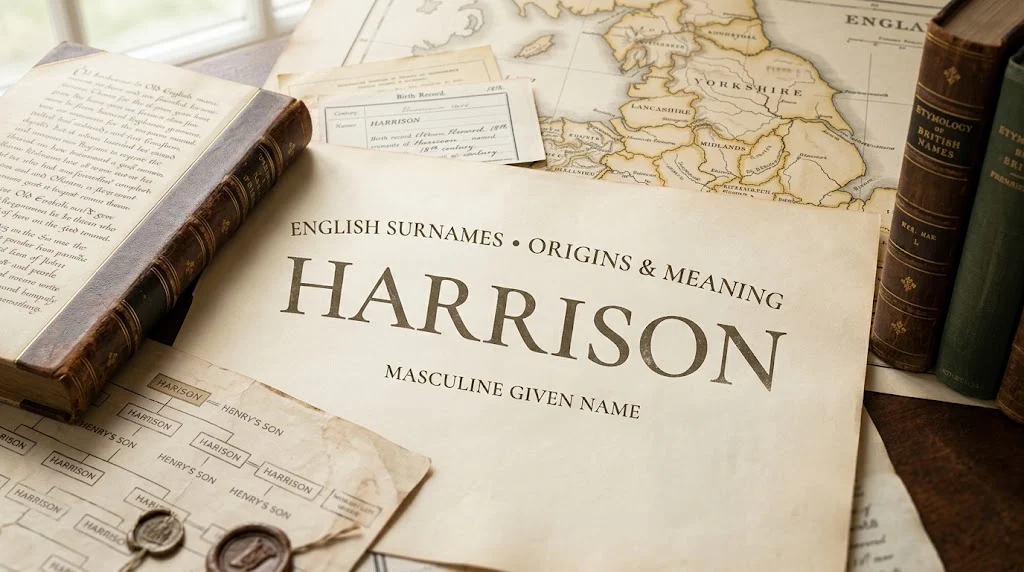
Harrison name meaning is generally understood as “son of Harry.” Harrison originated as an English patronymic surname, referring historically to the son or descendant of someone named Harry. Because Harry was a medieval English form of Henry, Harrison also has an indirect connection to the older Germanic name Henry and its traditional sense of a “home ruler.”
Today, Harrison is widely recognized as both a surname and a masculine given name. It combines an unmistakably English heritage with a modern surname-to-first-name style, making it appealing to parents looking for a name that feels traditional, strong, polished, and distinctive.
What Is the Name Harrison?
Harrison is an English masculine given name that developed from a surname. Its most established etymological explanation is the patronymic construction Harry + -son, meaning “son of Harry.”
The name therefore belongs to a broad family of English names ending in -son, such as Jackson, Johnson, Robinson, and Wilson. Historically, these names often identified a person through their relationship to a father or male ancestor.
Although Harrison began primarily as a surname, it eventually became established as a first name. This transition is part of a larger English-language naming tradition in which hereditary surnames are adopted as given names.
As a first name, Harrison is commonly associated with qualities such as:
- English heritage
- Family and ancestry
- Strength and stability
- Traditional naming
- Formality and refinement
- A modern surname-style appeal
The exact personal symbolism attached to a name can vary from family to family, but the historical meaning of Harrison remains connected to Harry and the idea of lineage.
Harrison Name Meaning
The primary Harrison name meaning is “son of Harry.”
This is a patronymic meaning rather than a descriptive meaning. In other words, Harrison originally identified someone’s family relationship instead of describing a physical characteristic, occupation, location, or personality trait.
The name can be understood in three related layers:
1. Direct Meaning: “Son of Harry”
The most direct interpretation is “son of Harry.” The suffix -son has a straightforward genealogical function in many English surnames.
2. Connection to Henry
Harry developed historically as a form of Henry, particularly in English usage. Therefore, Harrison has a linguistic connection to Henry through Harry.
Henry ultimately traces back to the Germanic name Haimric, traditionally analyzed from elements associated with home/house and power/rule. This is why some modern name references give Harrison an extended interpretation such as “son of Henry” or connect it symbolically with a “home ruler.”
However, the safest direct meaning is still “son of Harry.” The extended “home ruler” interpretation comes from the older etymology of Henry rather than from the literal construction of Harrison itself.
3. Family and Heritage Meaning
Because Harrison originated as a patronymic surname, it can also carry a broader symbolic association with:
- family lineage
- ancestry
- inheritance
- continuity
- connection between generations
These are cultural associations rather than separate dictionary definitions of the name.
Origin and Etymology of Harrison
Harrison has an English origin, particularly associated historically with northern England.
The surname is formed from the personal name Harry or Herry combined with -son. Historical surname references describe Harrison as deriving from Middle English forms of Harry or Herry, which were common forms or pronunciations associated with Henry.
This construction reflects the way medieval English naming systems often identified people through their fathers. A person might be described as the “son of Harry,” eventually producing a hereditary surname such as Harrison.
The etymological development can therefore be represented simply as:
Henry → Harry/Herry → Harrison
The final element works differently:
Harry + son → Harrison
It is important not to treat “son of Harry” and “home ruler” as two unrelated literal definitions. “Son of Harry” describes Harrison directly, while “home ruler” belongs to the deeper etymological history of Henry, to which Harry is connected.
The Historical Background of the Name
The history of Harrison is closely connected to the development of hereditary surnames in England.
During the medieval period, a single personal name was often insufficient to distinguish everyone in a growing community. Additional identifiers became useful. These identifiers could refer to a person’s occupation, location, physical characteristics, or parentage.
Patronymic surnames were particularly common.
A name such as Harrison essentially told others that the person belonged to the family or lineage associated with Harry. Similar naming patterns produced surnames such as:
- Johnson — son of John
- Jackson — son of Jack
- Richardson — son of Richard
- Robinson — son of Robin
- Harrison — son of Harry
The exact development of hereditary surnames was gradual, and surnames could arise independently in different locations. Therefore, not every person carrying the surname Harrison necessarily descends from one single medieval Harrison family.
Historical surname references particularly associate Harrison with northern England, where the surname became well established.
Harrison as a First Name
Although Harrison has deep surname roots, it is now also used as a given name.
This follows the familiar English-speaking tradition of converting surnames into first names. Names such as Carter, Parker, Hunter, Mason, Cooper, and Harrison demonstrate how occupational, locational, and patronymic surnames can develop a second life as modern given names.
As a first name, Harrison tends to preserve some of the character associated with its surname origins.
It can sound:
- Traditional without being old-fashioned
- Formal without being overly serious
- Familiar without being extremely short
- Distinguished without requiring an unusual spelling
The longer structure also gives Harrison a more substantial sound than the nickname Harry, while allowing Harry to function naturally as an informal short form in some families.
Harrison Pronunciation
Harrison is commonly pronounced approximately as:
HARR-i-sun
In phonetic notation, English pronunciation may be represented approximately as /ˈhærɪsən/, with regional variation.
The name generally has three syllables:
Har – ri – son
The pronunciation is relatively straightforward for English speakers, which is one reason the name travels easily across English-speaking communities.
Is Harrison pronounced like Harry?
Not exactly.
Harry is normally pronounced as two syllables, while Harrison has three:
- Harry: HARR-ee
- Harrison: HARR-i-sun
Because Harrison developed from Harry + -son, the names are closely related historically, but they are pronounced differently.
Harrison and Harry: What Is the Connection?
Harry is one of the most important names to understand when researching Harrison.
Historically, Harry was a common English form of Henry. Harrison then developed from Harry with the patronymic suffix -son.
This means that Harrison is not simply another spelling of Harry. Instead, the two names have a family relationship:
Henry → Harry → Harrison
This also explains why Harrison has an older historical connection to the name Henry.
For parents choosing Harrison today, this connection can be appealing because it combines the traditional familiarity of Harry and Henry with the more formal structure of Harrison.
Cultural and Historical Associations
Harrison has appeared in several important areas of English-speaking history and culture.
One notable historical connection is with William Henry Harrison, the ninth president of the United States, and his grandson Benjamin Harrison, the 23rd U.S. president.
The Harrison surname also became particularly recognizable through George Harrison, the English musician and member of The Beatles. His international fame helped make Harrison familiar to audiences far beyond its original English surname context.
Another major cultural association is actor Harrison Ford, whose career in films such as Star Wars and Indiana Jones contributed to the visibility of Harrison as a personal name.
These people do not determine the meaning of Harrison, but they demonstrate how the name has developed associations with history, music, entertainment, and public life.
What Does Harrison Symbolize?
The historical meaning of a name does not automatically determine a person’s personality. Still, names can develop symbolic associations through language, family tradition, and cultural use.
Because Harrison literally refers to a relationship with Harry, its strongest symbolic themes are connected with:
Family
The patronymic structure naturally suggests family relationships and ancestry.
Heritage
Harrison has a long English surname history, giving it a strong heritage-oriented character.
Continuity
The “son of” construction can symbolically represent one generation following another.
Strength and Stability
Although “strength” is not the literal dictionary meaning of Harrison, the name’s traditional and formal sound can lead modern families to associate it with reliability and confidence.
Classic Style
Harrison has a traditional foundation while fitting comfortably into modern surname-style naming trends.
These are interpretive associations rather than strict etymological definitions.
Harrison Name Variations and Related Names
Harrison belongs to a broader group of names connected through Harry, Henry, and patronymic naming.
| Name | Meaning/Origin | Relationship to Harrison |
|---|---|---|
| Harrison | Son of Harry | Core name |
| Harry | English form of Henry | Direct linguistic root |
| Henry | Germanic name associated with home and rule | Older name connected through Harry |
| Harris | Surname derived from Harry | Related surname |
| Harison | Variant spelling | Historical/orthographic variant |
| Henson | Son of Hen/Henry-related form | Similar patronymic pattern |
Spelling and usage can vary by historical record, region, and family tradition. A variant spelling does not necessarily indicate a different origin.
Harrison as a Surname vs. First Name
Harrison has two important naming roles today.
| Feature | Harrison as a Surname | Harrison as a First Name |
|---|---|---|
| Original role | Family surname | Given name |
| Basic meaning | Son of Harry | Same historical meaning |
| Naming function | Identified lineage | Personal identity |
| Origin | English | English surname transferred to given name |
| Style | Traditional surname | Modern surname-style first name |
| Gender usage | Family surname | Primarily masculine given name |
The underlying historical meaning remains the same. What changes is how the name functions within a person’s full name.
Examples of Harrison in Use
As a first name
- Harrison James Carter has a traditional, formal sound.
- Harrison Lee combines the longer first name with a short middle name.
- Harrison and Henry create a strongly traditional sibling-name combination.
As a surname
- Mr. Harrison uses Harrison as a family name.
- The Harrison family refers to people sharing the surname.
- George Harrison demonstrates the surname’s use in a famous personal name.
In everyday naming
Parents may choose Harrison because they want a name that feels established but still works naturally for a child and an adult.
Why Do Parents Choose Harrison?
Harrison offers several practical advantages as a modern first name.
First, it has a clear historical background. Parents who value names with established linguistic roots may appreciate that Harrison is not a newly invented construction.
Second, it has built-in nickname possibilities. Harry is the most obvious familiar form, although a family can choose to use Harrison in full.
Third, it works well across different life stages. Harrison can sound appropriate for a child, student, professional, or older adult.
Finally, the name combines surname heritage with a contemporary naming style. That makes it attractive to families who want something traditional but somewhat more distinctive than Henry or Harry.
Is Harrison a Biblical Name?
Harrison is not a biblical name in the traditional sense.
Its origin is English and patronymic rather than directly biblical. However, Harrison can still be chosen by families who value biblical or Christian traditions, just as many families choose historically English names that are not themselves found in the Bible.
If biblical origin is an important requirement, Harrison should therefore be distinguished from names whose origins are directly found in biblical languages or scripture.
Is Harrison a Good Name?
Harrison is a good name is ultimately a matter of personal preference, but it has several qualities that make it a strong choice.
It has:
- A documented English origin
- A clear patronymic meaning
- A connection to Harry and Henry
- A recognizable pronunciation
- A traditional historical background
- A natural nickname option
- A polished surname-to-first-name style
For someone seeking a name associated with family heritage and English naming traditions, Harrison offers a particularly clear historical story.
Harrison Name Meaning in Different Contexts
The meaning of Harrison can be summarized differently depending on what the reader wants to know.
Literal meaning: “Son of Harry.”
Linguistic origin: English.
Name type: Patronymic surname that became a given name.
Related name: Harry.
Deeper connection: Harry is historically associated with Henry.
Cultural association: English heritage, family lineage, and surname tradition.
Modern use: Primarily a masculine given name as well as a longstanding surname.
This distinction is useful because a name’s literal etymology and its modern symbolism are not always identical.
FAQs
What does Harrison mean?
Harrison means “son of Harry” and originated as an English patronymic surname.
Is Harrison an English name?
Yes. Harrison is of English origin and historically became established as a surname, particularly in northern England.
What is the origin of the name Harrison?
Harrison comes from Harry or Herry + -son, meaning “son of Harry.”
Is Harrison related to Henry?
Yes. Harry was historically used as an English form of Henry, creating a linguistic connection between Henry, Harry, and Harrison.
Is Harrison a boy’s name?
Yes. Harrison is traditionally used as a masculine given name, although it is also widely used as a surname.
Is Harrison a biblical name?
No. Harrison is an English patronymic name, rather than a name originating directly from the Bible.
What is a nickname for Harrison?
Harry is the most natural traditional nickname associated with Harrison, although some people use the full name.
How do you pronounce Harrison?
Harrison is commonly pronounced HARR-i-sun, with regional differences possible.
Is Harrison a surname?
Yes. Harrison began as an English surname meaning “son of Harry” and later became popular as a first name.
What names are similar to Harrison?
Names with a related traditional or surname style include Harry, Henry, Harris, Jackson, Jameson, and Richardson.
Conclusion
The Harrison name meaning is most accurately explained as “son of Harry,” reflecting its origins as an English patronymic surname. Its connection with Harry also links it historically to Henry, giving Harrison a deeper linguistic heritage associated with traditional English and Germanic naming.
Today, Harrison successfully bridges the past and present. It retains the strength of a historic surname while working naturally as a modern first name, making it a meaningful choice for families who value heritage, continuity, and timeless style.
Discover More Related Articles:
- Ingrid Name Meaning | Origin, History & Nordic Beauty In 2026
- Zayden Name Meaning | Beautiful Symbolism & the Lasting Appeal of a Unique Name In 2026
- Aniyah Name Meaning | Cultural Heritage & the Modern Charm Behind This Beautiful Name In 2026










