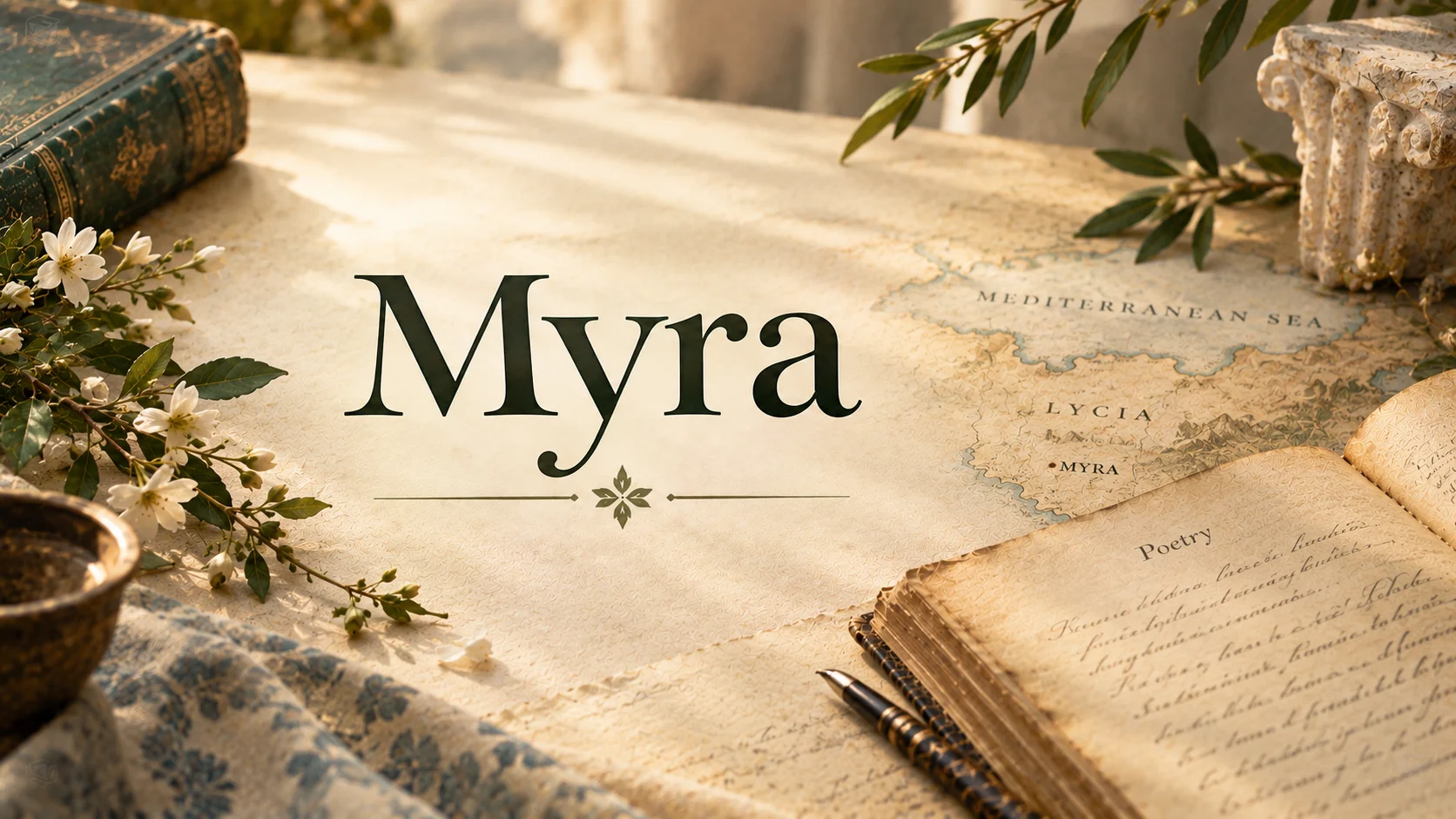
The Myra name meaning is often associated with possible connections to myrrh, a fragrant natural resin, although the name’s precise etymology remains uncertain. Myra is generally recognized as a feminine given name with a literary origin linked to the 17th-century English poet Fulke Greville. It also shares its spelling with the ancient city of Myra in Lycia, present-day Turkey
This name offers an interesting combination of literary history, possible classical associations, and geographical significance. In this guide, we explore the Myra name meaning, its origin, pronunciation, historical context, symbolic interpretations, related names, and important questions parents may have when considering it.
What Is the Name Myra?
Myra is a feminine personal name used primarily in English-language naming contexts. Its modern given-name history is commonly connected to Fulke Greville, who used Myra as a poetic name in his work. Its exact linguistic derivation is not established, although proposed explanations include a connection with the Latin word myrra, meaning myrrh, or a rearrangement of the letters in Mary.
The name should be distinguished from the ancient place name Myra. Although the two share the same spelling, the historical city and the modern personal name are not automatically the same etymological entity.
Quick Overview of Myra
| Attribute | Details |
|---|---|
| Name | Myra |
| Common usage | Feminine given name |
| Pronunciation | MY-ruh |
| Pronunciation (IPA) | /ˈmaɪ.ɹə/ |
| Literary association | Fulke Greville |
| First known literary use | 17th century |
| Possible meaning | Associated by some sources with myrrh |
| Etymology | Uncertain |
| Related spelling | Mayra |
| Historical place association | Ancient Myra, Lycia |
The pronunciation and English naming history are documented by Behind the Name, while the connection to Mayra is recognized as a related form in some naming contexts.
Myra Name Meaning: What Does Myra Mean?
The name Myra does not have one universally established meaning. Its most frequently discussed proposed association is “myrrh,” a fragrant resin historically used in perfumes, incense, and ceremonial contexts. However, this interpretation should be presented as a possible etymological connection rather than a confirmed literal meaning.
Other explanations connect Myra with literary invention or possible relationships to Mary. These interpretations differ in their evidence and should not be treated as interchangeable facts.
1. Myra and the Meaning “Myrrh”
Myrrh is an aromatic resin obtained from certain trees and has a long history of use in cultural, religious, and medicinal traditions. The proposed connection between Myra and myrra, the Latin term associated with myrrh, gives the name a fragrant and classical symbolic association.
If parents choose to interpret Myra through this association, they might connect it with:
- Fragrance and natural beauty
- Tradition and historical continuity
- Refinement and simplicity
- Ancient cultural heritage
These are symbolic interpretations, not proven personality characteristics or a definitive translation of the name.
2. Myra as a Literary Name
A significant part of the name’s documented history is its use by Fulke Greville, an English poet who lived from 1554 to 1628. Myra appears in his poetic work Caelica, where it functions as a name for a beloved or idealized female figure.
This literary background gives Myra a different kind of significance. Rather than being established solely through an ancient word with a certain translation, the name also has a recorded history as a poetic creation.
3. Myra and the Possible Connection to Mary
Some name references suggest that Greville may have formed Myra by rearranging the letters of Mary. This remains a proposed explanation, not a confirmed etymology. The similarity in letters alone does not establish that the names share a linguistic origin.
For families who appreciate names with possible traditional or literary connections, this theory may be interesting. It should nevertheless be separated from the documented fact that Myra was used as a poetic name.
Origin and Etymology of Myra
The origin of Myra requires a distinction between the modern personal name and the ancient geographical name.
Literary Origin of the Given Name
The modern English given name is widely associated with Fulke Greville’s 17th-century poetry. Name references identify his use of Myra as an early documented example of the name in literary form. The exact inspiration for the coinage is uncertain.
Possible explanations include:
- A connection with Latin myrra, meaning myrrh.
- A rearrangement or adaptation of Mary.
- A poetic invention without a definitively established original root.
Because these theories have different levels of certainty, a responsible explanation of Myra’s etymology should acknowledge the debate rather than assign one origin as proven.
Is Myra a Greek Name?
Myra is sometimes associated with Greek or classical naming explanations, particularly because of proposed links with myrrh and the ancient city of Myra. However, the modern English personal name is commonly described as a literary creation associated with Fulke Greville.
It is therefore more accurate to say that Myra has classical associations and a documented English literary history, rather than simply declaring that it is definitively a Greek-origin name.
Linguistic Uncertainty Matters
Name etymology is not always straightforward. A name may resemble a word in another language without having been historically derived from that word. It may also acquire new meanings through cultural usage, popular interpretations, or later naming traditions.
For Myra, the distinction is particularly important because several explanations circulate online, while major name references describe the precise origin as uncertain.
History and Cultural Context
Myra in Ancient Lycia
Myra was an ancient city in Lycia, a historical region of Anatolia in what is now southwestern Turkey. The city became an important center in the ancient world and was associated with the Lycian region, later experiencing Greek and Roman cultural influences.
The city’s history is separate from the documented literary origin of the English given name, but the shared spelling creates a meaningful historical association.
Myra and Early Christianity
The ancient city is particularly notable in Christian history. According to biblical and historical references, the apostle Paul visited Myra during his journey toward Rome, as described in Acts 27:5. The city is also associated with Saint Nicholas, a historical bishop whose traditions later contributed to the development of the Santa Claus figure.
This geographical and religious history can add depth to the name’s cultural associations. It does not, however, establish that the modern personal name was derived from the city.
The Difference Between Historical Association and Etymology
A name can share a spelling with a famous historical location without having the same origin. In the case of Myra, the ancient city is a documented place in Lycia, while the English feminine name is commonly traced in name references to a literary coinage.
Understanding this difference helps readers avoid confusing a historical association with a proven linguistic derivation.
Myra Name Pronunciation
Myra is commonly pronounced MY-ruh, with emphasis on the first syllable. Behind the Name gives the pronunciation as /ˈmaɪ.ɹə/.
Simple Pronunciation Guide
- Myra: MY-ruh
- First syllable: Sounds like “my”
- Second syllable: A soft “ruh” sound
Pronunciation can vary slightly depending on regional accent and the speaker’s language background. When choosing the name, parents may wish to consider how it sounds alongside the family surname.
Myra Name Symbolism and Interpretation
A name’s symbolism is often shaped by its etymology, literary associations, historical references, and personal interpretation. Myra offers several possible symbolic directions, although none should be treated as an objective description of a person’s character.
Fragrance and Natural Beauty
The proposed association with myrrh can inspire symbolic themes of fragrance, nature, tradition, and refinement. These themes are interpretive extensions of the possible etymological connection, rather than confirmed meanings.
Literary Elegance
Myra’s association with Fulke Greville gives it a literary dimension. Families interested in poetic or historically documented names may appreciate the fact that the name appears in early modern English poetry.
Historical Depth
The shared name of the ancient Lycian city creates an additional geographical association. This may appeal to parents who enjoy names connected with historical places, ancient civilizations, or cultural heritage.
Symbolism Versus Personality Claims
Baby-name websites sometimes connect names with traits such as kindness, intelligence, beauty, or strength. Such descriptions are usually symbolic or subjective. There is no reliable basis for assuming that a person’s personality can be predicted from the name Myra alone.
A thoughtful name guide should distinguish historical evidence from creative interpretation.
Myra in Modern Naming
Myra continues to be recognized as a feminine given name in English-language naming references. Its short structure, two-syllable pronunciation, and established literary history make it recognizable as a personal name. Behind the Name classifies it as an English feminine name and lists Mayra as a related form used in American Hispanic and Latin American Spanish contexts.
The form Mayra should not automatically be assumed to have exactly the same usage history in every country. Spelling preferences and pronunciation conventions may vary across languages and communities.
Why Parents May Consider Myra
Parents might consider Myra for several practical or aesthetic reasons:
- It is relatively short and easy to write.
- Its pronunciation is straightforward in many English-speaking contexts.
- It has a documented literary association.
- It has historical connections through the ancient city of Myra.
- Its spelling has a classic, established appearance.
These are considerations for personal preference, not universal measures of suitability.
Myra Name Variations and Related Names
Myra has a few relevant connections to other names, although similar spelling or sound does not necessarily indicate shared etymology.
| Name | Relationship or distinction |
|---|---|
| Myra | The name discussed in this article; associated with an English literary coinage |
| Mayra | A related spelling form recognized in some Spanish-language naming contexts |
| Mira | A separate name with multiple origins and meanings across languages |
| Mary | Sometimes proposed as a possible source of the literary coinage through rearrangement |
| Miranda | Sometimes discussed in connection with Latin mirus and the meaning “wonderful,” but not established as the source of Myra |
The connection between Myra and Mary is a proposed theory, while Mira and Miranda have their own linguistic histories. Similar sounds should not be treated as proof of a shared origin.
Examples of Using the Name Myra
A name can be explored through everyday usage, family naming decisions, and creative contexts.
Example 1: Introducing Someone
“Myra is joining our class this semester.”
Here, Myra functions as a conventional personal name in an English sentence.
Example 2: A Baby-Naming Context
“We chose Myra because we liked its gentle sound and literary history.”
This example illustrates a personal naming reason without claiming that the name has a fixed personality meaning.
Example 3: A Historical Reference
“The ancient city of Myra was located in Lycia, in present-day Turkey.”
In this context, Myra refers to a historical location rather than a person.
Example 4: Comparing Spellings
“The family considered both Myra and Mayra before selecting the spelling they preferred.”
The example demonstrates how families may consider related spelling forms while making an individual naming decision.
Is Myra a Good Name for a Baby?
Myra is a good name depends on personal taste, cultural context, pronunciation preferences, and how the name fits with the child’s surname and family traditions.
Parents who value short names, literary associations, and historical connections may find Myra appealing. Those who prioritize a specific religious, linguistic, or traditional meaning should research the relevant interpretation carefully, especially because Myra’s etymology is uncertain.
A name does not need to have one universally accepted translation to be meaningful to a family. Its significance may come from family history, sound, cultural connections, or the personal reasons behind choosing it.
Myra Name Meaning in Different Interpretive Contexts
The name can be discussed through several distinct lenses, each with its own limitations.
| Context | What can be said responsibly |
|---|---|
| Etymology | The exact origin is uncertain; myrrh and Mary are proposed connections |
| Literary history | Associated with Fulke Greville’s 17th-century poetry |
| Geography | Shares its spelling with ancient Myra in Lycia |
| Pronunciation | Commonly pronounced MY-ruh in English |
| Symbolism | May evoke fragrance, literary heritage, or historical depth |
| Personal meaning | Determined by the family or individual using the name |
This approach keeps the article informative while avoiding the assumption that all popular interpretations are historically proven.
Why Understanding Name Origins Matters
Researching a name’s background helps parents and readers distinguish between established information and later interpretations. Myra demonstrates how a name may have a literary history, possible linguistic explanations, and geographical associations that do not necessarily share one origin.
A careful name guide should provide the documented history first, then explain the possible meanings and symbolism without presenting speculation as fact.
FAQs
1. What does the Myra name mean?
Myra has an uncertain etymology. It is sometimes associated with myrrh, while other theories connect it with literary invention or Mary.
2. What is the origin of the name Myra?
The modern English given name is commonly associated with the 17th-century poet Fulke Greville. Its precise original derivation remains uncertain.
3. How do you pronounce Myra?
Myra is commonly pronounced MY-ruh, with emphasis on the first syllable.
4. Is Myra a Greek name?
Myra has classical associations, but the modern English given name is generally linked to Fulke Greville’s literary usage rather than a confirmed Greek etymology.
5. Is Myra a biblical name?
Myra is the name of an ancient city mentioned in Acts 27:5. The personal name’s literary origin should be distinguished from the biblical city’s historical identity.
6. Is Myra related to Mira?
Myra and Mira are similar in spelling and sound, but they have distinct naming histories and should not automatically be treated as etymologically related.
7. What is the difference between Myra and Mayra?
Mayra is a related spelling form recognized in some American Hispanic and Latin American Spanish contexts. Usage and pronunciation may vary by community.
8. Is Myra a feminine name?
Yes. Myra is commonly classified as a feminine given name in English-language naming references.
9. Does Myra have a confirmed meaning of “wonderful”?
Some references connect related names or proposed roots with ideas such as “wonderful,” but this is not an established, universally accepted literal meaning of Myra.
10. What are names similar to Myra?
Names such as Mira, Mayra, and Miranda may be considered related in discussions of sound or naming associations, although their etymologies differ.
Conclusion
The Myra name meaning has a fascinating combination of literary history, possible classical associations, and geographical significance. Although its exact etymology is uncertain, its connection with Fulke Greville’s poetry provides a documented historical foundation for the modern given name.
For families considering Myra, the name’s short pronunciation, established usage, and potential symbolic associations offer several ways to appreciate it. Its meaning can be personal and meaningful even when its original linguistic history cannot be confirmed with certainty.
Discover More Related Articles:
- Maggie Name Meaning | Origin, History & the Story Behind This Timeless Name In 2026
- Linda Name Meaning | Origin, History & the Timeless Beauty of the Name In 2026
- Adriana Name Meaning | Origin, History & the Story Behind the Name In 2026










9 thoughts on “Myra Name Meaning | Origin, History, Symbolism & Cultural Significance In 2026”