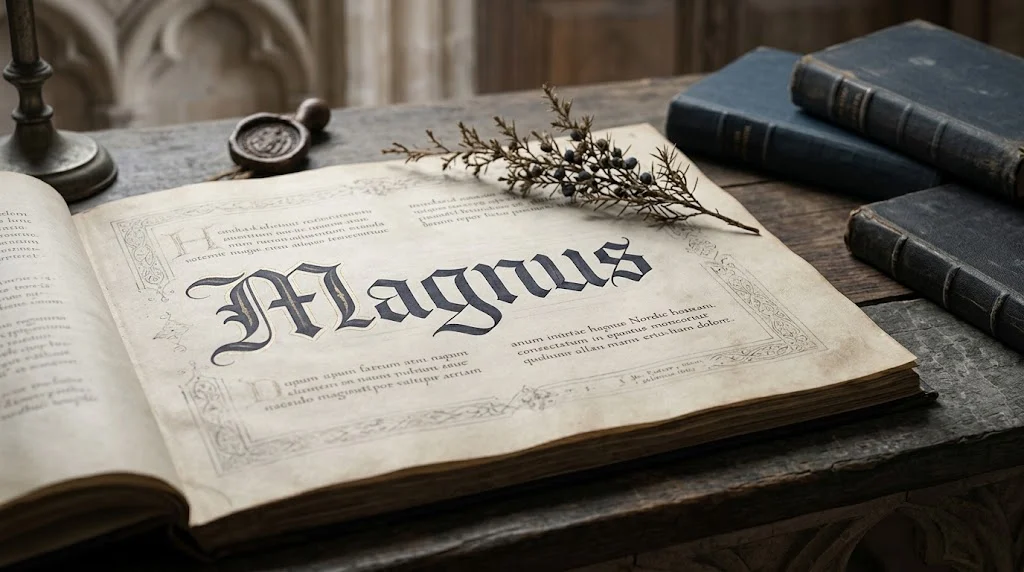
The Magnus name meaning is “great,” “large,” or “grand,” from the Latin word magnus. It began as a Latin word and later became an established personal name, especially through medieval European and Scandinavian naming traditions. Magnus has strong historical associations with saints, kings, and rulers, giving the name a sense of dignity, strength, and importance.
Today, Magnus is particularly associated with Scandinavia, although its Latin roots connect it to a much broader European history. It is a distinctive choice for parents looking for a traditional boy’s name with a straightforward meaning, substantial historical depth, and an international character.
This guide explores the meaning, etymology, pronunciation, history, cultural associations, variants, nicknames, and modern appeal of Magnus.
What Is the Name Magnus?
Magnus is a masculine given name derived from the Latin adjective magnus, meaning “great,” “large,” or “grand.” As a personal name, it became particularly prominent in medieval Europe and Scandinavia, where several kings and saints helped establish its long-term cultural importance.
The name is easy to recognize across many European languages, although pronunciation and related forms can vary by region.
Unlike names whose meanings are based on occupations, places, animals, or religious concepts, Magnus has a direct descriptive meaning. Its underlying idea is greatness or largeness, which can give the name an especially strong symbolic quality.
It is also worth distinguishing Magnus from modern English uses of the word “magnus.” In the name itself, the relevant origin is the Latin magnus. The name should not be interpreted as a modern English adjective simply transferred into a first name; it has its own long historical development as a personal name.
Magnus Name Meaning
The central Magnus name meaning comes from Latin magnus, meaning:
- Great
- Large
- Grand
- Important or significant, depending on context
The simplest translation is “great.”
In Latin, magnus was an ordinary adjective used to describe something physically large or metaphorically important. Over time, the word’s range naturally allowed it to express ideas such as greatness, prominence, magnitude, and distinction.
As a personal name, Magnus therefore carries a symbolic association with greatness and stature. However, parents should treat these associations as the traditional meaning of the name rather than as a prediction of someone’s personality.
A name meaning “great” does not mean that every person named Magnus will necessarily be ambitious, powerful, successful, or authoritative. Those are modern interpretations inspired by the literal meaning rather than fixed characteristics of the name.
What Does Magnus Mean Symbolically?
When interpreted symbolically, Magnus can suggest:
- Greatness
- Strength
- Importance
- Ambition
- Dignity
- Leadership
- Grandeur
- Lasting significance
These qualities help explain why the name has historically suited royal and religious figures.
Magnus Name Origin and Etymology
The Magnus name origin is Latin.
The name comes from the Latin adjective magnus, meaning “great” or “large.” Latin was the language of the Roman world and later remained highly influential in medieval European religious, scholarly, and administrative life.
The feminine Latin form is magna, meaning “great” in the feminine grammatical form. The related Latin word magnus also belongs to a broader family of Indo-European linguistic forms associated with the concept of greatness or size.
As a given name, however, Magnus became especially important through later European naming traditions rather than simply because Romans commonly used Magnus as an everyday first name in the modern sense.
Its development into a major personal name was strongly influenced by medieval Christian and Scandinavian history.
From Latin Word to Personal Name
One important figure in the history of the name was Charlemagne, whose Latin name was Carolus Magnus, literally “Charles the Great.” The phrase demonstrates the long-standing use of magnus as a Latin expression of greatness.
The personal name Magnus later became especially prominent in northern Europe. Saints and Scandinavian rulers helped turn it into an enduring given name.
This distinction is important: the word magnus is ancient Latin, while the personal-name tradition of Magnus developed through later European history.
History of the Name Magnus
Magnus has a particularly strong medieval and Scandinavian history.
The name became prominent in Scandinavia through rulers and saints, most notably Saint Magnus of Orkney and several medieval kings of Norway and other Scandinavian territories.
Magnus in Medieval Scandinavia
The name became closely associated with Scandinavian royalty.
A number of Norwegian kings were named Magnus, including:
- Magnus I of Norway
- Magnus II of Norway
- Magnus III of Norway, often called Magnus Barefoot
- Magnus IV of Norway
- Magnus V of Norway
- Magnus VI of Norway
This royal history gave Magnus an association with leadership and authority that extended well beyond its original Latin meaning.
The name also appeared among rulers in Sweden and Denmark, reinforcing its status as an established Scandinavian name.
Saint Magnus
Another major influence was Saint Magnus of Orkney, a medieval Christian figure associated with the Earldom of Orkney.
Magnus Erlendsson, traditionally known as Saint Magnus, lived during the late 11th and early 12th centuries. His cult became important in Orkney, and St Magnus Cathedral in Kirkwall is named in his honor.
The association with Saint Magnus helped connect the name not only with Scandinavian history but also with medieval Christian culture.
Magnus and Royal Naming Traditions
Names often gain cultural significance through prominent historical figures. Magnus is an excellent example.
Because several medieval rulers carried the name, Magnus came to sound particularly traditional and distinguished in Scandinavian contexts. It belongs to the same broad category of European names whose popularity was reinforced by royal, noble, or saintly usage.
That history is one reason the name can feel simultaneously ancient, formal, and modern.
Is Magnus a Scandinavian Name?
Yes. Magnus is strongly associated with Scandinavian naming traditions, particularly in Norway, Sweden, Denmark, and related Nordic contexts.
Its linguistic root is Latin rather than Scandinavian, but names frequently travel between languages and cultures. Magnus became established in Scandinavia through medieval Christian and royal traditions.
This makes Magnus an interesting example of a name with a Latin origin and strong Scandinavian cultural identity.
In other words:
Origin: Latin
Historical cultural association: Scandinavian and northern European
Primary traditional gender: Masculine
Calling Magnus simply a “Latin name” is therefore accurate in terms of etymology but incomplete in terms of cultural history.
Magnus Pronunciation
The pronunciation of Magnus varies somewhat depending on the language.
In English, Magnus is commonly pronounced approximately:
MAG-nus
The first syllable is stressed.
In Scandinavian languages, pronunciation can differ from the typical English version. Norwegian, Swedish, and Danish speakers may pronounce the vowels and consonants somewhat differently according to the phonetic patterns of their language.
For English speakers, MAG-nus is the most straightforward pronunciation.
Is Magnus Easy to Pronounce?
Generally, yes.
Magnus has a relatively simple spelling and a recognizable pronunciation for English speakers. Its two-syllable structure also makes it easy to pair with many short or long surnames.
Its international familiarity is another advantage for families looking for a traditional name that does not require extensive explanation.
Magnus in Scandinavian Culture
Magnus has a particularly deep place in Nordic history.
In Norway, the name is connected to numerous medieval monarchs. In Sweden and Denmark, related royal naming traditions also contributed to its recognition.
The name’s cultural identity therefore developed through a combination of:
- Latin linguistic heritage
- Medieval Christianity
- Scandinavian royal history
- Saints and religious traditions
- Continued Nordic naming practices
This combination gives Magnus more historical depth than a simple dictionary definition of “great” might suggest.
Magnus and Nordic Identity
Although Magnus is not originally a Norse word, it has become culturally recognizable as a Nordic name.
This illustrates an important feature of naming history: a name’s origin and cultural identity are not always the same thing.
A name can originate in one language and become deeply established in another region. Magnus is a clear example of this process.
Magnus Name Variations and Related Forms
It has several related forms and regional variants.
| Name/Form | Language or Region | Relationship |
|---|---|---|
| Magnus | Latin / Scandinavian usage | Main traditional form |
| Magne | Norwegian | Related Scandinavian form |
| Måns | Swedish | Traditional Swedish form related to Magnus |
| Magni | Scandinavian usage | Related form, also found in Nordic naming traditions |
| Magno | Italian/Spanish-related usage | Romance-language form or related form depending on context |
| Magna | Latin | Feminine grammatical form of magnus |
Not every form functions as a direct modern equivalent in every country, so regional context matters.
Magnus Nicknames
Possible informal forms include:
- Mags
- Mag
- Manny in some informal contexts, although this is less directly tied to the traditional Scandinavian form
- Magne, where it is used as an established Scandinavian form rather than merely a nickname
Many people named Magnus may simply use Magnus without a nickname because the name is already short and distinctive.
Is Magnus a Biblical Name?
Magnus is not a biblical personal name in the usual sense.
Its root is Latin, and the name became particularly prominent through later Christian and European history rather than originating as a Hebrew or Greek biblical name.
However, Magnus has a significant Christian historical association, especially through saints such as Saint Magnus of Orkney and through medieval Christian Europe.
Therefore, someone looking for a Christian-associated name could consider Magnus historically connected to Christianity, but it would be misleading to describe it as a biblical name in the same way as Matthew, John, David, or Daniel.
Magnus and the Meaning of Greatness
The strongest conceptual association of Magnus is greatness.
The Latin magnus could describe physical size, but it could also communicate importance, rank, or distinction. This broader semantic range makes the name particularly rich symbolically.
For a baby-name interpretation, Magnus can represent the hope that a child will grow into a person of:
- Character
- Strength
- Significance
- Confidence
- Achievement
- Positive influence
Again, these are symbolic interpretations rather than promises about personality.
Famous and Historical People Named Magnus
It has been carried by numerous historical figures, especially Scandinavian rulers and religious figures.
Magnus the Good
Magnus I of Norway, known as Magnus the Good, was a 11th-century Norwegian king. His reign helped establish Magnus as a prominent royal name in Norway.
Magnus Barefoot
Magnus III of Norway, commonly known as Magnus Barefoot, was a powerful medieval Norwegian ruler. His historical reputation contributed to the continuing visibility of the name.
Saint Magnus of Orkney
Saint Magnus is among the most important religious figures associated with the name. His legacy is particularly connected with Orkney and its medieval Christian heritage.
Albertus Magnus
Another famous historical association is Albertus Magnus, the medieval German philosopher, theologian, and scholar. His Latin name contains Magnus, meaning “great.”
Albertus Magnus was an important medieval intellectual and was later canonized as a saint and recognized as a Doctor of the Church.
These examples show how the name Magnus has appeared across royal, religious, intellectual, and cultural history.
Magnus as a Baby Name
For parents considering Magnus as a baby name, its strongest advantages are its meaning, historical depth, and distinctive sound.
Reasons Parents May Choose Magnus
1. Strong meaning:
The literal meaning “great” provides an immediately positive association.
2. Rich history:
Magnus has centuries of European and Scandinavian history behind it.
3. Scandinavian character:
It offers a recognizable Nordic identity without being difficult to spell.
4. International usability:
The name is recognizable in multiple European cultures.
5. Distinctive but traditional:
Magnus feels less conventional in some English-speaking settings while remaining an established historical name.
6. Strong sound:
Its two syllables give it a firm, memorable quality.
Names That Pair Well With Magnus
Magnus can work with many middle names, particularly names that balance its strong historical character.
Examples include:
- Magnus Alexander
- Magnus James
- Magnus Elias
- Magnus Oliver
- Magnus Leo
- Magnus Arthur
- Magnus Henry
- Magnus Theodore
These are examples of stylistic combinations rather than recommendations based on any particular naming tradition.
Magnus also pairs naturally with Scandinavian names such as:
- Magnus Anders
- Magnus Erik
- Magnus Lars
- Magnus Nils
- Magnus Johan
The best combination ultimately depends on family heritage, surname, pronunciation, and personal preference.
Magnus vs. Similar Names
It is sometimes compared with other strong or historically significant masculine names.
| Name | Meaning/Origin | How It Differs |
|---|---|---|
| Magnus | Latin, “great” | Strong Scandinavian and medieval royal associations |
| Maximus | Latin, “greatest” | More explicitly expresses superlative greatness |
| Max | Short form of Maximilian/Maxwell and others | Much shorter and more modern-feeling in many contexts |
| Augustus | Latin, “venerable,” “majestic” | Strong Roman imperial association |
| Alexander | Greek, “defender of men” | Greek origin with extensive royal and military history |
| Victor | Latin, “conqueror” | Emphasizes victory rather than greatness |
Magnus and Maximus are especially close conceptually because both are connected to greatness in Latin. However, magnus means “great,” while maximus is the superlative “greatest” or “very great.”
Is Magnus a Good Name?
Magnus can be an excellent choice for parents who want a name with strong meaning, historical credibility, Scandinavian heritage, and an uncommon-but-established feel.
Its biggest appeal is that it does not rely on a modern invented meaning. The connection to magnus, meaning “great,” is well established, while centuries of royal and religious usage give the name additional cultural depth.
It is particularly attractive for families with Nordic or European heritage, but its relatively simple spelling and pronunciation also make it accessible internationally.
The Personality Associated With Magnus
Baby-name websites sometimes assign personality traits to names, but these should be treated as symbolic rather than factual.
Because Magnus means “great” and has historical associations with kings and notable figures, modern interpretations may associate the name with qualities such as:
- Confidence
- Leadership
- Strength
- Ambition
- Intelligence
- Independence
- Dignity
These associations arise from the name’s meaning and history, not from scientific evidence that a person’s name determines personality.
How Rare or Common Is Magnus?
The popularity of Magnus varies considerably by country and period.
It has traditionally been much more familiar in Scandinavian countries than in many English-speaking regions. In countries such as Norway and Sweden, its historical use gives it a much stronger cultural presence.
Its popularity can also change over time as parents revive older traditional names. For this reason, anyone interested in current rankings should consult the official birth-name statistics for the specific country and year rather than relying on a universal claim about how common Magnus is.
What Makes Magnus Distinctive?
Magnus combines several characteristics that are difficult to find together in one name:
- An ancient linguistic root
- A simple literal meaning
- Medieval history
- Scandinavian identity
- Royal associations
- Christian historical connections
- International recognition
- A strong, concise sound
The result is a name that feels traditional without necessarily sounding old-fashioned.
That balance is one of the reasons Magnus continues to attract interest among parents searching for distinctive historical names.
FAQs
1. What does the name Magnus mean?
Magnus means “great,” “large,” or “grand.” It comes from the Latin word magnus, which was used to describe physical size as well as importance or greatness.
2. What is the origin of Magnus?
Magnus has a Latin origin. The personal name later became strongly established in medieval Europe, particularly in Scandinavian countries such as Norway, Sweden, and Denmark.
3. Is Magnus a Scandinavian name?
Magnus is strongly associated with Scandinavian naming traditions, although its original linguistic root is Latin. Numerous Scandinavian kings and historical figures helped establish its Nordic identity.
4. Is Magnus a biblical name?
No. Magnus is not a biblical personal name in the traditional sense. It became associated with Christianity through medieval saints, rulers, and European Christian naming traditions.
5. How do you pronounce Magnus?
In English, Magnus is commonly pronounced MAG-nus, with emphasis on the first syllable. Scandinavian pronunciation can vary according to the local language.
6. Is Magnus a boy’s name?
Yes. Magnus is traditionally a masculine given name. It has been used extensively for men throughout European and Scandinavian history.
7. What is the Latin meaning of Magnus?
The Latin adjective magnus means “great” or “large.” Depending on context, it can also convey ideas such as importance, grandeur, or prominence.
8. What are names similar to Magnus?
Names that may appeal to people who like Magnus include Maximus, Max, Augustus, Alexander, Victor, Anders, Erik, and Arthur. Magnus is particularly distinctive because of its combination of Latin origin and Scandinavian history.
9. Does Magnus have nicknames?
Possible informal forms include Mags or Mag. However, Magnus is already a relatively short name, so many people simply use the full form.
10. Is Magnus a strong name?
Magnus is often perceived as a strong name because its literal meaning is “great” and because it has historical connections with Scandinavian kings and other notable figures. The personality associations are symbolic rather than scientific.
Conclusion
The Magnus name meaning is rooted in the Latin word magnus, meaning “great,” “large,” or “grand.” Although its linguistic origin is Latin, Magnus developed a particularly strong identity in medieval Scandinavia through kings, saints, and centuries of Nordic naming tradition.
For modern parents, Magnus offers more than a powerful definition. It combines ancient Latin roots, Scandinavian heritage, royal history, Christian associations, and a simple international pronunciation. Its meaning of “great” also gives it a timeless symbolic quality without requiring an invented or modern interpretation.
Discover More Related Articles:
- Kinsley Name Meaning | From English Roots to Modern Grace In 2026
- Annie Name Meaning | Origin, History, Popularity & More In 2026
- Aziel Name Meaning | Origin, Bible & Symbolism In 2026











1 thought on “Magnus Name Meaning |Origin, History & Significance In 2026”