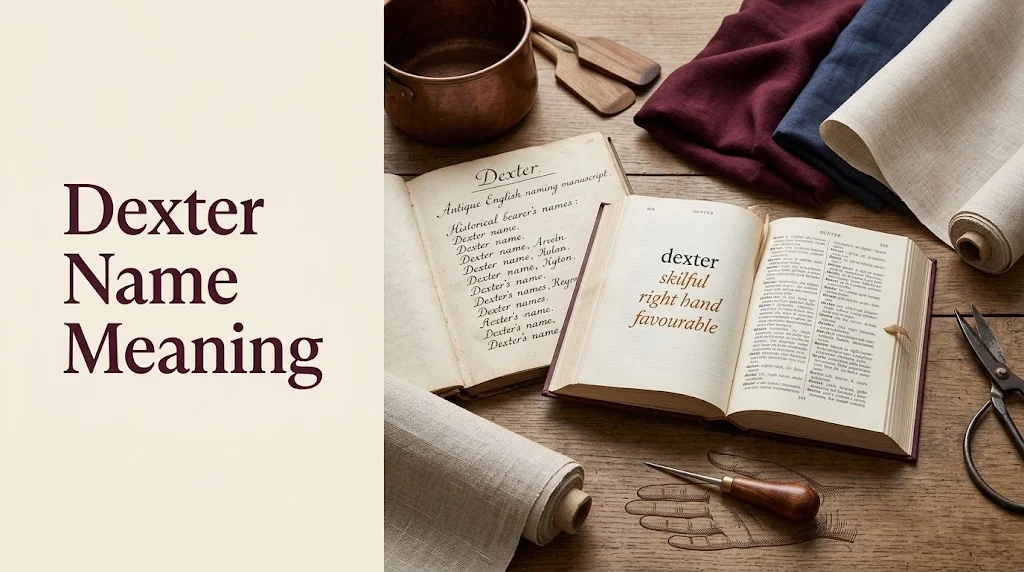
The Dexter name meaning is associated with two important linguistic traditions. In English, Dexter developed from an occupational surname meaning “dyer,” referring to someone who worked with dyes. Separately, the name coincides with the Latin word dexter, meaning “right,” “right-handed,” or “skillful.” Latin dexter could also carry the sense of something favorable or fortunate in certain contexts.
The name Dexter has therefore developed an interesting combination of English occupational history and Latin associations. It can sound modern and energetic today, yet its background reaches into older English naming practices and classical Latin vocabulary.
This article explores the Dexter name meaning, pronunciation, origin, etymology, history, symbolism, related names, nicknames, and modern usage.
What Is the Name Dexter?
Dexter is primarily used as a masculine given name in English. It is also an established English surname. As a given name, Dexter is connected to an English surname that originated as an occupational name for a dyer a person whose work involved coloring cloth or other materials.
At the same time, Dexter has a separate linguistic association with the Latin adjective dexter. In Latin, dexter referred literally to the right side or right hand, while figurative meanings included skillful, dexterous, handy, favorable, and fortunate.
This distinction is important. It would be inaccurate to say that every historical use of Dexter simply meant “skillful.” The English surname history and the Latin word are related to the modern name in different ways.
Basic Dexter Name Facts
| Attribute | Detail |
|---|---|
| Name | Dexter |
| Primary usage | Masculine |
| Language association | English |
| Surname connection | English occupational surname |
| Surname meaning | “Dyer” |
| Latin association | dexter |
| Latin meanings | “right,” “right-handed,” “skillful,” “favorable” |
| Pronunciation | DEK-stər |
| Common nickname | Dex |
Dexter Name Meaning
The Dexter name meaning can be understood through its two major associations.
The first is the English surname meaning “dyer.” An occupational surname was originally a way of identifying a person by their trade or work. In this sense, Dexter belongs to the same broad historical naming tradition as English surnames derived from occupations. The surname source describes Dexter specifically as an occupational name meaning “dyer” in Old English.
The second association comes from Latin dexter. Its basic spatial meaning was “right” or “on the right-hand side.” From that physical meaning, the word developed figurative associations with being skillful, dexterous, handy, suitable, favorable, or fortunate.
For modern parents, these meanings can give Dexter several appealing symbolic interpretations:
- Skill and ability
- Dexterity and competence
- Being capable or handy
- Good fortune
- A favorable direction
- Connection with the right hand
- Craftsmanship, through its English occupational surname history
These are best understood as symbolic associations rather than a claim that every person named Dexter possesses these qualities.
Dexter Name Origin and Etymology
The origin of Dexter is especially interesting because the modern given name sits at the intersection of English surname tradition and a Latin vocabulary word.
The Old English Surname Connection
The English surname Dexter is an occupational surname meaning “dyer.” Historical occupational surnames commonly identified people according to their professions, and dyeing was an established craft associated with textile production. The surname reference traces Dexter to Old English and notes that the occupational word was originally feminine but was later applied to men as well.
Over time, surnames could become personal names. Dexter is an example of this broader English naming pattern, in which an inherited family name can eventually be adopted as a given name.
The Latin Connection
The other major association is Latin dexter. Classical Latin used dexter for the right side or right hand. The word could also describe someone or something as skillful, dexterous, handy, suitable, or favorable depending on context.
This Latin connection is also the source of English words such as dexterous and dexterity, which relate to skillful or coordinated movement.
It is worth keeping the etymology precise: the English given name Dexter is documented as coming from an occupational surname, while the Latin word dexter is a separate linguistic association that coincides with the spelling and contributes additional meaning to the name.
History of the Name Dexter
Dexter’s history reflects an important feature of English naming culture: the movement of occupational surnames into the pool of personal names.
In medieval and later English society, occupational surnames were useful because a person’s profession could distinguish them from others with the same personal name. A name associated with dyeing therefore could become a hereditary surname. The surname Dexter is classified as an English occupational name meaning “dyer.”
As English naming traditions developed, surnames increasingly became available as given names. Dexter eventually came to be used independently as a first name rather than only as a family name.
The name’s Latin association adds another historical layer. Because dexter referred to the right side and could carry positive meanings such as “skillful” and “favorable,” modern discussions of Dexter often emphasize ideas of ability, competence, and good fortune. Those meanings come from the Latin vocabulary rather than from the occupational meaning of the English surname.
What Does Dexter Mean in Latin?
In Latin, dexter primarily means “right” or “on the right-hand side.” It can also mean “skillful,” “dexterous,” or “handy.” In certain classical contexts, it can have the figurative sense of “favorable,” “fortunate,” or “propitious.”
This positive figurative meaning has an interesting historical explanation. The University of Chicago’s Logeion entry notes the association between the right side and favorable omens in ancient Greek and Roman cultural contexts.
Therefore, if someone asks for the Latin meaning of Dexter, a concise answer is:
Dexter means “right” or “right-handed,” with extended meanings such as “skillful” and “favorable.”
That is different from the English surname meaning, which is “dyer.”
Dexter Pronunciation
Dexter is commonly pronounced:
DEK-stər
In American English, the pronunciation is approximately /ˈdɛk.stɚ/, while British English commonly uses /ˈdɛk.stə/.
The name has two clear syllables:
Dex-ter
Because the pronunciation is straightforward, Dexter is generally easy to say for English speakers.
Is Dexter a Boy Name?
Yes. Dexter is primarily used as a masculine given name in English. It also exists as an English surname.
Its surname-to-first-name development gives it a style shared with other English names that began as family names. This can make Dexter feel both traditional and modern at the same time.
Parents choosing the name may also appreciate its short structure, recognizable pronunciation, and the nickname Dex.
Dexter Name Symbolism
Names do not determine personality, but their historical meanings can inspire symbolic interpretations.
Because of its Latin association with dexter, the name Dexter can symbolically suggest skill, coordination, capability, and favorable circumstances. The connection with the “right hand” can also create imagery of action, craftsmanship, and practical ability.
The English surname meaning adds a different symbolic dimension. A dyer was a craftsperson who worked with materials, color, and textile production. This makes Dexter suitable for parents who enjoy names with an occupational or craftsmanship-based heritage.
Possible symbolic themes associated with Dexter include:
- Skill
- Craftsmanship
- Practical ability
- Confidence
- Good fortune
- Creativity
- Tradition
- Individuality
These are interpretations of the name’s linguistic and historical associations, not fixed characteristics of people who bear the name.
Dexter as a Surname
Before becoming familiar as a first name, Dexter existed as an English occupational surname. Its surname meaning is “dyer.”
This makes Dexter part of a large group of English surnames based on occupations. Such names developed because occupations were useful identifiers in communities where many people shared common personal names.
The surname also has an interesting linguistic detail: the source describes the Old English occupational term as originally feminine and later applied to men as well.
Today, Dexter can therefore function in two ways:
- As a family name, retaining its English occupational history.
- As a given name, where it carries both surname heritage and the additional associations of Latin dexter.
Dexter in Modern Naming
Modern parents often choose names that combine historical roots with a contemporary sound. Dexter fits that pattern because it is short, recognizable, and connected with both surname tradition and classical vocabulary.
The nickname Dex gives the name an even shorter everyday form. At the same time, the full name Dexter retains a traditional English appearance.
Its association with Latin dexter can also make it appealing to people interested in names connected with ideas such as skill and ability. Meanwhile, the occupational surname meaning provides a less commonly known historical layer.
The name’s presence in modern entertainment has also increased its cultural recognition. However, fictional characters should not be confused with the historical meaning or etymology of the name itself.
Famous People Named Dexter
Several notable people have carried Dexter as a given name. One well-known example is Dexter Gordon, the American jazz saxophonist whose career became associated with bebop and hard bop.
Another is Dexter Fletcher, the English actor and filmmaker. These real-world examples demonstrate that Dexter has long been used as a personal name rather than existing only as a surname or fictional character name.
Popular culture has also used Dexter for fictional characters. The television series Dexter, for example, made the name particularly recognizable to many contemporary audiences. The fictional character’s storyline is separate from the historical etymology of the name, so the character should not be treated as evidence for its original meaning.
Dexter vs. Similar Names
| Name | Main Association | How It Differs |
|---|---|---|
| Dexter | Dyer; Latin “right/skillful” | Has both English surname and Latin associations |
| Dex | Short form of Dexter | Usually functions as a nickname |
| Dyer | Cloth dyer | Direct English occupational surname |
| Dexton | Modern-style name | Sounds similar but has a different naming history |
| Derek | Germanic given name | Different linguistic origin and meaning |
The closest direct relationship is between Dexter and Dex, since Dex is commonly used as a shortened form of Dexter. The surname Dyer is also conceptually related because both Dexter and Dyer are connected with the occupation of dyeing, although they are not simply interchangeable versions of the same surname.
Nicknames for Dexter
Dexter is already relatively short, but several informal forms can be used.
Common nickname: Dex
Dex is the most natural short form of Dexter and preserves the strongest sound of the original name.
Other playful forms may be created within individual families, but they are not necessarily established traditional forms. For most everyday use, Dex is the clearest nickname.
Is Dexter a Strong Name?
The answer depends on personal taste, but linguistically Dexter has several features that can give it a distinctive character.
Its English surname history provides traditional depth, while the Latin association with skill and the right hand gives it a positive semantic layer. Its two-syllable structure also makes it relatively simple to pronounce.
Rather than describing the name as objectively “strong” or “weak,” it is more useful to say that Dexter combines occupational heritage, classical vocabulary, and modern surname-style naming.
Examples of Using Dexter as a Name
Here are a few natural examples:
- Dexter James — a traditional first-and-middle-name combination.
- Dexter arrived early for the ceremony. — ordinary sentence usage.
- Everyone calls him Dex. — demonstrates the common short form.
- The Dexter family has used the surname for generations. — surname usage.
- Dexter is an English name with an occupational surname background. — descriptive usage.
These examples show that Dexter can function naturally as either a first name or a surname.
Why Parents May Choose the Name Dexter
A parent considering Dexter may be interested in several different aspects of the name.
1. It has occupational heritage
The English surname connection gives Dexter a genuine historical connection to the craft of dyeing.
2. It has a classical association
The Latin dexter provides meanings connected with the right side, skill, dexterity, and favorable circumstances.
3. It has a simple nickname
Dex provides a natural shortened form.
4. It works across different naming styles
Dexter can fit a traditional, surname-inspired, or more contemporary naming style without requiring an unusual spelling.
5. It has recognizable cultural usage
The name has appeared in real-world biographies and popular culture, giving it a recognizable identity beyond dictionary definitions.
Important Distinction About the Dexter Meaning
One of the most important points when researching Dexter name meaning is that the name should not be reduced to a single definition.
If a source says Dexter means “dyer,” it is referring to the English occupational surname origin. If a source says it means “right-handed,” “skillful,” or “fortunate,” it is generally referring to the Latin word dexter.
These meanings can coexist in discussions of the modern name, but they come from different linguistic pathways. Keeping those pathways separate makes the explanation more historically accurate.
FAQs
What does the name Dexter mean?
Dexter is associated with an English occupational surname meaning “dyer” and with Latin dexter, meaning “right,” “right-handed,” or “skillful.”
Is Dexter a Latin name?
Dexter is primarily an English given name, but it coincides with the Latin word dexter, which means “right” and can also mean “skillful” or “favorable.”
What is the origin of Dexter?
As a given name, Dexter developed from an English occupational surname meaning “dyer,” while its spelling also corresponds to the Latin word dexter.
Is Dexter a boy name?
Yes, Dexter is primarily used as a masculine given name in English.
How do you pronounce Dexter?
Dexter is commonly pronounced DEK-stər, with two syllables.
What is a nickname for Dexter?
The most common short form is Dex, which is also listed as a diminutive of Dexter.
What does Dexter mean in Latin?
The Latin word dexter means “right” or “right-hand” and can also describe someone as skillful, dexterous, handy, favorable, or fortunate.
Is Dexter a surname?
Yes. Dexter is an English occupational surname associated with the occupation of a dyer.
Conclusion
The Dexter name meaning combines a fascinating English surname history with a significant Latin association. Its English origin connects it with the occupation of a dyer, while Latin dexter contributes ideas of the right hand, skill, dexterity, and favorable circumstances.
Overall, Dexter is a name with genuine historical depth and a straightforward modern style. Its connection to craftsmanship, skill, and English naming tradition gives it several layers of meaning without requiring an invented or overly symbolic interpretation.
Discover More Related Articles:
- Imogen Name Meaning | Origin, History & Timeless Charm In 2026
- Alistair Name Meaning | From Ancient Roots to Modern Grace In 2026
- Kara Name Meaning | Origin, History, & the Story Behind the Name In 2026











5 thoughts on “Dexter Name Meaning| Origin, History & Symbolism In 2026”