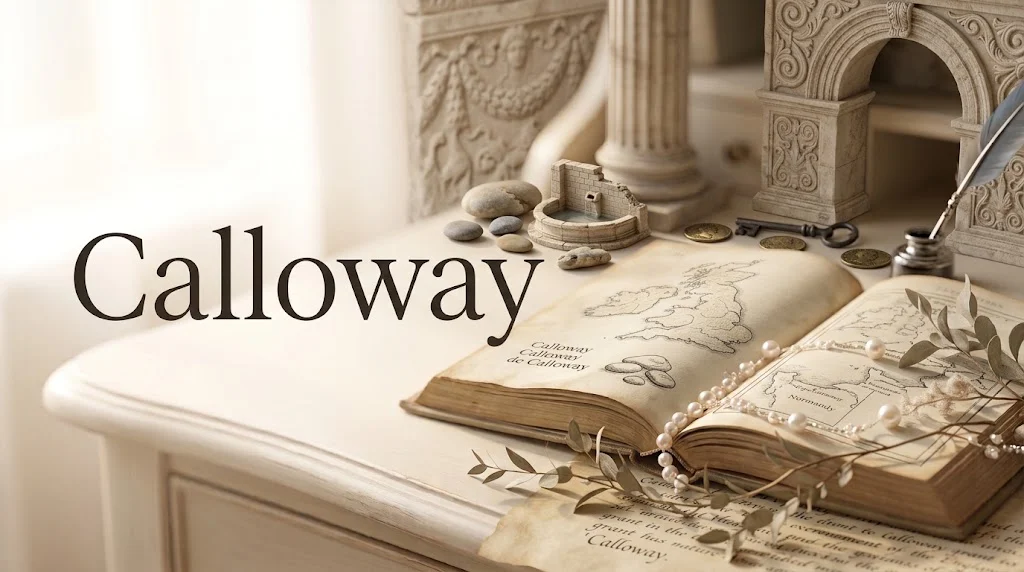
Calloway is an English surname-derived given name traditionally connected with the surname Calloway, a variant of Callaway. The surname is of Norman origin and is associated with the French place-name Caillouet-Orgeville, whose name is connected with the Old French word for “pebble.” This gives Calloway the commonly interpreted sense of “pebbly place” or a name associated with a place of stones.
Today, Calloway is increasingly encountered as a first name, particularly in English-speaking naming culture. Its long, flowing sound gives it a modern surname-style character, while its historical roots connect it to medieval English and Norman French naming traditions.
This guide explores the Calloway name meaning, origin, etymology, surname history, pronunciation, symbolism, gender usage, related names, and modern use.
What Is the Name Calloway?
Calloway is primarily documented as a surname, but it is also used as a modern given name.
As a surname, Calloway is described by FamilySearch and Ancestry as an English surname of Norman origin and a variant of Callaway. The name is particularly associated with southern England and the West Midlands.
As a first name, Calloway belongs to the broad category of surname-to-first-name names. This naming pattern has become familiar in English-speaking countries, where historical family names are sometimes selected as children’s given names.
The transition from surname to first name does not necessarily create a new etymology. Instead, the original surname history generally remains the foundation of the given name.
That distinction matters with Calloway: it is more accurate to describe its meaning through the history of the surname than to assign it an invented personality-based definition.
Calloway Name Meaning
The most commonly documented interpretation of the Calloway name meaning comes through the related surname Callaway.
FamilySearch identifies Callaway as an English surname of Norman origin and describes it as a habitational name from Caillouet-Orgeville in Eure, France. The place-name is connected with a collective form of Old French cail(ou), meaning “pebble.”
Calloway is identified as a variant of Callaway.
For this reason, baby-name references commonly simplify the meaning as:
- “Pebbly place”
- “Place of pebbles”
- “Place of stones”
“Pebbly place” is best understood as a concise interpretation of the place-name origin rather than a literal translation of the personal name itself.
What Does “Pebble” Have to Do With Calloway?
The connection comes from the Old French element cailou or related forms meaning pebble.
Because Callaway developed as a habitational name, its original function was geographical: it identified someone through a connection with a particular place rather than describing a personal quality.
This is an important distinction.
Calloway does not originally mean a personality trait such as “strong,” “brave,” or “kind.” Its historical meaning is connected to place and landscape.
That gives the name a subtle geographical character: rather than describing the person who carried it, the surname pointed toward a place associated with stones or pebbles.
Calloway Name Origin and Etymology
The strongest documented etymological pathway for Calloway leads to Norman France and England.
The related surname Callaway is traced to Caillouet-Orgeville in Eure, France. According to FamilySearch and Ancestry’s surname references, the place-name contains an Old French element associated with a pebble.
Calloway is treated as a spelling variant of Callaway in major surname references.
The basic development can therefore be represented as:
Caillouet-Orgeville → Callaway → Calloway
The exact historical spelling of surnames was not always fixed. Medieval and early-modern names could appear in multiple forms because spelling conventions varied between regions and records.
Historical references show forms resembling Chailewai, Kaillewey, and Callewey, illustrating how the surname family developed different spellings over time.
Norman French Influence
The Norman element is particularly significant.
Following the Norman Conquest of England in 1066, Norman French language and naming traditions became deeply connected with English society. Many English surnames have Norman or French geographical origins, and Calloway belongs to this broader historical environment.
This does not mean that everyone who bears the modern surname necessarily descends from one particular medieval family. Surname histories can develop through different branches, spelling variations, migrations, and independent geographical associations.
Therefore, etymological origin and individual genealogical ancestry are not automatically the same thing.
History of the Calloway Surname
Calloway has a documented history as an English surname.
FamilySearch describes it as a variant of Callaway and places its historical association in southern England and the West Midlands.
Historical surname records demonstrate that related spellings appeared in England during the medieval period. HouseofNames, for example, cites Philip de Chailewai in the Gloucestershire Pipe Rolls of 1165 and Thomas de Kaillewey in Warwickshire in 1242.
These records are useful for demonstrating the antiquity of the surname family, but they should not be interpreted as proving a single uninterrupted family line for everyone named Calloway today.
Over centuries, surnames could change spelling as families moved between regions or as clerks recorded names according to local pronunciation.
That helps explain why Calloway, Callaway, Calway, Kellaway, Kelleway, and related forms can appear in surname histories.
Calloway as a Given Name
Although Calloway has a long history as a surname, its use as a first name is more modern.
This is an example of the surname-as-first-name tradition, in which an established family name becomes an independent given name.
Names such as Carter, Parker, Sawyer, Cooper, and Walker demonstrate the broader English-language pattern. Calloway fits the same general naming style while retaining a distinctive sound.
As a given name, Calloway can appeal to parents who want something that feels:
- Traditional without being old-fashioned
- Connected to family-name traditions
- Distinctive
- Sophisticated
- Geographic or nature-associated
- Suitable for a modern child
The original surname meaning remains important, but modern parents may also choose the name because of its sound, rhythm, family connection, or aesthetic appeal.
Is Calloway a Boy or Girl Name?
Calloway is used as a gender-neutral given name, although current U.S. baby-name data show stronger use among boys.
For example, Nameberry’s current listing describes Calloway as a boy’s name while also recording it as a girl’s name.
The U.S. Social Security Administration maintains separate rankings for kids and notes that some names are used for both sexes. Its baby-name data are based on Social Security card applications for U.S. births.
Because usage can change over time and differs between countries, it is more accurate to call Calloway gender-flexible rather than assigning an exclusive gender to the name.
How Do You Pronounce Calloway?
Calloway is commonly pronounced:
kal-LOW-ay
The emphasis generally falls on the middle syllable.
A simple phonetic approximation is:
kuh-LOW-way
The exact vowel quality can vary somewhat depending on regional accent.
The spelling may initially look complicated to someone unfamiliar with the name, but once heard aloud, the three-syllable rhythm is relatively straightforward.
What Does Calloway Symbolize?
The literal historical meaning of Calloway is connected with a place associated with pebbles or stones. Symbolic interpretations should be distinguished from that etymological meaning.
Because stones and pebbles are natural landscape elements, the name can inspire associations such as:
Stability
Stones are often used metaphorically for firmness and stability.
Endurance
A pebble can remain in a landscape through long periods of environmental change, making endurance a natural symbolic association.
Nature
The name’s geographical origin gives it an understated connection with the natural landscape.
Journey and Place
Because Calloway developed as a habitational surname, the idea of place and belonging is particularly relevant to its history.
These are modern symbolic interpretations rather than literal translations of the name.
Calloway and the Meaning of Place
One of the most interesting features of Calloway is that its history is fundamentally geographical.
Many surnames originated because people needed to distinguish individuals within growing communities. A person could be identified by occupation, parentage, physical characteristics, or place of residence.
Habitational surnames belong to the last category.
Calloway’s relationship to a place-name means its early function was essentially geographical. The name carried information about a person’s association with a particular location.
That makes Calloway part of a much larger European naming tradition in which landscapes became family names.
Calloway vs. Callaway
Calloway and Callaway are closely connected, but they should not simply be treated as identical spellings in every family.
| Name | Historical connection | Main distinction |
|---|---|---|
| Calloway | Variant of Callaway | The spelling ending in “-oway” |
| Callaway | English surname of Norman origin | Established form linked with Caillouet-Orgeville |
| Calway | Historical/variant form | Shorter spelling |
| Kellaway | Related surname form | Different historical spelling |
| Kelleway | Related variant | Another surname spelling |
FamilySearch explicitly identifies Calloway as a variant of Callaway.
For a modern family, however, the spelling can have its own identity and family history. A person named Calloway does not need to regard the name simply as a misspelling of Callaway.
Calloway vs. Galloway
Calloway is sometimes compared with Galloway because the names sound similar.
They should not automatically be treated as having the same origin.
Some surname sources list Galloway as a possible alternative or variant theory, but the stronger documented Calloway pathway in major surname references connects it with Callaway and Norman French origins.
This is a useful example of why similar pronunciation does not necessarily establish shared etymology.
Related Names to Calloway
Several names may appeal to someone who likes Calloway because of their surname-style sound or historical background.
Callaway
The closest related form. Callaway is the surname from which Calloway is documented as a variant.
Galloway
A Scottish place-name and surname with a different historical background, despite its similarity in sound.
Callahan
An Irish surname commonly used as a first name, offering a similarly substantial surname-derived style.
Callan
A shorter given name with a similar opening sound and surname-like character.
Conway
Another established surname and place-associated name with a comparable rhythm.
Bellamy
A surname-derived first name with a similarly flowing, multi-syllable sound.
Calloway in Modern Naming
Modern surname names often occupy an interesting space between traditional and contemporary naming.
Calloway has the advantage of being historically established as a surname while sounding distinctive as a first name. Its three-syllable structure also gives it a more elaborate rhythm than very short surname names.
Current baby-name sources show that Calloway is being used as a given name in the United States, with use recorded for both kids. Nameberry’s current data list 2025 as a recent high point for the name among boys, while also documenting female use.
The official U.S. Social Security Administration explains that its baby-name statistics come from Social Security card applications and that different spellings are counted separately.
This matters for interpreting popularity figures: Calloway and Callaway should not be combined into one name when analyzing official spelling-specific data.
Is Calloway a Good Baby Name?
Calloway is the right choice depends on the style a family prefers, but its characteristics are fairly distinctive.
Calloway may appeal to parents looking for a name that combines:
- Surname heritage
- Norman and English history
- A geographical origin
- A distinctive three-syllable sound
- A modern surname-as-first-name style
- Flexible gender usage
- A connection with the imagery of stones and landscape
It can also work particularly well for families interested in names with historical surname backgrounds rather than names created specifically for modern naming trends.
The most historically responsible description, however, is not that Calloway literally means “strong” or “beautiful.” Its documented etymological pathway is geographical and ultimately associated with pebbles or stones.
The Meaning Behind Calloway
Calloway is a name where the history is more interesting than a single-word definition.
Its surname background points toward Norman France, medieval England, geographical naming, and a place associated with pebbles. Over time, variant spellings developed, including the form Calloway.
As the surname entered modern first-name use, the name gained a new context without losing its historical foundation.
For parents choosing Calloway today, the name can therefore represent a blend of heritage, place, landscape, and modern individuality.
FAQs
What does the name Calloway mean?
Calloway is associated with Callaway and a Norman French place-name linked to the Old French word for “pebble,” commonly interpreted as “pebbly place.”
What is the origin of Calloway?
Calloway is an English surname of Norman origin and is documented as a variant of Callaway.
Is Calloway a boy or girl name?
Calloway is used for both kids, although recent U.S. baby-name data show stronger use among boys.
How do you pronounce Calloway?
Calloway is commonly pronounced kal-LOW-ay, with the main emphasis on the middle syllable.
Is Calloway a surname?
Yes. Calloway is historically a surname, particularly associated with English usage and Norman origins.
Is Calloway related to Callaway?
Yes. Major surname references identify Calloway as a variant of Callaway.
What does Callaway mean?
Callaway is a Norman-origin English habitational surname associated with Caillouet-Orgeville in France and an Old French element meaning “pebble.”
What names are similar to Calloway?
Names with a similar surname-inspired style include Callaway, Galloway, Callahan, Conway, Bellamy, and Callan.
Conclusion
The Calloway name meaning is generally connected to the surname Calloway, a documented variant of Callaway with Norman origins. The related place-name Caillouet-Orgeville in France is associated with an Old French word for “pebble,” leading to the commonly used interpretation “pebbly place.”
Today, Calloway has moved beyond its surname roots and is also used as a distinctive given name. Its history gives it a strong sense of place and heritage, while its flowing sound makes it fit naturally within modern surname-style naming.